2019 NFL Conference Championship Preview

The Chiefs are the odds-on favorite (43%) to win the Super Bowl and they are the only team to return to Championship Sunday from last year’s group. The Packers and 49ers are familiar faces in this round, but they are here after combining for 10 wins (plus one pesky tie) in 2018. The Titans had their usual 9-7 record, but they are halfway through a Super Bowl run that could be the most improbable ever. While this looks like a historically odd grouping, you’d only have to go back two seasons to find an odder one when the Eagles and Vikings competed for the Super Bowl a year removed from non-winning seasons and the Jaguars (with Blake Bortles) nearly pulled it off in New England.

These aren’t bad matchups, but I think impartial fans would agree that rematches of Chiefs-Ravens and Saints-49ers (or Seahawks-49ers III) would make for the best final four this season. But those teams didn’t deliver so here we are with only the fifth Championship Sunday since 1998 where both home teams are favored by at least 7.5 points. The good news (POV may vary) is that the last four times all featured one upset: 1998 Falcons over Vikings, 1999 Titans over Jaguars, 2001 Patriots over Steelers, and 2007 Giants over Packers. Two of those games went to overtime.

So don’t pencil in a Chiefs-49ers Super Bowl just yet, though that is the expected outcome. Home favorites of 7-plus points in the Conference Championship round are 29-6 (.829) straight up and 20-15 (.571) against the spread. But expectations and this year’s postseason haven’t gotten along well so far.

Before getting into each game, I want to share some historical stats on rematches in this round.

Conference Championship Rematches

The lack of rematches this postseason won’t continue this week with both games being a rematch from November. The Titans are the last team to beat Kansas City, doing so 35-32 in Week 10 at home. The 49ers crushed the Packers 37-8 on Sunday Night Football in Week 12. I’ll talk a lot about each game again, but you don’t have to be an NFL fan for long to know that every game is different and things can change drastically. While the Seahawks and Eagles played to two 17-9 finishes this year, you didn’t know Carson Wentz would leave injured in the first quarter or that Josh McCown would play on a torn hamstring. While the Texans scored 31 in Kansas City both times, you didn’t expect a 51-point onslaught from Mahomes and company after falling behind 24-0.

With that said, I want to share some rematch data from 1978-2018 on this round. Fans are no doubt going to be curious to know how much the venue change from Tennessee to Kansas City helps the Chiefs, or if the 49ers are going to smash the Packers again at home like they did in the regular season.

In instances where the teams were from the same division and meeting for a third time that year, I used only the most recent meeting as the first matchup.

CC_rematch

I thought it was interesting that the home team had the same record (37-19) in the last meeting and in the playoffs. In a case like San Francisco’s, they are hosting both games. That has happened 29 times and while those home teams were 24-5 (.828) in the first game, those 24 teams trying to pull off the sweep were only 14-10 (.583) in the title game. So the sweep happens just under half the time. Of course being the home team itself is beneficial in this round since it means you had a higher seed than the opponent.

For Kansas City’s situation, the venue switch from playing on the road to at home in the title game has been quite beneficial. Those teams were only 14-13 (.519) on the road in the regular season meeting, but 19-8 (.704) at home in the championship game. However, if you lost that first game on the road like Kansas City did, then it’s not as optimistic things will get better at home in the playoffs. Those teams were only 7-6 (.538) with the Super Bowl on the line, including last year’s Chiefs who lost 43-40 in New England and lost to the Patriots again at home 37-31 in overtime in the AFC Championship Game.

As for the spread, both home teams are favored by 7.5 this Sunday. In Tennessee, the Chiefs were a 5-point favorite and lost 35-32. In Week 12, the 49ers were 3-point favorites and smoked Green Bay 37-8 in a game that was over at halftime. Teams that are 7.5 point favorites in a rematch in the Conference Championship are 7-6 ATS and 10-3 SU. When the team was at least a 3-point favorite in both matchups, those teams are an impressive 19-10 ATS and 22-7 SU in the playoffs. When they were a 5-point favorite in both games like the Chiefs this year, they are 6-2 ATS and 7-1 SU.

That last line sounds great for Kansas City, but keep in mind the one loss was by Dan Marino’s Dolphins to the run-heavy, never-throw-the-ball Patriots in 1985, one of the most disappointing losses of Marino’s career. Everyone thought for sure he was headed back to another Super Bowl in his third season, so it’s the kind of fate that Mahomes will want to avoid this weekend. That game is a perfect segue into Titans-Chiefs.

Titans at Chiefs (-7.5)

We’re down to two games, so I’m going to break these down into sections to make sure I get all my points across succinctly.

Kansas City Sure Remembers the Titans

If not for a Ryan Fitzpatrick-led Miami comeback win in New England in Week 17, we would have had Titans at Chiefs on Wild Card weekend. What a shakeup that could have been to this postseason, because if any team has befuddled Andy Reid in his Kansas City tenure, it’s the Titans. Tennessee has won four straight against the Chiefs, including three games at Arrowhead. That includes a blown 10-point lead in the fourth quarter in 2016, a blown 21-3 halftime lead in the 2017 AFC Wild Card, and a blown 9-point lead in the fourth quarter this year in Tennessee (Week 10).

Only one of those games had Patrick Mahomes at quarterback for the Chiefs, but it’s also the last time KC lost this season. After already knocking off the Patriots in New England and the Ravens in Baltimore, the Titans are one more road upset away from completing quite arguably the toughest path to the Super Bowl in NFL history.

What if the Tennessee Defense Is Just Lucky?

The Chiefs faced the worst defense to make the playoffs in the Texans last week and scored 51 points. Tennessee is a tougher matchup, but I’m not convinced this defense is anything special or ready to shut down a healthy Mahomes at home. Kevin Byard is a very good safety, but none of the defensive backs on the Titans have had a particularly strong year in coverage. They don’t have a dominant pass rusher either. Harold Landry is fine and Jurrell Casey can make a play here and there, but there’s a pretty big drop off after those two. The only players to make the Pro Bowl on this Tennessee team were their running back and punter. Fitting.

The Titans are getting a lot of credit for allowing just 25 points on the road this postseason to the Patriots and Ravens. That’s an impressive total in places that are hard to win. But let’s not beat around the bush here. What if it’s simply a matter of Tom Brady is washed and the Ravens choked? Brady is 42 and could barely throw a touchdown a game down the stretch, and the Patriots were at their worst offensively this season. Still, Julian Edelman dropped a wide-open pass at his own 45 late in the game for the Titans to hang on to that 14-13 lead.

Then the Baltimore game was something to behold. When I write a playoff preview I try to lay out how the underdog could win. My Tennessee strategy ended up being one of the most prescient previews I’ve ever done. I basically said the Titans need to get lucky, have a fast start, and the Ravens need to make a lot of mistakes and exhibit rust from all the time off. I even nailed it down to Jackson being a little high on some throws to his tight end (like the tipped pick), botching some fourth downs they’ve made all year, and the young receiving corps catching a case of the yips after having the second-best drop rate in the regular season. As I laid out here on Saturday night, the Ravens flat out choked.

Baltimore racked up 530 yards of offense, but only scored 12 points. Since 1940, 326 teams have had at least 530 yards of offense in a game. The Ravens are the only one out of 326 to not score 14 points. Now you could chalk that up as “Titans were amazing, Baltimore got that high up there in garbage time!” Or you could just acknowledge that this had much more to do with the offense that had three turnovers, four failures on fourth down, and a slew of dropped passes and a tipped pick on a brutal night of execution.

When Mahomes led the Chiefs to 530 yards of offense in Week 10 in Tennessee, that put 32 points on the board and it really should have been more if not for three missed kicks. He will not waste the yardage the way the Ravens did. Lamar Jackson was a deserving MVP this year, but Mahomes is the best quarterback right now.

You also have to consider what the Titans have done on defense over the long haul and not just the last two games.

Since Tannehill took over in Week 7, the Titans allowed at least 20 points in eight of their next nine games (three games allowing 30+). The only game they didn’t was in Indianapolis when the Colts attempted a go-ahead field goal for a 20-17 lead in the fourth quarter, but it was blocked and returned for a game-winning touchdown. I think good offenses will move the ball against the Titans with ease this year. The Chargers didn’t have a good year, but they could have ended Tennessee’s season prematurely in Week 7 had they not botched the end of the game. The Chargers thought they scored a touchdown on three straight plays, which would have led to 27 points and a likely win. But they were stopped twice, and then in the ensuing chaos a fumble was ruled by Melvin Gordon at the 1-yard line. The Titans lucked out and went on a run from there. Drew Brees and the Saints hung 38 on this defense in Nashville, and we know the Chiefs have already scored 32 there. Then Week 17 happened and the Titans got to face Houston’s backups, holding them to 14 points to make the playoffs.

You can’t just rely on offensive failures to account for good defense every week. Having said that, the Chiefs showed us last week and earlier this season when they were only 6-4 that they could screw up too. That’s why they weren’t as efficient at scoring as they were in 2018 (plus all the injuries this year). In the first quarter against Houston last week, the Chiefs dropped five catchable passes, including a couple on third down to kill drives. In Week 10, we saw another Chiefs running back fumble and it was returned for a big touchdown by the Titans. The Chiefs have cut down on penalties in recent weeks, but that was another issue during the 6-4 start.

I’m not going to say the Chiefs won’t make mistakes this week that the Titans won’t capitalize on. But this is a much more dangerous offense than the Patriots, and Mahomes isn’t going to press like crazy if he falls behind the way Jackson has shown he will in this league so far. He also won’t fold after halftime if the Chiefs take a 21-3 lead like Alex Smith did two years ago in the playoffs. So the onus is more on the Tennessee offense to deliver at least 28 points in this game, because Mahomes is going to get his numbers one way or another.

What Is This Tennessee Offense?

While I may have gone out of my way to discredit the Tennessee defense, I’m not going to crucify the offense. At least, I’m not going to crush the offense that Tannehill took over for the last 10 games of the regular season that was actually fun to watch. The Titans kept his attempts low, but he was throwing a lot of vertical passes and hitting shot plays to A.J. Brown and company off play-action while they fed Derrick Henry consistently. It’s an offense that definitely works for them, but we have seen something much different in these two playoff games.

The Titans are the first NFL team since the 1985 Patriots to win consecutive games without gaining over 100 net passing yards and 16 pass attempts in either game. This is one of the craziest stats I’ve ever written in my life. This is the kind of offense the Houston Oilers dreamed about in the 1970s with Dan Pastorini and Earl Campbell. The Titans are living it with Tannehill only throwing for 160 yards (but three touchdowns) in the two playoff games combined while Henry has rushed for 377 yards this postseason.

So it may not be sustainable or logical against the Chiefs, but the Titans have continued to sustain their incredible red zone success. They are now 31-of-35 at scoring touchdowns in the red zone with Tannehill. They’ll definitely need that efficiency on Sunday.

I’ve seen arguments on Twitter about the Titans offense being average at best this postseason. There is some truth to that. They only scored 14 points in New England and 28 last week for an average of 21 per game. That’s below the league average. Tennessee had touchdown drives of 35, 45, and 20 yards last week, all set up by Baltimore’s offensive failures. That’s the part I would say is not sustainable, but there are some other drives where we’re probably not giving Tennessee enough credit. For example, against the Ravens the Titans were up 28-12 in the fourth quarter with 11:00 left. They called eight straight runs, gained 28 yards and punted. That doesn’t sound great on paper, but when you consider they consumed almost five minutes of clock and made the Ravens burn two timeouts, that’s a successful drive with a 16-point lead. The Titans also had a drive that lasted 8:01 in the fourth quarter in New England as they clung to a 14-13 lead.

That ability to bleed the clock, shorten the game and keep Mahomes on the sideline could be extremely valuable in this matchup. Of course it’s hard to do if you’re playing from behind, but the Titans would have to get down three scores before they abandon the run. We saw that in Week 10. Down 29-20 in the fourth to the Chiefs, they only called two passes on a 10-play drive for a key touchdown with 6:26 left.

I don’t think the Titans can win this game with Tannehill doing his sub-100 yard thing for a third straight week. That’s just the respect I have for what Mahomes brings to the scoreboard. However, the Titans certainly need to make Henry a focal point against a run defense that has been shaky at times for the Chiefs this year.

This tweet was posted recently about Kansas City being 9-0 when they hold opponents under 110 rushing yards:

Naturally, he was met with criticism for missing the correlation-causation and how winning teams run the ball late and trailing teams pass. That is undoubtedly true about how games flow in the NFL, but I think Analytics Twitter goes out of its way to exaggerate this point while not providing the evidence they should be looking at. If you just read tweets, you would think a team that rushed for 150 yards piled up 100 of those yards with a double-digit lead in the fourth quarter. That might happen a couple times a season league-wide, but that’s not the norm.

What if I told you that nearly 59% of teams that rush for 100 yards get there before the fourth quarter, or that over 72% get there with more than 10 minutes left in the game? What if I told you that teams that win by 17-plus points average 40.8 rushing yards in the fourth quarter while teams that win by 3-7 points average 34.0 rushing yards in the fourth quarter.

All of that was true in the 2019 season and I’ve seen similar results in past years. For playing the Chiefs, there are obvious advantages to shortening the game and minimizing Mahomes’ possessions. That way when there is a Travis Kelce drop on third down or a RB fumble, it hurts them even more when you’re giving him seven more possessions than it would in a game where he gets the ball 11 more times. We also know with the Chiefs that you’re not going to blow them out as they have one of the greatest streaks in NFL history of not losing a game by more than 7 points:

We saw it this year in Kansas City’s four losses, all of which were by 3-7 points and half of which they had a fourth-quarter lead. The offense only had five drives with a one-score 4Q deficit in those four games, and Mahomes only had one drive each against the Colts, Texans and Titans. Anything short of perfection wouldn’t work.

The Titans, who never ran a play in the second half with a lead, rushed for 177 yards in the second half after 48 yards in the first half, thanks in part to a 68-yard touchdown run by Henry. The Colts (105 after 77), Texans (118 after 82) and Packers (86 after 35) also had second-half rushing success in wins over the Chiefs this year. These were not stat-padding situations by any means. The Packers literally had one offensive drive with the lead in the second half, and called seven straight runs for 31 yards to help keep the ball away from the Chiefs in a 31-24 win. The Colts completed one pass in the fourth quarter against the Chiefs, but used two run-heavy drives to kick two field goals that secured the win after draining the Chiefs of their timeouts. A 14-play, 35-yard drive for a field goal to take a 16-10 lead doesn’t look good on paper, but it forced the Chiefs to be aggressive and go for a fourth-and-1 at their own 34. Damien Williams was stuffed and by the time Mahomes got the ball back he was down 19-10 and with 2:27 left. Game over barring a miracle.

We should be treating productive runs with a one-score lead in the fourth quarter as the best way to close out a game as they keep the clock running in a situation where that’s more important than scoring again. This is about the only part of the game where perceived inefficiency is the preferred offensive strategy. You’d rather take three (or four) plays to gain 10 yards than one pass play, EPA be damned.

The biggest detriment to Mahomes in his career has really been the clock, or not getting the ball last or with enough time. Had he a little more time at the end against the Patriots last year or the Titans this year, he may have scored the game-winning touchdown instead of settling for a field goal that only leads to overtime where he may never see the ball again. This is why the Titans will ride Henry on Sunday, but they’re still going to have to get back to their regular season strategy with Tannehill if they’re going to outscore the Chiefs again.

Pressure Is on Patrick Mahomes

Simply put, there will be more pressure on Mahomes to win this game than there’s been in any other game of his career so far. He gets a bit of a pass for last year since it was his first title game, the mystique of the Patriots, and he did drop 31 points in the second half before never touching the ball in overtime. However, if he loses this game he’ll be the guy who is 0-2 at home in Conference Championship Games. That’s when people start to forget about the 31-point second half and focus more on the missed touchdown (overthrown) or bad sack he took to fall behind 14-0 at halftime against the Patriots last year.

He can’t afford a bad game this weekend. In 31 regular-season games, Mahomes has thrown multiple interceptions just three times. He has only four games with multiple turnovers in his career. In three playoff games, Mahomes has zero turnovers. He’s the third quarterback in NFL history after Sid Luckman and Tobin Rote to lead his team to at least 31 points in each of his first three playoff games. He has led his team to at least 23 points in all but one game of his career so far.

Furthermore, Mahomes has already played a stellar game this year in Tennessee against this defense with 446 passing yards and no turnovers. It was his first game after the dislocated kneecap and it was his best recent game until last Sunday in the playoffs when he was as close to perfect as you can get at the position.

By the way, in the effort to score seven straight touchdowns against Houston, Mahomes had 7 carries for 9 yards from his running backs on those drives. These offenses couldn’t be any more different right now, but as long as the receivers are catching the ball, Mahomes should deliver against the Titans. You like to think he’ll get a little more rushing support this week than that, but he can do pretty much anything you want out of a quarterback. There’s no real weakness in his game other than something his teammates fail to do, or an overtime system that doesn’t give him the ball.

In fact, if the Chiefs lose this game I hope it happens the same way as last year: 37-31 in overtime with Mahomes never touching the ball. Then the Chiefs and their fans need to raise hell the likes of which New Orleans couldn’t even dream of for pass interference so we can change a flawed system for the playoffs.

Don’t Forget: Special Teams

Last but not least, we have to talk about special teams. The Chiefs had an excellent unit this year while the Titans were pretty bad (no kicking game of value), but that didn’t matter in Week 10. Special teams were arguably the main reason the Chiefs lost in Tennessee. Harrison Butker missed an extra point, then late in the fourth quarter the Chiefs botched a field goal that would have put them ahead 35-27, leading to overtime at worst after Tannehill tied the game. Then on the final play, Butker’s 52-yard field goal was blocked to give the Titans a 35-32 win.

In the divisional round, special teams threatened to end Kansas City’s season after a blocked punt for a touchdown and a muffed punt return by Tyreek Hill led to a 21-0 hole. However, this unit can giveth and taketh in the same game, and I don’t think it got much attention how special teams really redeemed themselves to make the comeback happen. It came in the form of three plays in the second quarter: Mecole Hardman’s 58-yard kick return to spark it, the stop on Houston’s fake punt, and the forced fumble on a kick return that set Mahomes up at the Houston 6.

The Chiefs have return specialists who can be dynamic, and Butker is usually good, but they can’t afford these mistakes again versus the Titans.

Before placing a bet on this game, it’d be nice if someone could get visual proof that Mike Vrabel still has his penis, because he may have already cut it off to secure this trophy. My boldest prediction may be that the Titans actually settle for a field goal this week, but it won’t be enough to stop Mahomes from reaching that first Super Bowl.

Final: Chiefs 34, Titans 24


Packers at 49ers (-7.5)

Remember when Steve Young couldn’t beat the Packers and it took a missed Jerry Rice fumble to finally do it? Okay, I’ll stick to the Rodgers’ era for the rest of the way.

Packers: Reversal of Fortune?

I left this out of my rematch data above, but teams that win the last matchup by at least 17 points are 9-2 in the Conference Championship Game with an average scoring differential of 13.5 points. That doesn’t bode well for the Packers overcoming the 37-8 smackdown in Week 12.

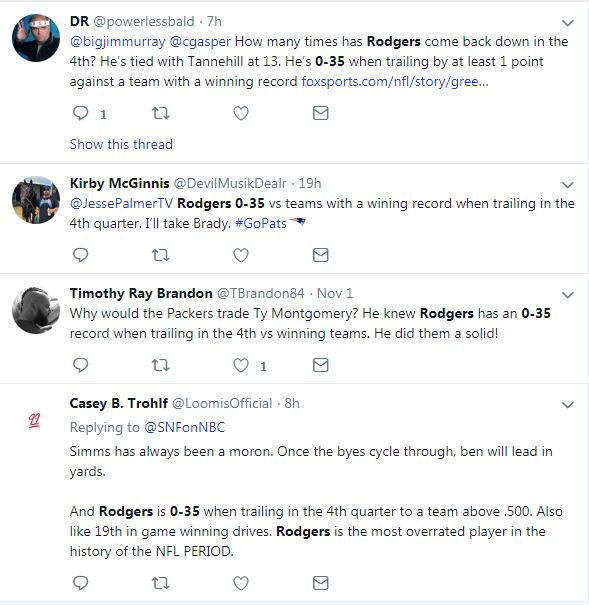
It’s not exactly breaking news that the Packers don’t excel in these spots: on the road against a physical team that should have advantages in the trenches again. In fact, the Packers led by Aaron Rodgers are 0-4 in his career when he’s an underdog of 7+ points. That includes losses to the 2014 Seahawks (twice), 2015 Cardinals (NFC-DIV), and 2018 Rams, all NFC West powerhouses on the road, which is the case again this week at No. 1 seed San Francisco (14-3).

But he is 3-1 against the spread in those games, so a close game is not out of the question. We’ve also seen Rodgers’ Packers have dramatically different playoff results in rematches from the regular season:

  • In 2010, the Packers lost a close one 20-17 in Atlanta, but blew the Falcons out 48-21 in the divisional round.
  • In 2011, the Packers got to 12-0 with a 38-35 win in New York, but fell 37-20 in stunning fashion at home to those Giants in the divisional round.
  • In 2014, the Packers fell 36-16 on opening night in Seattle, but had a 16-0 lead in the NFC Championship Game before losing 28-22 in overtime.
  • In 2015, and perhaps most comparable to this weekend, the Packers were destroyed 38-8 in Arizona in Week 16 (Rodgers sacked eight times). But in the divisional round they forced overtime with two Hail Mary’s by Rodgers, only to lose 26-20.
  • In 2016, Green Bay lost 30-16 at home to Dallas before winning there 34-31 in the playoffs, but also turned a tough 33-32 loss in Atlanta to a far more embarrassing 44-21 loss in the NFC Championship Game.

Points don’t carry over from last time and that’s really the NFL in a nutshell.

Injury Outlook

One of the simplest explanations for why matchups can change so much is the addition or subtraction of players through injury. However, most of the players taking the field this week were active in Week 12 and last week when these teams won a playoff game. If anything, the 49ers have the edge here as left tackle Joe Staley, running back Matt Breida, pass-rusher Dee Ford, linebacker Kwon Alexander and even kicker Robbie Gould were absent in Week 12. The 49ers have all of those guys back, though they did limit Ford’s snaps last week (still got a sack in 22 snaps). San Francisco’s running game has been at its worst when running off left tackle, though Staley missed nine games this year. Sure, the 49ers also lost center Weston Richburg in Week 14, but they’ve been fine without him. Right tackle Bryan Bulaga was out last week with an illness for the Packers, but he was on the field in Week 12 when Rodgers took five sacks.

Rodgers: Worst Night Ever?

Remember this in Week 12?

That historically bad night for Rodgers in Week 12 — a career-low 3.15 YPA — is hard to shake. The good news: he just had one of his best games of 2019 against Seattle. The bad news: San Francisco’s defense just had one of its best games of 2019 against Minnesota’s more talented offense.

What Should Green Bay’s Offense Do on Sunday?

Last week the Packers were basically a one-man receiving show with Davante Adams gaining 160 of Rodgers’ 243 passing yards against Seattle. Adams caught a touchdown in Week 12, but the 49ers held the connection to 7-of-12 for 43 yards that night. I don’t know how receivers like Adams (and Michael Thomas in New Orleans) are so consistently open when these teams lack other options at wideout, but the 49ers should do a much better job than the Seahawks did on Adams. The Packers averaged 12.3 PPG in four games this year when Adams was held under 50 yards.

Most offenses have failed to move the ball through the air against the 49ers this year. Eight teams were held to fewer than 135 net passing yards, and only three offenses exceeded 223 yards in 17 games. Of the six 100-yard receivers allowed by the 49ers, the top two were Julio Jones and Michael Thomas with 134 yards each, but they also had 15-20 targets between them. So Adams will probably have to be force-fed the ball to have a productive game this week. The Packers will likely prefer to get Aaron Jones involved more this time as he had 13 carries for 38 yards in Week 12. Jamaal Williams actually outgained him (11 carries for 45 yards) after getting most of that production on the final drive in garbage time. The 49ers just held Minnesota to 21 yards on 10 runs last week.

It’s a delicate balance for head coach Matt LaFleur to figure out. Do you go pass-happy with Rodgers when he has a more pedestrian receiving corps? If the San Francisco pass rush resembles last week and Week 12 and the early portion of the season when they were so dominant with rookie Nick Bosa and the D-line shining, then it’s a pretty tough matchup for Green Bay. The Packers also aren’t a dominant rushing team in the form of say the Titans, but they still get their share of yards most weeks because they often play from ahead thanks to good starts. Remember, last week I pointed out they were third in first-quarter scoring, but 27th, 9th and 26th in the rest of the quarters. The 49ers are faster starters with the running game. They’ve had seven games this year with more than 80 rushing yards at halftime compared to two for Green Bay.

The Packers are quite good in the red zone, but getting there is the biggest concern. Green Bay had one trip to the red zone in Rodgers’ 10 drives in Week 12. Only seven offenses went three-and-out more often than the Packers this year. I’m not really sure what the best strategy is for Green Bay’s offense this week, but I know they can’t go 1-of-15 on third down again like they did in Week 12. Rodgers will have to do a few things off script that work for Green Bay and hope he can deliver on third down as well as he did against Seattle last week (team was 9/13 before a kneeldown).

San Francisco’s Offense

While Green Bay’s offense was imploding in Week 12, it wasn’t until the fourth quarter when the 49ers converted a third down that night. The 49ers won that game easily despite only 16 first downs. Rodgers coughed up the ball on a strip-sack on the first drive, leading to a 2-yard touchdown drive. Two quick three-and-outs late in the first half were turned into 10 more points by the 49ers, which saw big YAC plays from George Kittle and Deebo Samuel for touchdowns. The Packers have had few answers for tight ends this year and Kittle is as good as anyone right now. YAC has been a big part of San Francisco’s passing game all year, though they only put 19 balls in the air against the Vikings in a run-heavy game plan.

Jimmy Garoppolo won his first playoff game by doing the bare minimum, so don’t say he didn’t learn anything from Tom Brady in New England. Garoppolo did most of his damage on the opening drive, but didn’t have to do much more when his defense and running game were so dominant. He was much better in Week 12 against the Packers and will have to play more like that in this game. It was actually the best statistical game any QB had against the 2019 Packers. Garoppolo has his full complement of backs to use and two fine wideouts to go along with Kittle, so what more can he ask for besides maybe a run call on 3rd-and-1 from Kyle Shanahan if they’re up big in the fourth? The Packers were terrible this year at stopping teams in short-yardage situations and stuffing runs for losses.

Garoppolo is more likely to turn the ball over than Rodgers. He does have a tendency to throw an interception early in games this year, though the 49ers are 10-1 in games where he is intercepted (11-0 if the kicker came through in overtime vs. Seattle), so it hasn’t been a problem. I watched all 13 of his interceptions last week and noticed about six that were tipped and one that was lobbed on a 4th-and-5 against Washington in the rain. So that was encouraging, though he does get fooled by linebackers on short throws a bit too much. The Packers are 11-0 this season when intercepting the starting QB, but only have three picks from non-defensive backs. Green Bay has mostly feasted on bad passers and served twice as Kirk Cousins’ kryptonite. Green Bay has some really good pass-rushers this year (The Smiths) and they got to Garoppolo three times in the last matchup. Only five passers avoided multiple sacks from Green Bay this year.

I think Garoppolo already held up well this year in marquee matchups against Lamar Jackson, Kirk Cousins, Drew Brees, Aaron Rodgers, and Russell Wilson. Maybe he implodes with the Super Bowl on the line, but I’m not concerned about him this week like I would be with certain quarterbacks.

Close Game or Nah?

The 49ers have lost three games on the final play this year, so they would have to have a Baltimore-sized choke to get blown out at home in this game. That’s more likely to happen to Green Bay again. If it’s a close game, we’ve already seen Garoppolo lead four comebacks and game-winning drives this season, something Rodgers still hasn’t done in any season of his career. But Rodgers (17-41 at 4QC opportunities) does have three game-winning drives for Green Bay in 2019 and the Packers are 11-1 in close games without a single blown lead in the fourth quarter.

If you want an ultra-specific prediction, I’m feeling a game where Garoppolo will overcome a rough start with his running game not dominating, only to lead the 49ers to a game-winning field goal to send San Francisco to another Super Bowl. Or at least I like the sound of that better than saying the refs hand Green Bay a horseshit illegal hands to the face penalty that gives us a rematch of Super Bowl I (Chiefs-Packers) in the 100th year of the NFL. That might be even more likely if the Titans pull off an upset in the early slot as I can’t imagine the NFL would be happy about promoting Titans-49ers to casual viewers.

But if there was ever a postseason to completely stick it to the status quo…

Final: 49ers 23, Packers 20

NFL Top 100 Players of All Time

Back in August I spent a little time breaking players down by position to create my list of the 100 greatest players in NFL history. My plan was to post this before the 2019 season started to celebrate 100 years of the league, but then I ran into a familiar problem of not being sure how to rank one player over another when they play different positions.

For example, I knew I would have more quarterbacks (15) than any other position. However, just because I favor Roger Staubach over John Elway, does that mean I like both over Jack Lambert, my No. 4 linebacker, or does Lambert belong somewhere between the two? Also, thought was given to extending the list to 101 players and starting it with Patrick Mahomes just because of how absurd the start to his career was coming into 2019. I’m not doing that, but he is off the charts so far.

So as a late Christmas gift, you are getting my list today. After seeing the way the NFL has rolled out its controversial top 100, I decided to just rank the players by position instead of a 1-100 ranking. I’ve already made my share of comments on here and Twitter about the NFL Network’s list, and some of those will be repeated here. I expect about 66 of my players to match the 100 on here:

nfl100

My Approach

As far as how I arrived at my 100 players, I did not purposely neglect the early decades. I absolutely did place an emphasis on players who were truly dominant and stood out despite having so many worthy peers to compete with for honors and statistics. I can honestly say I’m not too interested in what a two-way lineman from the 1920s did, but I feel like I still included enough pioneers of the game who deserve honor in 2019. I also wasn’t going to neglect this past decade and the players who have already carved an incredible legacy.

I am not a ring counter, but I respect a player’s contribution towards winning. There’s no fancy formula or system I use to rank players, but I try to take everything I’ve learned from research into consideration from stats, eye test, peak performances, longevity, durability, awards, rings, how quickly they made the Hall of Fame, and how the player was perceived during his career. When we’re only picking 100, we should be focusing on first-ballot HOF types.

The choice to keep comments open may be one I regret, but let’s do this. Scroll to the bottom (or click here) if you want to see my full list of the top 100 players in NFL history.

Quarterbacks (15)

  1. Peyton Manning
  2. Joe Montana
  3. Johnny Unitas
  4. Drew Brees
  5. Tom Brady
  6. Dan Marino
  7. Steve Young
  8. Roger Staubach
  9. Brett Favre
  10. Aaron Rodgers
  11. Sammy Baugh
  12. Fran Tarkenton
  13. Ben Roethlisberger
  14. John Elway
  15. Otto Graham

My last real post about the top quarterbacks in NFL history is over four years old and a Part II was never made. You can read that if you want, but the fact is my thoughts have changed a lot since September 2015. Sure, my top 15 quarterbacks are the same group of players, and my top three hasn’t changed. However, nearly five full seasons have been played since and even just fundamentally I am seeing things a bit differently now.

I may be even more down on rings for quarterbacks than I was in 2015. This comes after watching Zombie Manning win his second, the Falcons handing Brady another after he turned a game-ending pick into a 23-yard catch by Julian Edelman, Nick Foles Super Bowl MVP, and Brady again cementing his legacy as the only quarterback to win a Super Bowl by scoring 13 offensive points (for the second time). When 2016 Matt Ryan and 2018 Patrick Mahomes turn in two of the greatest QB seasons ever and don’t even get the ball in overtime in championship game losses, what are we really accomplishing by putting everything on rings?

Sustained peak play is also something I value more now, so that will definitely come up when we get into the middle of the list here.

1-3: No Changes (Manning-Montana-Unitas)

I still have Peyton Manning, Joe Montana and Johnny Unitas as my top three quarterbacks of all time, which has been the case for quite a while now.

3. Johnny Unitas

Unitas always deserves respect for being the game’s first true field general. He called the shots and is regarded as having created the two-minute drill. His championship game performances against the Giants are the stuff of legends. He led the league in touchdown passes four years in a row. He threw 32 touchdowns in a 12-game season in 1959. He was as good as anyone when it came to throwing game-winning touchdown passes. He was a five-time All-Pro and three-time MVP winner. He succeeded with multiple coaches. The only real knock on him would be that his career was in the gutter after Year 12 and his playoff games after 1959 were rough, but what a run it was before that. He would have loved to play in this era with more passing, more shotgun, better kickers, wild cards, etc. In his last great season (All Pro in 1967), Unitas led the Colts to an 11-1-2 record that wasn’t good enough for the playoffs. Imagine that now. Unitas would have routinely been in the playoffs in a league with expansion.

2. Joe Montana

Montana was a great fit for Bill Walsh’s West Coast Offense, displaying elite accuracy, decision making and underrated mobility for years in San Francisco. He put up great numbers and won two Super Bowls even before the team drafted Jerry Rice in 1985. Montana proved he could win big without Walsh as he did in 1989, his most dominant season and first MVP. Montana also showed later in Kansas City after major injuries that he could still lead a team to success, getting the cursed Chiefs in the AFC Championship Game immediately in 1993. Like Unitas, Montana was great at throwing game-winning touchdowns in the clutch. His playoff runs over the 1988-1993 seasons were incredible. Durability was a knock as Montana did miss roughly 55 games to injury in his career. So he never threw for 4,000 yards and only hit 30 touchdown passes once, but he was the most efficient passer of his era.

1. Peyton Manning

Peyton Manning played the position at a higher level more consistently for a longer period of time than any quarterback in NFL history. He was the most individually-honored QB of all time with seven first-team All-Pro seasons and five MVP awards. He could have easily had eight of each (see 2005, 2006 and 2012). He struggled the first six games of his career before improving and setting numerous rookie records in 1998 at a time when rookies rarely did anything in the NFL. He didn’t struggle consistently like that again until 2015 when he was 39 and his body was failing him. He still led the Broncos to five late wins in the fourth quarter that year to help win a second Super Bowl before retiring.

Manning’s career path is most enviable, if not logical. He was at his worst as an infant and an elder, and still came away with records and a ring in those two seasons. For the 15 seasons in between, he was the most valuable player in NFL history. We’ll likely never see another quarterback take four different head coaches (from two franchises) to a Super Bowl like Manning did. He was the system, and it fell apart any time he was taken out of the game for playoff rest or when he missed the 2011 season for the 2-14 Colts. He couldn’t even leave a game for one play with a broken jaw without the offense fumbling in the fourth quarter to lead to a game-losing touchdown. No player took on a heavier burden and won as often as Manning did. He was also 89-0 when his team allowed fewer than 17 points in a game he finished. No one was better at making sure a strong defensive effort resulted in a win.

We’ll likely never see another quarterback break the passing touchdown record twice like Manning did, including 2013 when he threw 55 scores and the most yards ever in a season with marginal arm strength at best. The way he tailored his game in Denver to throw with even more anticipation was amazing.

In his physical prime in Indianapolis, Manning led the Colts to at least 12 wins in every season from 2003 to 2009. They were almost never out of any game then, including that 21-point comeback in the final four minutes in Tampa Bay in 2003 or the 18-point comeback win over the Patriots in the 2006 AFC Championship Game. With most quarterbacks you can turn the game off with a big deficit in the fourth quarter, but Manning was the best at making those games uncomfortable for the opponent.

Aside from maybe Dan Marino, Manning was the toughest quarterback to pressure and sack, always making life easier for any offensive line put in front of him. He called his own shots like Unitas in an era that’s increasingly gone towards radio communication telling the QB what to run. The Colts took the no-huddle offense to new heights in the 2000s. Manning was so uniquely talented that he even made the end zone fade — one of football’s worst play calls — a useful weapon thanks to the work he put in with Marvin Harrison before games. Manning’s work ethic, accuracy and consistency helped make millionaires and household names out of numerous coaches and teammates. When a putz like Adam Gase brags about being rich, he can thank Manning for their time in Denver.

The bugaboo for Manning will always be the 14-13 playoff record and the nine one-and-done postseasons, but the fact is he was one of the best playoff quarterbacks in NFL history too with numerous records there. As I solved before Super Bowl 50, the record number of playoff losses (13) are a combo of making the playoffs more often than anyone with teams that sometimes had no business being there, and losing several of the most highly-contested opening-round games to good teams. Most players aren’t opening their playoffs against the 99 Titans, 05 Steelers, 07 Chargers, or 12 Ravens. Other quarterbacks would have their close calls in the later rounds of the playoffs, but Manning saw five of his record six blown fourth-quarter leads in the playoffs happen in opening games. Only one other QB in NFL history (Warren Moon, 3) had more than two such games. In years where Manning got past the first game, his teams were 13-4 in the playoffs and 2-2 in the Super Bowl.

The detractors have to stick with poor box-score scouting of playoff games and remembering things like Tracy Porter and Ty Law (but forgetting the picks the 2003 Colts didn’t make that day) because that’s all they have left. Year after year Manning erased the arguments against him:

  • They said Manning was only good because of RB Edgerrin James (see record in 1998 and 2001 without him), so Manning immediately won his first Super Bowl after Edge left in 2006.
  • They said Manning was only good because he had a left tackle like Tarik Glenn, so after Glenn retired he kept things going and even won an MVP with noted bust Tony Ugoh as his left tackle in 2008. He also improved his pocket movement after the 2005 Pittsburgh loss.
  • They said Manning would miss the calming presence of Tony Dungy and his all-time leading receiver Marvin Harrison after retirement in 2009. He only started that season 14-0 with the corpse of Jim Caldwell on the sideline and by integrating Pierre Garcon and Austin Collie seamlessly into the offense.
  • They said Manning’s QB whisperer Tom Moore was the key to his success in Indianapolis, but Manning set up shot without Moore in Denver and immediately got the desired results for a franchise that tried to run a 1930s offense with Tim Tebow in 2011.
  • They said Manning had great stats because he played in a dome in Indianapolis, so after diminished arm strength following four neck surgeries, he led one of the most dominant passing offenses in NFL history for three years in Denver outdoors. Several of his worst games in that uniform came indoors as a visitor.

The only thing Manning didn’t prove is that he can still play at a high level thru age 39 and beyond like Favre, Brady and Brees have. Then again, they’re the only three on my list to do that, so it’s not a deal-breaker.

Manning is the easiest quarterback to defend because his success isn’t dependent on one constant coach, team, owner or any factor but his own hard work and skill. He wasn’t the most durable, but he was more durable and harder to replace than Montana. He wasn’t washed after Year 12 like Unitas nor did he peak in his first five years like Marino. His peak was far longer than the eight years of relevance Young gave us. He didn’t need four years to break out like Brees did and 7-9 seasons were beneath him. There were some throws he’d like to have back, but that’s true for all of these guys, and there were fewer regrets than Favre had. He also didn’t have Bill Belichick holding his hand for two decades like Brady. We didn’t have years of “What’s wrong with Peyton?” articles like we’ve had with Aaron Rodgers since 2015, because the decline was so rapid.

Manning ascended to the top of the game quickly, stayed there for a long time, and then fell off the cliff in a hurry. Maybe another quarterback with the initials P.M. will wipe Manning out of the record books in the next 15-20 years. But for the first 100 years of NFL history, the only clear GOAT to me is Peyton Manning. Period.

4-6: I Want to Watch the World Burn (Brees-Brady-Marino)

Good news for Brady fans: this is the first time you’ve seen me rank Brady ahead of Dan Marino. Bad news for Brady fans: I put Drew Brees ahead of them both, which you might have expected was coming from my recent look at Brees as the Hypothetical GOAT. You can read that for more context on the crazy amount of records Brees owns so I don’t need to repeat them here.

My very recent epiphany on this was that Brees is having the career we wish Marino had. Don’t get me wrong when it comes to Marino’s greatness. If Marino played now he would be battling Brees for the most 5,000-yard passing seasons and would still be incredibly hard to sack with his quick release. But why do we seemingly only do this “if he played now” thing with Marino and never with Unitas or Montana or even 1983 classmate Elway? It’s always the hypothetical for Marino, the best to never win a Super Bowl, or something Brees actually has done and could still do again.

My justification for putting Marino ahead of Brady all these years was that he was a better passer surrounded by far worse teams, especially on defense. If it was a close playoff game, Marino always did his job. He just wasn’t always close or in the playoffs often enough because he didn’t have enough help around him.

This argument actually works better for Brees, who has seen more great seasons and games go to waste than any QB in NFL history. Sean Payton has just never done much to coach up the defense in New Orleans. Brees won three passing titles in a row in 2014-16 for teams that never won more than seven games in any of those seasons. Brees has been saddled five times with a defense that ranked 31st or 32nd in points per drive allowed. As I already explained a few weeks ago, Brees has the most fourth-quarter comebacks in NFL history, but not the most comeback wins.

In the playoffs, Brees actually has better efficiency stats than Brady and Marino. Brees is one of 12 quarterbacks to appear in at least eight different postseasons (he’ll make his ninth this year). He’s the only QB out of those 12 who can say he’s never had a bad postseason. The closest was 2013, but in two road games he still pulled out one late win in Philadelphia before struggling with Seattle’s vaunted defense. The guy just doesn’t have duds in January, and I’m sure I’m jinxing myself here but it’s a fact so far.

Brees has been on the losing end of many heartbreakers in the playoffs. Brees lost his first playoff game (2004 NYJ) after his kicker missed a game-winning field goal in overtime. He threw for over 400 yards and scored 36 points in Seattle, but it wasn’t enough because of the Beastquake. He is the only quarterback to lose a playoff game after throwing two go-ahead touchdown passes in the fourth quarter because of what Alex Smith did to his defense in the final two minutes. Then we have the last couple of years with the Minnesota Miracle (only walk-off TD in 4Q in playoff history) and the sham of no DPI on the Rams that would have enabled the Saints to kick a last-second field goal and get to another Super Bowl.

While Brees continues to excel at 40, Marino peaked very early with that 1984 sophomore season and never got back to the Super Bowl. His first five years are significantly better than the rest of his career. He struggled at 38 and retired. One of the most nonsensical things is when people say “Marino would throw for 6,000 yards and 60 TD if he played today.” No, he wouldn’t. Even though passing stats continued to get better throughout Marino’s career, his own numbers did not. Maybe that was from a decline of the talent around him a la Rodgers in Green Bay right now (see below), but he never really found that resurgence outside of his 1994 season when he came back from the Achilles injury. Why would Marino throw for more than Brees and Peyton ever did when he was barely ahead of the pace of Moon and Kelly in the 90s?

Meanwhile, Brees was the best QB not named Mahomes in 2018 and should have been back to the Super Bowl. He was injured this year, but is back to being a top passer again. Even if he was fully healthy he’d probably still be denied MVP because of what Lamar Jackson did, which is just the kind of luck Brees has had in his career.

Brees’ continued excellence and success that would be even greater if he had better teammates gives him my Marino argument, except his case is even better. So that’s really why I swapped him into Marino’s spot at No. 4 ahead of Brady. The biggest knock on Brees is really the length of time it took him to get to a high level of play.

Brees didn’t do himself any favors in that he played one game as a rookie, was middling at best in 2002, then played poorly and was benched in 2003. He finally broke out in 2004 and has played at a high level for the 16 seasons since. Meanwhile, Marino had that incredible start, but as I said, he never really had elite years down the stretch of his career. Brady also started off better than Brees, only hitting his low point this year at the age of 42. So early impressions have put Brees behind the eight ball here, but he’s continued to play at such a high level that he owns the all-time passing records and may never have to give them up to Brady if he puts it far enough out of reach.

The concept of Brady chasing Brees is wild given how it’s really always been the other way around due to how their careers started. Perception is a hell of a drug in the NFL. By the time Brees finally showed us he was good (2004), Brady had already won two Super Bowls. After Brees’ first year in New Orleans, big things were expected, but 2007 actually proved to be his worst season as a Saint with a poor 0-4 start. Meanwhile, Brady exploded that year with by far his best season with 50 touchdown passes. Then after Brees was Super Bowl MVP in 2009, big things were again expected with him set to join the ranks of Manning and Brady at the top. However, 2010 proved to be Brees’ second-weakest season as a Saint while Brady had a hot eight-game finish to claim his second MVP award. Brees exploded in 2011 again, but Aaron Rodgers was just a hair better, so Brees again was second fiddle. Then a lot of those seven-win seasons started for the Saints and it wasn’t until 2017 that they started consistently winning again. Meanwhile the Patriots are in at least the AFC Championship Game every year since 2011.

Over the last three years Brees’ passer rating is 15 points higher than Brady’s (111.1 to 96.1). If we continue working backwards from 2019, Brees has a higher rating than Brady for every single year back to 2001. However, we experienced their careers in the normal order where Brady was higher every year from 2002 through 2017. Brees didn’t surpass him until 2018.

DBTB-PR

Now how could I put Brees ahead of Brady when the MVP count is 3-0? Even with Marino it’s 1-0. That one’s simple. I think their top seasons match up very well, and Brees’ lack of MVPs is a case of bad luck. Several of his best years coincided with someone else having a career year like Mahomes in 2018 or Rodgers in 2011. Then he’s also been bitten by Peyton a couple of times. Meanwhile, I think Brady was a default MVP in 2010 and 2017 since no other candidate stayed healthy or was worthy enough that year. In the end, I think Brady (2007) and Marino (1984) have the best individual seasons (2007) between the three, but seasons from Brees like 2009, 2011 and 2018 are all better years than Brady’s MVP years of 2010 and 2017. Marino’s only other MVP argument would have been 1986, but he missed the playoffs at 8-8. So I don’t think the MVP argument is a valid one for Brees vs. Brady/Marino like it would be for Brees vs. Peyton/Unitas/Montana.

Sadly, it looks more and more likely that Brees will be left off the NFL’s top 100 as I have been saying for weeks. It’s a tough list to crack and people have stronger biases than usual when it comes to quarterbacks. Brees has had the misfortune of trying to shine in an era with three other all-time greats, but I just don’t know how anyone could look at the body of work and how he’s played and not be super impressed. Most accurate quarterback of all time and most prolific passer of all time are worth celebrating.

Some quarterbacks simply receive more help and have better luck than others. These things do not just even out, even over two decades in the league. It’s true that I don’t think I can use my method of changing one play (usually one that has nothing to do with the QB too) to change enough outcomes to get any other QB in nine Super Bowls like Brady. But I know I just have to change the Tuck Rule/Vinatieri’s kick (2001), Lee Evans in the end zone (2011), and Dee Ford offsides (2018) and I already have Brady down to a 4-2 Super Bowl record. Don’t even get me started on the 2014 Seahawks and 2016 Falcons not committing to the run when they should have, or Drew Bennett in 2003 (Titans) or #MylesJackWasntDown in 2017. The list just goes on and on for what I call the Coin Flip Dynasty in New England. Meanwhile, I could find a few more title games and possible Super Bowls for Manning and Brees quite easily.

That’s how I don’t get caught up in counting Super Bowls for this list. I can look at how the QB performed individually and asses how much help they had to win or lose the game. We know Brady isn’t blowing away his peers in any statistic except for the one that says New England wins the most in practically every situation.

The one stat the QB has the least control over should not be the centerpiece for his greatness. That’s been my argument for Marino over Brady, but it’s better applied to Brees now.

7-10: The Curious Case of Aaron Rodgers

Here’s an interesting one. Roger Staubach and Steve Young are similar in that they were the most efficient passer of their decade while also being really good at scrambling. Both had shorter-lived runs as starters for various reasons, but they rarely left you disappointed. The Green Bay quarterbacks, Brett Favre and Aaron Rodgers, also showed some dominance with multiple MVP awards and a flair for extending plays. They however couldn’t be any more different when it comes to interception avoidance. Maybe Rodgers learned from watching Favre slump through a bad 2005 season as a rookie, but we know he’s very protective of the ball and will throw it away or take sacks at a higher level than he should. Favre was the ultimate gunslinger, but he paid for that a lot too. You had more exciting comebacks with Favre, but also some really tough losses after bad interceptions.

With Staubach, we basically had eight relevant seasons with only one of those (1974) seeing him have subpar stats and missing the playoffs. With Young, his peak in San Francisco was also eight years (1991-98) and it’s one of the best eight-year runs you’ll ever see. I think only 2003-2010 Manning exceeds it. Young, Favre and Rodgers are three of the best ever one-ring QBs. Favre’s Packers (and Aikman’s Cowboys) actually had a lot to do with Young only starting one Super Bowl. It’s one of the biggest disappointments this decade that the Packers haven’t been back to the Super Bowl with Rodgers.

Favre obviously has the ironman streak and longevity in his favor. The thought was that Rodgers could provide 15 years of standout play despite having to wait until his fourth season to start a game thanks to Favre. However, it has been a strange path. Most all-time great quarterbacks don’t have to wait as long to start as Rodgers did. Most never come close to the peak run Rodgers had in 2009-2014, which I have dubbed as Peak Aaron Rodgers. Then we have the last five years that have taken place since I last ranked quarterbacks. Ever since that 6-0 start in 2015 without Jordy Nelson, Rodgers has seen his stats take a major nosedive from his lofty standards. In his last 64 regular season games, starting with that embarrassing night in Denver (2015), his YPA is just 7.05. Rodgers has had the lowest TD% of his career in the last two seasons.

Blame has made its rounds everywhere. Former head coach Mike McCarthy took the brunt of it, but under new coach Matt LaFleur, Rodgers is having a very familiar 2019 season that looks a lot like last year. The difference is the defense has been much better and the schedule more favorable. We have metrics to show the offensive line is pretty good. Aaron Jones has been an impressive running back as the running game has been blamed for this decline even though Rodgers rarely had one in his peak years.

I think there is something to be said for having the best and deepest receiving corps in the NFL when Peak Aaron Rodgers played, compared to now just having Davante Adams and some guys. That obviously doesn’t reflect greatly on Rodgers for not developing the receivers better, but he is clearly working with less than he had before. He’s also never been a huge fan of tight ends for some reason so Jimmy Graham hasn’t been much help there. I think this hurts him a bit in an era where Manning and Brees could seemingly plug anyone in and get production. Rodgers loves to extend plays and go off script, but the rewards just haven’t been there like they used to, and he misses having a threat like Jordy Nelson. Health concerns have also been present for Rodgers in some of these seasons.

I used to knock Rodgers for the lack of 4QC/GWDs. He’s improved there for sure, but some of it has come at the expense of his usual early-game dominance. Simply put, the Packers trail by bigger margins and more often now than they used to. So while it helps Rodgers get more big comeback opportunities like the ones he led last year against the Bears and Jets, it’s overall hurting the team that he’s just not as efficient as he used to be.

So it’s unusual to see such a great QB with these struggles in his ages 32-36 seasons. If Rodgers had a 15-year career that looked like his play for 2015-19, I’m not sure he’d be a HOFer. He might be short of the mark like Philip Rivers actually. I’ve been saying that the ways to get Peak Aaron Rodgers back come in only three forms. One is to change teams, which seems unlikely right now. Another was to change coaches, but again, that hasn’t done the trick yet. The third is for Green Bay to land a generational talent at receiver that can transform the offense. Unfortunately, players like this rarely come along (think Rob Gronkowski or Randy Moss). That might be the only hope.

Peak Aaron Rodgers is one of the best QBs we’ve ever seen, but this guy of the last five years is not. I’m keeping Favre ahead of him for now because not only did he have an MVP reign and great run in the 90s himself, but he rebounded later with a great season at 38 in 2007 and nearly had the Vikings in the Super Bowl when he was 40.

Rodgers will turn 37 next season. Does he have that kind of resurgence in him? Time will tell, but he still has an opportunity right now to turn in an impressive postseason no one really expected from Green Bay and get to another Super Bowl in February. Perhaps denying Brees a second trip would be a big win for Rodgers’ legacy.

11-15: Roethlisberger over Elway

Wrapping things up for quarterbacks, I’ve kept my order of Baugh > Tarkenton > Graham from 2015, but Elway has moved down from eighth and Roethlisberger has gone from 15th to 13th. I have known for years that I wanted to move Elway down more, but this did not prove to be perfect timing for the Roethlisberger push only because he suffered the first long-term injury of his career this year and missed all but 1.5 games.

Let’s not ignore the facts though. Roethlisberger and Elway have each played 16 seasons in the NFL. Roethlisberger expects to play at least a 17th too, so there’s no longevity dispute here. Elway has only appeared in 16 more regular-season games than Ben, but Ben already has more passing yards, more passing touchdowns, and he is only four wins behind Elway as a starter. They have the same number of comeback wins (34) and game-winning drives (46). Roethlisberger has one more lost comeback (9) than Elway (8), or games where the QB put his team ahead late but still lost.

Roethlisberger kills Elway in rate stats and top 5/10 finishes among his peers. Top 5 seasons in passing DVOA? Roethlisberger has five to Elway’s two. Top 10 seasons in passing DVOA? Roethlisberger has 10 to Elway’s seven. Roethlisberger has finished 11th or better in passing DYAR (total value) in 14 of his 16 seasons, only missing in 2008 (23rd) and 2019 (IR). We don’t have any QBR data on Elway’s career, but chances are he wouldn’t finish that well in most years. Elway had more rushing production which could help, but he also fumbled 38 more times.

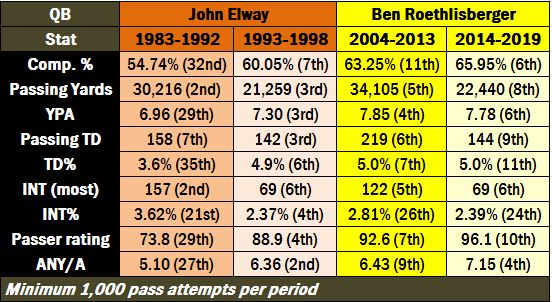
Beyond that, Roethlisberger didn’t need 11 seasons to start putting up efficient passing numbers like Elway, who had 158 touchdowns and 157 interceptions from 1983-1992. Look at this split for each quarterback’s first 10 seasons versus their 11th-16th seasons and how they ranked among their peers at that time (minimum 1,000 attempts for rate stats).

JE-BR

(Keep in mind Roethlisberger has had stiffer competition too with Brady, Brees and Rodgers in each split. Someone like Manning is replaced by Mahomes in the 2014-2019 split. Meanwhile, Chris Chandler and Mark Brunell were two of the better quarterbacks in that 1993-1998 split for Elway, a bit of a down period for offenses league-wide.)

Roethlisberger immediately had great efficiency stats and was Offensive Rookie of the Year before later having the volume stats as well. He’s always had top 10 statistics while Elway was often poor for a decade among his peers before turning it on later when the Broncos eventually supplied him with a HOF tight end (Shannon Sharpe), HOF RB (Terrell Davis), HOF left tackle (Gary Zimmerman), HOF-caliber wideout (Rod Smith), and other good assets. Roethlisberger’s boost starting in 2014 was Le’Veon Bell becoming a capable receiver at running back, which he never had before in his career. The improved line and his personal change to get rid of the ball faster has resulted in far fewer sacks taken. The Steelers also had better skill weapons in recent years before Bell and Antonio Brown mentally imploded, but Roethlisberger has always helped his receivers excel. Santonio Holmes, Antwaan Randle El, Mike Wallace and Martavis Bryant disappointed greatly after leaving Pittsburgh, and almost every draft prospect (mostly mid-round picks) has panned out thanks in part to Roethlisberger’s consistency. The only wideout who broke out somewhere else was Emmanuel Sanders in Denver (with Manning of course).

Roethlisberger didn’t need 15 seasons to win his first Super Bowl either. He needed two and then added a second in his fifth year with the greatest game-winning touchdown pass in Super Bowl history. If you want to say Roethlisberger sucked in his Super Bowl win against Seattle, that’s fine. Just admit the same for Elway against the 1997 Packers. The helicopter spin was cool, but it’s not a better play than the tackle Roethlisberger made to save Jerome Bettis’ legacy and his team’s ring in the playoffs in Indianapolis in 2005. While “The Drive” is an iconic moment for Elway, it didn’t directly win the game for Denver like Roethlisberger’s march and throw against Arizona.

Elway has his moments of lore, but so does Roethlisberger to anyone paying attention to the last 15 years of the NFL. This is the problem of playing in the same era as the big four of Manning, Brady, Brees and Rodgers. Yet Roethlisberger is the only QB in NFL history with three 500-yard passing games, which were all wins against winning teams, including the last-play touchdown to Mike Wallace against the 2009 Packers. He also has the most 450-yard games (7). He’s the only QB to ever throw six touchdown passes in back-to-back games, which was also done against playoff teams. He is tied with Brady for the third-most games of five touchdown passes (seven) in NFL history, and five of those games were nationally televised. He is tied with Peyton for the most 158.3 perfect passer rating games with four. He had a great game as a rookie to end New England’s historic 21-game winning streak. He led a memorable comeback to win the AFC North on Christmas in 2016, connecting with Antonio Brown in the final seconds. There was the slug-out win in Baltimore in 2008 with a Santonio Holmes touchdown breaking the plane late. He’s broken the hearts of Bengals and Ravens fans with nine game-winning drives against each.

At the end of the day, it doesn’t surprise me that Roethlisberger wasn’t even one of the 22 nominated names for this list by the NFL. He’s always been the Rodney Dangerfield of quarterbacks — no respect. But what factors other than nostalgia would make one choose Elway? Are an extra two Super Bowl losses the deciding factor? It’s not for me when I know that’s the result of Elway playing in a far weaker AFC where he took advantage of cursed Marty Schottenheimer teams like so many others would. Imagine if Elway had to deal with the Patriots and Manning-led teams like Roethlisberger has. Elway did nothing to break up Buffalo’s four-year run of winning the AFC. Elway wasn’t the only one who saw his defense implode in playoff games either, most notably those three Super Bowl losses. Roethlisberger is 13-1 in the playoffs when the Steelers allow no more than 24 points, but 0-7 when they allow 29-plus.

It’s hard to say how Roethlisberger, going on 38, will recover after surgery. The Steelers could also be in for some lean years with the Ravens running wild now and the Bengals probably drafting QB Joe Burrow with the top pick. The Super Bowl window may be closed for Ben, but he’s long since matched Elway in that “precious” ring category people care about.

It has been a pleasure watching Roethlisberger the last 15 years. It has been painful watching the Steelers try to operate an offense without him this season. That should earn him more respect, but we know that never seems to be the case despite all the evidence.

Running Backs (7)

  1. Barry Sanders
  2. Jim Brown
  3. Walter Payton
  4. Emmitt Smith
  5. Eric Dickerson
  6. LaDainian Tomlinson
  7. Marshall Faulk

My top three have been set in stone for quite a number of years now thanks to their pure domination and consistency. When it comes to No. 4 Emmitt Smith, I hear the arguments about the offensive line, but his longevity and durability were special. There’s no other way you get to be the all-time leading rusher without that. He was also the dominant, featured player in his offense at a time when his Cowboys were the most successful team in the NFL. The 90s were a peak time for workhorses and he won four rushing titles despite battling with the human highlight reel that was Barry Sanders. Eric Dickerson rounds out my top five, and he may be No. 1 if we just focused on his first six or seven seasons when he was so prolific and didn’t have much help from his passing game. His record of 2,105 rushing yards in 1984 still holds up and may never be broken (at least not in a 16-game season).

While the NFL included 12 backs, I only felt it was necessary to pick seven as I am a firm believer in the ease of replacement at the position. I also picked LaDainian Tomlinson and Marshall Faulk to round out my list, which explains why I was so shocked to see neither make the NFL’s list. Both were league MVPs who set the single-season touchdown record and were prolific receivers as well. Faulk had that dominant 1,000-yard rushing, 1,000-yard receiving season in 1999 that led to a Super Bowl win for his Rams. Tomlinson was insanely productive through seven seasons back at a time when the league was still filled with the workhorse back, a dying breed ever since.

You have to wonder if there was a personal vendetta against Faulk at the NFL Network to not honor him on this show due to his involvement in a sexual harassment case years ago. That would be a bit hypocritical for a show that had no problem bringing Jim Brown, Ray Lewis, and Lawrence Taylor on the studio and also talked about the inclusion of O.J. Simpson. Not to get on a moral high horse, but allegations of murder and physical/sexual assault against women are a serious matter.

Either way, I have no problem putting players who finished third and seventh in career touchdowns on my list. Tomlinson and Faulk were massive snubs by the NFL. I did not pick a back older than Brown, but I respect the NFL’s decision to include Steve Van Buren. I think that’s the right pre-1950 pick and I also like Lenny Moore a lot too as a big-play threat. I can even respect O.J. Simpson’s inclusion as he was a monster (on and off the field).

But again, I just do not love the position enough to include more than seven as I wanted to get more quarterbacks on my top 100.

Wide Receivers (10)

  1. Jerry Rice
  2. Randy Moss
  3. Don Hutson
  4. Terrell Owens
  5. Lance Alworth
  6. Calvin Johnson
  7. Larry Fitzgerald
  8. Julio Jones
  9. Marvin Harrison
  10. Cris Carter

For the record, if I was ranking all players 1-100, Jerry Rice would be my No. 1 overall player, the GOAT. You could kill a lot of time digging into his records and being amazed at how incredible his peak was and how he was the best Old Man WR in history too. One of the first football articles I ever did was about how unbreakable Rice’s records were. Even in this era of pass-happy offenses, it’s hard to see anyone playing now breaking his records. It would have to be someone who comes in later when the seasons are 18 games long. Hopefully that change never happens and someone beats him on merit instead of increased opportunities. If one record falls it would have to be receptions, but good luck to anyone on the yards and touchdowns. Not to mention all the playoff records.

I saw more of Randy Moss than I ever did Rice, but he’s my No. 2 because I think he had a tendency to take plays off. He basically quit on the 2006 Raiders, which maybe I can’t blame him for given his QB was Andrew Walter and his coach was Stuck in the 1990s Art Shell. But Moss was such a dangerous deep threat and I loved seeing him raise his hand almost instantly out of his break to get his QB’s attention to throw it. He might have sniffed Rice’s touchdown record if his career didn’t go haywire at age 33 (played for three teams in 2010), but that’s just another reason Rice is the GOAT.

Now that I hit on my two favorites, let’s circle back to the NFL’s very controversial list, which I had a somewhat viral tweet about in mocking the addition of Elroy “Crazy Legs” Hirsch.

In my opinion, my top five players should be locks for a top 10. The NFL didn’t go with Terrell Owens for probably some of the same reasons he had to wait years for the HOF. Perceived “bad teammate” stuff. As an on-field talent, the guy was amazing and excelled with several quarterbacks and franchises, and his teams generally won. His performance in the Super Bowl loss after a serious leg injury was also awe inspiring. T.O. can be in my top five for sure.

When it comes to 6-10, I think many players have a good argument. Wide receiver is a very difficult position to evaluate because their success is so dependent on the quarterback in a way that just isn’t true for RB/OL/TE (see my rant here). We have to consider the team’s pass-run ratio, the quality of the quarterback and other receivers, and did the receiver create a lot of YAC, score a lot of touchdowns, or did he just load up on short completions from the slot? There’s a lot more to evaluate here so it’s not surprising that the HOF has a difficult time with the position and so did this list.

For one, I think having five of the top 10 wide receivers of all time as white players is a head scratcher (unless that was the Bill Belichick Special given he’d include “Julian Welkendola” as a player if he could combine the three). Don Hutson and Lance Alworth were locks that I included in my top five. Hutson is basically the George Washington of the position, the first true great receiver. Alworth was an incredible deep threat and the best from the AFL era. I did not include Raymond Berry or Steve Largent on my list, but I at least see cases for them making the NFL’s list.

The one that bugged me was Crazy Legs Hirsch. He indisputably had one of the all-time great receiving seasons in 1951 with 1,495 yards and 17 TD in 12 games. But that was on a stacked, historically prolific passing team with two HOF passers. The competition also leaves something to be desired from that year. The Rams opened the season with the New York Yanks, a team that finished 1-9-2 and was defunct the following year. That’s the game where Norm Van Brocklin set the single-game record with 554 passing yards, and Hirsch had 173 yards and four touchdowns that day. Hirsch never came close to his 1951 numbers again and only had a couple other really strong seasons.

I get that they were trying to highlight different eras, but why so much focus on that time between Hutson and the pass-happy AFL that Alworth helped bring along? I would have ignored Hirsch’s era for sure, just like how they ignored the last dozen years when Calvin Johnson and Julio Jones were so outstanding, living up to the draft hype with their freakish talent. Calvin came the closest to a 2,000-yard season of anyone so far and retired early much like Detroit’s other great skill player (Barry Sanders). Julio doesn’t score touchdowns like you’d like to see, but it’s hard to argue with his NFL record average of 96.4 receiving yards per game. He is looking to finish in the top three in yards for the sixth time this year. That’s big when you consider Larry Fitzgerald has only finished in the top three one time in his career (he has been fourth a total of three times). This gets back to how voters don’t seem to properly understand how to evaluate a player relative to his peers in this era.

Fitzgerald made my list too even though he’s less dominant than most of the other guys. His hands are amazing, he’s been very durable, and his playoff performances were nothing short of historic. Cris Carter also made my list for his ability to score a ton of touchdowns with various quarterbacks. I’ve always had him ranked ahead of the likes of Tim Brown and Michael Irvin. Sterling Sharpe would get more respect if injury didn’t stop him early, but he should be in Canton.

Then there’s Marvin Harrison. I’ve said that the best WR in NFL history, statistically, would be Peyton Manning’s No. 1 WR. Harrison was fortunate to get the biggest chunk of those seasons as he lit up the record books with Manning in Indy. Harrison’s playoff struggles are hard to explain, but it’s hard to argue with his 1999-2006 peak when he averaged 105 catches, 1,425 yards and 13 TD per 16 games.

Tight Ends (6)

  1. Rob Gronkowski
  2. Tony Gonzalez
  3. Antonio Gates
  4. John Mackey
  5. Kellen Winslow
  6. Mike Ditka

This was probably the least disagreeable position on the NFL Top 100. They only selected five players, but I had the same five plus Antonio Gates, who played college basketball in case you forgot. Shannon Sharpe would also be an honorable mention, but I like this list.

Gronk was the GOAT and the numbers would be even more stunning if he wasn’t injured so often. But when playing he was the best. Think of Tony Gonzalez as Arnold’s T-800 model of Terminator. Iconic and durable. Got the job done. But Gronk was the T-1000, except he’d rather melt into a puddle of goo off the field than continue risking his body after yet another Super Bowl win. Man, it sure is funny how the two most stat-inflating receivers of the last two decades (Moss and Gronk) played at their peak with the quarterback who “never has any weapons” in New England.

John Mackey has one of the best highlight reels of any player in NFL history. He was an OG like Mike Ditka, and Kellen Winslow took things to another level in Air Coryell’s offense as a receiving tight end. A relatively newer position than the others, it wasn’t hard to come up with the tight ends.

OFFENSIVE LINE (19)

Before we get into the OL positions, I want to acknowledge that it’s still the unit we have the least data for, especially for past decades. At least we have new game charting metrics for blown blocks and rates of snaps won in pass blocking, but we’re still pretty much in the dark on most decades of NFL history. So excellence at these positions have largely been defined by draft status, games started/longevity, and Pro Bow/All Pro honors. We know that can be very dubious, such as Maurkice Pouncey making eight Pro Bowls largely on the fact that the Steelers drafted him in the first round in 2010 rather than his actual play. So when I’m picking an offensive lineman, I try to pick someone who contributed to successful offenses while also garnering a lot of individual honors, but again I think a lot of us are simply guessing when it comes to these positions.

Offensive Tackle (7)

  1. Anthony Munoz
  2. Orlando Pace
  3. Jonathan Ogden
  4. Willie Roaf
  5. Joe Thomas
  6. Forrest Gregg
  7. Jim Parker

The NFL list had seven tackles too, though we only agreed on three of them. Sort of. Jim Parker made my list here, but the NFL list put him at guard where he also played. He was Johnny Unitas’ left tackle during the title years in Baltimore. Point is he’s on this top 100 list. My top pick was Anthony Munoz who seems to be the consensus for the best tackle ever.

It was surprising not to see Orlando Pace on the NFL’s list. He was the No. 1 overall pick in 1997 and really highlighted that great run on tackles in the late 90s with Jonathan Ogden, Walter Jones, Tony Boselli, etc. I have no problem including someone from the Greatest Show on Turf Rams.

Joe Thomas did not make the NFL’s list, which is another slap in the face to modern players since he was retired at the time they voted. Thomas went to 10 Pro Bowls and 6 first-team All-Pros for the freakin’ Browns, their best player by far since returning to the league in 1999. He never missed a snap until 2017. He’s a first-ballot HOF lock and in an era where a lot of tackles struggle and high draft picks miss, it’s worth highlighting the best of the last two decades in Thomas. It’s just too bad he retired right before the Browns got a quarterback worth protecting (at least we hope that’s the case with Baker Mayfield).

Offensive Guard (7)

  1. John Hannah
  2. Bruce Matthews
  3. Gene Upshaw
  4. Larry Allen
  5. Randall McDaniel
  6. Jerry Kramer
  7. Steve Hutchinson

John Hannah was the GOAT for the Patriots before people ruined that label. Bruce Matthews could excel at any position on the line, so you know he would make the list high somewhere. I did not choose Art Shell for my tackles, but I did go with Gene Upshaw from those Oakland lines for the guards. Larry Allen was a monster who could also play multiple positions. Randall McDaniel was a 12-time Pro Bowler who was also All-Pro when the 1998 Vikings set the scoring record.

The NFL also chose seven guards, including my tackle pick of Jim Parker. They didn’t pick Steve Hutchinson and Jerry Kramer like I did. Kramer finally got into the HOF as a key member of the Packers, the most successful dynasty in NFL history. Hutchinson was my pick for representing the last 20 years of football. He should get into the HOF soon too, and he was an anchor for those strong Seattle offenses and also blocked for a young Adrian Peterson in Minnesota.

Center (5)

  1. Jim Otto
  2. Dwight Stephenson
  3. Mike Webster
  4. Dermontti Dawson
  5. Mel Hein

Hard to say if there’s any consensus on the #1 center like there is for tackle (Munoz) or guard (Hannah), but Jim Otto was a 10-time first-team All-Pro. Sure, it helped that most of that came in the AFL when there weren’t many teams, but the Raiders were a highly successful offense in that era. Dwight Stephenson might have gone down as the best if he played longer (just 114 games), especially since he was with Dan Marino in Miami.

I mentioned Pouncey earlier, but you can see why center is such a big deal in Pittsburgh. Mike Webster and Dermontti Dawson were two of the best to ever do it. Finally, Mel Hein made my list as the best from his era (1931-1945).

The NFL had the same list, except Dawson didn’t make it there. So there’s probably more groupthink with OL than any position, but my 19 picks being somewhat close to the NFL’s list makes me feel good.

Defensive End (9)

  1. Reggie White
  2. Bruce Smith
  3. Deacon Jones
  4. J.J. Watt
  5. Carl Eller
  6. Michael Strahan
  7. Jack Youngblood
  8. Julius Peppers
  9. Gino Marchetti

You might be able to argue with the order, but I think White/Smith/Jones make up a pretty consensus top three. This is such a crucial position, so I was surprised to see the NFL only chose seven players. More baffling was how they included Doug Atkins and Lee Roy Selmon, but not J.J. Watt or Michael Strahan.

The Watt snub especially bugged me because it showed that they’re not acknowledging how great an active player has already been in his career. Watt played six full seasons and was first-team All-Pro in five of them and won three Defensive Player of the Year awards. Most guys can play 15-20 years and never sniff those achievements. Watt’s only played nine fewer games than Selmon, who started out on those horrible Tampa Bay teams and only had one All-Pro season and DPOY award. Watt is as big of a snub as any by the NFL.

I also like to represent Minnesota’s Purple People Eaters line, so I included Eller on my list. Strahan was a surprise snub too. Not only does he still hold the record for sacks in a season (22.5), but he still ranks sixth all time (141.5) and led the Giants defense on that great Super Bowl run in 2007, shutting down the undefeated Patriots. Julius Peppers also made my list as a modern player with his freak athleticism and having the fourth-most sacks ever. He should be an easy HOF choice in 2024.

Defensive Tackle (9)

  1. Joe Greene
  2. Merlin Olsen
  3. Bob Lilly
  4. Randy White
  5. Warren Sapp
  6. John Randle
  7. Alan Page
  8. Cortez Kennedy
  9. Aaron Donald

Much like with the Watt selection, I think Aaron Donald has already done enough this decade to belong on the list. We are fortunate to have stats for pressures and QB hits now, even if they aren’t as objective as a sack. But Donald is so dominant in those categories despite playing inside and seeing a lot of double teams. Donald and Watt will be the first two incredible defenders in the game charting era where we have more data to quantify just how much better they were than their peers. I’m not surprised the NFL snubbed him, but I won’t.

Like with Marshall Faulk, I wouldn’t be surprised if Warren Sapp was purposely left off as he’s also run afoul off the field in recent years. But he was another great pass-rusher at a position where it’s just harder to break through to the quarterback than playing on the edge.

The NFL chose seven players, of which I agreed with six of them (not Buck Buchanan from the Chiefs). It’s pretty obvious to agree with the gold standards of the position like Greene, Olsen and Lilly. I just think Sapp, Donald and also the late Cortez Kennedy deserved it too.

Linebackers (12)

  1. Lawrence Taylor
  2. Ray Lewis
  3. Derrick Brooks
  4. Jack Lambert
  5. Junior Seau
  6. Mike Singletary
  7. Dick Butkus
  8. Derrick Thomas
  9. Chuck Bednarik
  10. Joe Schmidt
  11. Bobby Bell
  12. Jack Ham

Here is an old-school position where teams start three or four players, so it’s not that hard to come up with a list of legends. I picked 12 just like the NFL did, but we had two big disagreements. I went with Derrick Thomas and Mike Singletary while they chose Willie Lanier and Ted Hendricks. Sure, Hendricks is a fine selection and nearly made my list too. Lanier is overkill for me since he played with Bobby Bell on the Chiefs, who also made the list. Singletary was a dominant force in Chicago and is second to only Ray Lewis in Pro Football Reference’s new HOF monitor for inside linebackers.

Derrick Thomas was the snub that stood out most to me the night the NFL revealed their list, because I assumed Singletary was on there too. But for Thomas, he was a great pass-rusher with monster games (games of 7 and 6 sacks) and production (41 forced fumbles) for a winning Chiefs team in the 90s. He sadly passed away at 33 after a car accident, but I have to have him on my list.

This was a position where I didn’t think any active player was really deserving of inclusion. Ray Lewis was the most recent player, retiring after 2012. Luke Kuechly is building up a great resume in Carolina, but I wouldn’t put him ahead of Brian Urlacher yet, let alone in the top 12.

Cornerback (9)

  1. Rod Woodson
  2. Deion Sanders
  3. Mel Blount
  4. Champ Bailey
  5. Darrelle Revis
  6. Night Train Lane
  7. Willie Brown
  8. Charles Woodson
  9. Herb Adderley

This was another controversial position from the beginning when Patrick Peterson was included on the finalist list over Richard Sherman. What bugged me about the NFL’s list of seven cornerbacks is that Mike Haynes was reportedly a unanimous choice, but Rod Woodson and Deion Sanders were not. How in the world can any of the 26 voters not all have Woodson and Sanders on their ballot? That’s absurd. I put them in my top two along with Mel Blount, who changed the game so much for Pittsburgh that they had to create illegal contact.

I also made sure to give credit to shutdown corners in this era where the pass is so heavily utilized. So that’s why I have Champ Bailey and Darrelle Revis so high when neither made the NFL’s list. Charles Woodson also made the cut for me with one of the best resumes a football player has ever put together.

Night Train Lane is someone I joke about getting 15-yard penalty after 15-yard penalty if he played today with his rough style, but he was the stud corner in his era. I also gave respect to Willie Brown and Herb Adderley with the latter being a snub in my eyes from the NFL list. Given what we know about NFL media and the things they value, you would think a six-time champion with five picks in the playoffs and four All-Pro seasons would be more highly regarded.

I left out Darrell Green on my list, but the NFL didn’t. I said on Twitter that he was most notable for his speed and insane longevity (played thru his age-42 season). In 20 seasons he was an All-Pro just once and he never had more than five interceptions in any season. While interceptions may not be the end-all, be-all stat for a player, just keep in mind that roughly 600 players can claim to having a season with six interceptions at least once. It’s not asking for much. So I’d much rather have Revis and Bailey than Green and Mike Haynes.

Safety (4)

  1. Ed Reed
  2. Ronnie Lott
  3. Emlen Tunnell
  4. Larry Wilson

This was a position I cut short a bit at the end to not go over 100 players. The NFL list had six, including all four of my players. Ed Reed was an easy choice as the GOAT for me and the only one needed from his era (over Troy Polamalu and Brian Dawkins). Ronnie Lott was crucial and a punisher for the 49ers’ success so he’s up there, but I love the way Reed could outsmart the Manning’s and Brady’s in a way no other safety could. When Reed got the ball in his hands (64 INT!) he was electric to watch too. You didn’t know if he’d make a 100-yard return or lateral to a teammate. Here’s one of my favorite stats ever:

Emlen Tunnell was before my time, but the four-time All-Pro still ranks second in interceptions (79) and probably will never be passed unless someone changes teams weekly to play against Jameis Winston for years to come. Paul Krause still holds the record with 81 interceptions and may have been my fifth safety if I had room, but I felt like he was more of a compiler in that statistic than anything. So my last pick went to Larry Wilson, an innovator of the safety blitz.

Others

I did not select a punter, let alone two like the NFL did, but Ray Guy is the obvious choice there. For kicker, I’ll go with Adam Vinatieri for his longevity and reliability in clutch situations and inclement weather. He also really started finding the touch on 50-plus yard kicks in the back half of his career. Justin Tucker is on his way though, but this is still too much kicker talk. Devin Hester would be my pick for the return specialist, and finally, you can see my top 10 coaches here:

Here is the final breakdown of my top 100 players in NFL history:

Top100NFL


NFL Week 9 Predictions: Brady vs. Rodgers vs. GOAT Edition

The Week 9 schedule looks as good as any week this season, and the game of the week should be Rams at Saints. However, I am using this space (and the weekend’s extra hour) to clear up some things from late in the 2016 season that I wanted to write about, but never got around to doing. After all, this very well may be the second and last time there’s a game between Aaron Rodgers and Tom Brady.

The GOAT Discussion: Part I (Statistical Regret)

Naturally, the discussion has been who is the GOAT? Brady or Rodgers? More accomplished or more talented? I tend to avoid this particular debate, because I’d easily take Peyton Manning over both of them as no one played the position at as high of a level as consistently long as he did.

But that’s not the main focus today. I want to express some rare regret over posting a stat from January 2017. It’s hard to regret citing a fact, because I don’t feel responsible for how people choose to interpret them. However, if I knew what Patriots fans would do with this one, I never would have brought it up.

Leading into the 2016 NFC Championship Game (Green Bay at Atlanta), I was doing research on the Packers that showed this team was not good as an underdog, not good against high-scoring offenses, and as I’ve written about since 2011, not good at winning after falling behind. That led me to post the stat that said:

Packers are 0-35 with Aaron Rodgers at QB when trailing by more than one point in the fourth quarter against a team with a winning record.

I wanted to make it clear how getting off to a good start was paramount for the Packers in Atlanta (Narrator: they didn’t.). I tweeted the stat of course, and in the months & years since, it randomly gets retweeted and liked at all hours of the day, typically by Patriots fans who use it as the ultimate dig against Rodgers and a sign of his anti-clutchness in comparison to Brady.

Beyond my own mentions, I see it often cited on Twitter from people who probably have never seen my work, and many who would be pissed if they did since I always choose to push fact over narrative for their King of Kings. Here’s a small sampling of tweet results for “Rodgers 0-35” from just the last day, and notice how none of them actually get all the details of the stat correct (like more than 1 point):

035stat

Basically, by arming NE fans with this stat, I feel like the US giving chemical weapons to Saddam, and I regret it more and more by the day.

The fact that people don’t even choose to update it just shows some of the damage I caused by getting this out there. For the record, it’s now 1-38 for Rodgers when trailing by more than 1 point in the fourth quarter against teams with a winning record thru 2017.

And that’s teams who finish the season with a winning record, so it’s thru 2017 only. Maybe the Bears game this year will be his second win, but the first was Dallas last year. Oddly enough, the Cowboys only finished 9-7 instead of 8-8 because the Eagles rested starters in Week 17. That’s one of the ways this stat can be totally unfair to the QB, just like citing their playoff W-L record often would be. These guys aren’t playing Andy Dalton postseason bad and earning winless records in a small number of games. It’s much more nuanced than that, but I’ve unfairly helped label Rodgers as the 0-35 guy.

So why post it in the first place? You have to remember that of Rodgers’ 10 4QC at the time, the first was a 1-point deficit against the 0-16 Lions (a game Detroit lost by 23). Then he had a pair of them against the otherwise 7-7 Bears of 2009, a bad debut year by Jay Cutler. His 6th was the first against an 8-8 team (2013 Bears) where the argument is valid that the Bears would have been 9-7 division winner had Rodgers not come back to beat them in Week 17. That’s fair, but someone like Peyton Manning had nine 4QC against teams that finished 8-8, but he still managed at least 17 of these comeback wins against winning teams. Then I noticed Rodgers had two comebacks from a 1-point deficit early in the quarter against 2014 Dallas and 2015 Seattle. Teams down 1 point early in 4Q often have a win probability > 50%, especially if they were at home and favored. So it was an interesting mix of comebacks from typically small margins against pretty average teams.

It’s a wild stat, and while it is a difficult situation, the average QB is going to win 10 percent of the time, and it’s more like 25 percent for the best. Even the aforementioned Dalton is 7-25-1 in that situation in his career thru 2017. So there is still some doubt to associate with Green Bay and comebacks, but Rodgers rarely is the main problem there.

The GOAT Discussion: Part II (Those Damn Super Bowl Collapses)

I also have to blame the 2016 Falcons and 2014 Seahawks for not running the ball in the fourth quarter of their Super Bowls and ruining the GOAT discussion on a national level. People think it ends with those games, both won by New England to give them a fourth and fifth title in the Brady-Belichick era.

I think they only add to the overwhelming evidence that Brady, who had shaky performances throughout both games, gets to win games other quarterbacks would lose based on factors out of their control. Did Brady will Malcolm Butler to intercept a pass at the 1-yard line for the costliest interception in NFL history? Did he will Robert Alford to drop an interception that turned into a 23-yard catch by Julian Edelman? Did he will the Patriots to win the coin toss in overtime and get the ball first? That came only after a stop in the last minute against Matt Ryan (something Russell Wilson couldn’t get the benefit of with 31 seconds left in 2012).

Some people are such simpleton ring counters that I think they’d still call Brady the GOAT even if the Seahawks and Falcons finished off the Patriots on the ground. But I do believe a lot of national perception would be different if the Patriots were riding a 5-game Super Bowl losing streak with no titles since the 2004 season. However, Butler made the play, so good for him. Dont’a Hightower had the crucial strip-sack on third-and-short to change the Atlanta game, and the Patriots sacked Matt Ryan again to knock the Falcons out of field goal range when they could have put it away by going up 11. So good for them too. They made the plays to get the win.

The problem is when people act like these comebacks were all Brady, or worse: that no other quarterback could do what he did. They act like he has some special sauce or gene that will elevate him in these spots over the likes of Rodgers, Manning and any other QB you want to name.

It’s really just a bunch of narrative-driven BS, so let’s look at the facts. Two weeks before SB LI, Rodgers faced this same Atlanta team and its lousy defense on the road in the NFC Championship Game. He was down 31-0 in the third quarter after Julio Jones embarrassed his defense with a long touchdown (wow, feels like he hasn’t scored since). Never mind the fact that Rodgers wasn’t as bad as Brady (pick-six in 2Q) to this point in the game against Atlanta. Never mind that Atlanta went up 10-0 after Green Bay started with a missed 41-yard field goal and fumble by the fullback deep in scoring territory. The fact is it was 31-0 and Rodgers was going to have to be amazing the rest of the way.

What did Rodgers do? He led three straight 75-yard touchdown drives against Atlanta. It may have been four in a row, but he sat out the last drive. Why? The Falcons were up 44-21. Despite Rodgers’ best efforts on those touchdown drives, his defense continued to give up two more touchdowns to Atlanta. You can’t come back without stopping them too, and that’s not on the quarterback. Brady’s defense stopped the Falcons on four straight drives, including the huge stops with sacks in the fourth quarter. Rodgers didn’t get that benefit, so no comeback.

Go back two years earlier to 2014: Rodgers was at Seattle for the NFC Championship Game. Again, tougher to play on the road than neutral field, but I digress. Rodgers didn’t have a good game, but that’s likely a win if GB just recovers an onside kick late. They didn’t and Wilson put the Seahawks ahead. Down 22-19, Rodgers still put the Packers in range for a game-tying field goal to go to overtime. He just never touched the ball again after the Seahawks scored a touchdown on the only drive of overtime.

Now imagine if the Falcons did that to Brady in the Super Bowl: a TD in overtime with him not getting the ball. We’d probably have a rule change by now because the outcry would be so massive. No one cares that it happened to Atlanta though. The GOAT won his fifth (after escaping a game-ending interception, mind you).

I’m also just realizing how close we were to Rodgers/Brady II in SB 49, which may have changed a lot of perception years ago, but alas, things happened. The Packers beat NE that year, by the way.

Let’s also use these ATL/SEA games and compare this to Manning, who faced the tougher version of the Seahawks in 2013. That defense didn’t feature the Legion of Boom with all the serious injuries that Brady saw them with in SB 49. They also didn’t lose Cliff Avril and Jeremy Lane to injuries after interceptions like with Brady. But again, I digress. Manning threw a pick-six in the first half of that game and was down 22-0. Not much unlike Brady, who threw a worse pick-six (wasn’t hit in motion like Manning) being down 21-0 to Atlanta. However, the Patriots settled for a field goal before halftime to make it 21-3. They knew Atlanta’s D was bad at holding leads and could be scored on. Down 22-0, Denver felt the need to score a touchdown now, especially with Seattle getting the ball to start the third. So they went for a fourth-and-short over the field goal, but Manning’s pass was knocked down. 22-0 was going to be a hell of a comeback effort against one of the best defenses this century, but Seattle made it a moot point after Percy Harvin returned the opening kickoff for a TD to make it 29-0.

Now Manning would need the 2nd-largest comeback in NFL history, so good luck with that one. Manning actually had his best quarter that night in the third quarter, but they ran the ball on a third-and-10 before punting, Demaryius Thomas lost a fumble at the SEA 21, the Seahawks added another touchdown, and it was 36-0 before Manning finally got Denver on the board to end the quarter at 36-8. A 28-point 4QC has never been done in NFL history, but Manning never even got the chance after Seattle added yet another touchdown for a 43-8 final. Again, Rodgers and Manning didn’t get any stops when they needed them like Brady continued to get against what was actually the strongest offense in this little study (2016 Falcons with MVP QB Matt Ryan).

So while Brady gets praise and MVP honors for the 10-point 4QC against Seattle that only held up after Butler’s incredible pick, no one remembers that Manning played the 2014 Seahawks (without torn MCLs and labrums in the secondary) in Seattle that year. He was down 17-5 in the 4Q and threw two touchdown passes to force OT. He was down 20-12 in the final minute with 80 yards to go before leading a touchdown drive with a game-tying two-point conversion pass. That type of comeback drive (down 8 in final minute) had never been pulled off before in NFL history.

But no one remembers this drive because the Seahawks got the ball first in OT and they handed the ball off to Marshawn Lynch in the red zone for a 6-yard TD to end it. We just covered four games for Manning and Rodgers where they never got the ball in overtime after tying late, or they didn’t get the stops on defense to make a huge comeback possible. But for Brady? He always gets that help, which is why the Patriots have this long-running dynasty.

We have seen playoff comebacks of this nature from several of the game’s recent greats, but the difference in winning or losing is rarely ever about the QB himself.

Peyton Manning led an 18-point comeback win against Brady’s Patriots in 2006 AFC Championship Game, which was the biggest comeback in a championship game until SB LI. Manning also came up a field goal short (missed terribly by Mike Vanderjagt) of overtime against the Steelers in 2005 after trailing 21-3 in the fourth quarter.

Ben Roethlisberger erased a 28-10 4Q deficit against the 2007 Jaguars to take a late 29-28 lead, but his defense allowed a game-winning field goal in the final minute after David Garrard converted a 4th-down scramble (holding penalty missed).

Drew Brees has twice erased 17-0 deficits on the road in the playoffs against the 49ers (2011) and Vikings (2017). He put his team ahead in the final 100 seconds in both games, but watched his defense give up touchdown drives to Alex Smith and Case Keenum.

Don’t forget Atlanta has a history of blown leads. In 2012, the aforementioned Russell Wilson led a 20-point 4QC in Atlanta to take a late 28-27 lead with 31 seconds left, but his defense still blew it in that small amount of time. A week later, Colin Kaepernick helped the 49ers erase a 17-point deficit to beat Atlanta in the NFC Championship Game.

In his first playoff game, Aaron Rodgers led three 4Q touchdown drives in Arizona in 2009 to force overtime. Granted, he did miss an open Greg Jennings in overtime and gave up a game-ending fumble-six, but he still at least got the game to overtime on a day where Kurt Warner shredded the defense for 45 points.

Andrew Luck has already led a 28-point comeback win in the playoffs, beating the 2013 Chiefs 45-44.

I just stuck to Brady’s peers here, but Joe Montana also once led a 21-point comeback in the fourth quarter of the 1983 NFC Championship Game by throwing three touchdown passes to tie the game. It’s just unfortunate that the Redskins hogged the ball and got away with a shaky pass interference call to set up their game-winning field goal to advance to the Super Bowl.

If I see QBs in need of a late-game drive to win, I expect Brady will get the win more often than anyone. However, my expectations of that are due to the overall machine that NE has under the Faustian Belichick rather than the quarterback himself. If it’s a Manning or Rodgers team, I’m expecting how one of their teammates is going to screw the latest game up. That difference in help is the main difference between these quarterbacks, because individual QB skill is certainly not driving these results.

The GOAT Discussion: Part III (Help)

We know ring counters ruin most sports talk, but it’s always amazed me when people bring up the eye test to label Brady as the GOAT. I claim to have bad eyes, but I’m pretty sure my football vision has been good enough to see that there are more talented quarterbacks in this era. Let’s add Drew Brees, the NFL’s all-time passing king, to this discussion.

Brady doesn’t have the accuracy of his peers, especially Brees. Brady doesn’t command the offense from the line, practically serving as the coordinator like Manning did in his career. Brady doesn’t have the mobility and improv skills of Rodgers. He’s got a hell of a QB sneak though.

It’s 2018, yet people still seem to define a QB’s help as his receivers. The fact is a great QB will elevate his receivers by producing better stats for them and help them make Pro Bowls and get paid if they hit free agency. He’ll keep pressures and sacks down since those stats are more reflective of QB play than offensive line play. He’ll get his offensive coordinators hired to more important jobs. He’ll make the whole operation run smoother, and while Brady does those things, it’s hard to say with any actual evidence that he does them better than Manning, Rodgers or Brees.

I can write a whole book about this part, but let’s keep it simple for today. The real #1 advantage in New England has never been at quarterback, but at head coach. Brady simply gets more help from always having Bill Belichick, a defensive genius who has also kept the team ahead of the curve on the other sides of the ball.

Peyton Manning went to four Super Bowls with four different head coaches, a feat likely to never be repeated. Without him, those coaches have often been fired from their jobs with subpar records. But he could win 12+ games with just about anyone as he was the ultimate coach on the field. Despite mostly having defensive-minded coaches, Manning rarely had a good defense. That’s the edge for Brady. He actually has a defensive-minded coach who keeps the points down on that side of the ball.

Brees succeeded in San Diego first with Marty Schottenheimer as his head coach. Sean Payton has been a godsend to him offensively, but Brees proved in 2012 when Payton was suspended the whole year that the offense could still run through him just as well. Payton’s problem is that he’s Don Coryell with a ring in the way he has struggled to put together a defense to help Brees.

Mike McCarthy has been the head coach of every NFL start by Rodgers, but many have noticed his tactics have grown stale over the last four years as the Packers lost their league-best wide receiver depth. He hasn’t been an innovator on the level of recent hires like Sean McVay and Doug Pederson, nor has he taken the game to another level to keep up with the times a la Andy Reid and Belichick. When Rodgers went down last year, the offense looked terrible for the most part. We know that’s not the case when Brady is out in New England. Rodgers is saving McCarthy his job, and if they miss the playoffs this year, it might be time up for Mike.

It’s not as sexy as Rodgers 0-35, but let’s state some more facts that people should know about these quarterbacks.

Brady (11) has had more top 10 scoring defenses than Manning (four), Rodgers (three), and Brees (one) combined.

QB-DEF

While not as important as defense, the help on special teams is even more advantageous for Brady.

QBST

Brady has had 12 top eight finishes in special teams DVOA compared to one for Rodgers, Brees and Manning combined. We’ll see if the 2018 Saints can finish that high, but don’t be surprised if New England finishes high again for DEF and ST this year. Remember, they have more AFC East games coming.

I got through 3500 words of this before even mentioning that Brady’s had the biggest divisional advantage over any quarterback in the 32-team era (2002-2018). Yeah, that helps too when the best quarterback you have to compete with in 17 years is Chad Pennington, or when the best coach is Rex Ryan. But I’m not even getting into that today as I want to wrap this up now.

The GOAT Discussion: Conclusion (Some Guys Have All the Luck)

While I regret my Rodgers 0-35 stat, it has to pain Green Bay fans who are in my corner when it comes to the lack of help for him to hear what Rodgers said about the GOAT this week. In talking about Brady, Rodgers said “He’s got five championships, so that ends most discussions, I think.”

Except it shouldn’t end them, Aaron. I don’t know why, but the football gods always seem to grace a lesser quarterback with the most help, which leads to the most championships. We saw it with Bart Starr over Johnny Unitas, Terry Bradshaw over Roger Staubach, Joe Montana over Dan Marino, and I think you can argue Brady over all three of Manning/Rodgers/Brees in this era. The only one there who I think still had a good argument as the better quarterback was Montana over Marino given Montana’s continued statistical greatness and success after Bill Walsh retired. Marino’s big stat years peaked early and he had a lot of playoff losses that were routs.

But when so many quarterbacks are doing great things statistically year after year, we’re doing them a great disservice to let a series of coin flips in the playoffs tell us who is the best. Plays where the quarterback wasn’t even on the field are writing these legacies, but that’s why I’ll continue to do what I’ve been doing for 15 years: analyzing the impact of the team around the quarterback via statistical evidence to explain why games are won and lost. The other side will continue to do what they’ve done for 15 years: poorly explain why the quarterback who doesn’t have any statistical edge over his peers deserves the most credit for why his team wins the most.

All Rodgers can do this week is play his best to try getting a rare road win over the Patriots and make their path to a top seed harder. This defense has some holes he should be able to exploit, so it wouldn’t surprise me to see the game come down to a final drive. At the very least, Ty Montgomery won’t be there to defy his coaches and fumble a kickoff to deny Rodgers a chance again like in Los Angeles last week. Can you imagine that happening to Brady’s team? No, and therein lies the real difference.

Now excuse me while I crank up some of the GOAT.

NFL Week 9 Predictions

I had one of my best weeks ever last week (10-4 ATS, 13-1 SU). Having faith in the Giants cost me from a perfect 14-0 week, but not again this season on the Giants. I already started 0-1 this week after having bad expectations for Nick Mullens, but underestimating just how little Oakland cares right now.

2018Wk9

Still reeling from my lock last week (Bengals -4) blowing that late lead to the Bucs and only winning by 3. This week, I like an underdog teaser with PIT +9, ATL +8, NO+8 and GB +12. I also feel like the Browns could give the Chiefs a real scare in Cleveland with Gregg Williams replacing Hue Jackson.

Wk1-8

NFL Week 2 Predictions: The Good Life Edition

I’m not going to say that Week 1 of the 2018 NFL season sucked, but when the first two full games I watched live were Falcons-Eagles and Steelers-Browns, it didn’t get off to the best start. The Week 2 schedule looks really good, but it didn’t take long for injuries to start having an impact. Some of the players missing in action this week include Devonta Freeman, Greg Olsen, David DeCastro, Olivier Vernon, and basically every long-time Seahawk not named Russell Wilson or Earl Thomas. We’re also waiting to see if Aaron Rodgers, Ben Roethlisberger, and Marcus Mariota are good to go this week at quarterback. We still must wait to see the 2018 debuts of Joey Bosa, Carson Wentz, Alshon Jeffery, and Jack Conklin.

Game of the Week: Vikings at Packers

I really hope Aaron Rodgers plays this one, because it is a huge game for playoff seeding despite it only being Week 2. The Vikings knocked Rodgers out early in the first matchup last year and didn’t have to see him for the second one. They shouldn’t get that advantage again this year. They also have Kirk Cousins now in what is arguably the second-biggest game of his NFL career when you think about it. His only playoff game was also against Green Bay and Rodgers, a 35-18 loss at home in the 2015 Wild Card.

Over the last three seasons in Washington, Cousins was 3-10 on the road against teams that finished the year with a winning record. You’d expect Green Bay to be that kind of opponent this year. However, that 3-10 mark includes wins last season in Seattle and LA (Rams). Cousins also should have had a signature win in Kansas City, but Josh Doctson dropped a game-winning touchdown in the end zone. He can function in these spots and his Minnesota debut last week was solid.

Mike Zimmer’s had some decent success against Rodgers in his career, and this should be the most talented roster he’s taken into a Green Bay game yet. As I pointed out in FOA 2018, Zimmer entered this season with the best record against the spread (44-23) among active head coaches. Last week, his defense forced Jimmy Garoppolo into the worst start (and first loss) of his young career, and covered the spread.

HCATS

We don’t know what the spread is yet for this one because of Rodgers’ health, but clearly he isn’t 100 percent. I think a lack of mobility can be troublesome against such a talented Minnesota defense, and the Vikings should have scoring opportunities on the other side of the ball. That’s why, regardless of Rodgers’ status, I like the Vikings to pull this one off on the road with a superior roster. I know I’m already going against my season predictions where I had these teams splitting the series with each home team winning, but I also didn’t anticipate another Rodgers injury situation so soon.

Chiefs at Steelers

Under Andy Reid, Kansas City has beaten just about every contender in the NFL over the last four years. That includes wins over six of the last eight Super Bowl teams: 2014 Seahawks, 2014 Patriots, 2015 Broncos, 2016 Falcons, 2017 Patriots, and 2017 Eagles. (They didn’t play against the 2015 Panthers or 2016 Patriots, but notched wins against those teams the following season.)

One team Kansas City has not beaten is Pittsburgh, or at least not the Steelers with Ben Roethlisberger at quarterback. They won a game at Arrowhead in 2015 when Landry Jones had to start. But Reid is 1-6 in his career against Roethlisberger going back to 2004 with the Eagles. That’s not even necessarily impressive for Ben, because he doesn’t play defense and the number that stands out in those seven games is 16. Reid’s teams never scored more than 16 points against the Steelers in those games.

That could really change on Sunday after the Chiefs come in hot behind new QB Patrick Mahomes after scoring 38 points in LA as underdogs. Mobile quarterbacks have been giving the Steelers fits as of late with Brett Hundley, DeShone Kizer (Week 17), Blake Bortles and Tyrod Taylor (he actually stunk passing, but still ran well) hanging pretty good scoring numbers on the defense. Now the Steelers could be without Joe Haden and Artie Burns in the secondary, which is bad news with Tyreek Hill and Sammy Watkins coming to town. This isn’t Mahomes’ first road start either so they can’t hang their hat on that advantage, though Heinz Field is a different beast from the Chargers’ small park. He looked pretty poised last week and this is one of the most talented offenses in the league. It just hasn’t clicked in the past against Pittsburgh, though James Harrison is no longer there to own Eric Fisher. T.J. Watt is coming off a huge multi-sack game, and the pass rush looked quite good in Cleveland albeit a very indecisive game from Taylor.

If Mahomes can avoid the turnovers on the road, then the Chiefs have a great shot to win this one. It’s a bad week for Roethlisberger to be questionable and missing practices with an elbow injury, because this defense looked really vulnerable for the Chiefs last week. Philip Rivers had huge numbers that would have been even better without so many drops. Roethlisberger should have success with his weapons at home where the Steelers obviously play much better. I think the conditions played a factor in several of the turnovers last week, a game that Pittsburgh almost certainly wins without the rain leveling the playing field.

It could be a really fun game, but I think the Steelers get a tight win at home to avoid an awful 0-1-1 start to what was supposed to be another season with Super Bowl aspirations.

Patriots at Jaguars

I wish this rematch of the AFC Championship Game was the Sunday night game instead of Giants-Cowboys, but you know we can’t let a September or October go by without getting that matchup at night. When you try to pick out one of the few games the Patriots are going to lose this season, you always start with road matchups against playoff-caliber teams. This should be one of those, though the Jaguars didn’t scream “playoff lock” to me coming into the season. The offense scored 13 points last week against the Giants.

Much of that has to do with Blake Bortles, who lost the two Allen’s (Robinson and Hurns) at WR, and Marqise Lee is out for the season with a torn ACL. I’m just not sure this team has enough firepower to keep up with the Patriots, who aren’t as loaded themselves right now, but still have the best TE in the game. For all the talk Jalen Ramsey did this offseason, I’d like to see him match up frequently with Gronk in this one. Walk the walk, if you will. That’s really the key to slowing them down right now without any Welker clones left (Julian Edelman is suspended for three more games).

It would take an excellent performance from the defense, which has the talent to pull it off, to keep the Patriots under 20 points (preferably under 17). I think that’s what the Jaguars must do to win this one, because I just don’t see Bortles putting up many points. NE played the Texans and Deshaun Watson well last week.

Alas, it doesn’t sound good for RB Leonard Fournette playing this week. I actually think that could help Jacksonville. Maybe they won’t lean so heavily on him, because in that playoff game, the Jaguars tried to run out the clock way too early and weren’t aggressive enough on early downs. Also, Corey Grant had three early catches for 59 yards in that game. Maybe this lets Jacksonville get more people involved and opens up the playbook instead of just trying to grind things out with Fournette.

NFL Week 2 Predictions

I started 10-5-1 for both ATS and SU last week, but fell victim (like many) to the Buccaneers’ shocking upset in New Orleans, the season’s first double-digit favorite to collapse. Starting next week I’ll post a fancier version of my results, but for now, here are my Week 2 picks with a Twitter update to come on my MIN-GB pick (likely going Vikings regardless of spread).

2018Wk2

My three favorite picks: NO -9.5, ATL -6, NYJ -3.

NFL Week 1 Predictions: Awards Edition

NFL 2018 Award Predictions

Let’s start with my picks for the top awards this season. I was 0-for-8 last year after Aaron Rodgers, David Johnson and J.J. Watt all suffered serious injuries before Week 6 ended.

  • Most Valuable Player: Aaron Rodgers, Packers
  • Coach of the Year: Mike Zimmer, Vikings
  • Assistant Coach of the Year: Teryl Austin, Bengals
  • Offensive Player of the Year: Aaron Rodgers, Packers
  • Defensive Player of the Year: Jalen Ramsey, Jaguars
  • Offensive Rookie of the Year: Saquon Barkley, Giants
  • Defensive Rookie of the Year: Derwin James, Chargers
  • Comeback Player of the Year: Deshaun Watson, Texans

For comeback player, I’m sticking with my predictions that have the Texans edging out the Colts for the playoffs, so Deshaun Watson gets it over Andrew Luck (another great candidate for that) after proving he is the real deal over a full season. I had Aaron Rodgers as MVP last year, and I think that had a decent shot had he not broke his collarbone again. Give Rodgers a mediocre defense and a soft schedule and I think he’ll be on top of things again this year. I struggled with the coaches because I didn’t really pick surprise teams to come out of nowhere this season. So I’m sticking with my No. 1 seed in the NFC in Minnesota as Zimmer wins again with another quarterback.

NFL Week 1 Thoughts

Steelers at Browns

The weather for this one sounds brutal with a ton of rain in the area this weekend. I’d imagine they’ll keep the field in better working condition than the time Heinz Field had a 3-0 game with Miami in town (when the punt stuck in the ground). But it could be pretty nasty so I definitely like the under in this one.

It was only a 21-18 win by Pittsburgh in Week 1 last year, one of Cleveland’s closest calls on the way to 0-16. The offense scored just 14 points after getting a punt blocked for a touchdown to start things. That’s right, even with Le’Veon Bell, who finished with 10 carries for 32 yards, the Steelers’ starting offense scored 14 points on the Browns last year.

That’s why I’m hoping people can be rational, especially if the field is a mess, if the results of this game are not favorable to the offense with Bell holding out. For one, I think James Conner will be just fine in his absence. But as I just showed, the bar was already set so low for the offense with Bell in Cleveland last year. You know the Browns, with a much improved roster, will be fired up to finally win a game by beating their hated rival. If Myles Garrett and company wreck the line like they did a year ago, it wouldn’t matter if Bell was playing or not.

So I’m a bit worried about the outcome of this one driving a ton of irrational “Pay the man!” and “This is what you get Steelers!” hot takes. Since 2014 the Steelers are 12-6 without Bell. They score just about as many points without him as they do with him. Let’s not act like Mike Tomlin and Ben Roethlisberger haven’t had first-round bye seasons and been to multiple Super Bowls before Bell.

As long as the offensive line plays well, Conner should be just fine. However, this is a game the Steelers should win on the road against a team not expected to be anything this year. So you know I’m already skeptical of a good performance coming from Pittsburgh in this one. If the weather evens the playing field even more, well we could be looking at the upset of the week right here.

Texans at Patriots

This was one of the better matchups in 2017, a game that Houston should have won had it not dropped a late interception by Tom Brady. That was only Deshaun Watson’s second start and our first glimpse at just how exciting he can be as a dual-threat quarterback. He threw for over 300 yards in that game and had the Texans over 30 points in Foxboro, a very difficult feat to pull off. I’m excited to see him and J.J. Watt back, but the Patriots have done a very good job of limiting Watt in past matchups. It’s also a fact that we haven’t really seen Watt playing at a high level since the 2015 season.

DeAndre Hopkins won’t have Malcolm Butler to deal with, but the Patriots still have Stephon Gilmore and will likely make Houston’s other receivers try to beat them. Will Fuller did not play in that game last season. I’m interested to see how the Patriots operate without Julian Edelman (suspended) and Danny Amendola (Miami). At least Edelman will be back soon, but for a month they’ll have to go without one of their prototypical slot receivers. They still have Chris Hogan, Gronkowski and the receiving backs, but it’s another new-look offense for the Patriots, albeit one that’s less impressive than last year’s.

Bears at Packers

I usually groan at this matchup that we probably get in prime-time every single year, but this one could actually be good on Sunday night. Aaron Rodgers is back, which is the only storyline Green Bay really needs. The Bears have a new offensive-minded coach, Mitchell Trubisky is no longer a rookie stuck in a dead-ball passing offense, they have noteworthy receivers again, and they managed to add Khalil Mack. The Bears should finally be watchable again, but how about good?

I think the Packers should feel very fortunate that they get this home game in Week 1. Chicago should be a much better team later in the season when the offense gets to mature together under Nagy. You get Mack and rookie Roquan Smith arriving very late in the preseason, so that too can take time to get the front seven going. I think they can give Green Bay a good fight tomorrow night, because most teams do with the Packers these days. But I wouldn’t count on an upset just yet unless Mack is an absolute monster to spoil several drives for Rodgers.

NFL Week 1 Predictions

I’ll be picking every game against the spread this season. In my first partial season of trying that, I finished 60-59-5 (basically .500) last year. I’m looking to do better, but I already am 0-1 after picking the Falcons to win by a touchdown in Philadelphia, forgetting about the cursed red zone.

2018Wk1

NFL Week 12 Predictions: “Soft Division” Edition

There are five games on Sunday with a double-digit point spread, and no spread is larger than the Patriots (-17) at home against Miami, the team I called the worst 4-2 team ever. The Dolphins haven’t won since, but the Patriots are 2-5 against the spread under Bill Belichick when favored by 17+ points.

I’d say this Miami team is no doubt going to trail by 17+ at one point on Sunday, but may do enough damage in garbage time to cover. Last season, Adam Gase’s Dolphins trailed 31-3 in New England, but still pulled to within 31-24 and actually had a 4QC opportunity at the end.

This is the beginning of a six-game slate where the Patriots play five division games and Pittsburgh, so basically five bye weeks and a game that likely determines home-field advantage in the AFC.

Oh, you thought the AFC East was going to be more competitive this year? Sorry. While the Jets started better than anyone imagined, things are back to where we expected them, especially with Buffalo doing its annual tease and denial act. The Patriots should have this thing locked up again very soon.

On Friday, I tweeted a table (with no comment) about how many wins were needed for the top five quarterbacks of this era to win their division in the period of realignment (2002-2016). I removed seasons where the QB missed the majority of time, so no 2011 Colts for Peyton Manning or 2008 Patriots for Tom Brady. The methodology was to look at what these teams needed as a minimum number of wins to win the division free of tie-breakers each year. I didn’t want to run into situations where you’re saying “well they could have finished 9-7 and still won the division thanks to a season sweep of the 2nd place 9-7 team, or by the third tie-breaker.” I also didn’t want to use ties, since who the hell ever wants to predict ties? Sure, technically an 8-7-1 record can win a division when the next-best record is 8-8, but let’s just be reasonable and use whole wins, so 9-7 it is.

So for the 2016 NFC North, you had GB (10-6), DET (9-7), MIN (8-8), and CHI (3-13). Since Detroit had the next-best record at 9-7, Aaron Rodgers’ minimum was 10 wins, or exactly what he got. For the 2015 NFC South, it was CAR (15-1), ATL (8-8), NO (7-9), and TB (6-10). So if we were doing this from Cam Newton’s perspective, the minimum number was 9 wins. But from Drew Brees’ perspective (and Matt Ryan’s), his minimum was 16 to topple Carolina’s 15-1 record. Granted, if he went 16-0, then Carolina at best could go 14-2, so I can see an argument for this outlier that the number should be 15 rather than 16. In fact, since Carolina’s lone loss was to Atlanta, I did change this one number to 15 for Brees, dropping his average from 12.1 wins to 12.0 wins, so still the highest average.

avgdiv

I also included a second column to show what happens with 11+ wins, and that even if the Saints won 11, 12, or probably even 13 games in 2015, they still wouldn’t have been able to win the division over Carolina. 11 is a great breaking point since (post-merger) only the 1985 Broncos and 2008 Patriots (go figure, the one year the AFC East got competitive by adding Brett Favre and a healthy Chad Pennington in Miami) have missed the playoffs with 11+ wins.

Naturally, my mentions, which I left alone for the night, were flooded with angry Patriots fans. I read a lot of it, and I didn’t see any good arguments to refute this table. In fact, I’d like to know how posting a stat table without comment is a “take,” but I guess that’s the world we live in now.

Anyways, there was one repeated argument that has merit in that it’s logical: the Patriots crush their division annually so the wins needed in their division are lower in part because of their success.

That’s a totally sound argument…except the same is true for everyone who dominates their division, and there is no data to support this reality that the Patriots are far ahead of the curve here.

From 2002 to 2016, Brady was 65-17 (.793) against his division in the regular season. That’s great, but did you know Peyton Manning was 62-14 (.816) in his division games in that span? It’s not as obvious since he played for two different teams, but that is the case, as is Aaron Rodgers and Ben Roethlisberger hovering around 75% division wins despite actually playing some really strong teams like the 2006 Ravens and 2009 Vikings. Those two teams are better than anything the Jets, Dolphins, or Bills have put on the field in the 21st century.

What’s happening here is that Patriots fans love to aggregate division records, but ignore things like Brees and Manning switching teams, or the injuries to Roethlisberger and Rodgers. Sure, the division records don’t look as good when you do a quick search that ignores that the Steelers are 1-7 against Baltimore since 2004 when Roethlisberger didn’t start the game.

One of Brady’s greatest accomplishments that you never hear about is his durability. Aside from one Bernard Pollard hit in Week 1 2008, he’s been an ironman that only a few can compare to in that regard in NFL history. Yet instead of praising him for his steady availability even through old age, they resort to this myth that his play is just so much stronger than any other QB’s when that’s not the case. That’s what I look to point out.

The other problem with aggregating division stats is it hides the distribution of wins. Which division is easier to win? One with three 6-10 teams, or one with teams that are 12-4, 4-12-, and 2-14? Both add up to 18-30, but you have to win at least 12 games in the latter just to have a shot at a division title (13-3 without relying on tie-breakers). If you’re a double-digit win team and a legit Super Bowl contender, there’s not much difference in playing against a 4-12 team versus a 6-10 team. You’re expected to win those games almost every time. But a team that’s capable of going 12-4, or the type of team that the AFC East never presents to NE, is not likely to get swept. We’ve seen Baltimore and Pittsburgh split many times in years where both made the playoffs, for example.

The best thing you can say about MIA/NYJ/BUF is that none of the three have been a consistent bottom-feeder like the Browns (any year but 2002 and 2007) or Raiders (2003-2015) or recent Jaguars (2011-2016) teams. That’s the only reason the aggregate records aren’t so bad for the AFC East in this era. Oh, there have been some major duds like the 1-15 Miami team in 2007, but teams like the Bills and Dolphins have specialized in going 6-10/7-9 without ever being a real threat to anyone. Some of the worst 10-6 teams by DVOA (going back to 1986) are AFC East teams (2006 NYJ, 2015 NYJ, 2016 MIA). The Patriots also allowed two division rivals (2005 MIA and 2014 BUF) to get to 9-7 with Week 17 wins in rare “playoff rest” games for Brady.

Let’s finish with a few more stats that will hopefully slow people from tweeting me that only the Patriots with Brady can beat up on their division.

Average score for a division game, 2002-2016

  • Brady: 27.6-17.0
  • Manning: 27.4-18.7
  • Rodgers: 27.2-18.6
  • Brees: 25.0-22.2
  • Roethlisberger: 23.1-16.1

This is based on the final score, so it’s not adjusted for return scores or anything. Brady, Manning, and Rodgers are all very close with just over 27 points per game, but the Patriots have allowed 17.0 PPG, second to only the Steelers (16.1), who love to feast on the Browns twice a year and play plenty of low-scoring games with Baltimore and Cincinnati. But maybe the biggest number here is the 22.2 points per game allowed by Brees’ teams, which can easily explain why he is only 49-36 (.576) in division games. He started 4-6 with subpar stats in 2002-03 when he wasn’t a good player yet in San Diego, but obviously the defenses in New Orleans (perhaps until 2017) have given him less help than any of the other four quarterbacks. Teams that allow 22.2 PPG in the regular season only win about 48% of their games since 2002, so Brees doesn’t look too bad at 57.6% here.

I already showed that these other quarterbacks (minus Brees) were able to win 75-80% of their division games just like Brady. Now let’s add some passing stats to that as well as an important split that really puts things into perspective. I split up the division games by ones against teams with fewer than 11 wins and games against teams with 11+ wins.

QBDIV.JPG

So Brady, Rodgers, Manning, and Roethlisberger all won at least 80% of their division games against teams with fewer than 11 wins. Imagine that. Brady has the lowest completion percentage and YPA in those games, but they’re all pretty similar statistically.

But when you look at the 11+ win teams on the bottom, Brady’s only faced one since 2002: the pesky 2010 Jets, who split the regular season with Brady, and pulled off that shocking playoff upset a month after the 45-3 demolition. This means that Brady helped create his only 11-5 division foe, and they destroyed one of his best shots at another Super Bowl ring.

So when you try to say that these other QBs have created so many 11+ win teams in their division by losing to them, that’s not really accurate. Brees missed the first game against the 15-1 Panthers in 2015, and played very well against them in the loss that produced a Cam-led 4QC. The 2006 Ravens (13-3) are still 11-5 if the sweep went to Ben’s Steelers. The 2008 Titans are still 12-4 if Manning would have came back to beat them on MNF. Also, Peyton was still a very impressive 10-4 in these games, which includes a loss in the worst game of his career (2015 Chiefs) that almost ended his career. He was 4-0 against those Jacksonville teams that went 12-4 in 2005 and 11-5 in 2007. He probably would have preferred to face those Jaguars again in the playoffs like Brady did instead of the 2005 Steelers and 2007 Chargers (with Philip Rivers’ ACL intact for three quarters). Manning also led sweeps of the 2003 Titans (12-4) and 2013 Chiefs (11-5), who still both won at least 11 games regardless of Manning’s teams.

Sure, you can argue that Roethlisberger should have swept the 2005 Bengals (11-5) or Rodgers should have swept the 2009 Vikings (12-4) to put them both at 10-6, but it’s a shitty argument. Their teams allowed 30-plus points in those losses, and let’s just respect the fact that the Bengals had a breakout year with Carson Palmer and the Vikings were a great team with Favre at 40.

Believe it or not, but the success of one team doesn’t dictate that the other three must be failures for 16+ years.

I started this whole thing not out of interest of the Patriots in the AFC East, but as part of my research on Drew Brees that I hope to use for an article this year. I ran out of time in August to do one on him, but the Saints are doing so well that I’m sure the opportunity will present itself again. His numbers not being overly great here surprised me, but when the time comes for that article, I’ll be fair and acknowledge that along with some interesting breakdowns for context. For example, there were 19 division games for these quarterbacks where their teams allowed 34+ points. Brees has 12 of those games (2-10 record) compared to just one for Brady (a 34-31 loss to Buffalo in 2011 in which he threw a pick-six in the 4Q).

There’s a lot of nuance that 240 characters will never be adequate for, which is why I chose to not argue the point about this original chart on Twitter, but to wait for this post. I hope this clears up what I was looking into, but it’s not like I don’t expect to still get tweets that read “Brews, rogers, payton just not winners like [GOAT emoji].”

What, you think I’m exaggerating? I don’t do fake news.

https://twitter.com/35_mjk/status/934259790955544576

Game of the Week: Saints at Rams

We do have one standout game in Week 12. It’s another chance for the Rams to show us something against a contender. The tests against Seattle and Minnesota didn’t go well, but this is another home game against a New Orleans team that showed some cracks last week, but still won with a crazy 15-point comeback. Robert Woods is out for the Rams, but that’s more than offset by rookie CB Marshon Lattimore being out for the Saints. I could see a deep-ball success for Sammy Watkins in this game, but it could very well be a lower-scoring game than expected weeks ago. I could also see Brees facing some interior pressure from Aaron Donald, but the running game has been fantastic for New Orleans with Mark Ingram and Alvin Kamara. As much as I’m not used to picking the Saints in road games like this one, I just really like the way they have been playing since Week 3 and think they find a way to grind this one out. I’m not fully sold on the Rams as a legit contender this year until they show more in a game like this, but it’s definitely the one to watch tomorrow.

2017 Week 12 Predictions

So I had my Thanksgiving picks not go too well after nailing the Vikings-Lions game. I really want to pick the Colts for some reason, but just can’t go through with it.

Wk12

Note: my SEA-ATL pick last week went from SEA at -3 to SEA at +1, so I gave myself the spread win, SU loss for that game. 

  • Week 1: 8-7
  • Week 2: 11-5
  • Week 3: 9-7
  • Week 4: 8-8
  • Week 5: 6-8
  • Week 6: 6-8
  • Week 7: 11-4
  • Week 8: 12-1
  • Week 9: 6-7
  • Week 10: 12-2 (Spread: 6-8)
  • Week 11: 8-6 (Spread: 8-5-1)
  • Season: 97-63 (Spread: 14-13-1)

2016 NFL Conference Championship Predictions

An offensive-driven team is going to win the Super Bowl this year, but the defense that plays the best over the next two games is still going to be the one holding the trophy. I would expect a game-changing turnover to highlight this weekend.

Green Bay at Atlanta

Both games are rematches, but I think this one is more likely to resemble the first matchup, a 33-32 shootout won by the Falcons in Week 8. I think both offenses and quarterbacks are going to be very good, but I do have some concerns with the health of Green Bay’s receivers; Jordy Nelson in particular. I also think in a game with two bad defenses, Atlanta should be able to run the ball better with the duo of Devonta Freeman and Tevin Coleman compared to Green Bay with Ty Montgomery. This isn’t going to be a game where one defense surprises everyone with a dominant performance. Both offenses are going to move the ball and score frequently. It’s just a matter of situational stops, like on third down, forcing a field goal attempt or coming up with an unexpected fumble recovery. If the Packers get the hot start they so need like in Dallas last week, Matt Ryan can’t afford to press and throw a terrible pick like he did to Tramon Williams before halftime in his last playoff meeting with the Packers. But that was a long time ago, and Ryan is playing the best ball of his career. He’s been the MVP this season. Aaron Rodgers has been on an incredible hot streak, but this is the time of year where I start looking at how teams have done against good teams. With Green Bay, you’re talking about a team that’s 9-18 on the road against teams with a winning record since 2011. There was a 2-15 stretch going there before these last two wins in Detroit (31-24 in Week 17) and Dallas last week (34-31). Last week was the first time Rodgers won a game in his career as an underdog when Green Bay allowed more than 26 points. He was 0-17 before that. The Falcons are favored at home and have scored at least 24 in every single home game this year. Similar research also led me to this crazy stat.

Packers are 0-35 with Aaron Rodgers at QB when trailing by more than one point in the fourth quarter against a team with a winning record.

ar035

We knew Rodgers had the 10-34 record at 4QC opportunities, but I was reminded this week that only two of the 10 wins came against teams with a winning record (2014 Cowboys in Dez Caught It game, 2015 Seahawks), and both of those were 1-point deficits erased early in the quarter. Throw out a 2008 Minnesota game where he only trailed by 1 late (28-27 loss after long FG missed by Mason Crosby) and a 2008 loss in OT to the Bears in which he only had the ball in a tied game, and that’s how you end up with 0-35. Matt Flynn led GB’s only win in this situation against the Lions in 2011 (his 6 TD game).

It’s very important for Atlanta to start hot. You might recall Ryan had the Falcons up 17-0 in his last NFC Championship Game (2012 against the 49ers), but that lead was blown and the Falcons came up 10 yards short of the Super Bowl, or maybe Harry Douglas keeping his feet away from the big game. This time is the last game in the Georgia Dome. I think the crowd will understand the magnitude of this one and help the home team to victory in another high-scoring game.

Final: Packers 28, Falcons 34

Pittsburgh at New England

I already cranked out over 4200 words on this one at FO, so please read that. I rarely read my own articles, but I read this one on Friday evening and thought it came together very well. If you know me well, you know that I am sometimes not truthful in my game predictions in big games involving the Patriots. I always pick them anyway, but it’s hard to tell when I honestly believe them to win or I’m just conjuring up a reverse jinx. I think the first paragraph in my outlook for this game subtly hints at my real feelings about this one on Sunday night. But as I wrote back in Week 7, Tomlin vs. Belichick is like checkers vs. chess. If Tomlin wants to win this game as an underdog, he’s going to have to make some ballsy calls, whether it’s a fourth-down attempt at midfield or a two-point conversion try to win the game. And when Antonio Brown drops the game-winning 2PC in the final 20 seconds, maybe I start looking for work in a different field on Monday. But I think Brown will play well, Bell will play well, and Roethlisberger usually plays well against the Patriots, but not good enough to overcome the defense. Still, the loss of Gronk should be felt in this one, and I still believe the Patriots defense is vastly overrated and can be exposed by a top quarterback. We just need to see top QB play from Pittsburgh again, and it’s rarely been there even during this winning streak.

Go figure, I like the home teams, both of which I picked to get to the Super Bowl a few weeks ago.

Final: Steelers 21, Patriots 28

Season recap

  • Week 1: 7-9
  • Week 2: 10-6
  • Week 3: 8-8
  • Week 4: 8-7
  • Week 5: 7-7
  • Week 6: 12-3
  • Week 7: 10-5
  • Week 8: 7-6
  • Week 9: 8-5
  • Week 10: 7-7
  • Week 11: 12-2
  • Week 12: 12-4
  • Week 13: 10-5
  • Week 14: 9-7
  • Week 15: 12-4
  • Week 16: 9-7
  • Week 17: 11-5
  • Wild Card: 4-0
  • Divisional: 3-1
  • Season: 166-98

NFL Week 2 Predictions: Embracing Mediocrity

I always like it when the afternoon games I’m most interested in are on my local CBS and FOX affiliates, which is the case this week. Without failure, each season someone is shocked that I don’t have Sunday Ticket, but why would I ever want or need such an expensive service? I prefer to watch a full live game if I can, particularly the Steelers, but I also have the RedZone channel. Then there’s Game Pass and torrents. So I get the league-wide access I need at a favorable cost. If there’s a drive full of 4-yard papercuts to Jarvis Landry that I need to see, I’ll see it in due time. No worries.

Bengals at Steelers

This is easily the game of the week. That may not mean it will play out as the best, but it is the most important game — the next chapter in a heated rivalry. It also brings up one of the more fascinating stats in the NFL: Marvin Lewis is 6-7 in Pittsburgh, but 2-13 at home against the Steelers (including two crushing playoff losses). The road team just happens to play better in this series, and Cincinnati’s 6-7 record in Pittsburgh trails only Jacksonville (3-1) and New England (3-2) since 2003 among teams with at least 3 trips to Heinz Field. Part of this weird split is that Ben Roethlisberger’s stats are better in Cincinnati than at home where he has had some of the worst games of his career in low-scoring struggles, including last season’s 16-10, three-pick defeat. At least this won’t be a game where Roethlisberger is just returning from injury as was the case last year.

In his career, Roethlisberger is 54-4 at home when the Steelers allow fewer than 21 points, but three of those losses were to the Bengals. Lewis’ defense has a good feel for defending this offense, including pressuring Ben and containing Antonio Brown as a receiver (he does have 3 punt return touchdowns against the Bengals). In Brown’s last 48 games with Roethlisberger at quarterback, he’s had at least 5 catches in all 48, and at least 70 yards in 40 of them. Only the Ravens (4), Bengals (3) and Seahawks (1) have held this duo under 70 yards. I think the Bengals can limit his damage again this week, and A.J. Green is going to have the bigger game. He almost has to with both offenses experiencing many departures, putting the onus on their star receivers to dominate. Heath Miller retired, Ladarius Green and Tyler Eifert are injured, Mohamed Sanu and Marvin Jones are gone, Martavis Bryant is suspended and Markus Wheaton appears to still be injured. This means newcomers have to contribute, including Eli Rogers, Brandon LaFell and Tyler Boyd. While a game of HORSE between Brown and Green would be interesting, the offense that gets more secondary receiver contributions is likely to win this game. I do not think either running game is going to go off, though I’d give the Steelers the edge there with DeAngelo Williams still looking really good at an advanced age behind this offensive line. I’m still not sure what to think of Jeremy Hill after a disappointing 2015, and he’ll especially be happy if Ryan Shazier isn’t at full strength after Shazier’s dominant playoff game helped eliminate the Bengals. The Steelers ought to be happy that Vontaze Burfict is still suspended for this one after Burfcit injured Le’Veon Bell, Ben and Brown on hits last season.

Defensively, I would be concerned that the Steelers did not get much rush on Washington and gave up their share of plays, but got enough big stops to limit the points to 16. That is always key, but a similar offense in Cincinnati should get rid of the ball quickly and there really is no one capable of matching up with Green in this secondary. Andy Dalton is usually one of the best-protected quarterbacks in the NFL, but he took seven sacks on the road last week. The Steelers are going to have to get their front seven to deliver more this week. I would expect a few sacks from the Bengals of Roethlisberger, but he’ll be glad to see no Reggie Nelson in the secondary. The offense had few problems in the last three quarters against Washington, but must build off that performance. You saw the ugly first quarter and how a few turnovers could really change the game around. The Bengals have the better defense in this matchup.

So home field has been established as pretty irrelevant in this particular series, but I do give the Steelers a slight edge going into this one. They’ll be happy to be home given six of their last seven games were on the road thanks to being a 6th seed in the playoffs last year and opening this year on the road. Monday night’s performance was impressive enough for me to think this offense is clicking well enough early despite the personnel losses that they can pull out a close one here.

Bengals 21, Steelers 24

Colts at Broncos

I hope I’m not relying too much on “fighting narratives” to make game picks this season, especially after a bad Week 1. But this was a game where I picked the Broncos to win when I went through all 256 games before opening night. Yes, it is true that Andrew Luck has had great success against the Broncos (3-1), including the most efficient and effective game any QB had against them last year while he lacerated his kidney. Maybe he took those matchups with Peyton Manning personally, really wanting to impress the Indy fans. He doesn’t need any extra motivation to avoid going 0-2 this week, but he hasn’t seen this Wade Phillips’ called defense on the road yet. The Broncos are still very much led by that defense, which feeds on the crowd energy to play even better at home. Trevor Siemian threw one pass over 15 yards in Week 1 and it was intercepted. He may get a boost this week with the Colts’ beat-up defensive unit struggling to get pressure and cover receivers. The Demaryius Thomas injury is a little concerning given Denver is basically two deep at that position, but I like Emmanuel Sanders this week. Right now, Siemian looks like Alex Smith without the draft pedigree, but the Broncos can win with that as long as C.J. Anderson is making great cuts behind an improved run-blocking line. Luck looked great last week, but I fear his line on the road this week against a much tougher unit. I absolutely think the Colts can win this one since you really don’t need to score many points to beat Denver, but I just don’t see it working out this time. The Colts need more of a big defensive effort than a big game from Luck (smart will do).

Colts 17, Broncos 20

Seahawks at Rams

I always like to say I get a lot of predictions wrong throughout the season, but I still get more right. It never fails to amaze me when I mention a long streak and it gets broken in the next game or two. All throughout the summer I feared a Russell Wilson injury this year due to his unusually good durability despite a frantic playing style behind a porous offensive line. Was this the year that would catch up to Seattle? Then he hurts his ankle in Week 1 and just barely limps to a late win over Miami. Unless the Seahawks are covering it up, Wilson seems to have avoided the dreaded high-ankle sprain and will start on Sunday. We don’t know anything about what Injured Russell Wilson looks like since he’s always been healthy. However, if his mobility is limited, then that’s a huge problem against a Rams defense that always gives him fits even when he’s on his game. Who saw the Rams going into Seattle in Week 16 and pulling out that win? Jeff Fisher can’t sniff a real Super Bowl again, so he treats these Seattle games as his team’s Super Bowl, and the success has been pretty good given Seattle’s overall dominance since 2012.

After the game on Sunday, I was determined to pick the Rams to win this game in their home Los Angeles opener given the Wilson injury. And then Monday night happened — an embarrassing 28-0 shutout to Blaine Gabbert and the 49ers, projected to be a bottom-two team this year. They drafted Jared Goff No. 1 to be inactive for this shit? Forget 7-9 bullshit, this looked like the start of 2-14 c*cksucker blues. And they want to give Fisher an extension? It’s madness.

And yet, as much as that game cooled me off the Rams’ upset, I still think they’re going to give Seattle a game here. I just don’t think it’s going to be enough because of that horrific offense against this great Seattle defense. Wilson may not need to throw for 100 yards. Just don’t turn the ball over.

Rams 6, Seahawks 16

Packers at Vikings

Opening a new stadium should be a joyous occasion, but in Minnesota, the throng of yawns in the air have already given the new place a stale smell of boredom and disinterest. Nothing can suck the life out of a fan base more than having to start Sam Bradford at quarterback after trading a first-round pick for him. Vikings fans, get ready to embrace mediocrity.

Mediocrity would actually be an improvement over most of Bradford’s career, but it’s really the best-case scenario this year. He plays at a league-average level, but does just enough in the right moments to get this team enough wins. Adrian Peterson is going to have to play much better than last week, though the Titans were built to stop the run and stink at the pass. Green Bay is a solid, but not great defense, and Sam Shields being out should help. I wouldn’t expect much from Bradford, but honestly, why would you ever expect much from Sam Bradford?

The other side of the ball is what interests me most about this one, because what the hell has happened to this Green Bay passing game? It went from years of being one of the most efficient attacks ever to a broken mess. Where are the timing plays and the chemistry on the back-shoulder throws? Anymore this offense works best by producing broken plays and taking advantage of offside penalties. It’s not sustainable, and it hasn’t been effective even though the Week 11 game in Minnesota is one of two times the offense has scored 30 offensive points in the last 13 games.

Aaron Rodgers has five seasons with at least 8.2 YPA.  He still ranks 5th all time in YPA (7.99). So it’s incredible when one of the most efficient passers ever has been held under 6.0 YPA in five of his last six games. That’s something Rodgers has only done in 12 other starts in his career. He’s been held under 7.0 YPA in 11 of his last 13 games (including playoffs). One of those two was the Hail Mary in Detroit to boost him up. Even though Jordy Nelson returned last week, he wasn’t the same receiver as he didn’t make the big plays. In fact, his 6 catches for 32 yards (5.33 YPC) is the lowest YPC he’s ever had in a game with more than 1 catch.

The effect this stretch of play is having on Rodgers’ career stats is interesting. He was at 8.22 YPA thru 116 regular-season games. Now after going a Joey Harrington-esque 5.96 YPA in his last 11 games, he’s down to 7.99. He still manages his TD-to-INT ratio well, but it’s hard to call this depressed passing game effective. Keep in mind the Packers are 6-7 since a 6-0 start last year. Rodgers has tore up the Vikings many times in his career, but not last year against Mike Zimmer’s defense. I think that defense rises to the occasion in this one, but the offense lets them down as Green Bay does just enough to sneak away with the win in the new stadium.

Packers 19, Vikings 16

2016 Week 2 Predictions

Well I was some 7-9 bullshit in a bad opening week. At least I changed my mind on the Jets starting 0-6 to give them the Thursday win over a growing mess in Buffalo. See, Ryan Fitzpatrick sucks against Rex Ryan defenses, but that Rob Ryan D is another story.

Winners in bold

  • Bengals at Steelers
  • Titans at Lions
  • Saints at Giants
  • Ravens at Browns
  • Cowboys at Redskins
  • Chiefs at Texans
  • 49ers at Panthers
  • Dolphins at Patriots
  • Buccaneers at Cardinals
  • Seahawks at Rams
  • Falcons at Raiders
  • Jaguars at Chargers
  • Colts at Broncos
  • Packers at Vikings
  • Eagles at Bears

Week 1: 7-9

NFL Week 13 Predictions: The MVP Race Is FUBAR

We’re into Week 13, so it is about that time for me to rant about the NFL’s MVP race.

The 2015 MVP Race Is FUBAR

Seriously. Where in the world is Carson Palmer (and Carmen Sandiego for that matter)?

This has been a terrible season for MVP discussion, because it seems like the people having the discussion have never paid any attention to what usually qualifies for an MVP season in the NFL.

Team record has been driving the debate this year with the Patriots (now 10-1) and Panthers (11-0) having their quarterbacks on top of most lists regardless of performance. Team record matters, but you never had to be a No. 1 seed just to be discussed. Look at Aaron Rodgers last year. Of course, some like to be hypocritical and throw J.J. Watt into the mix, but I thought we killed that noise last year of how a defensive player almost can never be MVP. And are we really just going to ignore that the Texans were behind by over 40 points in two different games to start this season? Give him his DPOY (if that) and move on already.

Yet I saw a Friday poll on NFL Network for MVP that included Tom Brady, Cam Newton, Andy Dalton and J.J. Watt.

Frankly, I’m shocked they didn’t throw in Aaron Rodgers after a gift-wrapped Hail Mary to beat the Lions. Sure, we’ll just ignore he’s having his worst season since 2008.

But Andy Dalton? Yeah, through six games he was right up there, but we’ve seen more of the old Dalton emerge in recent weeks. He’s having a nice year, but it’s not in the MVP range.

Cam Newton’s season is not even close to what you’d expect from an MVP season. It’s more like a classic Steve McNair year, and I don’t even mean 2003. People just wanted to give him the award before the year started because he lost Kelvin Benjamin, yet for the fifth season now, we’ve seen that Newton essentially posts the same statistics every year regardless of what’s around him. And they are just solid, not spectacular numbers even if you adjust for shortcomings around him (while also adjusting for his own problems with overthrows and inaccurate passes). Defense is what drives the W-L record in Carolina, and it always has in the Newton era. Newton has played better since the Green Bay game, but if we prorate his numbers to a 16-game season, this would have to be one of the worst seasons ever for a MVP winner. And it’s coming against a Charmin-soft schedule that might help this team get to 16-0.

I saw another link from a top site that asked if Adrian Peterson can make this a three-horse MVP race. If that wasn’t bad enough, the article excluded other quarterbacks and had the nerve to say “Brady’s putting up better numbers with worse players.”

That statement is vomit inducing to say the least.

For all but two plays and two drives, Brady has had Rob Gronkowski, the best TE in football, all season long.

Dion Lewis was having an incredible season in terms of forcing missed tackles. He was the third-most targeted receiver on this team, and he’s missed four full games and most of a fifth. He wasn’t knocked out for the season until Week 9.

Julian Edelman is one of the best YAC receivers in the game. He has missed two full games and a large chunk of the Giants game.

Danny Amendola is about the closest thing you can have to an Edelman replacement. He missed some of the Buffalo game and one full game (Denver last week).

Most of Brady’s 2015 stats were compiled with these players on the field. If we look at since Week 9 when the slew of injuries (one every week) started, Brady’s numbers have clearly dropped to a non-MVP level.

  • Brady Weeks 1-8: 68.9% complete, 20 TD, 1 INT, 8.34 YPA, 115.8 PR
  • Brady Weeks 9-12: 58.6% complete, 8 TD, 3 INT, 7.35 YPA, 90.3 PR

Gee, it’s almost like the value-added parts of the team have been hurt in the last month. And you expect this to happen to any QB when they lose so much in a short period of time. But please stop pretending he’s put up his numbers with scrubs or that he’s still putting up MVP numbers. In this span he also should have thrown a game-ending interception against the Giants on a terrible pass, but Landon Collins dropped the ball.

In any other season, the quarterback on the No. 1 scoring offense with a 9-2 record with dazzling stats would be right at the top of the MVP discussion, yet that is not happening for some reason with Carson Palmer this year in Arizona.

He’s averaging 8.8 YPA, which is phenomenal at this volume.

Palmer’s average pass is thrown 11.0 yards beyond the line of scrimmage — highest in the NFL — and he is still completing 63.6% of his passes. Tom Brady’s average pass is 7.7 yards. Newton’s is high too at 10.5, but he’s completing 57.1% of his passes.

ESPN’s QBR has had strong correlation with MVP winners. Palmer’s 82.1 QBR is well ahead of No. 2 Dalton (73.1), and much higher than Brady (67.5) and Newton (58.5). Newton ranks 20th on the season. Palmer’s season has been more consistent than any of them.

Palmer had the big prime-time performances in back-to-back weeks against the Seahawks and Bengals, leading a GWD in each game. He’s led a GWD in three consecutive games.

Palmer slipped up late against the Rams and in Pittsburgh, but he still threw for over 300 yards in both games (over 400 in Pittsburgh) and had the team in position late. He would have liked a dropped pick in Pittsburgh.

Let’s not act like Palmer has a loaded cast here either. Never mind that his defense isn’t as strong as NE or CAR, but his offense is basically driven by three wide receivers best suited for intermediate to deep routes. John Brown and Michael Floyd are also weekly fixtures on the injury report. Chris Johnson just went down. They don’t really have much at TE. This is a vertical offense predicated on the QB being accurate down the field, and Palmer has excelled this year. If you’re someone in need of a storyline for the award, having a career year at 35 a year after a torn ACL is pretty damn good.

Guess which offenses rank first and second in average starting field position? That would be the Patriots (31.72) and Panthers (31.40). That’s very valuable to have, and none of it is driven by the QB. Arizona is solid at 7th (29.44), but again, not as favorable as what Brady and Newton have had.

Palmer should be running away with this MVP race so far, yet he’s a footnote at best in mainstream media. Offering him the “Comeback Player of the Year” award is a slap in the face.

Arizona gets Minnesota on Thursday night, and will finish the season with Green Bay and Seattle. If these quarterbacks continue to play the way they have, we’ll find out just how much of a popularity contest this award has become.

2015 Week 13 Predictions

I knew better than to start trusting the Lions, because once you do, they do something like that on Thursday night against Green Bay.

Winners in bold:

  • Ravens at Dolphins
  • Texans at Bills
  • Panthers at Saints
  • Jets at Giants
  • Bengals at Browns
  • Seahawks at Vikings
  • Falcons at Buccaneers
  • Jaguars at Titans
  • 49ers at Bears
  • Cardinals at Rams
  • Broncos at Chargers
  • Chiefs at Raiders
  • Eagles at Patriots
  • Colts at Steelers
  • Cowboys at Redskins

This feels like a week where Miami fired someone and will remember how to play good football for at least one game.

Luke McCown almost beat the Panthers in Carolina this year, so it’s good to have Drew Brees back, but the Saints are just playing lousy football right now. Panthers should win.

I like the Giants mainly because Darrelle Revis is out. Beckham in DFS, yes.

Browns are only punishing themselves by not starting Johnny Manziel. Austin Davis is not the future.

Really intrigued by Seahawks in Minnesota. Think the lack of passing game and soft running D from the Vikings hurts them in this matchup. Still, hard to trust Seattle in early road game. Should be a close one.

Normally I’d pick the Falcons to bounce back, but Tampa Bay goes against what I think this year. So I went with the opposite of my opposite pick and just stuck with Atlanta.

I expect Denver to run wild on the worst run defense in the league, which Brock Osweiler will somehow get the credit for.

Tom Brady won’t throw five touchdown passes against the Eagles, but the Patriots still might score five offensive touchdowns.

I expect the Cowboys to split the series with Washington down the stretch here, but give me the Redskins at home on Monday night.

Obviously the main game I’m focused on is Colts at Steelers. It was an offensive display last year with Ben Roethlisberger having the game of his career. He has to forget all about that one and just play the way he has this year. He’s piled up the yards in the games he has finished and has his full plethora of wide receivers for this one. I want to see if Matt Hasselbeck can win a shootout. He’s getting a lot of credit for 4-0, but this could be the toughest test yet if he has to score 28+ to win on the road. Yes, Pittsburgh’s defense has given up plenty of 300-yard passing games already, but points have been harder to come by. I think Hasselbeck is the perfect QB to repeatedly take advantage of Pittsburgh’s soft pass defense (big cushions), but you can’t do that the entire game. He’ll have to hit some big throws and the running game is still as unreliable as ever. Should be a fun game, but I like the Steelers at home here in a pretty important game for both teams.

Season Results

  • Week 1: 10-6
  • Week 2: 6-10
  • Week 3: 14-2
  • Week 4: 11-4
  • Week 5: 9-5
  • Week 6: 8-6
  • Week 7: 10-4
  • Week 8: 10-4
  • Week 9: 8-5
  • Week 10: 4-10
  • Week 11: 9-5
  • Week 12: 8-8
  • Season: 107-69 (.608)

The Top 64 Quarterbacks in NFL History (2015 Edition) – Part I

This definitely won’t be short. However, I’m not wasting any time in showing you my updated list of the 64 greatest quarterbacks in NFL history.

top64QB15

This is not created with a formula. I put everything I’ve learned and experienced from over a decade of research into creating this ranking. The only things I do not factor in are college career and time spent in other professional leagues like the AAFC, USFL, CFL, XFL, Arena, etc. So you’re still just a one-year wonder to me, Tommy Maddox.

Some players moved around from the 2014 edition, posted last August. So why is this going to be written in two parts on my blog? I figured some people won’t want to scroll through the epic length of Manning vs. Brady to read about the other players. For those who want to see the irrational debate rationalized, I promise Part II is worth the wait.

This might actually be the first time I have formally written about my list of the 64 greatest quarterbacks in NFL history. It was a personal project I started six years ago in an effort to figure out where Ben Roethlisberger stood historically after his fifth season (2008). Such rankings are subjective of course, but sports wouldn’t be the same without this stuff. Even if “that’s your opinion!” means you can’t objectively prove Roethlisberger is a better QB than Neil O’Donnell, Kordell Stewart, Mark Malone and Bubby Brister, you damn sure can make a convincing argument why he is better.

Just look at my list. Once you get past 30 or so, you’re looking at guys who maybe had six quality seasons, or a phenomenal four-year run like Rich Gannon (1999-2002) in Oakland. There aren’t many quarterbacks who sustained greatness over a long period of time in the NFL’s 95-year history. A total of 221 players have thrown at least 1,000 passes in the regular season in NFL history. Unless you mostly played before 1932 (Benny Friedman), are the latest hot rookie/sophomore (Teddy Bridgewater), or your name is Greg Cook or Cecil Isbell, you’re not even relevant from an all-time perspective. A thousand passes is about two seasons these days for a starter. Even the Browns let Derek Anderson throw 992 passes in 2007-09.

My method was to move up the list of all-time attempts, picking out which quarterbacks Roethlisberger was clearly better than, and grouping those he still has to surpass. A few years later I did something very similar to gauge where Joe Flacco stood after his fifth season (2012) led to the destruction of the QB salary market. Since then I’ve had a more concrete list and have updated it annually before the new season. The following explains some of my thought process, especially for the active players.

Five Actives in the Top 15 OF ALL TIME!?!?

I know some people are wondering how I could possibly think five of the 15 greatest QBs in NFL history are playing right now. Well, from 1991-94 we had Montana, Marino, Favre, Young and Elway active. That’s five of my top eight, so there*. Throw in Aikman, Kelly and Moon, and that’s eight of my top 28. It clearly can be done, and I think this has been a golden age of passing that’s not likely to be matched any time soon.

*Counter (because I know how to argue with myself): But Scott, were those five guys worthy of the top eight in 1991-94? This is a fair point. I don’t think Favre and Young were thru 1994, though both were well on their way. I think you could definitely have ranked Montana, Marino and Elway that high by then. My list thru 1994 would look something like Montana, Unitas, Marino, Staubach, Baugh, Tarkenton, Graham, Elway (ahead of Starr and Bradshaw). So yeah, three in the top eight with Young coming off his 6 TDs in the Super Bowl/2nd MVP award and Favre just getting ready for a 3-MVP run. This is legit.

Are the modern rules and modern medicine making it easier to sustain QB success in the NFL? I hesitate to say yes to that, because look at how many quarterbacks can’t sustain their success. Robert Griffin III had his one good year, but has been a disaster ever since. Josh Freeman (2010) can kind of relate, and I hate to see the path Colin Kaepernick is starting to head down after such early promise. Matt Schaub crumbled in 2013 after Richard Sherman picked off his confidence. Carson Palmer has fallen apart a few times, literally and figuratively. Michael Vick was never consistent and managed to have his best years four years apart (2002, 2006 and 2010). Jay Cutler and Cam Newton still can’t hit a 90.0 passer rating season in an era where it’s become common to do so. Matthew Stafford’s pretty much in the same tier, starring as the volume-heavy Drew Bledsoe of his era. Highly drafted quarterbacks are still flopping hard too (see: JaMarcus Russell, Brady Quinn, Joey Harrington, Matt Leinart, Blaine Gabbert, Christian Ponder, Jake Locker, etc.). Are rookie QBs overall more successful now? Sure, but they’re also getting more opportunities as of 2008. Try telling Blake Bortles and Derek Carr this is an easy game.

QBHOFCB

Where are all the great quarterbacks coming into the NFL since 2006? We’ve seen dips before, but this is starting to get alarming. Andrew Luck and Russell Wilson look like the best options, and I obviously think highly of Flacco and Ryan’s seven-year starts, but that’s about it since 2006. Save us, Tannehill, Bridgewater, Mariota and Winston. We need to start having some insurance that this next era when these HOF passers are retired will still be good.

(B)rees, Rodgers, Roethlisberger

We have clearly been spoiled from watching the highest level of sustained QB play in NFL history. We’ve known about “1812” for so long now, but the consistency of Drew Brees, Aaron Rodgers and Ben Roethlisberger is also special. Brees broke out in 2004, the rookie season breakout for Ben. Rodgers didn’t get to start until 2008, but I think he just locked up his spot in Canton after his second MVP season in 2014. No, it wasn’t as good as his 2011, but it was another monster year of dominant efficiency and it moved him up from 26th to 14th for me. Roethlisberger is the first great QB I can say I’ve been able to watch every game of his career live. You could definitely make the claim 2014 was his finest season yet. He’ll always be the first quarterback to have multiple 500-yard passing games, and the first to have back-to-back games with six touchdown passes. All of those games were against teams that made the playoffs.

The reasons I keep Brees ahead at 13th are that I think this 11-year run he’s been on (zero starts missed due to injury) is incredible, and he has quite arguably been better in the playoffs than the other two. He just needs to get there with more consistency, though he’s gotten the short end of the stick defensively when it comes to that top five active group. Brees was still great in 2014, but he had some bad decisions at important times. I don’t think he’s done yet by any means, though I question how much higher I could rank him on this list. He might be fifth in his era when it’s all said and done. That’s really not an insult either. This group is simply special.

Some might even put Rodgers higher than 14th, but I think that’s pretty generous for someone who has been a starter for seven years, including a debut season that was more solid than spectacular (2008) and a half-season due to injury (2013). Rodgers’ stats look off the charts right now, but that’s also the benefit of having 100 percent peak performance in this era of great stats. When you look at advanced metrics, especially ones that include sacks, Rodgers is much closer to his peers. Rodgers has led the league in Total QBR one time (2011) and in passing DVOA two times (2011 and 2014).

Any mainstream criticism of Rodgers is almost nonexistent, but I expect that to change if he continues to not shine in January as has been the case since he won a Super Bowl in 2010. His struggles against the other NFC champions in that time have been troublesome, but the good news is the Giants and 49ers don’t look to be contenders any time soon. Seattle is the defense he has to figure out. And yes, I still think he struggles more than the other top quarterbacks when it comes to comebacks or having to win in different styles. If he doesn’t start a game well, I just don’t expect him to pull it together late. Winning ugly is not on the menu yet. He needs to come out with his ‘A’ game, and his ‘A’ game is pretty much as good as any quarterback’s that’s ever played in the NFL. When he’s on, he’s unstoppable. But when he’s off like in Buffalo and Detroit last year or against Seattle, he doesn’t impress.

But if these other guys ever retire soon and the young quarterbacks don’t pan out, Rodgers could enjoy a nice run at various league-leads and awards if his only real competition is Luck. Going forward, I worry a little about Rodgers’ durability, because he still takes some really bad sacks. It’s hard to believe this is already going to be his age-32 season. Health is about the only thing that could stop him from cracking the top 10 soon. If his next seven years are in line with the last seven, I expect to see Rodgers in my top five one day.

apvotes

The elite MVP seasons of Rodgers are what put him over Ben, who hasn’t had years like that yet. Amazingly, Roethlisberger has never received an All-Pro vote in his career. He’s also only had three seasons where he’s started all 16 games. The main problem is his best seasons (2007, 2009 and 2014) are years where a lot of quarterbacks were standouts, so it’s understandable why he didn’t get a vote. But considering Luck and Brady got AP votes last year, you could definitely argue Ben deserved one in 2014.

Roethlisberger is having an unusual career path. He had personal and team success immediately, but he’s been statistically better in the second half of his career when he’s had to pick up more of the slack. However, he hasn’t had much playoff success since the night he led that epic drive to beat Arizona in Super Bowl 43. This year the Steelers seem to be fielding their worst defense yet around Ben, which feels like an 8-8 season in the making. Basically, the Steelers are turning into the Saints, which is good for Ben’s fantasy numbers, but terrible for his playoff success. He definitely doesn’t need to get to another Super Bowl, but how is this thing going to end? Is he going through a rough team patch like 1992-95 Elway, only to get a better team around him at the end? Is he going to fade away like Aikman in Dallas, unable to keep the team consistently in the playoffs after their talent core declined? Is he going to have an abrupt ending after taking a shot so big he can’t recover from it?

I’ll end this section by explaining some of the decision to move Rodgers and Roethlisberger past the players previously ranked 14-25. Since most of us can agree Rodgers has had the more dominant career, we’ll just look at this from Ben’s standpoint.

Roethlisberger is entering his 12th year as a starter, which already puts him on a short list of QBs in NFL history. Jim Kelly played 11 NFL seasons. Are you really going to tell me Roethlisberger’s play in the regular season and postseason hasn’t exceeded Kelly’s? It’s not a huge difference, which is why there are only five players between them, but Roethlisberger has put together a better resume with more to come. Kurt Warner played 12 seasons, and we know only six of them really count for his HOF push. He had higher highs than Ben, but good lord did he have many lower lows.

Quarterback is a position where you need to be the full-time starter to have value for your team. This is why I don’t put much stock at all in partial seasons where a guy throws like 150 passes and wins some games off the bench, or makes four decent starts, or has a good seven-game stretch before a season-ending injury. Screw that. True value is found by suiting up every week year after year. Ben’s missed 17 games in his career for various reasons, but he’s found a way to start at least 12 games in every season. That’s important. If he does it in 2015, he’ll be the 10th QB with a dozen starts in at least a dozen different seasons. I factored this into a lot of my decisions here, as a guy like Len Dawson played 19 seasons, but you can basically chop off the first five and the last three, leaving 11 years (1962-1972). Do I think that stretch, largely done in the AFL, is more impressive than Roethlisberger’s 11 years? I don’t anymore, so I moved him past Dawson this year.

Similarly, I downplay Sid Luckman vs. Ben due to his peak coming in WWII seasons, and I don’t see any value in his final two seasons (1949-50). I downplay Norm Van Brocklin’s career for spending time in his prime in a two-QB system with Bob Waterfield and facing some suspect competition. For Y.A. Tittle, I really respect his 1961-63 seasons with the Giants, but he’s another guy with a ton of seasons you have to throw away due to the AAFC, injuries or him just being terrible (1964 swansong). He had about seven or eight really solid years overall, which again I think Roethlisberger has exceeded. So I moved him ahead of those guys.

When the worst thing you can point to in Roethlisberger’s career is his 2006 season, that’s very telling of the quality of his career. Yes, he threw 23 picks, but he still finished 10th in DYAR and 13th in DVOA. He dealt with a motorcycle accident, an emergency appendectomy and a concussion after he was getting back to form. If that’s the low point of your 11-year career, then you’re probably having a hell of a career. A lot of guys sink lower than that.

Which finally leads me to putting Ben (and Rodgers) ahead of Dan Fouts, Troy Aikman, Terry Bradshaw and Bart Starr. Let’s get Fouts of the way quickly. He was great for eight years (1978-1985) in a record-setting passing offense, which I really respect. That’s why he’s 19th. His other seven seasons and his lack of playoff success — started and ended with 5-INT games — are why he isn’t higher. That’s a good chunk of negative that you can’t just ignore, though I admittedly don’t do a good enough job of punishing for the bad years.

Speaking of bad years, Aikman, Bradshaw and Starr had several and it’s only fitting to talk about this trio together. In fact, Starr was almost worthless without Vince Lombardi as his head coach. Bradshaw is lucky Joe Gilliam was ineffective in 1974, because he may have lost his starting job for good after an (extended) awful start to his career. Aikman was one of the worst QBs in the NFL his first two years, and his finale (2000) was on that level. Yet all three were the quarterbacks of dynasties, the best teams in their decades with great players on both sides of the ball and fantastic coaching. They all won at least three titles and had some great efficiency stats in those playoff wins. These quarterbacks had some nice regular-season numbers at times, but the volume wasn’t there to match their peers. Unitas was better than Starr. Staubach was better than Bradshaw. Young and Favre were better than Aikman if we’re just talking 1990’s NFC. But #RINGZ.

When asked to carry flawed teams, these quarterbacks weren’t capable of getting the job done. When their team’s talent wasn’t up to the level of all-time great, they couldn’t get them into the playoffs with any consistency. Now I won’t slam these guys as much as I would a caretaker like Bob Griese — they’re still in my top 18 — but they just had easier jobs in their primes. Throwing the ball 30 or 40 times wasn’t the plan, let alone a necessity.

I think Roethlisberger would have more than two rings if he had the Steel Curtain defense instead of Dick LeBeau’s “My Defense Works for 75% of the Game Against 75% of the NFL” shtick. But just to start any game with an average team, I’m taking Roethlisberger over Bradshaw, Starr and Aikman. That trio was only effective for about 8-9 years each. Roethlisberger has already surpassed that.

But without a strong finish, I think Ben is going to be stuck at 15 until someone moves ahead of him, or if his play really declines. His career has essentially peaked from an all-time perspective, but as long as the story is still being written, there’s always a chance of changing your legacy. I just don’t think the Steelers are going to build another balanced team in time for him to do so.

Change of Heart: Tarkenton over Graham

The only other change in my top 30 was swapping Fran Tarkenton for Otto Graham. Given what I value in QBs, this should have been the case years ago. Career length is a big factor. Tarkenton was essentially a starting QB for 18 NFL seasons compared to just six for Graham. Remember, I don’t care about the AAFC. What’s amazing is how Tarkenton was such a model of consistency despite his chaotic, scrambling style — he had one below-average passing efficiency season (1962) in 18 years according to Pro-Football-Reference’s advanced tables that adjust for era. Despite all his running around, he was very durable and never had more than eight fumbles in a season. While he never had the stunning peak of a Tittle or Jurgensen, Tarkenton ranks as high as anyone when it comes to the number of quality QB seasons in the NFL. He was a star for nearly two decades, and he retired as the all-time leader in wins, passing yards and touchdown passes. In fact, he’s held the passing yardage record longer than any player in NFL history.

PYDREC

Tarkenton amassed those numbers without throwing more than 25 touchdowns to any player. John Gilliam was his top guy. Tarkenton excelled under multiple coaches and for multiple teams (Giants and Vikings). He might have been the first great one-man show at quarterback, but unfortunately those guys don’t win rings. With or without Tarkenton, Bud Grant’s Vikings great defense (“Purple People Eaters”) was routinely run over in big games. In his 1975 MVP season, Tarkenton lost at home in the playoffs to Dallas thanks to a 50-yard Hail Mary from Roger Staubach to Drew Pearson (push off?) in the final minute. It remains the only game-winning Hail Mary in NFL playoff history and it came at the expense of one of the game’s finest players.

When it comes to Otto Graham, the first thing people like to mention is he led the Browns to 10 championship games in his 10 seasons. It’s as if Graham was the only player in the AAFC, and he’s certainly the only player people ever choose to recognize the stats and accomplishments of from the AAFC. I just want to point out Graham won just as many NFL Championship Games (3) as he lost. Some of the losses were absolutely brutal too. We weren’t that far off from having Bobby Layne and the Lions as the dynasty of that time.

The truth is Graham was a great player on the league’s most loaded team (7-9 HOFers every year), with a great defense and a true innovator (Paul Brown) as his head coach. Players in such situations don’t get full credit from me, because their job was easier. I still think enough of Graham to rank him 12th, and he was the best quarterback of that era (1950-55). He also wasn’t just some caretaker as he won two passing yardage titles. When you rank first in NFL history in passing yards per attempt (8.63), albeit in six seasons, you’re going to earn my respect. I just wish we would stop padding the AAFC stuff onto his legacy, because that league was not up to par with the NFL, which actually drafted Graham in 1944 (Lions). He didn’t play then because of World War II.

Graham is a player I expect to keep dropping as some of the players in my previous section continue to have long, successful careers in a more competitive era.

Eli Manning: Why?

Every year I post this list one of the main responses is why is Eli Manning so high? It bothers me too, because he should be about 10 spots lower with the other New York guys and right there with Romo and Rivers. I just haven’t had the heart to move him since first putting him 29th after the 2012 season. He was a joke in 2013 and played much better last year, but the fact is the Giants have missed the playoffs in five of the last six seasons. Eli and the Giants are like leap year: they strike every four years in February. 2008, 2012, and uh-oh, 2016 is next. It would only be fitting for the Giants to start with a bang (JPP), end with a bang (third title…Odell Beckham Jr. one-handed catch to beat New England of course) and for Eli to become the highest-paid player in NFL history.

At least that scenario would help keep my sanity about ranking him this high. Eli really is frustrating because you see the moments of older brother-like brilliance, but then you see the plays that would make Archie shake his head. Eli’s always been very good in 4QC/GWD situations, and I still think he engineered the greatest drive in NFL history with everything at stake in Super Bowl 42. The fact that he starts every single game cannot be undervalued either. It’s not easy to have 10 straight 3,000-yard passing seasons in the NFL. Only six other quarterbacks have had more such years. I think Eli’s 2011 season was one of the finest jobs of a QB carrying his team that we’ve seen, and even then it was a 9-7 year that barely resulted in a division title. Eli just doesn’t have the same efficiency as his peers, though his offenses do well at scoring and he doesn’t take many sacks.

If Eli’s playoff record remains intact at 8-3, then that’s very disappointing for the Giants, because that means they continued to miss the playoffs. You can’t go one-and-done or throw game-ending interceptions in January if you keep failing enough from September through December. That’s probably the single most frustrating thing about Eli. His regular-season defenses haven’t been good, so he gets credit for dealing with that. But in the playoffs, those defenses were outstanding, never allowing more than 23 points in any game and shutting down some of the best offenses in NFL history. And yet the QB still gets the most credit there. I want to see some more playoff losses, Eli. Preferably wins, but just get in the damn tournament. Increase that sample size. Give us some insurance you didn’t just have two one-month hot streaks four years apart. I’m going to drop him next year if 2015 doesn’t go well. Promise.

Ken Stabler for the HOF?

As I predicted this summer, the passing of Ken Stabler has led to him getting another look from the Hall of Fame as 2016’s senior nominee. Unfortunately he won’t be able to enjoy it if he gets in (good chance), but that’s how these things work sometimes. I believe enough time has passed to where a discussion on the merits of Stabler’s HOF case wouldn’t sound insensitive.

Stabler is one of four QBs (Charlie Conerly, Ken Anderson and Kurt Warner) to be a HOF finalist without getting voted in. We know there was some media vitriol going back to his playing days going on behind the scenes to keep Stabler out, so with new voters, that’s not likely to remain an issue. Personally, I can accept Stabler getting into the HOF. I’d sooner back Ken Anderson, but Stabler wouldn’t be a bad choice.

The argument for Stabler is simple: you’ve let George Blanda and Joe Namath in already. You can see I put Stabler ahead of both. Those guys had their peak years in the AFL. Stabler’s best years all came in the 1970’s NFL, the toughest modern decade of passing. He played against a lot of legendary defenses and teams, and definitely had the “Fame” part down with big plays in games with names. He was a very good postseason performer, winning a Super Bowl in 1976. He was also league MVP in 1974 and at least the second-best QB in 1976 (AP second-team All-Pro). Not many QBs can claim those accolades in NFL history. Stabler’s peak really lasted seven seasons (1973-79), but as we have looked at here, that’s still very good from a historical standpoint.

One problem for The Snake is that he threw a lot of interceptions, even for his era. In fact, here are some damning facts:

  • Most games with 4+ interceptions since 1970 merger (including playoffs): Ken Stabler (14)
  • Most games with 5+ interceptions since 1970 merger (including playoffs): Ken Stabler (5)

Stabler is also tied for the third-most games with at least three interceptions (29). Stabler somehow threw 20-30 interceptions in each season from 1977-1980, but still had a winning record each season. It was a different game then, but Stabler still threw too many picks. But again, that didn’t stop voters from keeping Namath and Blanda out. Stabler’s last few years with the Oilers and Saints don’t do him any favors. It’s all about the Oakland run, and that was strong enough in my book to crack the top 30. That also looks to be enough for the standards of the HOF. If you haven’t figured it out, the players in yellow in the list are in the HOF (red are active).

Marginal Moves You Probably Don’t Care About

I moved Phil Simms down four spots to 38 after becoming more impressed with the Giants’ defense and less impressed with his individual contributions.

I moved John Brodie up three spots to 32 after seeing he was one of the hardest quarterbacks to sack. Not quite Marino or Peyton level, but right up there. Part of his ascension was also at the cost of moving Bob Griese down a notch. Why did I do that? Well…

The Same Guy, But One’s Slower: Tony Romo and Philip Rivers

I’ve compared Rivers and Romo a few times over the years as equivalents in each conference. They’re basically the Dan Fouts and Warren Moon of this era: the best quarterbacks to not reach a Super Bowl. It’s a shame because this is the era of the Super Bowl quarterback. A record eight active QBs have a Super Bowl ring. Rivers and Romo have some of the highest passer ratings and YPA averages in NFL history, but haven’t enjoyed much January success for various reasons.

I had these guys 53rd and 54th last year. Romo just had probably the best year of his career, and probably deserved to be MVP if he didn’t get hurt against the Redskins on MNF. He moves ahead of Rivers, who had a MVP-like start, but faded fast after a probable rib injury hampered his play.

Both of these guys became relevant in the 2006 season as first-time starters. Here’s how I stack them up.

  • 2006: Rivers gets the edge for being the full-year starter (1-0)
  • 2007: Big edge to Romo (1-1)
  • 2008: Big edge to Rivers (2-1)
  • 2009: Romo good, but Rivers arguably at his best (3-1)
  • 2010: Not enthralled with this Rivers season, but Romo had broken collarbone (4-1)
  • 2011: Big edge to Romo (4-2)
  • 2012: Big edge to Romo (4-3)
  • 2013: Both did great things, but slight edge to Rivers (5-3)
  • 2014: Big edge to Romo (5-4)

Rivers wins the total seasons, 5-4, but Romo had more decisively better years. I also can’t help but side with Romo in the difference of styles. Romo can improvise under pressure, while Rivers can waddle towards the sideline and throw the ball away. Either way they are close, and you’d be fooling yourself to think otherwise.

These guys have been at it for nine years, and have mostly been consistent in that time. In fact, Romo has hit these bare minimums in a record nine straight seasons: 61.3% completions, 7.2 YPA and 90.5 passer rating.

These guys have winning records. They’ve led teams to No. 1 seeds and multiple 12-win seasons. They’ve had more playoff heartbreak than success, but at least they have won some games. More than Y.A. Tittle and Sonny Jurgensen for starters — that’d be none for those guys. And nine seasons as annual top 5-10 quarterbacks is really damn good. That’s why I ended up moving them past the guys with six good years or a smaller number of great years.

Yes, neither has won an MVP award like Steve McNair, Rich Gannon, Boomer Esiason, Bert Jones and Joe Theismann did, but just remember the competition from that elite group. This is the hardest era to win an award like that in. You really think Theismann, who was good for six years, is a better QB than these two? Give these guys Joe Gibbs and the Hogs instead of Norv Turner and Jason Garrett and see what happens. You want to talk about playoff failures? Boomer Esiason never threw for more than 150 yards in his five playoff starts. McNair, may he rest in peace, was a dreadful postseason QB who can thank the Music City Miracle for not leaving him with a 2-5 career playoff record. Bert Jones never won a playoff game either, was a hit machine and couldn’t stay healthy. Rivers has never missed a start in his career and even played on a torn ACL.

I think Romo and Rivers can crack the top 30 with strong finishes. As you can see, there’s just not much separating these players at this part of the table. A Super Bowl for either is likely a ticket to Canton as well.

More Shit You Really Don’t Care About

I dropped Don Meredith six spots to 58 after acknowledging he’s another QB with just about six relevant years.

I dropped Dave Krieg five spots after realizing some of his best seasons were small samples due to injury or being a backup. It’s kind of amazing he made the Pro Bowl despite playing 9 games in 1988, and it’s baffling why he made it at all in 1989. That was a poor year for the AFC though.

I got Matt Hasselbeck ahead of Bernie Kosar now, because I think his run of relevance (2002-07) is underappreciated. I don’t really blame Kosar for not getting to a Super Bowl (bad Cleveland luck), but I blame him for only having about six or seven relevant seasons.

Ryan vs. Flacco (Again)

Seriously, the Joe Flacco vs. Matt Ryan debates are quite heated — or elite as fvck depending whom you ask — on the internet. I guess I’m adding to it by simply ranking Ryan one spot ahead, the same as I did last year, but these two deserve to be very close. Advanced metrics will tell you Ryan is considerably better in his career, but 2014 was a different story. Flacco was 8th in DYAR; Ryan was 7th. Flacco was 8th in DVOA; Ryan was 9th. Flacco was 10th in QBR; Ryan was 7th. Hmm, that last one seemed to change more with the new QBR system, which surprises me since it’s supposed to devalue YAC. You saw those Antone Smith touchdowns last year, right? Then again, what do you do with the Steve Smith fluky touchdown against Carolina?

Either way, they were very close last year, which was arguably Flacco’s best regular season. Of course what happens here is Flacco has the edge in the playoffs, including getting there all but one time in his seven seasons. Ryan has had strong numbers the last two years, but Atlanta is just 10-22 and couldn’t win a pathetic division last year. Advantage: Flacco.

But I really wish something major would happen to create some separation between these two. Until it does, I’m going to continue ranking them side by side. I just hope other people can appreciate the seven-year starts they’ve had to their careers. Appreciate them even more when you consider the lack of quality signal callers joining the NFL since 2006 as detailed above.

Whither Andrew Luck and Russell Wilson?

Why didn’t I include Luck and Wilson? Well, they’ve only played three seasons. Despite the lack of great all-time quarterbacks, three seasons, no matter how impressive they are as a start, are a tiny sample to get into the top 64. However, I quickly threw together some names to branch out of the top 64 and I feel like it’s very possible Luck and Wilson could join this list after 2015. I also think it’s just as possible that at least one takes an unexpected step back this year. We’ll see what happens. And really, I just kept adding to this list Saturday night, and didn’t spend anywhere near as much time on it as I’ve spent on the top 64. I can tell you Nick Foles, Ryan Tannehill and even Andy Dalton are a big 2015 away from showing up in the top 130. Yes, even Dalton, which just goes to show how little you have to do to be considered an all-time quarterback.

Part II Preview

Why did Tom Brady stay put at No. 5 after his fourth Super Bowl, and why is Peyton Manning still on top? That’s what I’ll tackle in Part II, along with taking down the thin margin of what makes success in the postseason possible.

If you want an advanced copy of the tl;dr version of Part II, here it is:

Newsroom_Brady