Peyton Manning’s Eight One-And-Done NFL Playoffs: Learn What You Are Criticizing

Peyton Manning lost another playoff game. Starting as a common quarterback narrative, the story has breathed too many years without more Super Bowl success to dispel, because we all know the “NFL For Dummies” handbook says to judge a quarterback based on championships won in the ultimate team sport.

So when Manning loses a playoff game, the popular thing to do is bash his reputation as a postseason quarterback, bash his losing playoff record (9-11), and call him a choker. The latest loss was probably the most painful one yet, and it gives Manning 11 playoff losses (tied with Brett Favre for record) and eight one-and-done postseason’s (another record).

But when someone throws that last fact out, they clearly do not realize what they are criticizing. If you want to bash the Colts and No. 1 seed 2012 Broncos for losing these games, five of them at home (by a combined 14 points), as a team, then feel free. They probably should have won at least 5-6 of them.

Though if you are bashing Manning based on his performances, then you need your head examined. Which other QB in NFL history could possibly produce these numbers and go 0-8 in the process without getting royally screwed over by his teammates and various other factors in a way no player ever has?

This is what you are knocking when you throw out the eight one-and-done seasons and 0-8 record:

  • 176/302 (58.3 percent) – This includes over 30 dropped passes in what equates to half a regular season
  • 2,075 passing yards (6.87 YPA)
  • 10 TD passes, one TD run
  • 6 INT – Three deflected off his own receiver’s hands, two thrown vs. 2002 Jets when Colts trailed 34-0/41-0 in 4th quarter
  • 82.0 passer rating – This would rank 23rd all time in postseason history (min. 150 attempts).
  • Six games with rating of 82.0 or better (five over 88.3, which is roughly career rating).
  • Seven losses by a combined 26 points; one other loss by 41 points.
  • Led in final 5:00 of fourth quarter five times.
  • Led in final 0:40 of fourth quarter four times.
  • Three overtime losses.
  • Two games where Manning’s last possession resulted in a missed field goal by Mike Vanderjagt (2000 MIA, 2005 PIT).
  • 2002 at Jets: Manning set Vanderjagt up for 41-yard FG, trailing 7-0. The next time he took the field, it was 17-0 Jets.
  • A memorable play where Nick Harper could have returned Jerome Bettis’ fumble for game-winning TD, but was tackled by Ben Roethlisberger.
  • Billy Volek came off the bench for Philip Rivers to lead Chargers on fourth-quarter comeback win (2007).
  • The worst average starting field position for any road team in the playoffs in the last 30 years (2008 San Diego).

These are not normal occurrences, and somehow the same quarterback keeps experiencing them, and becomes the easy target every year.

Saturday was the ultimate bow on top. Rahim Moore had a shot at a game-ending interception, and instead offers up what will go down as the worst ball misjudgment in NFL playoff history, resulting in Baltimore’s 70-yard game-tying TD. That is “Game Over” for any other quarterback. This was supposed to be “Manning’s best defense ever,” yet they suffered the biggest lapse and letdown in his career.

The game incredibly continued into overtime, and on Manning’s second possession, he went Favre and threw a bad interception. Immediately this cues the “Manning with another crushing playoff INT” talk, yet look at the list. This is the first time he’s ever thrown an interception in a close game like this that was actually his fault.

Just like how the Tracy Porter play in Super Bowl XLIV was the first time Manning ever turned the ball over in the fourth quarter/overtime in a one-score game in the playoffs. Yet the narrative is he always does these things. How does that happen when the facts show otherwise? These plays are first’s, not repeats.

What Manning usually does in the playoffs is give his team a chance to win the game in a way no other quarterback has. When they don’t, he takes the blunt of the criticism regardless of his play.

This stuff isn’t that hard to analyze. They only play 11 playoff games a year. Blame the quarterback when he deserves it. Don’t just blame Manning because of his status, and that you expect a touchdown every single drive from him. He’s not perfect. No one is in the playoffs.

In a 20-game sample, things are not going to even out, and they certainly have not evened out for Manning just yet, and he is really running out of chances. If the playoffs are supposed to be so important, so micro-analyzed, why are we seeing more garbage analysis than ever before? Just saying “9-11” does not prove a thing.

You know why quarterbacks who win a lot of playoff games do so? It’s not because they statistically out-produce Manning, because few do in the postseason. It’s because their teammates don’t muff onside-kick recoveries like Hank Baskett in the Super Bowl, miss clutch field goals like Mike Vanderjagt, forget a snap count on 3rd-and-1 with a chance to clinch the game, or allow a back-breaking 70-yard touchdown bomb.

Winning playoff teams limit their mistakes and finish games in the playoffs. There is no magical playoff quarterback formula about it. Manning was just over 30 seconds away from clinching his 50th game-winning drive, moving onto next week’s AFC Championship, and then disaster struck. A disaster other quarterbacks simply don’t have to deal with, because games never end that way.

Stop writing your stories before the game even starts, and pay attention to what actually happens. Be a defensive writer; one who reacts to what they see. Otherwise, you end up with garbage that truly defines the word “offensive.”

NFL Divisional Playoff Predictions, Seeds and Writing Recap

The best weekend of the NFL season is upon us: the Divisional Playoffs. I am ready for an upset or three. I am prepared to go 4-0 or 0-4 on my game picks, which is exactly why this weekend rules. I spent a ton of time writing the history of it last year (Part 1 and Part 2), now this week I spent time summing up stats and anxiously looking forward to these four matchups.

This Week’s Articles

Captain Comeback Wild Card: Seattle’s Russell Wilson Last Rookie QB Standing – Cold, Hard Football Facts

We had three close games on Wild Card weekend, one real crapper in Green Bay, but it took the Seahawks in the last game to get a game-winning drive. Russell Wilson led it, and led-blocked on it for Marshawn Lynch. Otherwise we watched the Bengals go 0/9 on third down, and the Colts dropped the ball in Baltimore. Andrew Luck set several rookie playoff records, but with the loss and Robert Griffin III tearing his ACL, Wilson emerges as the last rookie standing in the playoffs.

Ignore the Raw Numbers, Andrew Luck Had a Great Rookie Season – Bleacher Report

Consider this my season review of Andrew Luck’s rookie year. A look at the type of offense he ran and why the Colts were successful despite having little to surround Luck with, and his generally below-average traditional stats.

Following a Legend: Andrew Luck Wild Card at Baltimore Ravens – Colts Authority

Luck’s rookie season came to a quick end in the postseason in a 24-9 loss. His 288 passing yards were the most by a rookie QB since Sammy Baugh way back in 1937. His 54 attempts and 28 completions were rookie playoff records, but it wasn’t enough for the Colts. They became the first offense in playoff history to compile over 400 yards of offense (419) and score single-digit points. Too many dropped passes doomed the Colts, as we came up with 8 drops in this one.

INDDrp

The Thinking Man’s Guide: NFL Divisional Weekend Predictions – Bleacher Report

Find out about Baltimore’s fatigue, the wild card that is Colin Kaepernick, Seattle’s early start time in Atlanta, and Houston being the latest rematch for New England in the playoffs.

Being the No. 1 Seed Often Means One and Done – NBC Sports

Expect the Broncos and Falcons to have a Super Bowl rematch? Don’t count on it. Just 3 of the last 22 Super Bowls have been between No. 1 seeds. A look at the decline in their postseason performances, along with what Atlanta and Denver can do to make it to the big game.

NFL Playoffs: What Seeding History Really Says About Your Team’s Chances – Cold, Hard Football Facts

Here I get even more seedy. Want a quick reference for every playoff seed since 1990? Want to know how often a No. 2 beats a No. 3 in the Divisional round, or what a No. 1 does vs. a No. 2 seed? We have all that here, and much more as I looked into the playoff seeds in the 12-team format (since 1990). A lot of interesting finds, but nothing better than this table that sums up the gap closing between the top and bottom seeds, resulting in a more exciting, unpredictable postseason.

Seeds

NFL Divisional Predictions

I set the bar too high last week. Sure, only 3-1 with the Colts loss, but did nail the correct point total for the three winners while coming very close to the loser’s score. That probably means I’ll be way off this week, which is expected with tougher games. All the favorites won last week. That won’t happen again this week.

  • Broncos over Ravens, 23-13
  • 49ers over Packers, 31-27
  • Falcons over Seahawks, 27-17
  • Texans over Patriots, 24-21

Like I said, you can easily go 4-0 or 0-4 this week. That’s why I love this week.

NFL Wild Card Predictions, MVP Voting and Writing Recap

Playoffs. I have already been feeling some postseason pressure to get things done, but it was a successful week and am looking forward to more significant research to put out there before we head into the offseason. This intro would sound much better read by Don Cheadle.

Last year I recapped every 4QC/GWD in playoff history for each round (can be found under Captain Comeback 2011 archives). The Wild Card round is home to the all-time NFL comeback, Houston’s 32-point collapse in Buffalo 20 years ago this week. It also has the only two playoff games ever ending on a defensive score in overtime, and both games involved the Packers. Finally, the only two playoff games to have two lead changes in the final minute are also on Wild Card weekend.

The best game last season ended up being the Steelers in Denver, with the longest game-winning TD pass in NFL playoff history from Tim Tebow to Demaryius Thomas. I have a feeling Sunday’s games could live up to that one again.

This Week’s Articles

Captain Comeback Week 17: 2012 NFL Regular Season Review – Cold, Hard Football Facts

It’s the year-end review of the regular season, with a ranking of all 32 offenses in the clutch. Go figure the Colts and Broncos were among the best, while San Diego was the only team in the league without a single comeback or GWD in 2012.

The Biggest Flaw for Each NFL Playoff Team – Bleacher Report

It may be a  slideshow, but you are getting 12 articles in one here. A look at each playoff team’s fatal flaw, whether it be something tangible or a perception they must overcome. Framing each team the proper way before the postseason starts.

Following a Legend: Andrew Luck Week 17 vs. Houston Texans – Colts Authority

Houston blitzed Andrew Luck on 75.9 percent of his drop backs this week, but the battered offensive line actually held up enough for one of the most efficient offensive performances of the year for the Colts. Luck threw perhaps his pass of the season with a 70-yard touchdown strike to T.Y. Hilton in the fourth quarter on a 3rd and 23 to ice the game and the Colts’ 11th win.

The Thinking Man’s Guide: NFL Wild Card Predictions – Bleacher Report

The four-game preview format of TMG works best here, looking at each Wild Card matchup. Also included is a review of some postseason studies I did in the last year on home-field advantage, quality wins in the regular season, and marquee blowouts in 2012.

Best Rookie QB Class Ever Makes Postseason Debut – NBC Sports

Andrew Luck, Robert Griffin III and Russell Wilson will be the 12th-14th rookie quarterbacks to start a playoff game. A look at their record-breaking success, and whether or not one of them can make more history by reaching the Super Bowl.

Voting History: Why Peyton Manning Should Run Away with NFL MVP Award – Cold, Hard Football Facts

Not only was this the argument for Peyton Manning clearly being the MVP over Adrian Peterson in 2012, but you also get a chance to view all the MVP voting results (AP award) for 1986-2011. A great resource given this information is nowhere to be found elsewhere in one place. Find out who the only TE to receive a MVP vote is, or the only cornerback.

 NFL Wild Card Predictions

I’m not a fan of picking the final score, but here’s a shot at it.

  • Texans over Bengals, 19-16
  • Packers over Vikings, 24-13
  • Colts over Ravens, 20-17
  • Seahawks over Redskins, 24-20

Season results:

  • Week 1: 12-4
  • Week 2: 11-5
  • Week 3: 4-12
  • Week 4: 10-5
  • Week 5: 10-4
  • Week 6: 5-9
  • Week 7: 12-1
  • Week 8: 10-4
  • Week 9: 11-3
  • Week 10: 9-4-1
  • Week 11: 11-3
  • Week 12: 10-6
  • Week 13: 8-8
  • Week 14: 11-5
  • Week 15: 11-5
  • Week 16: 12-4
  • Week 17: 11-5
  • Season: 168-87-1 (.658)

NFL Week 7 Predictions, Dick LeBeau and Writing Recap

That was a historic week. Peyton Manning set the new mark for fourth quarter comebacks, which only changed record holders for the third time since 1963, and I wrote eight articles totalling over 24,000 words.

Think I need a bye week.

This Week’s Articles

Captain Comeback Week 6: Matt Ryan Passes Tom Brady For Best Record in the Clutch – Cold, Hard Football Facts

While Manning and the Denver Broncos had the Drive of the Week, there was a rare (or at least they used to be) blown lead of two scores in the fourth quarter by the Patriots. With Tom Brady unable to answer, he was surpassed by Matt Ryan (19-11) for the best record in NFL history at 4Q/OT drives to win games.

Peyton Manning is the NFL’s All-Time Leader in Fourth Quarter Comeback Wins – Cold, Hard Football Facts

With 37 4th quarter comeback wins, Peyton Manning now has the NFL record. Of course in classic comeback semantics style, he was asked in the post-game conference the following question: “Did you know you passed, or tied Marino for the most fourth quarter comebacks?” You can’t make this stuff up, just as the Broncos can no longer claim Elway had 47 comebacks. The comeback king lives in Denver, and this time it’s valid.

NFL Rookie QBs Off to Unprecedented Start – NBC Sports

The 2012 season is the first time five rookie quarterbacks started in Week 1, and Andrew Luck, Robert Griffin III, Ryan Tannehill, Brandon Weeden and Russell Wilson continue to hold onto their jobs. They are off to one of the most productive starts in NFL history for a rookie class. I understand the table is not displaying properly in this article, so here is a picture of it.

2012 NFL Season is the Year of the Kicker – Bleacher Report

Did you know through 91 games kickers were on pace for the greatest kicking season ever? They have made 326 of 372 field goals (87.63 percent), which would be a new NFL record. A crazy fact: the top nine seasons in NFL history for FG percentage are the last nine seasons (2004-12). Find out what could be causing this.

Following a Legend: Andrew Luck Week 6 at New York Jets – Colts Authority

The second career road game, much like the first, for Andrew Luck did not go so well. A look at every drop back.

The Thinking Man’s Guide: NFL Week 7 Predictions – Bleacher Report

This week we take a look at Seahawks/49ers, and already a correct prediction on the 49ers holding up at home in a low-scoring game. Also: Joe Flacco is a much different QB on the road, Eli’s revenge on Washington, and the Steelers’ recent struggles in prime time.

Captain’s Challenge: Your Answers to the Top 5 Quarterbacks in NFL History – Cold, Hard Football Facts

Here are some of your answers and feedback on the challenge of using one stat to reflect the best top 5 group of QBs in NFL history. I still think 4QC wins does the best job, but some interesting choices also came up.

Don’t Believe Hype with Steelers’ Defense – NBC Sports

Steelers’ CB Ike Taylor asked us to look at the facts, so I did. Not only has the defense been blowing leads in the fourth quarter with regularity since 2007, but this was a big problem in Dick LeBeau’s first run as defensive coordinator in Cincinnati (1984-91). They allowed 27 game-winning drives in that span, tied for most in the NFL. Since 2007 the Steelers have allowed 20 (tied-2nd), and a whopping nine of them came with less than 0:40 left in the game. It’s a career trend, as is the constant failure against the elite QBs in the game.

This is one that can get at least two follow-up articles, so I’m not done yet.

One thing I’ll point out right now is why I didn’t include LeBeau’s 2004-2006 tenure into the stats.

For one, I do have a space limit, and already went over more than I should have on this piece. Two, I feel the problem has grown since Mike Tomlin became the head coach (2007), and I also know the game has statistically changed since that season in terms of passing efficiency.

LeBeau’s defense works great…if you want to win the AFC Central in 1995. But against today’s pass-heavy offenses with multiple receiver sets and little care to the running game, it is a lot easier to pick up his blitzes and throw against his CB cushions. If the scheme was still really that signficantly great, then why is it so dependent on one player (Troy Polamalu) to be there? Without Polamalu this defense is one of the worst in NFL history at creating takeaways.

As for the 2004-2006 seasons, let’s do a quick review for notable games.

2004

Week 1 vs. Oakland – in his first game back, LeBeau’s defense squandered a 21-10 lead in the fourth quarter, with Rich Gannong throwing a 38-yard TD pass on 4th and 12. Ouch. Fortunately, the offense put together a game-winning drive, using up 4:30 of the final 4:36 on the clock in a 24-21 win.

Week 4 vs. Cincinnati – Down 21-17, Carson Palmer threw a pick six late to Troy Polamalu, in what may have been the first big impact play of Troy’s career.

Week 6 at Dallas – Down 24-20, Vinny Testaverde only had 0:25 left at his own 35, but was able to get the ball to the PIT 30 for one final play. The Hail Mary was broken up in the end zone.

Week 11 at Cincinnati – Up 17-14, the Steelers made four stops in the fourth quarter, including forcing a late safety when Palmer was called for intentional grounding in the end zone.

Week 13 at Jacksonville – The Jaguars went 62 yards for a field goal to take a 16-14 lead with 1:55 left. Roethlisberger led the game-winning drive, and Byron Leftwich only had 0:11 left. He would complete a 19-yard pass to Jimmy Smith, but Josh Scobee was wide right on the 60-yard FG.

Week 15 at NY Giants – After the offense took a 26-24 lead, the Steelers allowed a 52-yard TD drive by the young Eli Manning. Giants led 30-26, but Ben led another go-ahead drive. With 3:31 left Manning’s deep ball was intercepted, and the offense converted two third downs to run out the clock.

Week 17 at Buffalo – Playing their backups, the Steelers forced a fumble of Drew Bledsoe, and a young James Harrison returned it for a touchdown to take a 26-17 lead.

AFC Divisional vs. NY Jets – After the offense tied the game 17-17, the defense allowed the Jets to drive, but Doug Brien missed a 47-yard FG with 1:58 left. Roethlisberger threw a big pick, but Brien missed it again. The Jets converted a 3rd & 13 in OT, but a holding penalty stalled their drive. The Steelers drove for the GW FG.

2005

Week 3 vs. New England – Down 13-10 in the 4th, Tom Brady led the Patriots on a 86-yard TD drive. They went 59 yards to add a FG (20-13). Roethlisberger led a game-tying TD drive. With 1:14 left Brady found two quick, easy completions to running backs, and Adam Vinatieri made the 43-yard GW FG with 0:01 left. It was a 37-yard drive.

Week 5 at San Diego – Down 14-13, Drew Brees led the Chargers 62 yards for a FG to take a 16-14 lead. Roethlisberger got the lead back with a 3-play TD drive. The defense allowed an 11-play, 62-yard TD drive to give up the lead again. Fortunately they stopped the 2pt conversion. More fortunately, the Steelers drove for the game-winning FG with only 0:06 left, so Brees didn’t have a third chance.

Week 6 vs. Jacksonville – Defense made a few stops in a tied game, but Tommy Maddox threw a game-ending pick six in OT.

Week 8 vs. Baltimore – Anthony “Radio” Wright led three straight FG drives in the 4th quarter to turn a 17-10 deficit into a 19-17 lead for Baltimore. Roethlisberger led the go-ahead FG drive, and the defense finally stopped Wright on a 4th and 6.

Week 9 at Green Bay – Up 13-10, the Steelers forced a 3 and out and a pick of Brett Favre.

Week 11 at Baltimore – With Maddox struggling at QB again, the Ravens went on a 30-yard drive in OT that ended with Matt Stover’s 44-yd GW FG.

AFC Divisional at Indianapolis – Despite leading 21-3, the Colts went on TD drives of 72 and 80 yards in the 4th QT, plus a 2-point conversion to make it 21-18. Getting the ball back, the Colts went 4 and out after two sacks of Manning. Jerome Bettis shockingly coughed the ball up, and Roethlisberger tackled Nick Harper. Manning completed two passes for 30 yards before rookie Bryant McFadden prevented a Reggie Wayne TD. Mike Vanderjagt missed a 46-yard FG.

Super Bowl XL vs. Seattle – Down 14-10, Seattle drove from their own 2-yard line to complete a pass to the 1-yard line, but Sean Locklear was called for holding. Three plays later Matt Hasselbeck threw an interception and the Steelers all but put the game away on Randle El’s touchdown to Hines Ward.

2006

Week 1 vs. Miami – Up 21-17, this one was a good hold to start the season. The defense intercepted Daunte Culpepper twice, including a pick six by Joey Porter to ice the game.

Week 3 vs. Cincinnati – Two fumbles led to two Carson Palmer touchdown passes on short fields in a comeback win for the Bengals. While the fumbles were bad, there’s no reason to give up one-play TD drives of 9 and 30 yards. Hold them to a field goal at least once. This was the season-long problem with the 2006 Steelers. The offense would turn it over, and the defense would compound it by allowing instant points. A perfect example here.

Week 7 at Atlanta – An unexpected shootout, the Steelers tied the game late 38-38. Michael Vick drove the Falcons, but Morten Andersen was short on a 52-yard FG. In OT Andersen made the GW FG from 32 yards out on the only drive of OT. Key play was Vick converting a 3rd and 9 for 26 yards to Alge Crumpler.

Week 10 vs. New Orleans – Another shootout with Brees, the Steelers took a 38-24 lead. The Saints went 64 yards, scoring on a “fumblerooski” play. Brees was driving late for the tie, but Terrance Copper fumbled at the PIT 25 after a huge hit from Tyrone Carter. Steelers won 38-31.

Week 11 at Cleveland – One of Roethlisberger’s best comebacks. Down 13-3, he led the offense 87 yards for a TD. Josh Cribbs returned the kickoff for a TD (20-10). Ben led another TD drive, then another with 0:32 left. Charlie Frye only had 0:27 left, but moved the ball to the PIT 22. On his last chance, Braylon Edwards could not complete the catch in the end zone.

Week 17 at Cincinnati – This turned into a 4th QT shootout. Down 7-3, Palmer went 80 yards, completing a 66-yard TD to the late Chris Henry. The Steelers went 63 yards for a TD (14-10). The Bengals came right back with a 73-yard TD drive (17-14). Steelers tied with a FG (17-17). With 0:55 left at his own 33, Palmer would find Henry deep for 47 yards. Shayne Graham was wide right on a 39-yard FG with 0:08 left, or else the Bengals would have won, made the playoffs, and another GWD against this defense. Instead the Steelers get the ball in OT and Santonio Holmes goes 67 yards for the TD to give a disappointing season a nice finish.

What do we see? Some good, some bad, and more of the offense bailing out the defense at the end. Things were better then than they have been in recent years, but it’s not the lockdown defense the stats show in terms of how many points and yards they allow. No one cares how many yards you gave up if you blow it at the end of the game.

2012 NFL Week 7 Predictions

I had the 49ers, so I’m already four wins away from matching last week’s awful total.

Winners in bold:

  • Titans at Bills
  • Cowboys at Panthers
  • Ravens at Texans
  • Browns at Colts
  • Cardinals at Vikings
  • Redskins at Giants
  • Packers at Rams
  • Saints at Buccaneers
  • Jets at Patriots
  • Jaguars at Raiders
  • Steelers at Bengals
  • Lions at Bears

Season results:

  • Week 1: 12-4
  • Week 2: 11-5
  • Week 3: 4-12
  • Week 4: 10-5
  • Week 5: 10-4
  • Week 6: 5-9
  • Season: 52-39

My 3-Year Story of NFL Comebacks: Crusade Over Conspiracy

In light of the three-year anniversary of my first ever article, I have decided to share the ride’s ups and downs in my attempt to rewrite NFL history by blowing open a statistical conspiracy on the Denver Broncos and the use of fourth quarter comebacks.

Thursday’s article was basically the 8th chapter in the story (first seven are notably linked throughout here), but today is a perfect time to summarize the last three years, while also providing even more new evidence of a Denver comeback clusterfudge.

Documenting this process has been very important to me, and I hope it has been an entertaining and eye-opening look into the dark side of record-keeping and history.

The irony is I never had any intentions of being a journalist or anything of the sort, but this story has basically been my form of investigative reporting, and my angle to breaking into the business.

Please pass this link along and help spread the truth.

2009: The Rookie

August 6, 2009. Three years ago today, I crossed over from the world of internet forum/Excel-worshipping stat nerd to writer. I posted my first ever article.

Actually Doug Drinen of Pro-Football-Reference posted it, but it was my writing, and it was called “Guest Post: Quarterbacks and fourth quarter comebacks, Part 1.” (Chapter 1)

I thank PFR for giving me that first platform to turn my researched data into words, and I can only wish I would have written a better two-part article (Chapter 2) than I did. But that was my first time, and after hundreds of thousands of words later, I think I have a much better grip on this writing thing.

On that same day three years ago, Mike Tanier gave me a boost into the sports writing world by infusing my piece into his great Walkthrough column at FootballOutsiders. That helped spread the word and was phase one of my crusade. Thanks again, Mike.

I have said before I am not the first person to reject or disprove Elway’s mythical “record” of 47 fourth quarter comebacks, but I am the first to create a standardized system of fourth quarter/overtime wins so that we can track the real all-time leaders.

Though in my first articles you can see I was still caught up on trying to bunch all of these wins together, I soon after realized the best method is to make them two stats, and say “QB X has Y fourth quarter comebacks and Z game-winning drives in his career.” This continues to catch on, which I greatly appreciate.

Not long after those first two articles, I sold my database to Pro-Football-Reference and we put the comeback tables on every quarterback’s page for all to use. I added a part three (Chapter 3) to the series during the playoffs to explain the nuances of the data on the site. The data started showing up in writers’ coverage of the NFL.

I talked to Pittsburgh’s best sports writer, Ed Bouchette, for a story after game one of the 2009 season, and it made the front of the Sports’ section in the Pittsburgh Post-Gazette, which had me excited as a local guy. Later that season I contributed data to articles which appeared on Forbes and The Wall Street Journal.

2010: The Plot Thickens

For a newcomer, things were going pretty well, though not once had I heard anything from the Denver Broncos. E-mails to the head of PR went unanswered, as did any phone call attempt. I can’t even get Woody Paige or any Denver-related media person for that matter to slay the dragon. Are they afraid they’ll lose their job or something?

I was also ill-prepared in the instance that Peyton Manning, who pulled to 35 comebacks, one shy of Dan Marino’s record 36, broke the record. I never could get into contact with the Colts on this matter either, despite the fact Manning and Johnny Unitas are two of the most prolific QB’s ever in this area. I will be over-prepared this season in the event that Manning finally ties and then surpasses Marino.

In the summer of 2010 I contacted NFL spokesman Greg Aiello after reading a 1996 article in which he stated the league would look into making comebacks a standard stat. I figured I have already done so much of the necessary work, so why not push him on it?

He eventually got me into contact with another NFL employee, and from there it was passed to the Elias Sports Bureau, who handles the league’s statistics. I must admit I was poorly prepared in adding a professional proposal, and basically just went off the three articles I had written at that point. Had I sent them something along the lines of what I have to work with today, things may have been much different.

Instead, the response was basically that teams are going to keep doing what they want in their media guides and press releases, and Elias, who only uses game-winning drives and never comebacks, was not changing anything.

The one time I tried to call Elias myself, a Spanish woman answered, creating a Consuela from Family Guy-esque moment, and I just hung up out of frustration. If you’re not familiar with the ESB’s website, it is basically an ad for buying a baseball book. It would be easier to reach the CIA for information or discussion.

I recently found this great article by Michael Weinreb, which talks about researcher John Turney’s similar plight with career sack totals. The NFL only made them official in 1982, but obviously sacks occurred for decades prior to that. With NFL Films having every game, why not go back and create the historical record of sacks? I of course fully support Turney’s position.

Weinreb’s characterization of dealing with Elias was classic:

So I called the Elias Sports Bureau, which keeps all the official statistics for all the major sports leagues in this country. I spoke to a man whose name I cannot use because he never gave it to me, and whom I cannot quote because he declined to be quoted, and who didn’t want to be forced to repudiate my premise. At times, I felt like I was engaging in a semantic discussion with the Comic Book Guy from “The Simpsons.”

To summarize: The Elias Sports Bureau feels as if there is no need to revise the history before 1982 because it would be impossible. They claim it would be impossible because there is no uniformity, because there was no standard definition of a sack before 1982, because then you fall into that statistical booby trap of comparing generations, and therefore, to go back to the play-by-play sheets and videotapes is both time-consuming and useless. In fact, Seymour Siwoff of Elias told Pro Football Weekly a couple of years ago that the only reason sacks were adopted as an official statistic in 1982 is because an increased number of incentive clauses and bonuses were built into contracts. This led to increased complaints and queries about statistics, which essentially, Siwoff said, “forced our hand.

It’s not impossible when people like Turney and me are willing to do the work. We may not be the Elias Sports Bureau, but I dare you to check the research and try and question the validity. It doesn’t take a genius to find mistakes in the “official” record.

In the 1990s, George Halas and Fran Tarkenton each held NFL records for most wins as a head coach and starting quarterback, respectively. But go figure, they each had one more win than they actually earned.

In 1992, Pro Football Hall of Fame’s Joe Horrigan found an error in Halas’ total based on a game he won despite having already left for World War II. Horrigan had the total changed from 325 wins to 324 twenty years ago, and it came at an important time as Don Shula was nearing the NFL record.

Sound familiar to anything? I tried contacting Horrigan recently, but he did not return the call.

When I was researching QB starts, I made note of this 1963 game that Fran Tarkenton could not have possibly started, as evident by his lack of any pass attempts or runs, and the fact that every newspaper archive said it was Ron Vander Kelen making his first career start. So I took it away from Tarkenton, which moved his record down from 125 wins to 124, and I put that total on PFR. I also changed it on Wikipedia, and before long, noticed some teams like the Patriots and Colts changed it in their media guides.

Last year I passed it along to the Minnesota Vikings’ PR and they agreed and made the change. They were very courteous about it, unlike some teams would be. Note: the Denver Broncos still have Tarkenton at 125. Gasp.

We’ll get another look next month when Tom Brady (124) takes the field. Right now he’s tied with Tarkenton, and the next win should surpass him.

But back to comebacks, because 2010 was when some really interesting stuff went down.

I wrote this article about the chronology of the records (Chapter 4), which expressed some of the stunning semantics blunders that went on between Elias, Denver and the Miami Dolphins in the mid-90s. That clued me in that this has been a problem that’s been going on for nearly two decades without a correction.

In late November, I put together an article that shines some of the sweetest irony you’ll ever see in life. Do you know what John Elway really did 47 times in his career? (Chapter 5)

47 is the number of times he had the ball in the fourth quarter, trailing by one score, and did not win the game.

46 losses and a tie. How unbelievable is that? I found similar results for Roger Staubach, who was falsely considered to have 23 comeback wins (real number: 15), yet 23 ended up being the number of losses in his career opportunities.

Speaking of Staubach, I experienced an incredible moment of success followed by disgust in the fall of 2010. The NFL Network aired a great NFL Films series called Top 100: NFL’s Greatest Players. During Staubach’s video, the narrator said that Staubach had 15 fourth quarter comebacks in his career.

15, which is my number I put out there in the second article I wrote. Someone had to see it, because you wouldn’t get that number anywhere else. Remember, I was in contact with the NFL that summer, making them aware of the issue. It was a sense of accomplishment. If they use the right number for Staubach, then what was to come for Elway and Marino?

What came next was the first moment I thought there might be a conspiracy that goes beyond the Broncos’ botching the stats for their star quarterback. With Marino aired and no mention, they teased before commercial break about the “king of comebacks” coming up next.

It was Elway, and the first line out of the narrator’s mouth included “a record 47 comebacks.” I could have broken my TV if it wasn’t so expensive. How do you use the factual number for Staubach, ignoring the Cowboys in the process, but then go and use Denver’s falsified number for Elway? It’s absurd.

I contacted NFL Films about it, but nothing came of that either. Could not get in touch with someone that had a clue of what I was talking about.

On the field, Peyton Manning was less than a minute away from that record-tying 36th comeback in the playoffs, but a long kick return by Antonio Cromartie put a damper on the ending with the Jets getting the walk-off field goal win. After seven straight comebacks to get to 35, Manning lost his next six opportunities and hasn’t played a game since that Wild Card loss.

2011: Captain Comeback Begins

Last year I had full intentions of doing a weekly column where I go over all the fourth quarter comebacks and game-winning drives of the week. This would provide an undisputable account of each week’s games, and with lots of exclusive data.

With PFR moving away from blogging, I joined the new site Football Nation last July and one of my first articles (Chapter 6) was about the news I received from the NFL that their Record and Fact Book for 2011 was going to feature game-winning drives. They only limited it to since 1970 and listed the top five, but it was accurate, had Dan Marino at the top, and it was a step in the right direction.

From Football Nation, I quickly got involved with the Cold, Hard Football Facts brand. That would be the destination of Captain Comeback, which had a very successful first season. By midseason I found a format I love, and will continue to provide this type of analysis each week during the season.

Last summer I refined my database of fourth quarter/overtime wins, which allowed for me to have good information done in a timely manner for my articles. I focused more on writing and building a brand rather than trying to get the Broncos or NFL to change anything.

It was a great season with plenty to write about in this area.

Even with Peyton completely gone in 2011, his brother Eli picked up the slack with a record-tying seven comebacks of his own. Tony Romo’s “clutch vs. choker” persona being questioned was good to write about. There was also the Tim Tebow story, which meant good news for me. Even got to correct Elias again on stats related to Tebow’s game-winning drives. And of course the whole Green Bay Packers/Aaron Rodgers mystery of how they’re such an anti-comeback team (3-18 record) continues to be a key story for me.

Getting the @CaptainComeback name on Twitter and networking/promoting there has been a huge boost as well. Interacted with a lot of cool people the last 12 months.

2012: Big Plans

This offseason I have been hammering away at completing an even bigger database in the hope that I can get the information people have been looking for the last three years: full comeback/GWD opportunities. I have been teasing some of the information here on my blog and in some articles lately, and hope to have results during the season.

I also have thought about writing a book in the future on this topic. A complete guide, from going over this history of how screwed up the semantics and use of comeback stats have been, with full tables of stats on teams and quarterbacks, and numerous case studies that you would expect from analysis of thousands of the close finishes in NFL history. So much great stuff could come from these databases. I’m excited about just the possibilities alone.

Peyton is back this year, so hopefully that will lead to a lot of attention over this Denver story. You can say I haven’t done enough to get it out there, but I always thought on-field action backed with indisputable research would always speak louder than anything I do by myself. But admittedly, I could have done (and do) more to get it out there.

I called ESPN’s Outside the Lines on Saturday to pitch a show idea about this story, and I should probably not stop at that one voice message.

I cannot rely on Peyton alone. I thought him joining Denver would do the trick (Chapter 7) by itself, but  of course the Broncos have gone with a defense that makes it look like Manning’s comebacks never existed by not mentioning them once in 678 pages of their media guide.

And these are the days of searchable PDF files, so they can’t say it’s in there and I just missed it. If they try and add it in now, I have the original copy saved and the revision date of 6/24/12 listed inside.

The use of their media guides against them was fun to compile last week, and I went even deeper over the weekend to look at their material from the Jake Plummer era. It further proves how badly the Broncos are botching comeback records and fabricating Elway’s legacy in the process.

This is from a 2006 press release:
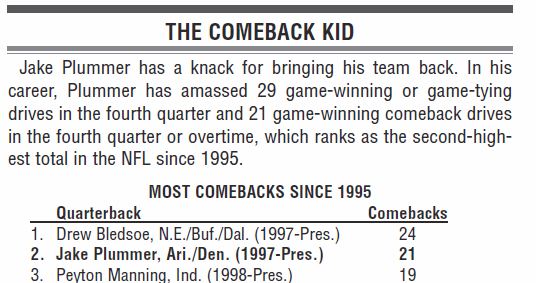
There’s a lot going on here. First, it’s very interesting to see Denver focus on only comebacks, as evident by the 21 and the table. Note: in the 2006 media guide, it even calls them “pure” comebacks. What’s awkward is the table saying since 1995, yet Drew Bledsoe’s total is listed since 1997. Something wrong with the five comebacks he had in 1995-96?

I know that for Bledsoe’s career (since 1993), he had 24 comebacks, but I bet my life they are not the same 24 games Denver had in mind here. Peyton did in fact have 19 comebacks then, which gives me a good idea of what number, if any, they will try and say he has this year. Hint: it will be about a dozen off what they have for Elway.

Plummer’s 21 is a farce. They include this 2002 game against Seattle as a comeback/GWD for Plummer, even though it consisted of Arizona blowing the lead to start the fourth quarter, and MarTay Jenkins returning the ensuing kickoff 95 yards for the game-winning touchdown.

“Pure” comeback, baby. Plummer was so good he got the offense the 4QC/GWD without even taking the field. The masters of comeback deception have outdone themselves here, as I have never seen any team credit their quarterback for a fourth quarter win like this when the return score did all the work.

One could argue Plummer started his career in Arizona, so maybe they were working off bad information. A logical argument, but I have the evidence this isn’t the case.

This is the Denver Broncos’ 2006 media guide claiming in Plummer’s player bio that the Seattle game was Plummer’s 17th comeback. Note the list of games here. That game, listed appropriately in “other games of note” at the bottom, was on 9/15/2002.

If you put the game in chronological order, it would be the 17th game on that page. This is Denver calling all of Plummer’s fourth quarter wins comebacks, even though three of the games (4, 9, 15 on PFR) were just game-winning drives where Arizona never trailed in the fourth quarter. And of course counting the Seattle game is pure lunacy. Plummer never even took the field for the opportunity, let alone do anything to deserve the comeback/GWD.

The Denver bio goes on to say Plummer finished 2002 with 21 comeback victories, even though six of them weren’t actually comebacks for him.

Plummer joined the Broncos in 2003, and his lone comeback/GWD of the season was noted by Denver as being his first for the team and the “22nd of his career.”

In 2004, Plummer had four game-winning drives, but only one of them involved a comeback (Carolina game). This time Denver says that Plummer led “four fourth quarter or overtime game-winning or game-tying drives on the year” to increase his total to 26.

Where they really blow it is when they give Plummer credit for his 19th comeback victory twice in two different seasons (2002 and 2004). Fancy that with both coming against Carolina, but they are two different games set over two years apart.


What does it show? When he was with Arizona, Denver refused to consider the difference between a comeback and a GWD, and just called them all comebacks. When he joined the team, they tried to get cute with “pure” comebacks, but outsmarted themselves when it came time to keep track of the stuff.

The 10/10/2004 game against Carolina was not Plummer’s 19th comeback. It was his 17th. Even if we get dumb about it and count the 2002 Seattle game, then that’s 18, which still comes up one short.

In 2005, Plummer had a comeback (9/18/2005 vs. San Diego) and two game-winning drives, though nothing specifically mentions them.

If the 10/10/2004 Carolina game was the 19th “pure” comeback of Plummer’s career, and he had 21 through 2005, then that means Denver is counting either the 12/12/2004 game against Miami or 11/24/2005 game in Dallas as a “pure” comeback, despite the fact Denver never trailed in the fourth quarter either time.

That would explain the bogus 21 comebacks at the beginning of 2006. However, that means there was another change when Plummer actually did have a comeback in Week 2 over Kansas City, but the number remained at 21 comebacks. Game-winning drives went up to 29.

Sticking with 2006, after a game-winning drive over Baltimore, the Broncos now went with 22 comebacks and 30 game-winning drives.
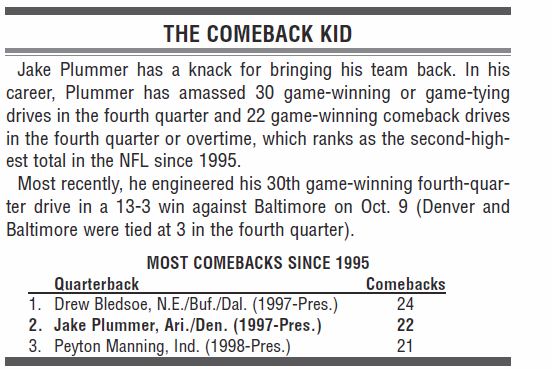
Even though the graphic clearly states the teams were only tied 3-3 in the fourth quarter, they add one to Plummer’s comeback total. The 0-point “deficit” is a popular thing for the Broncos.

And that is one of the core factors in how they were able to fabricate a record for John Elway, and get away with it all these years. If they can’t even handle a few Jake Plummer games from the digital media era, then it’s no wonder they had such ridiculous numbers for Dan Marino the 1990s.

That is why pure ignorance like the following from the Denver Post in 1996 has been allowed to exist: “Despite what you’ve heard and saw again Monday night, Elway is the NFL’s king of comebacks, not Dan Marino. Elway has 41, Marino has 32.”

Why is this so hard for people? In the words of Denver’s own PR man Jim Saccomano from a 1996 Denver Post article:

It doesn’t take a genius to figure out that you’re either ahead or behind and you either won or you didn’t.

Nope, it doesn’t take a genius. It takes Captain Comeback. It takes someone willing to put in the effort and call out a team when they are indisputably wrong.

From the confines of my home, I have done my part to rewrite NFL history. My history does not stand for one team winning the semantics battle to falsify a record to make their Hall of Fame quarterback look better.

For once, I feel very optimistic about this 2012 season, and the next chapter in the crusade over comeback conspiracy. The darkest days are behind us. The hardest work has been finished. Now we wait for new history to unfold, and put the past behind us.

Pass the link, and spread the truth my friends.
NFL: Once Upon a Time in the AFC West

The 2012 AFC West is being billed as a very competitive division where just about any of the four teams can win it. Last season three teams finished 8-8 with Kansas City at 7-9.

It may end up being a very competitive division, though it’s still a highly flawed one, and a great source of myths.

First there’s last season. I updated the regression model and in today’s article at Bleacher Report, I looked at 2011’s biggest overachievers and underachievers, where the 2011 AFC West cleans up the overachiever category. Denver, Kansas City and Oakland are the top 3,and it’s easy to see why when you look at these interesting graphics:

They may have been 7-8 win teams, but they are easily among the three worst in NFL history when you look at the scoring differential.

You can check the pulse of a team by what they have at QB and head coach.

Denver – John Fox brings stability in year two, and if healthy, Peyton Manning brings HOF QB play back to Denver. Of course I like the Broncos as a 10-6 division winner, assuming Manning is what he used to be. What I don’t like is the myth that Denver has a great defense. Elite offenses like Detroit, New England and Green Bay destroyed this unit last season. The Broncos have a strange tendency for allowing 40+ point games, and Manning should know this well from his days at New England. He’ll make the defense better by giving them more rest and keeping them out of bad field position, but there’s still a lot to prove from this unit.

San Diego – Major stability with Norv Turner and Philip Rivers. The problem is it’s Norv Freakin’ Turner, and his neck wrinkles are beginning to suck in the rest of Rivers’ career. This team has become very NORVOUS in the clutch the last two seasons, as evident by a 2-11 record at 4QC/GWD. Combined with red zone problems, and that’s part of the reason why I think Rivers had a very overrated season in 2010. San Diego’s had a lot of success against Manning, but we’re talking a ton of changed parts since 2010 and beyond compared to this season.

Oakland – It’s probably been five years since a lot of people thought Carson Palmer was a top-tier quarterback, and rightfully so. Had it not been for Jason Campbell’s season-ending injury last year, we’re likely not even talking about Palmer in a Raider uniform. Dennis Allen comes from Denver as a rookie head coach. This team has the potential to field a decent offense if Palmer plays better than last year, though the defense should find little answers for a lot of the strong offenses they’ll be playing. Looks like the non-winning season streak will hit 10 for Oakland.

Kansas City – While the win over Green Bay was great, it may have duped Chiefs fans into a year or two of a bad head coach. Romeo Crennel was not the answer in Cleveland, and he’ll be relying on the healthy returns of Cassel, Charles, Moeaki and Berry. There is talent on this team, though Matt Cassel has proven he can’t do anything unless he plays a ridiculously soft schedule like he did in 2008 and 2010. He also had better offensive coaching in those years (Josh McDaniels, Charlie Weis). Personally, this is a team I think Manning should have explored ahead of a destination like Denver. There’s more talent here than in Denver, though just based on who the QB is, I’d choose Denver to win the division for that reason alone.

Next week I’ll take a look at the plight of Denver’s offense.
