Inspired by my recent Hall of Fame case for Russell Wilson and this tweet about the HOF from Kurt Warner, I thought I’d upload my old Kurt Warner HOF case that was published in 2014 on a site that no longer exists because it had poor management and couldn’t pay its writers.
So this is my work, and I’m just going to post it as it was. Warner was inducted in 2017 after waiting a couple of years, but I was always in support of him getting in.
The Kurt Warner Hall of Fame Case
In 1998, a legendary quarterback started his NFL career. He soon took control of one of the league’s worst teams and turned them into an offensive juggernaut. It wasn’t long before this deadly accurate quarterback earned MVP awards, set passing records and won a championship.
That was supposed to be the story of Peyton Manning, the No. 1 pick in the 1998 draft. That was actually the story of Kurt Warner, the greatest undrafted success in NFL history.
Warner will be eligible for the Pro Football Hall of Fame next year (voting process will start soon). With Hall of Fame week upon us, we start the early conversation about probably the most polarizing first-ballot candidate (the rest of the candidates will be featured on Friday).
No quarterback has been inducted into Canton since Troy Aikman and Warren Moon went on their first ballot in 2006. Since then, no quarterback has even sparked an argument except for those of us wishing Ken Anderson, now restricted to a senior selection, finally earn his due respect. With the way Donovan McNabb’s career ended, we can forget about him gaining any traction. Warner’s the only interesting quarterback case we have before the inevitable first-ballot selections of Brett Favre (2016), Peyton Manning and Tom Brady.
Is Kurt Warner a Hall of Fame quarterback? The burden of proof is on the prosecution, and we are going to give this one proper treatment. I’ll do my best Ed Norton (Primal Fear) impersonation, representing both sides of the case. However, I’m not sugarcoating anything. I think Warner belongs in the Hall of Fame, but I have a good grasp on how the other side feels. Since I’m more likely to slip into Norman Bates territory with the split personality dynamic, we’re going to keep things simple. We’ll start with the evidence for why Warner should be inducted into the Hall of Fame, followed by the evidence to keep him out. In closing, I will refute the arguments against Warner and make a closing statement.
Evidence for Induction
There are 23 modern-era quarterbacks in the Hall of Fame (HOF). Kurt Warner doesn’t have to be better than all of them to join, nor does he have to be better than peers such as Peyton Manning and Tom Brady. Debating his place amongst the all-time quarterbacks is a different topic. All we care about here is if his career was worthy of the HOF, and a look at the body of work clearly confirms he was.
Pick any of the usual arguments people use for the HOF, and Warner passes each one except for longevity. Oh, he played 12 seasons (1998-2009) after getting a late start at 27, but about half of them were largely forgettable. No one’s going to deny that, but when he was on few quarterbacks ever reached the level of play Warner did.
Was he ever the best player at his position?
Two MVP awards and two first-team All-Pro selections in a three-year period (1999-2001) tell us he was in St. Louis. It’s almost impossible to earn those accolades without playing at an insanely high level.
Warner is one of 15 quarterbacks since 1950 to have multiple first-team All-Pros. Nine are in the HOF, the trio of Favre/Manning/Brady will make it 12, and that just leaves Warner with Rich Gannon and Earl Morrall. Gannon was basically a four-year sensation with the Raiders (1999-2002), but his peak was never as dominant as Warner’s and he had a lot of incomplete seasons in his career. Morrall has earned the reputation as the best backup quarterback ever, but his most notable success came on loaded teams coached by Don Shula like the 1968 Colts and 1972 Dolphins.
The two MVP awards really set Warner apart. He’s one of only eight players in NFL history to win multiple MVP awards. The first four were first-ballot HOFers and the same will happen for Favre, Manning and Brady. Honestly, when does a two-time MVP not get into his sport’s HOF? I looked at the NFL, NBA and NHL.
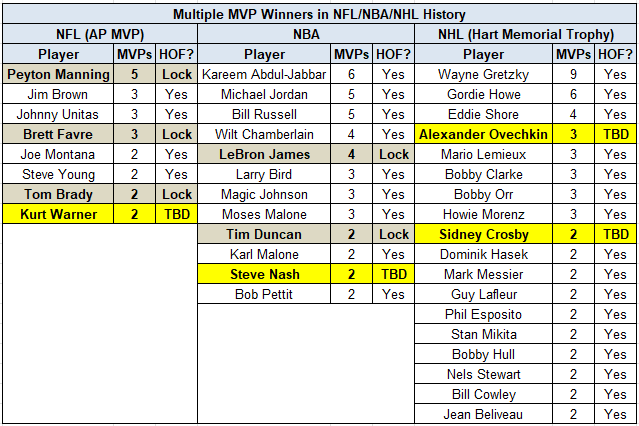
Note: Additionally, HOF receiver Don Hutson twice won the Joe F. Carr Trophy, which served as the NFL’s MVP award for 1938-46.
It’s obvious that LeBron James and Tim Duncan are locks for basketball’s HOF. Steve Nash might be the closest comparison to Warner, and Nash is one of the greatest players to never reach the NBA Finals. Still, his numbers in assists, three-point field goals and free throws are all among the best ever and he likely gets in quickly. Sidney Crosby and Alexander Ovechkin are absurdly productive and probably in lock territory as well. I’m not that familiar with a lot of the old hockey players — the Hart Memorial Trophy has been handed out since 1924 compared to the MVP award in NFL/NBA starting in the late 1950’s — but they’re all in the HOF. All 13 players listed in the NFL/NBA who are already in the HOF were all first-ballot choices.
Out of 38 players to win multiple MVP awards, 29 are in the HOF, five-to-seven are locks and that just leaves Nash and Warner to be determined. In other words, no multiple-MVP winner in the NFL/NBA/NHL has ever been kept out of the HOF. Are we really going to ostracize Warner? This isn’t baseball, which I did study, though didn’t include above since it’s different. A MVP is given out in each league and steroids/cheating have had a big impact on voting politics. For those curious, 30 MLB players have won multiple league MVP awards, and 23 are in the HOF. Albert Pujols should be a lock. Miguel Cabrera (active) has a good case, and so did Alex Rodriguez before cheating scandals. That means only four athletes in major North American professional sports have been denied HOF induction despite multiple MVP awards: Barry Bonds, Juan Gonzalez, Roger Maris and Dale Murphy.
When a player is great enough to win multiple MVP awards, you expect a lot of strong seasons in his career. Warner can’t give us a number higher than six (1999-2001 and 2007-09), but some of his best years are worth multiple “good” seasons from lesser players.
Was he a “winner” and did he play well in “big” games?
We know it’s not fair, but quarterbacks are judged by wins and championships more than any other position in the game. Warner is the last player to win a MVP and a Super Bowl in the same season (1999). He was a Super Bowl MVP with a record 414 passing yards. In fact, Warner still has the three-highest games in passing yardage in Super Bowl history: 414 vs. Tennessee, 377 vs. Pittsburgh and 365 vs. New England.
In the three seasons he started all 16 regular-season games, Warner led his team to the Super Bowl. He got there with three different head coaches (Dick Vermeil, Mike Martz and Ken Whisenhunt) and two teams, which has only been matched by Peyton Manning. Warner is one of 12 quarterbacks to start at least three Super Bowls. Eight are in the HOF, Manning and Brady are locks, Ben Roethlisberger is on the path, and Warner would make it 12-for-12.
Warner did not make the postseason often, but he made his runs count. Warner is statistically one of the best postseason quarterbacks ever. In 13 games he threw 31 touchdowns to 14 interceptions with a 102.8 passer rating. He has the highest completion percentage (66.5 percent) and passing yards per attempt (8.55) in postseason history. He has the third-most passing DYAR (1,639) since 1989, including the single-highest game (380 DYAR vs. 2009 Packers). Against Green Bay, Warner became the only quarterback to ever win a playoff game in which his team allowed 45 points. He threw more touchdowns (five) than incompletions (four) in his final virtuoso performance.
Warner’s passing DVOA in the playoffs (42.3%) is the second highest since 1989, trailing only Joe Montana’s late-career hot streak:
An argument could be made that Warner has been the best playoff quarterback of his era. His record is 9-4, but he led a valiant comeback effort in three of the defeats. The only game that wasn’t competitive was the swansong of his career: a 45-14 loss he left injured in New Orleans in the 2009 NFC Divisional. Warner’s 0.28 win probability added per game is the third highest in the playoffs since 1999.
In the regular season, Warner was 67-49 (.578) as a starter. That gives him a better winning percentage than the likes of HOFers who he probably fits best with on a tier: Joe Namath (.496), Fran Tarkenton (.531), Sonny Jurgensen (.487), Dan Fouts (.506) and Warren Moon (.502). Five times Warner left a start early with no more than 13 pass attempts. His teams went 0-5 those days. He also left the 1999 regular-season finale (for playoff “rest”) after tying the game at 24 in the third quarter. The Rams turned the ball over on their next five drives without Warner and lost 38-31. He also led his team to a 3-1 record in four significant outings off the bench.
Warner would have won more games if he played with better defenses. He had a great one when he won the Super Bowl with the 1999 Rams, but Warner also dragged with him two of the worst defenses to ever see the postseason in 2000 and 2008.
Only six teams have made the playoffs after allowing 400 points, and Warner was the primary quarterback for two of them. He was the first to win a playoff game with one of these defenses, and has the only 10-win season on the list (2000 Rams). Technically, Trent Green started five games (2-3 record) that year with Warner injured, but the Rams actually allowed more points — 30.2 points per game is a pace of just under 483 points — in Warner’s 11 starts. Warner still went 8-3 as a starter.
Did he pass the eye test?
Numbers can mislead at times, but anyone who watched Warner saw a very accurate quarterback. Even in his down years Warner was still a high completion percentage guy, and he currently ranks fourth in that stat (65.5 percent). He did not have a cannon, but his timing and accuracy on intermediate throws (15-25 yards) was as good as any of his peers. The dig route was probably his trademark throw, and it’s that type of high-risk, high-reward pass that made the Rams the Greatest Show on Turf. Warner didn’t have the greatest pocket presence, he wasn’t mobile, he wasn’t known for the two-minute drill, but he could stand and deliver from the pocket with only five blockers with the best of them.
Was he prolific?
Warner’s penchant for big passing numbers was evident early. He threw 14 touchdown passes in his first four starts, which is still a record. When he threw 41 touchdowns in 1999, he and Dan Marino were the only quarterbacks to hit 40. It’s since been done by five more players. Warner was the fastest passer to 5,000 yards (19 games), 10,000 yards (36 games) and tied Marino as the fastest to 30,000 yards (114 games).
Warner averaged 9.88 yards per attempt in 2000 — the highest season in the Super Bowl era (since 1966). Through 43 starts in 1999-2001, Warner completed 67.2 percent of his passes, averaged 9.1 yards per attempt, had a 103.4 passer rating and was 35-8 (.814) as a starter. It was always going to be difficult to sustain that absurd start.
The efficiency dropped, but some of the volume continued. Warner played in 124 games, but he threw for at least 300 yards in 52 of them. That’s the sixth-most 300-yard passing games in NFL history, and tied with Drew Brees for the highest rate (41.9 percent) for anyone with at least 100 games played.
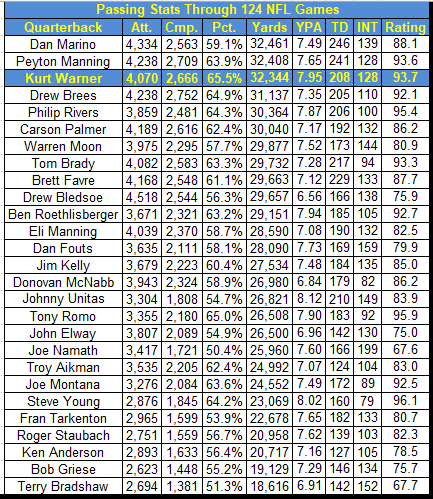
If we look at Warner’s stats in his 124-game career compared to where some other notable quarterbacks were at in their first 124 games, he comes out very favorably with the third-most yards and the highest completion percentage.
Can you tell the story of the NFL without him?
Remembering this is the Hall of Fame, this is a classic argument that Warner has in spades. Warner defined a transitional era in NFL history when the stalwarts of the position moved on to retirement, and new quarterbacks emerged from unusual origins. None were more impressive than Warner’s journey from stocking groceries to Super Bowl MVP. When the game said goodbye to John Elway, Steve Young, Dan Marino, Warren Moon and Troy Aikman, it was Warner taking over the mantle (for a limited time) as the best quarterback. Brett Favre’s MVP reign was over and Peyton Manning’s had yet to begin. Other quarterbacks rose to unexpected success like Gannon, Brad Johnson, Jake Delhomme and Tom Brady, but Warner was the most dominant of that era. The 2004 season was when teams went back to mostly finding quarterbacks in the first round, but for an odd period (1999-2003) where defense dominated and unheralded quarterbacks won championships, Warner was the best of the bunch.
If his career ended after St. Louis, Warner would be the Terrell Davis of quarterbacks. However, his late resurgence in Arizona completes his story and should solidify his reputation as a HOF player. Without Warner, there wouldn’t be much to say about the Rams and Cardinals; certainly not in the television era. The following table shows the longest streaks in the Super Bowl era of teams missing the playoffs and not having a winning record.
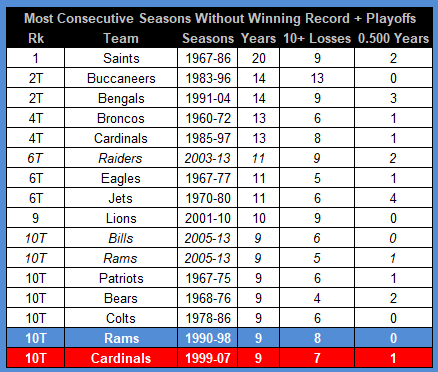
The Rams (1990-98) and Cardinals (1999-2007) were a season away from a decade of ineptitude before Warner led them all the way to the Super Bowl. Where are those teams since Warner left? The Rams are on the list again for 2005-2013, and the Cardinals have averaged a rank of 27.8 in offensive DVOA since 2010. Warner made those teams relevant when it was least expected. That’s the stuff of legends. That’s what a Hall of Famer does.
Evidence Against Induction
Think of a pie with a delicious top layer and a fresh crust underneath. Now imagine the filling as the most rancid thing you ever tasted. Would you still praise that pie or would you send it back? That pie is Kurt Warner’s career. It starts off great, but once you get to the middle, everything goes sour. For some people, it’s not worth digging through to get to the good stuff at the bottom.
A lot of HOF players have bad seasons. That’s undeniable. However, how many have a five-year gulf on their resume like the massive one Warner had in 2002-06? We say Warner pulled the Rams and Cardinals out of the abyss, but he fell into his own in between.
In those five years, Warner was 8-23 (.258) as a starter. He threw more interceptions (30) than touchdowns (27), which is hard to do in today’s game. After losing Super Bowl XXXVI as a heavy favorite to the Patriots, he never won another start for the Rams (0-7) and led the team to more than 17 points just once. Warner was replaced by Marc Bulger, who vastly outplayed Warner in 2002 and led the Rams to the playoffs in 2003-04.
When Warner went to the Giants and no longer had the services of a stud left tackle like Orlando Pace, he was shell-shocked, taking a sack on 12.5 percent of his dropbacks. Without a dominant cast of receivers, Warner’s numbers were pedestrian, never passing for more than 286 yards or one touchdown in any game with New York. His early-season success was mostly about the defense, which never allowed more than 14 points in any of his five wins. After falling to 5-4, the Giants replaced Warner with rookie Eli Manning.
In Arizona, Warner was kept on the bench for Josh McCown. The Cardinals drafted Matt Leinart in 2006 and quickly put him behind center after Warner failed to impress during a three-game losing streak. If Leinart ever figured things out, Warner would have ended his career as an afterthought.
But that didn’t happen and we must acknowledge what did. Whether it was his pair of three-year successes or the five-year pitfall, there were flaws in Warner’s game throughout his whole career.
The Fumbler
Warner had fumbilitis. His rate of fumbles per dropback was 2.27 percent — ranked 164 out of 174 quarterbacks in NFL history (minimum 1,500 attempts). Some of those mistakes were crippling to his teams. In 2002 against Washington, Warner fumbled on a sack with the ball at the 6-yard line in the final seconds with his team down 20-17. Warner fumbled six times in the 2003 opener, which became his final start with the Rams. Against the Rams in 2006, Warner had a first down in the red zone in the final two minutes, down 16-14. Arizona could have taken three knees and won with a field goal, but Warner fumbled the snap on first down to lose the game. In 2007, Warner took a sack in the end zone in overtime, losing to the 49ers on a game-ending fumble recovered for a touchdown.
Then in Super Bowl XLIII, some may forget the Cardinals were at the Pittsburgh 44 with 15 seconds to play. Larry Fitzgerald was playing like a man possessed, and any jump ball in the end zone could have been a game-winning score. Warner didn’t even get the pass off, getting strip-sacked to deny us the Hail Mary finish.
Warner was a little below average with interceptions, because he played in a vertical offense. The fumbles are inexcusable, and they’re a big reason he ranks 97th in quarterback turnover rate (5.1 percent). Warner would have the worst turnover rate for any quarterback in the HOF who started his career since 1974. With the direction the game is headed, he’s likely the last quarterback with a turnover rate over 5.0 percent who will even be considered for Canton. The only other recent players to hit that mark are David Carr (5.0 percent), Kyle Boller (5.3 percent), Mark Sanchez (5.3 percent) and Rex Grossman (5.3 percent). Enough said.
The postseason turnovers
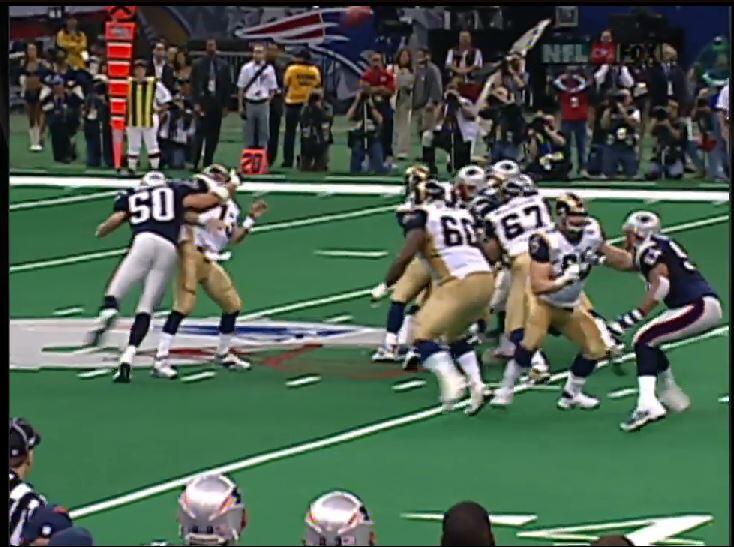
It’s an amazing feat that Warner has the top three games in passing yardage in Super Bowl history, but why don’t we ever hear that he never scored more than 23 points in any of those games? Why don’t we connect the dots that he threw for so many yards because he threw two of the most deadly pick-sixes in Super Bowl history? There’s a reason his record is 1-2 in those games. He gave the Patriots the lead on the Ty Law pick-six, and the James Harrison play was a 14-point swing before halftime. That one was especially a poor decision. Even in his “valiant comeback effort” against the 2000 Saints in a Wild Card game, Warner needed a 24-point comeback because he turned the ball over four times. Meanwhile, Warner’s defense supplied him with 30 takeaways in his nine playoff wins.
Warner might not have ever won a Super Bowl if his defense didn’t bail him out in the 1999 NFC Championship Game against Tampa Bay. Great defense was beating great offense again as Warner threw three interceptions. There’s a long history of juggernaut offenses crashing and burning in the playoffs (see 2013 Broncos as latest example). The 1999 Rams were on track to be another, but the difference was they had a defense (and the opponent had Shaun King at quarterback). Warner got the 11-6 win and his first fourth-quarter comeback, which proved to be the most important of his career.
The Front-runner
With the high-powered offenses Warner ran in his best years, you probably think there was no deficit too big for him to overcome, right? Wrong. Warner was at his best on teams who jumped out to big leads and stayed in front. Comebacks were hard to come by, especially from bigger deficits. In other words, Warner was a great front-runner.
In his career, Warner was 2-44 (.043) when trailing by at least 10 points at any time in the game. The league average is around 15 percent. In two years, Andrew Luck is already 7-9 (.438) when trailing by at least 12 points (Warner is 1-37). Maybe Luck’s the outlier, but Warner looks like an outlier on the opposite end. Teams win about 10 percent of games when trailing by 12-plus points. Peyton Manning’s already done it four times in Denver, and he’s been there two years. In a three-week span last season, Brady led New England to comebacks of 24, 10 and 16 points.
Warner was 9-30 (.231) at fourth-quarter comeback opportunities, which are only for deficits of 1-8 points. That’s below average too, but the interesting part is Warner’s nine wins had an average deficit of just 2.2 points — the smallest average deficit for any quarterback with at least nine fourth-quarter comeback wins in NFL history.
On the road, Warner had just two fourth-quarter comeback wins. They came against the 2005 49ers (4-12; 30th-ranked scoring defense) and 2005 Rams (6-10; 31st-ranked scoring defense). How big were those deficits? One point each.
Warner was 0-42 when trailing by at least six points in the fourth quarter, including 0-23 when he had possession in a one-score game. That’s just unfathomable for someone who quarterbacked four different 400-point teams.
Where does he get those wonderful toys?
When Warner was lighting up the scoreboard, he played with an arsenal of weapons few quarterbacks ever get to experience. Isaac Bruce, Torry Holt, Anquan Boldin and Larry Fitzgerald are all 10,000-yard wide receivers who will receive HOF consideration. HOF running back Marshall Faulk was the most dynamic offensive player in the league in 1999-2001, and he’s one of the best receiving backs ever. Faulk, not Warner, was the player Bill Belichick sought to shut down in Super Bowl XXXVI.
Warner threw 50.5 percent of his career regular-season passes to those five players. He also played with talented receivers such as Amani Toomer, Jeremy Shockey, Ike Hilliard, Steve Breaston, Ricky Proehl and Az-Zahir Hakim. Orlando Pace, Warner’s left tackle in St. Louis, is also eligible for Canton this year and probably has the best case of these GSOT Rams. Warner had just about everything on offense except for a good tight end.
We know how Bulger outperformed Warner in 2002-03, but that wasn’t the only time. When a capable quarterback like Trent Green stepped in for Warner in 2000, he actually had a higher passer rating (101.8) and DVOA (28.6%) than Warner. If not for Rodney Harrison injuring Green in the 1999 preseason, we might be talking about Green’s HOF case today.
Beyond the weapons, there were other factors contributing to Warner’s great statistics. He played in a dome with the Rams and there was no such thing as bad weather in Arizona with that retractable stadium. Warner played in one game with precipitation in his career. He lost 47-7 in New England in 2008, completing 6-of-18 passes for 30 yards.
Warner also played most of his career in the NFC West when it was the laughingstock of the league. Soft schedules boosted his early start. The 1999 Rams are the only team since 1970 to play just one team with a winning record in the regular season. They lost. Warner went 36-13 in games against the NFC West in his career. He was 1-7 against the NFC South (10 touchdowns, 14 interceptions) and 7-13 against the NFC East (24 touchdowns, 23 interceptions). This is why Warner’s VOA (not adjusted for opponent) is higher than his DVOA for nine of his 12 seasons. He played some weak schedules of defenses.
All-star casts needed for relevancy, weak schedules to inflate the numbers, a “win big lose close” reputation, and five years of nothingness. Is it really a HOF career if we’re asked to forget half of it?
Well Allow Me to Retort
The other side of my mind makes a convincing argument for why Warner’s not a top 15 all-time quarterback. However, that does not mean he’s not a HOF quarterback, because anyone would be hard-pressed not to have him in the top 25. It’s hard to find sustained greatness at quarterback, which is why the main argument against Warner isn’t a strong one.
Circa 2002-06
Yes, the five-year abyss is a little too long and the six years of great play should be bigger. However, something simple as health can explain some of those problems that started in St. Louis. Warner broke his finger and his throwing hand in 2002. That will make gripping the ball difficult for any player, so that explains some of the fumbling and general issues in those final starts with the Rams. After he moved on, there was obvious pressure to start top 10 picks like Eli and Leinart back when those guys were paid handsomely before playing a down. Warner was on a short leash. Ken Whisenhunt, who did not draft Leinart in Arizona, realized quickly in 2007 that Warner was the right man for the job, and the slump was over.
Were those five years really as bad as they appear? The record was bad, but so were the teams. Warner didn’t have a running game or defense in Arizona. The sacks were too high, but Warner worked best in systems that utilized rhythm passing with three-to-four receiver sets. Once he got back to that, he had the three lowest sack percentages of his career in 2007-09 despite no stellar offensive linemen around him. In 2005, Warner actually ranked a respectable 15th in DVOA. With the Giants, he led the league in lowest interception percentage in 2004.
For all the bad memories we may have of 2002-06 Warner, in that time he completed 63.9 percent of his passes, averaged 7.2 yards per attempt and had a 2.7 interception percentage. Those are all above-average numbers. Some people actually think Eli Manning has been an elite quarterback and he never consistently puts up those numbers. Warner’s biggest problem back then was that he just didn’t throw many touchdowns. He moved the ball well, but it’s hard to explain why the scoring was down. At least it picked back up for him.
It’s true Warner did not have nearly as many good years as Favre, Marino, Joe Montana, Fran Tarkenton or even the efficient version of John Elway. It’s also true no one is going to say he’s a better quarterback than those guys, but he still played at their level (or better) often enough to belong in the HOF.
How many years do we need to see greatness? Troy Aikman played 12 years and he was one of the worst quarterbacks in the NFL in three of them (1989-90 and 2000). Warren Moon played until he was 44, but he would have more efficient stats and a better record if we chopped off his first three seasons and his last two. Did those five years of going 12-34 with 41 touchdowns and 60 interceptions make him more HOF viable? We’re better off looking at his CFL days.
Terry Bradshaw threw 48 touchdowns and 81 interceptions in his first five seasons. I like to think Warner’s 1999 season was worth as much as those five Bradshaw years combined. Joe Namath had six throwaway seasons, and his other seven weren’t nearly as good as Warner’s top six. He’s also famous for one Super Bowl while Warner played prolifically in three of the most exciting ever.
We’ve seen enough of Warner to know he wasn’t a one-year wonder. He wasn’t a product of one system or dependent on one coach. He’s come closer than any quarterback in NFL history, including Peyton Manning last year, to winning Super Bowls with two different teams (a decade apart too), which would be the ultimate vindication of an all-time great.
Some people might be satisfied with totals padded by seasons of 18 touchdowns and 7-9 records, but Warner gave us huge seasons only a select few quarterbacks are capable of having. Someone like Ryan Tannehill could look like Dan Marino on any given Sunday, but can he keep it up for a full season? How about three in a row? Six years total? Warner did that.
There’s a small list of the greatest quarterbacks ever, who were able to sustain success for over a decade. Then there’s a list of the next tier with players who were capable of a few elite seasons. That list includes HOFers. That list undoubtedly includes Warner.
The weapons and other surroundings
Warner played with some great supporting casts, but part of their greatness was fueled by Warner. Marc Bulger never threw more than 24 touchdowns in his career with those weapons. Fitzgerald has been wasting away in the desert, waiting for another opportunity at the postseason.
Here’s a look at what those four primary wide receivers have done (regular season only) with Warner and with all other passers in their careers:
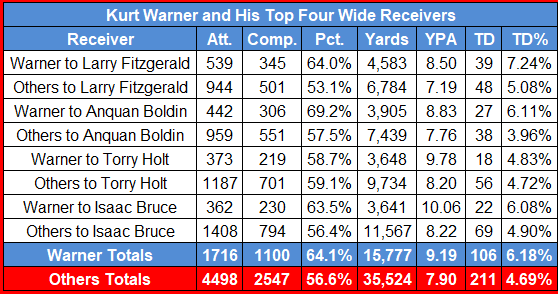
As all four would agree, an accurate quarterback makes a huge difference. Warner also completed 67.2 percent of his passes to Steve Breaston, who he got a 1,000-yard season out of in 2008. He completed 68.8 percent to Hakim and 70.9 percent to Proehl in St. Louis. Warner did what the greats do and that’s make the players around them better.
As for things like schedules and playing indoors, those are fine topics for another day, but it’s hard to imagine anyone would factor them into a HOF decision. They didn’t keep Moon out on his first ballot even though he played most of his home games in the Astrodome (Houston), Metrodome (Minnesota) and Kingdome (Seattle).
The Super Bowls and lost comebacks
Warner could have been 0-3 in his Super Bowls just as easily as he could have been 3-0. He played in the three Super Bowls with the largest deficits erased (16, 14 and 13 points), and he erased the two largest fourth-quarter deficits, but still lost both games. Yes, the pick-sixes were killers, but he was clearly hit in the face by Mike Vrabel on the Ty Law play, yet there was no flag.
The lack of points in those three games is a concern, but Warner had to supply most of the offense with little-to-no help from the running game. Against the 2008 Steelers, Warner had to face the league’s best defense with the help of 11 carries for 33 yards. Against the 1999 Titans, Warner handed off 11 times for 28 yards. In fact, out of 48 Super Bowl runs, no quarterback has won a championship with less help from his running game in the postseason than Warner, who only received 45 carries for 108 yards in three games in 1999.
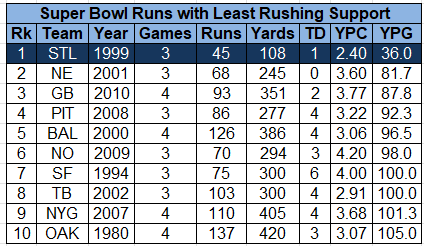
In the playoffs, teams rushing for under 40 yards are 2-53 (.036). Warner led the two wins in 1999. His 1,063 passing yards that postseason are still the record for a three-game postseason.
Warner had some red-zone issues against Tennessee, but the Rams also botched two easy field goals. At least he connected with Bruce on the 73-yard game-winning touchdown pass. That’s the thing with Warner. People will remember his clutch moments in the postseason. He only had 14 game-winning drives, but three of them were game-winning touchdown passes in championship games. His records listed above are horrific, but people will remember the almost comebacks he had in Super Bowls. He erased New England’s 17-3 lead, only to never see the ball again. He had the Cardinals — come on, the ARIZONA CARDINALS — one stop away from a 13-point comeback, only for Roethlisberger and Santonio Holmes to snatch it away with 35 seconds left.
You need a lot of bad luck to have records like 1-37 and 0-42. If Gus Frerotte didn’t convert a fourth-and-26 against the 1999 Rams, Warner would have had a nine-point comeback that day. He came off the bench against the 2007 Ravens and led a 17-point comeback to tie the game before never seeing the ball again. Overall, it’s not that Warner was bad in those moments, but his teams just weren’t successful.
Closing Statement
Whether or not we agree with them, the media has a major impact on shaping the narrative of a player’s career. We have been told that certain elements carry more weight than others. We’re supposed to value a player who has won a championship and plays well in big games. Media-voted awards like the MVP showcase the very best in the game. We’re also pushed to be saps for rags-to-riches stories where a person overcame adversity to fulfill their dream. And in this country, when people fall down, everyone loves a good comeback story.
Warner passes all of that, and then some. He’s one of the game’s “good guys,” clean of any arrests or nasty allegations. That matters too, even if voters are told not to consider off-field complications.
There are a lot of great careers with slack and fat tacked on to the beginning and end. Warner started late and walked away while he still could. Would he be a better candidate if he played another year or two to pad the totals? Maybe, or maybe he would have struggled as a 39-year-old quarterback and hurt his chances. We’re sure Favre would have chosen not to return in 2010 if he knew how bad that season would go. Then Favre would be eligible this year in the same class as Warner. We know who the voters would pick first there, but it’s not the duty of the HOF to try ranking players by who is the best at their position. They just have to figure out if a guy belongs in the ultimate elite group.
So what if he only gave us six seasons of relevance? So did The Sopranos. Enjoy excellence when you see it. Appreciate Kurt Warner more for what he was, and not what you thought he could be. If we can remember Gale Sayers that way on some mediocre Chicago teams, then we should remember that at his peak, Warner was one of the best quarterbacks to ever play the game.
The Verdict
The verdict’s not up to me, but I hope anyone reading this who was sitting on the fence has picked a side now. In November we’ll see Warner’s name on the 25 semifinalists. In January, he’ll probably be one of the 15 finalists. On the weekend of the Super Bowl, his first-ballot fate will be decided.
I feel pretty good about Warner’s chances, but I also thought the prosecutor in the Casey Anthony trial nailed his case, and we know how that one turned out. You never know what will happen once the jury starts deliberating, but at least there will only be a few Florida residents in this process.
It would not come as a surprise to see Warner have to wait three or four years. Some will keep a hardline against his first-ballot induction. Some voters seem to have this weird thing about not putting in players from the same position in the same class, so how dare Lord Favre share the stage with any other quarterback in 2016, especially Warner, a former practice squad backup (1994) of his. Canton also has been unofficially the “NFL Hall of Fame,” so Warner’s induction into the Arena Football Hall of Fame or the fact that he led all quarterbacks in yards and touchdowns in NFL Europe (1998) won’t carry any weight.
 Captain Comeback: NFL Analysis by Scott Kacsmar