Lamar Jackson: Breaking Stats, Hearts, and Minds

While the talk surrounding Baltimore’s 23-7 win in Denver on Sunday is about Lamar Jackson’s late run to extend the team’s record streak of 100-yard rushing games, it has been quiet on the NFL media front that he threw 37 passes and registered his third 300-yard passing game in his career. It is only the fifth game in Jackson’s career where he threw the ball at least 35 times.

Jackson recently broke 1,000 pass attempts in his regular season career, which must have prompted this Deadspin article last week about how Jackson has the “NFL’s greatest QB start ever.” I’ll get into multiple things from the article below, but it ends by saying, “Lamar Jackson is only 24 years old, and just posted the greatest FIRST 1,000 Pass start in modern quarterback history. Now write about it.”

Challenge accepted, because I already subtweeted about this article the other day, but it and Lamar’s unique career deserve a more in-depth look. I have neither any beef nor familiarity with the author (Chuck Modiano) of the piece. I just think Lamar’s career is the right place to talk about quarterback statistics in a game that is evolving.

Yes, Running QBs Make Life Harder on Statistics

The premise of the Deadspin article is that stat companies such as PFF and Football Outsiders continue to miss the mark on running quarterbacks like Lamar Jackson (and Cam Newton). The author concludes that if you combine Lamar’s elite passing production through 1,000 attempts, his historic rushing production, and his team impact (high winning percentage), then he’s had the greatest first 1,000 pass start in modern history for an NFL quarterback.

I have certainly read worse arguments over the years, but I disagree with this one on the obviousness of Patrick Mahomes dominating the league and rewriting the record books at the same time as Jackson’s rise.

Not to mention Mahomes is still 3-1 in the head-to-head matchups. While Jackson unanimously won MVP in 2019, Mahomes ended that season with the Super Bowl MVP and had another stellar run last season. 2020 also brought the return of Peak Aaron Rodgers in Green Bay and the breakout of Josh Allen in Buffalo. Of course, we also live in a world where Tom Brady reverse ages and annually hits the “EASY” button he sold his soul for each postseason to add to his ring collection. So given Lamar’s playoff struggles, it is no surprise that the media does not revolve around Jackson in this era.

But one thing I won’t argue is that Jackson is indisputably the most prolific rushing quarterback in NFL history. He proved that after back-to-back 1,000-yard rushing seasons and leading the NFL in yards per carry both years. He has also shown he can be durable doing it (so far) as only COVID-19 has kept him out of one game, plus that night in Cleveland where he had to take a shit and missed a few plays.

However, this rushing part of his game that makes him so unique also makes him harder to evaluate statistically. While the author is correct that the stat companies have struggled in this area, his remedy to fix it also misses the mark.

Any time you see someone try to combine rushing with passing in a quarterback metric, it tends to overvalue the running quarterback. ESPN’s QBR is notorious for having a hard-on for rushing quarterbacks, especially when they scramble for a big gain on a third down. You can see it in the way that Mitchell Trubisky (71.0) was their No. 3 quarterback in 2018, or how David Garrard’s 2007 with Jacksonville is still the No. 8 season since 2006. You also should note that Lamar’s 2019 (83.0) is the fourth highest season in QBR.

I cannot find the link now, but about 15 years ago I saw a guy rank the top ~50 quarterbacks of all time, and he used a formula that put a bonus for rushing. It ended up having Mark Brunell in the top 30 if I’m not mistaken. Yeah, adding rushing is problematic. Football Outsiders has not figured out a good way of doing it in two decades, so rushing is still kept separate from passing.

While the author wants to include Jackson’s rushing, there are parts early in the article where he keeps it separate. But by not thinking about Jackson’s attempts on the ground, you’re presenting what are misleading figures for Jackson’s touchdown passes. Through 1,000 passes, Jackson (70) has the fourth-most touchdown passes, trailing only Dan Marino (75), Kurt Warner (73), and Mahomes (71).

This looks great for Jackson but think about what the average touchdown drive looks like for these quarterbacks. The other three were going to throw a lot of passes while Marino and Warner would rarely ever run. Mahomes scrambles at times, but most of the offense is him passing. For Lamar, his Ravens run a lot and so does he, so he can keep his pass attempts lower while still ending drives with touchdown passes. This is why we need to stop fixating on that number of 1,000 passes and start focusing on things like an equal number of games played and rate stats.

On Pro Football Reference, you can search a quarterback’s first four seasons and find their Adjusted Net Yards per Pass Attempt index (ANY/A), which will factor in sacks (but not rushing) and the era the quarterback played in. When you run that search for quarterbacks with 1,000-plus attempts, Jackson comes in 14th at 112 ANY/A+, right behind the likes of Russell Wilson (115), Peyton Manning (113), and Deshaun Watson (113). Warner (133), Marino (132), and Mahomes (129) are the only players above 120, and it is hard to argue with anyone having better starts to their careers than those three.

But that does not include rushing, which means it also does not look at fumbles, or something that Jackson does a fair amount since he handles the ball so much with defenders coming after him. The author talks about interception totals by decade, but again, that can be misleading as mobile quarterbacks often have lower interceptions due to their love of scrambling and taking more sacks than pocket passers. We should be looking at total turnovers by including fumbles lost.

The author makes an argument for combining rush and pass stats instead of segregating them. “When Lamar ran for two 4th-quarter TDs to beat the Chiefs, it counted for the same exact points as if he threw those TDs. So why don’t we show that PRODUCTION?”

By making that argument, and earlier saying that he favors substance over style and will not reward style points, then he must agree that we should be treating a 6-yard completion on a curl route the same as a quarterback escaping a blitzing linebacker and scrambling for a 6-yard gain. That simple pass play still counts for the same yards as if he ran the ball, right?

So here is what I did. I gathered data for the first 45 starts (playoffs included) of the 60 quarterbacks who have made their starting debut since 2001. Jackson just made his 45th start on Sunday in Denver in case you’re confused why I picked 45. I looked at their passes, sacks, runs, and fumbles and combined those stats to figure out their total number of plays, total yards gained, total touchdowns, and total turnovers. From there I can figure out their yards per play and touchdown rate (TD%) per play.

Finally, I took the ANY/A formula and tweaked it to include fumbles and rushes. I thought this was better than tweaking passer rating for rushing as the author did at the end to get a 109.5 Production Rating for Lamar. I’ve just never liked the idea of giving a quarterback completion bonuses for every run, so I stuck with ANY/A.

Here are some of the findings on where Lamar stacks up among the 60 quarterbacks thru 45 starts:

Win% and Average Points Scored: Jackson is 34-11 (.756) as a starter, second only to Mahomes (36-9, .800). Brady, Roethlisberger, and Wilson were all 33-12 (.733), or just one game behind Jackson. Scoring has gone up in recent years, so it is not a big surprise to see Mahomes (32.4) and Jackson (28.7) average the most team points per start.

Jackson’s Passing Ranks and Rushing:

  • 14th in completion percentage (62.8%)
  • 49th in passing yards (8,975)
  • 15th in yards per attempt (7.51)
  • 11th in touchdown passes (74; tied with Kirk Cousins)
  • 2nd in touchdown pass rate (6.19%)
  • 12th in lowest interception rate (2.18%)
  • 5th in passer rating (97.3)
  • 7th in ANY/A (6.80; passes only).

In rushing, Jackson is easily No. 1 in attempts (550) and rushing yards (3,413), and he is No. 4 in YPC (6.21) and No. 3 in TD runs (21). Jackson’s 38 fumbles trail only Josh McCown (42) and Michael Vick (39). His 14 lost fumbles are tied for the seventh most. Jackson’s 40 total turnovers are tied for the ninth fewest.

Advanced Metrics to Include All Play Types: Jackson is No. 7 in total yards (11,891) and tied with Josh Allen for No. 4 in total touchdowns (95). That’s good company, but on a per-play basis, Jackson falls as the increased choice to be a 6.2 YPC runner instead of a 7.5 YPA passer hurts his numbers. Jackson ranks 15th in yards per play (6.46) and 6th in TD% (5.16%). When I include everything into ANY/A, he ranks No. 6 in that too (6.51).

Here is a graph of all 60 quarterbacks through their first 45 starts since 2001. The x-axis is their total TD% and the y-axis is their ANY/A with all plays included.
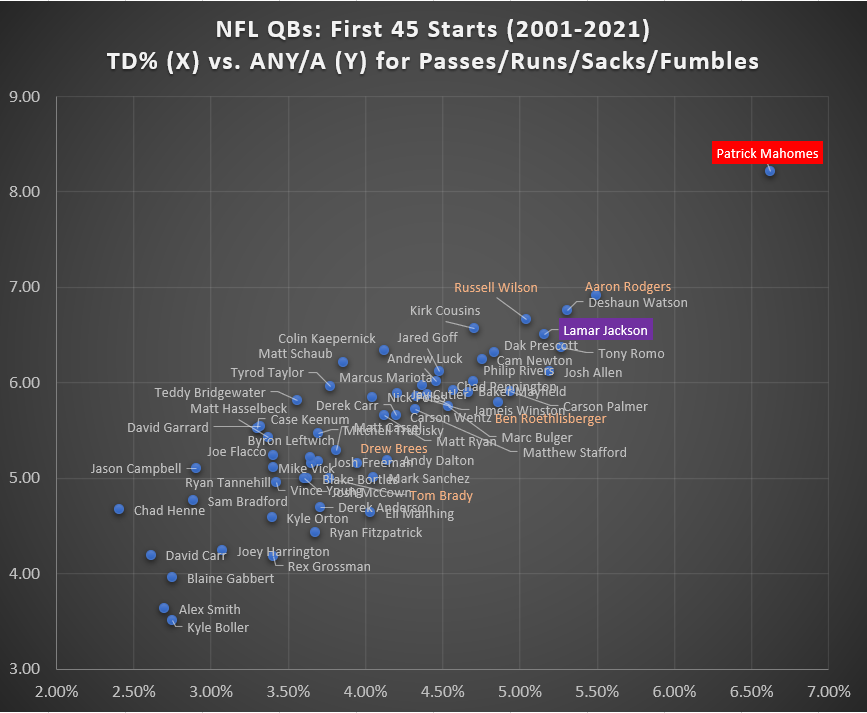
Yep, Jackson is doing very well, but Mahomes is killing the league. Running for over 100 yards as a team every week is cool and the Ravens have been historic with that under Lamar, but it still does not produce the results of being a lethal passing team like the Chiefs.

Jackson Is Still Developing

You can appreciate Jackson’s unique greatness while still having valid questions and criticisms about his ability to perform in certain situations or what his long-term success will be.

The four playoff games bring Jackson down a bit, but shouldn’t we have some higher expectations for him there? Most of the players who come up in comparison to him here (Mahomes, Wilson, Marino, Warner, Roethlisberger, Brady) all won or were in a Super Bowl within two seasons as a starter. Jackson is 1-3 with his best game being a low-scoring wild card win in Tennessee last year.

While we talk about Jackson’s unique place in history, his postseason history leaves so much to be desired. 2020 was the third postseason in a row where the Ravens scored their season-low in points with Jackson at quarterback. Safe to say that stat will not come up in his contract negotiations. When you compare that to some other recent quarterbacks for how often they scored their season-low in a playoff game, Jackson’s three-for-three is a huge eyesore. It is as many times as Peyton Manning, Aaron Rodgers, and Ben Roethlisberger combined.

  • Lamar Jackson (100%): three times in three postseasons (2018, 2019, 2020)
  • Patrick Mahomes (33.3%): once in three postseasons (2020)
  • Philip Rivers (28.6%): two times in seven postseasons (2007, 2009)
  • Tom Brady (27.8%): five times in 18 postseasons (2005, 2007, 2011-T, 2012, 2019-T)
  • Cam Newton (25.0%): once in four postseasons (2015)
  • Peyton Manning (20.0%): three times in 15 postseasons (2002, 2004, 2013)
  • Joe Flacco (16.7%): once in six postseasons (2009)
  • Matt Ryan (16.7%): once in six postseasons (2011)
  • Russell Wilson (12.5%): once in eight postseasons (2015)
  • Drew Brees (10.0%): once in 10 postseasons (2020)
  • Aaron Rodgers (0.0%): zero times in 10 postseasons
  • Ben Roethlisberger (0.0%): zero times in 11 postseasons

The other thing I saw in that article was a link to another piece saying that Jackson has debunked that he can’t be clutch because of the Detroit finish in Week 3. I also saw Ryan Clark on Twitter ask why people weren’t talking about Lamar’s play on 4th-and-19 to Sammy Watkins to set up the game-winning field goal.

Well, I think it’s pretty obvious why a record-setting 66-yard field goal by the great Justin Tucker stole all the headlines. Especially with the way it bounced in good. Just an incredible, history-making play.

But this is another situation where if Jackson played the position better, he’d get more of the attention. No one was expecting the Ravens to be down late in that game. Drops by Marquise Brown aside, it was Jackson who forced an interception on third down in Detroit territory, which the Lions turned into a go-ahead scoring drive. On the last drive, it was a 4th-and-19 after Jackson took two sacks on the drive. If he plays the drive better and sets Tucker up for a shorter, easier field goal, then Jackson gets more credit. He didn’t, so we go nuts over what Tucker did to bail the team out. Simple as that.

Similar things with the Chiefs win the week before. While Jackson did his part in the fourth quarter, most people can see that it took a really bad fumble by Clyde Edwards-Helaire in field goal range to decide that game. Jackson put them away on the ground, but he was only in that position after a rare fumble. Had the Ravens lost 38-36, Jackson would have still been credited for having his best game yet against the Chiefs, but those early interceptions, including a pick-six to start the game, would have stood out too.

If that CEH fumble and 66-yard field goal are the new proof that Jackson is clutch, well then that’s just not a good argument either.  Jackson has six game-winning drives in his career and five of them were field goals by Tucker from distances of 24, 46, 49, 55, and 66 yards. Oof. He did at least have the touchdown drives against the Chiefs and the long touchdown on fourth down to Hollywood Brown in the Cleveland Poop Game (47-42), but to say Jackson is proven in this department is just not true at all.

While Jackson is absolutely unique and fun to watch, let’s roll back the hyperbole that he’s off to the greatest start in NFL history by a quarterback. No metric, no matter how much you want to overvalue his runs, is going to support that.

It’s not even the best start by someone drafted in the last five years.
NFL Stat Oddity: Week 4

You know what this 2021 NFL season is missing? More close games that end in failure by one team, such as the Vikings’ failed comeback attempt in a 14-7 loss to the Browns. It was a shock to see The Kevin Stefanski Bowl end with 21 points on 22 drives, but Baker Mayfield was inaccurate, and the Browns got through Minnesota’s line with ease. But there was Kirk Cousins with a whopping five drive attempts in the fourth quarter, trying to get that elusive touchdown and never doing so.

There were only six games in Week 4 with a comeback opportunity, and one of them was in the Jacksonville-Cincinnati game on Thursday night. Joe Burrow left that one with the first fourth-quarter comeback win of his NFL career. Urban Meyer left for some college comforts at the bar.

But the funny thing is NFL teams are now 19-24 (.442) at comeback opportunities in 2021. In each of the last two seasons, that success rate was just about 30% like it usually is. Now we are seeing closer to a coin flip this season and I think part of the problem is a lack of close games overall as we’ve only had 28 through Week 4.

Some games have been quasi-close with the leading team having the ball in the fourth quarter before extending to a two-score lead or running out the clock. I do not specifically track that number of games weekly, but I might need to start if this keeps up.

This season in Stat Oddity:

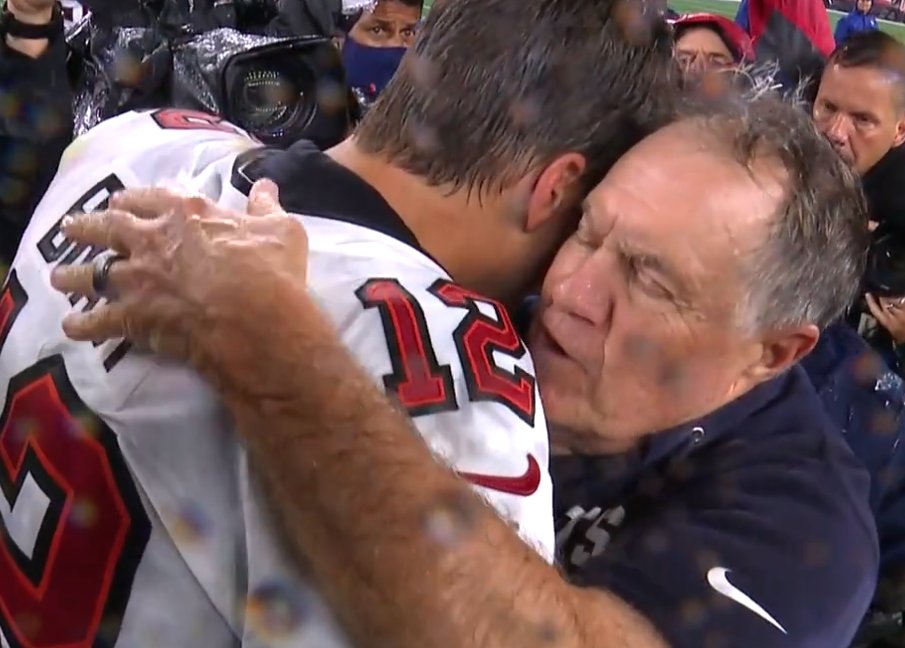
Buccaneers at Patriots: Now We Can Get on with the Important Games

After hearing for a week how this was the most “anticipated game of the season” and to see more promos for it than any non-Super Bowl game, you just know I have to vent a bit now that it’s over.

Yes, the most over-hyped regular-season game in NFL history is behind us, but I have to give them credit for playing a competitive, 60-minute game. The low-scoring chess match between Tom Brady and Bill Belichick was at least compelling, and the rain and injuries evened the playing field a bit for an outmatched New England roster.

If only we could have seen the Patriots win a game despite rushing for minus-1 yard (franchise record) and being minus-two in turnovers. But Brady getting his 50th fourth-quarter comeback win at the expense of a coaching blunder and missed field goal in that stadium was all too familiar.

This was really just the fourth all-time matchup of a legendary quarterback returning to face his former team, but on paper it was the weakest one of them all with Brady (of course) having the biggest advantages.

  • Joe Montana (1994 Chiefs) had to overcome a 49ers team led by MVP Steve Young in a 24-17 game where he threw for two touchdowns and a 101.9 passer rating.
  • Brett Favre (2009 Vikings) returned to Lambeau Field to take on the Aaron Rodgers-led Packers in a 38-26 win where he threw four touchdowns and a 128.6 passer rating.
  • Peyton Manning (2013 Broncos) took his team into Indianapolis on SNF to take on Andrew Luck in a 39-33 loss where he still threw for 386 yards and three touchdowns with a 96.1 passer rating.
  • Tom Brady, as only he can, got to celebrate a 19-17 homecoming win in New England against a team with rookie Mac Jones in a game where Brady had no touchdowns and a 70.8 passer rating.

Even in something as trivial as this, Manning takes the loss because the other quarterback was fantastic against his defense while Brady played the worst and still gets the only game-winning drive credit.

It never fails, does it? But I probably should have expected disappointment like this. I shouldn’t have expected Brady to throw for 300-plus yards and three or four touchdowns to his assortment of weapons. After all, Brady and Belichick have given us several of the lowest-scoring Super Bowls in NFL history, including 13-3 against the 2018 Rams. Brady just came off a 31-9 Super Bowl win. He’s the “we’re only going to score 17 points?” quarterback from Super Bowl 42 against the Giants, flopping hard on the big stage as he tried to throw deep and make memorable highlight plays to get to 19-0.

I saw some of that in this game as Brady’s deep ball was off. He was throwing high often. He had receivers open almost every play and adequate protection, but the rain and unprecedented emotions he was feeling about the situation probably played a bigger role than any specific game plan by Belichick. You could also tell Brady was missing Rob Gronkowski as the connection to Cameron Brate in particular looked out of sync. I’m not sure why Brady was throwing deep late to Antonio Brown other than to stick it to Belichick, because that was strategically the wrong move even if Brown had a good shot at making one of those throws a touchdown.

It was just not an impressive performance, and in hindsight, it makes those ridiculous props of Brady throwing for 555 yards or seven touchdowns look even funnier for this game.

You could easily argue that Mac Jones outplayed Brady on what was supposed to be his night. Jones even made a lot of classic Brady plays with the screens and play-action to a wide-open tight end to start the fourth quarter with a touchdown that put the Patriots on top. Jones even put the ball into danger multiple times on a go-ahead drive in the fourth, but the Buccaneers and their ravaged secondary did not make him pay. He completed 19 passes in a row at one point, tying Brady’s career-long streak. It’s too early for anyone to say if Jones is going to be the real deal, but you have to feel better with him after this game than you did a week ago when he played the Saints.

But Brady still gets the win after Belichick of all people mismanaged the final drive. The rain was coming down good at this point with New England down 19-17. Jones just had a pass knocked down to set up 4th-and-3 at the Tampa Bay 37 with 59 seconds left. The Buccaneers had a couple timeouts. You could try the 56-yard field goal, but that cannot be any better than a 50/50 shot, and it would leave Brady with nearly a minute (plus timeouts) to answer. That sounds bad. But if you can convert the fourth-and-3, that should be able to set up a last-second field goal from shorter distance.

That’s what I would have gone for, but Belichick reportedly did not even think about it. He sent out Nick Folk and the 56-yard field goal hit the left upright with 55 seconds left. Game over. Kickers are now 0-for-7 on clutch field goals of 50-plus yards against a Brady-led team. Folk has three of those seven misses, which only includes field goals in the final half of the fourth quarter or any time in overtime, tied or down 1-3 points). While this would have been a bigger miracle kick than most, it’s just something how Brady literally never ends up on the wrong side of these finishes.

In trying to find an old tweet, I stumbled on this research of mine that said the Patriots were 47-1 at home from 2001-2017 when a team threw 40 passes. That record was 53-1 a game into the 2019 season, but the Patriots have since gone 0-4 in these games, losing to Patrick Mahomes (Chiefs) and Ryan Fitzpatrick (Dolphins) with Brady at quarterback in 2019, and getting blown out by Josh Allen and the Bills (38-9) on Monday Night Football in 2020.

Now Brady did it to them last night on 43 throws, but he didn’t throw a touchdown pass. The record since 2001 for road teams that threw 40-plus passes without a touchdown and scoring fewer than 20 points was 8-174 (.044). Ho-hum.

With some better play in the red zone late in the game, the Patriots could easily be 3-1 right now. As I detailed in Week 1 when the Patriots lost to the Dolphins, Jones is quickly experiencing things it took years for Brady to see in New England, if he’s ever seen them at all in 22 years in the NFL. Let’s update a few of those that I said would be coming soon.

  • Mac Jones lost in his NFL debut with a 102.6 passer rating (29-of-39 for 281 yards, 1 TD, 0 INT).
  • It took Brady 79 starts and 18 losses to lose a game with a passer rating higher than 83.3. He was in his sixth season then.
  • Jones lost in his fourth NFL start vs. Tampa Bay with a 101.6 passer rating (31-of-40 for 275 yards, 2 TD, 1 INT).
  • It took Brady 137 starts and 30 losses to lose a second game with a passer rating higher than 100.0. He was in his 10th season then (it was 4th-and-2 Night).
  • It took Jones four starts to lose a game after a clutch field goal was missed.
  • It took Brady 183 starts to lose a game after a clutch field goal was missed (it’s happened once in 348 career starts).
  • It took Jones four starts to lose a game after leading in the fourth quarter.
  • It took Brady 66 starts to lose a game after leading in the fourth quarter. He threw four interceptions that night against the 2004 Dolphins, a 2-11 team.

A couple things I can say with certainty about Jones so far. He won’t melt in the rain like Davis Mills did for the Texans in Buffalo. But he’s also not destined to be the LOAT like Brady is. If he was, then he would have willed Folk to drill that kick followed by some random defender to intercept Brady to end the game.

This would have been a hell of a win for the Patriots, but now they can just focus on improving and getting back to winning important games in the AFC. Taking the division back from Buffalo. Frustrating Patrick Mahomes and the Chiefs better than most have. All the Brady stuff is in the past and the Patriots have to cope with mediocrity for now.

You can’t take a picture of this – it’s already gone.

Steelers at Packers: The Standard Is the Standard

What did the Steelers do differently this week in Green Bay compared to their last 10 games with a broken offense? They scored an opening-drive touchdown! Ben Roethlisberger threw a dime for 45 yards to Diontae Johnson to take an early 7-0 lead.

Unfortunately, this was not a sign of things to come as the normal broken offense returned for the rest of the game. The defense had another letdown before halftime for the fourth week in a row, and the Packers led 27-10 in the third quarter after Aaron Rodgers went on a hot five-drive scoring streak to put up all of Green Bay’s points.

Najee Harris scored a late touchdown for the Steelers to make it 27-17, but it was too little too late after a couple more horrible fourth-down throws short of the sticks. The only reason I can think of Roethlisberger turning into Alex Smith this season is that he doesn’t want to throw more interceptions, since those tend to get quarterbacks benched. But his quick throws on fourth down that lose yards are unheard of. He never had such a play in his whole career, but he now has such a completion in back-to-back games.

But maybe no play better symbolizes how broken this offense is than this 2-yard completion to JuJu Smith-Schuster on 4th-and-5 where he extends the ball as far as he could and is still multiple yards short of the marker.

You have to love how taking a screenshot on Game Pass is worthless these days since the player details won’t disappear even after 10 seconds. App is about as worthless as this Pittsburgh offense.

Not pictured: James Washington pointing like JuJu got the first down. Hilarious. Sad. Fvcked.

In eight of their last 10 games following last year’s 11-0 start, the Steelers have allowed 23-27 points. In seven of their last 10 games, the Pittsburgh offense has scored 10-17 points. This consistency of being so painfully below average on offense and also below average on defense is just ridiculous.

And yet I still say anyone who thinks benching the future Hall of Famer with a cap number just south of $26 million this year for Mason Rudolph or Dwayne Haskins is crazy if they think that solves anything. It is broken and this coaching staff is not qualified to fix it.

NFC West: Tough Day for the McVay and Shanahan Fanboys

While I was busy hate-watching Steelers-Packers, the first two NFC West showdowns of the season took place. Both road dogs, the Seahawks and Cardinals, came through with big wins in games that were far from classics, but they could be seen as real turning points for these franchises in what has been the NFL’s most competitive division since 2012.

Los Angeles’ Sean McVay was 8-0 against Arizona and all but one of those games was won by double digits. He has Matthew Stafford now and they just had that outstanding win over Tampa Bay. I certainly let all of that play into my decision making for betting on this game, but I couldn’t have been more wrong on this one.

The Cardinals just went in there and kicked their ass in a 37-20 final that was never closer than 11 points in the second half. Arizona just may have built something special here as this is the high point of the Kliff Kingsbury era so far. The Cardinals have produced at least 31 points and 400 yards of offense in each of their first four games. That’s only been done by the 2007 Patriots, 2011 Patriots, and 2013 Broncos in NFL history. Two of those teams set the single-season scoring record and all three lost the Super Bowl.

Why not Arizona in the Super Bowl this season? This is what you draft a quarterback like Kyler Murray No. 1 overall for. Murray (80.4) finished sixth in QBR this week – his third top-six game in four weeks – while Stafford (50.2) was 17th in his weakest game yet for the Rams. The Los Angeles running game produced 17 carries for 100 yards, so you could argue it was their best running game of the season. Yet Stafford still had his worst passing game. The Rams were sitting on 13 points until a drive in garbage time. Robert Woods had 30 yards and a touchdown on that final drive but only 18 yards before it. He is averaging just 43 yards per game with Stafford this year, making it one of the least-productive months of his career. That connection has just not taken off yet, and even the Stafford-to-Cooper Kupp connection was off in this one. Cupp had 64 yards on 13 targets.

This will continue to be one of the more fascinating parts of 2021 as so far the running success seems to have no correlation with how Stafford is doing in that game each week. But the Rams were outclassed on both sides of the ball, and this team still has a ton of work to do before we think of it as the favorite in the division. That may have just transferred over to the Cardinals.

The Seahawks will still have their say in this division as long as Russell Wilson and Pete Carroll are there. After beating the 49ers again 28-21, Wilson has still never lost three games in a row in the same season. This week had a different script though. In recent weeks, the Seahawks started fast before fading. On Sunday, they punted five times to start the game, scored four touchdowns over their next six drives, then just held on while the 49ers tried to mount a 15-point comeback with Trey Lance taking over the half for an injured Jimmy Garoppolo (calf).

Lance hit on a 76-yard touchdown pass to Deebo Samuel after a hideous blown coverage, but he showed why he is a raw rookie in need of reps. It sounds like he will be getting them with Garoppolo expected to be out some time. Will it be permanent? That depends on how well Lance plays, but he’ll have to do better than this game.

But with Samuel off to a dominant start and George Kittle still healthy, Kyle Shanahan is really lacking in the excuses department if this offense does not start to take off regardless if it’s Garoppolo or Lance at quarterback.

Ravens Stop Denver from Moving to 4-0, Panthers Finally Trail This Season

No 3-0 teams surprised people more than the Panthers and Broncos, but both had to deal with legitimate offenses in their biggest challenges yet this season.

I liked the Cowboys (-4) against Carolina, but it was a dogfight into the third quarter. But after Zane Gonzalez missed a 54-yard field goal, Dallas’ offense really took off with balance and big plays. Dallas led 36-14 in the fourth quarter before Sam Darnold, who rushed for two more touchdowns as he apparently wants to crush Cam Newton’s single-season record, led back-to-back touchdown drives to make it 36-28 with just over four minutes left. But when you think maybe this was another Mike McCarthy team collapsing with a lead, the Cowboys put the game away on offense and denied Darnold the game-tying drive opportunity.

Dallas has been impressive this season. When the offense is balanced like this – Prescott had four touchdown passes and only 188 yards passing while the backs rushed for 210 yards – they are going to be a challenge for anyone in the league. Clearly, the Carolina defense boosted its stats against cupcakes in the first three weeks. But I wouldn’t just write off the Panthers this season. They do look legitimately improved and D.J. Moore is a legit No. 1 wide receiver. They probably missed the greatness of Christian McCaffrey as an outlet receiver to deal with the pass rush better in this one. Darnold was sacked five times.

I saw very little of Ravens-Broncos, but it doesn’t seem like there was much there. Both teams have a lot of injuries, but the Ravens still have better players to make up for it. Teddy Bridgewater left with a concussion and Drew Lock was no match for Baltimore’s defense.

Lamar Jackson had just his third 300-yard passing game in the NFL and he has thrown for at least 235 yards in all four games this season. The only other time he’s done that in his career was his four-game start to his 2019 MVP season. Marquise Brown held on this week and finished with 91 yards and a touchdown.

Like Carolina, the Broncos were abusing bad, inexperienced quarterbacks to beef up their stats, but Jackson took it to them in one of the most pass-centric games the Ravens have had with him. His 37 pass attempts are tied for his third-highest amount in a game.

The Ravens were actually in danger of not rushing for 100 yards in this game, something they had done in 38 straight games (including playoffs). But after getting the ball back with three seconds left and an insurmountable 23-7 lead, John Harbaugh had the team run Lamar for a 5-yard gain instead of taking a knee like anyone else would. That gave the Ravens 102 yards and a new record of 39 straight 100-yard games, beating out the 1973-76 Bills. This does end their record streak of 38 games with at least 110 rushing yards.

But when coaches tell you they don’t care about numbers or records, there’s a decent chance they are lying. Extending the record, which is ultimately meaningless like most things in life, by having your star quarterback run with three seconds left is the definition of cheap.

Maybe the Ravens get there easier if they could figure out their running back rotation better. Latavius Murray led the way with 18 carries while Le’Veon Bell (4 for 11 yards) and Devonta Freeman (one 4-yard run) also saw action with Ty’Son Williams a healthy scratch. Maybe they’re saving him? Either way, it would be a good thing for the Ravens to continue developing this passing game.

Chiefs at Eagles: Let’s Not Take This for Granted

The Chiefs ended their two-game slide with a commanding 42-30 win, or only their second win by more than six points since the middle of last season. The bad news: the 2021 Chiefs are now the 14th team in NFL history to allow more than 28 points in each of their first four games. The good news: a dozen of those teams started 0-4 and the other (2012 Titans) was 1-3. The Chiefs (2-2) are now back to .500 after nearly having a perfect game on offense that should not be taken for granted.

The Chiefs were 9-of-10 on third down and scored a touchdown on six of their seven drives. Every touchdown drive was at least 65 yards and all but one of them was 75-plus yards. Literally the only mistake all day was a Patrick Mahomes interception forced under pressure on a third down, the only third-down stop of the day for the Eagles.

The Chiefs did it differently by rushing for 200 yards while Tyreek Hill had 186 receiving yards and three touchdowns. No other Kansas City receiver had more than 23 yards through the air. Travis Kelce hadn’t been held to that little yardage and kept out of the end zone in a game with Mahomes since their first start together in 2018 against the Chargers.

But the Chiefs were spectacular on that side of the ball and still left something to be desired on defense. Granted, they limited the Eagles to three field goals in the first three quarters, and Philadelphia’s last touchdown was a garbage-time score with four seconds left.

We’ll see just how ready the Chiefs are for a real test when they get the Bills next Sunday night in another potential AFC Game of the Year. But six touchdowns on seven drives is insane production in the NFL.

Giants at Saints: Seriously, WTF?

No team has puzzled me more on a weekly basis in 2021 than the Saints. They killed Aaron Rodgers and the Packers in Week 1, which looks like we can safely call it a fluke. They were embarrassed 26-7 by the Panthers in Week 2, which looks like a combo of division familiarity, an improved Carolina team, and some injuries and COVID problems in the coaching staff. They picked off Mac Jones three times in New England last week and took advantage of the rookie and limited offense there.

But then this 27-21 overtime loss to the Giants happened in the Superdome with a full crowd on hand, and I am more confused than ever. At least Jameis Winston passed for over 200 yards in regulation this week, but how the hell does a team throw 26 passes and not have one go to Alvin Kamara? He had 26 carries for 120 yards but no touchdowns since Taysom Hill, the touchdown vulture who threw a pick, hijinks happened, and it was the first game in Kamara’s career with no targets.

That is inexcusable, especially with the given lack of weapons in the passing game. But speaking of weapons, how do you let Daniel Jones pass for 402 yards and make only the second fourth-quarter comeback of his career (he was 1-13) on a day where Sterling Shepard and Darius Slayton were inactive? It does not make sense. Jones had failed to pass for more than 280 yards in every start with Jason Garrett as his offensive coordinator since 2020. Yet here he was getting two huge plays for 50-plus yard touchdowns out of John Ross and Saquon Barkley. Both players also delivered in overtime with Barkley taking in the game-winning score from 6 yards out on the only drive of overtime.

This is New Orleans’ 19th loss as a favorite of more than seven points since Sean Payton came to coach the team in 2006. The Saints are 39-19 SU (.672) as a favorite of more than seven points since 2006. Only Washington (6-4) has a worse winning percentage in such games.

I really thought the Saints would play better at home on offense. In some ways, they definitely did. But there were some key misses in this game like Kamara only getting two yards on a 4th-and-3 run, settling for a 58-yard field goal that was missed and led to the Ross touchdown, the Hill interception right after a long Winston touchdown pass was negated by penalty, and not closing out in the fourth quarter.

If this is what the Saints are post-Brees, then I’m out. I want nothing to do with Kamara’s prop bets anymore and I can’t even trust them to beat the Giants in the Superdome. Granted, Payton has lost in this spot more than you’d like to see in his career, but this was a really bad loss for the team. Daniel Jones is only supposed to do this shit against the Washington franchise.

Titans and Lions: Extend the Game vs. End the Game

Finally, I just wanted to highlight two coaching decisions on Sunday. Last week, I was happy when Tennessee’s Mike Vrabel went for two with a seven-point lead. He has been a bit of a renegade in breaking norms on two-point conversions. So, it kind of shocked me when he did not have his Titans go for the win against the lowly Jets after getting a touchdown with 16 seconds left in the game.

The timing was excellent with the Jets out of timeouts. This is the ideal spot to do it in and it’s not like the Jets were doing a great job of stopping Derrick Henry in the game. Ryan Tannehill also found his rhythm late after playing the game without Julio Jones and A.J. Brown available.

If you’re playing a lousy team on the road and the offense is the strength of your team, why not go for the win? That extra point surprised me. The Jets almost ended this one immediately in overtime, but eventually did settle for a field goal and 27-24 lead. The Titans had a rough time answering, needing to convert two fourth downs, but they eventually got into field goal range. It looks like we were about to have a damn tie, but fortunately, Randy Bullock is a bum kicker. From 49 yards out, he was wide left in the final 20 seconds to end the game.

The Jets had their first win in the Robert Saleh era. Rookie quarterback Zach Wilson had his first 4QC/GWD and it is one he can feel good about after a rough first three weeks. Wide receiver Corey Davis (111 yards and a touchdown) had a sweet revenge game on his former team.

While I wanted the Titans to end the game on one play, the Detroit Lions made a mistake of not extending the game. It was a rough afternoon in Chicago for the Lions, but they were down 24-14 in the fourth quarter with the ball. The Jared Goff-led drive stalled, setting up a 4th-and-1 at the Chicago 8 with 4:19 left. I get that it’s tempting to go for it there, but you have to realize you are still down 10 points (two scores) and time is a factor. Even if you go for it and get it, there is still no guarantee you are getting a touchdown here. In three more snaps, you could be kicking a field goal anyway if there’s a bad snap – oh, they had one of THOSE on Sunday – or a sack. Kick the field goal, use your three clock stoppages to get the ball back, and then get a touchdown and go for two or play for overtime.

But the Lions went for it, Goff’s pass was incomplete, and the Bears ran out the final 4:15 on the clock thanks to the Lions being offsides on a punt. Incredibly, the Lions had five drives inside the Chicago 8, and they only scored one touchdown on them, turning the ball over twice on fumbles and twice on downs.

Again, it was a lousy performance for the Lions against a Chicago team that seemed to be on the brink of collapse. But the Bears turned things around and got their second win of the season while the Lions remain 0-4.

NFL Week 4 Predictions: Angry Tom Brady Edition

After September 2021 set a record for fastest month ever completed, we’re already into Week 4. Do we know anything other than the given that the Bears and Jets never know how to get things done at the quarterback position? Not really, but some games this week should help a lot in figuring out legit turnarounds versus frauds.

I already did previews on Giants-Saints, Buccaneers-Patriots, and Raiders-Chargers. I also went into detail on Russell Wilson’s division problems as the NFC West takes center stage this Sunday with two matchups as Wilson looks to avoid the first three-game losing streak of his career with Seattle. So, let’s keep him in mind with this first part.

Does “Angry Tom Brady” Exist?

You wouldn’t like Tom Brady when he’s angry.

The hype for this Bucs-Pats game on Sunday night is pretty hilarious given that this has to be one of the least important non-conference games of the season. The Patriots (1-2) aren’t going anywhere this season and this punchless roster should not be able to handle the Bucs on Sunday night. Tampa Bay’s winning streak was snapped in Los Angeles, but this just means that Tom Brady is going to be extra angry as he looks to drop 40+ on Belichick in this one.

As if he wasn’t already in that mindset for this game. But the loss makes Tampa Bay covering my favorite pick of the week. I’m just mad that Rob Gronkowski, the real GOAT of the night, is unlikely to play with a rib injury.

But in that BMR preview, I looked into the idea of Angry Tom Brady with data. For many years it has been said that Brady is so tough to beat two weeks in a row, and the data will show that is true of course. We know the Patriots rarely endured losing streaks. But are his stats up in those games to suggest he is the one who steps his game up the most after a loss?

(Sarcasm) These results are going to shock you, but I found that Brady’s team has one of the best records after a loss, but his individual QB stats are more on the fringe of a top 10 QB rather than the most dominant in the league. Even if you only look at the last decade when Brady’s stats are up and the league-wide stats are up, his individual numbers actually have gone down in those games.

I’ll repeat the recap of the findings from my article here.

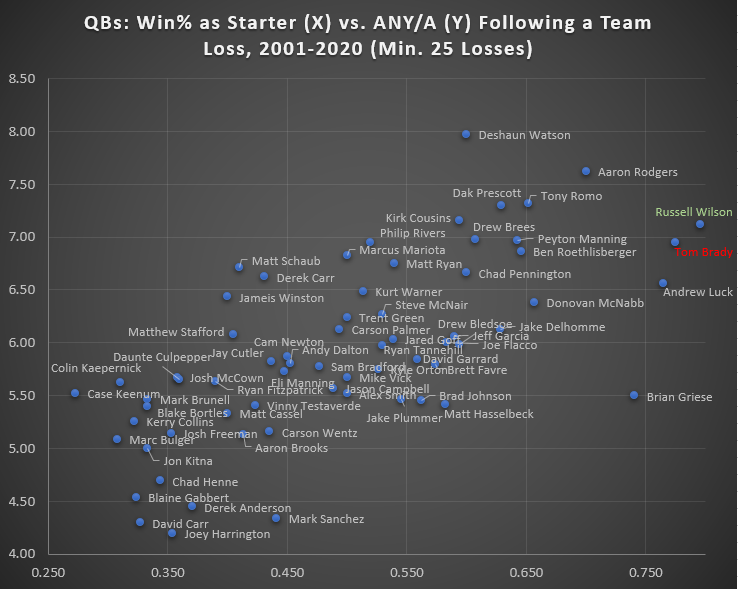
I looked at data on 66 quarterbacks from 2001-2020 in starts following a team loss and how they performed that next game. Here are the findings:

  • Brady is 55-16 SU (.775) after a loss, the second-best record behind only Russell Wilson (35-9, .795).
  • Brady is 49-22 ATS (.690) after a loss, the second-best record behind only Andrew Luck (24-9-1, .721).
  • Brady’s team has the highest scoring differential (10.3 points per game) following a loss, and only Wilson (9.1), Aaron Rodgers (8.2), and Luck (7.0) are even close.
  • Out of 66 quarterbacks, Brady ranks 21st in completion percentage (63.4%), 23rd in yards per attempt (7.26), 10th in passer rating (96.3), and 10th in adjusted net yards per attempt (6.95) after a loss.
  • If you only look at Brady’s post-loss games since 2011 when league passing stats have gone up, his passing stats all decrease but his team still wins 76.3% of games and covers 71.1% (27-11 ATS) of the time.

As it turns out, “Angry Bill Belichick” is likely more of a thing than Angry Tom Brady. I’ve included a chart of those 66 quarterbacks and looking at their win% vs. ANY/A after a loss. This looks very good for Russell Wilson, who again has never lost three games in a row in the same season with Seattle.

Something I did not look at was comparing how the QB played in the previous-game loss relative to his next-game performance. That could be a way of showing that Brady does step up from a loss better than anyone, but part of the issue there is that he’s just usually a bad QB when his team loses.

One thing’s for sure: if Brady loses to Belichick on Sunday night, he will break the record for calling people this:

NFL Week 4 Predictions

For the third time in four weeks, Thursday Night Football came down to a game-winning field goal. I was on the wrong side of that spread again too.

I’m about to start picking the opposite of what makes sense, because not much is making sense to me in this league this season so far.

I picked the Bears despite Detroit playing some spirited ball under Dan Campbell, because this feels like a spot where Matt Nagy is getting fired if he doesn’t deliver in this game, and he is 5-1 against the Lions in his career.

The Titans have me nervous with their top WRs (Julio Jones, A.J. Brown) out. The Jets beat the Browns last year when the Browns lost their WR room to COVID. Have to hope Derrick Henry pops some big ones there and Zach Wilson continues to be awful.

On the biggest surprise 3-0 teams, Panthers and Broncos, I am going with Dallas to put an end to this little run of Carolina never trailing with Sam Darnold playing his best ball in the NFL. I think Dallas had an impressive month and showed a lot even in the loss in Tampa Bay. Then I’m going with Denver to show that this team should be taken seriously with Teddy Bridgewater and the defense playing so well, and maybe things aren’t in great shape with Baltimore given the injuries and the fact that a 66-yard field goal was needed to escape the Lions.

I keep pointing out how the Chiefs have won one of their last 14 games by more than six points. But maybe this is the spot where they dominate again as the Eagles have not impressed the last two weeks. Jalen Hurts doesn’t seem to throw for many yards at home either in his career, so maybe the defense for Kansas City can actually step up for a change and the offense protects the ball better to get a much-needed win.

I’m going to be extremely pissed at the Steelers if they show up in Green Bay and get a win after losing home games by multiple scores to the Raiders and Bengals. Have you seen those teams play other weeks? Not that impressive with three overtime wins between them and a last-second field goal against Jacksonville. So if the Steelers won in Buffalo, who have looked dominant the other two weeks, and then in Green Bay, which still looks great offensively the last two games, I’m going to be pissed because that’s the same old “playing to the competition” bullshit they’ve done for years. But I really think the Pittsburgh offense is broken and Green Bay should cover.

In the NFC West, I like Seattle and the Rams in these first matchups of the year for that division. Sean McVay has owned the Cardinals in his career and now he has Stafford off to a great start. DeAndre Hopkins isn’t 100%. With the Seahawks, Wilson is having MVP first halves and the offense is disappearing in the second half. I think he can have a full game in this one and close out a Kyle Shanahan-coached team that consistently struggles to close games in the fourth quarter. I’m going to bet on Seattle to not lose three in a row.

I’m hedging with my picks on Monday night. I think the Chargers should win, but I can acknowledge the chance the Raiders get this one or only lose by a field goal.

Pittsburgh Steelers: The Day the Whole Offense Went Away

The date was December 2, 2020. It was a Wednesday afternoon. The Pittsburgh Steelers were 10-0 and while it was rarely pretty, they led the NFL in scoring differential (+124). They were the 10th team in NFL history to score at least 24 points in each of their first 10 games, and while they stick out like a sore thumb on such a list, they were still there. Ben Roethlisberger’s arm strength was limited post elbow surgery, but his anticipation was better than ever, and he was delivering good touchdown throws and performing on third down and in the red zone.

Things were working out for the team.

In a game that was rescheduled multiple times for COVID-19 reasons, the Steelers were finally hosting a reduced roster from Baltimore. Whether it was restlessness from the delays or rust or division familiarity or the weirdness of playing on Wednesday afternoon in an empty stadium, the Steelers struggled to score in a way they hadn’t all season. They got a pick-six to start the game, but the offense only contributed 13 points in the 19-14 win. Roethlisberger completed 36-of-51 passes, but for only 266 yards as the Steelers dropped way too many passes. But he delivered a great pass late to James Washington to put the game away and move the Steelers to 11-0.

Little did we know that this hiccup would become a chronic cough that has choked the life out of the offense and the team to this day.

The Steelers had a very similar performance the following Monday against Washington, but this time they did not find a way to close the game and suffered their first loss of the season. Things got even worse in Buffalo with Roethlisberger throwing a 51-yard pick-six before halftime that led to a 26-15 loss. In Week 15 in Cincinnati on a Monday night, the Steelers turned in maybe their worst offensive half of football in the Roethlisberger era. No play summarized the struggle better than Roethlisberger throwing a drag route to JuJu Smith-Schuster on a third-and-7 where he was blown up and fumbled. The Steelers were about to lose their fourth game in a row to the Colts before a vintage Roethlisberger rally from down 17 points in the second half at home. But then the starters rested against Cleveland, lost 24-22 to let the Browns make the playoffs, and then were blown away 28-0 in the first quarter in the wild card game after center Maurkice Pouncey blew the opening snap for a touchdown. The Steelers tried to make a brilliant comeback but fell well short in a 48-37 loss.

Offensive coordinator Randy Fichtner fell on the sword and lost his job, one that he was never cut out for. However, the Steelers made the same mistake by promoting from within to give Matt Canada the job for 2021. The offensive line was completely replaced by players of little caliber or value. Alabama running back Najee Harris was drafted in the first round despite a lack of blocking in place for him after the Steelers finished dead last in rushing in 2020. Roethlisberger decided to give it one more go and return for his 18th season.

And yet September 2021 looked like much of December 2020 and January 2021. The new offensive line is worse and Roethlisberger is taking more hits and sacks now despite getting rid of the ball faster than any quarterback. The Steelers remain last in rushing, not even cracking 50 yards in either of the last two losses. The receivers just dropped eight passes on Sunday, though most of the short variety again as the air yards remain limited in Pittsburgh. The defense has not been able to play well the last two weeks due to mounting injuries, most notably with T.J. Watt’s groin.

Nothing is working out now, and with four tough opponents coming up, it is hard to see how the Steelers stay relevant into December this year.

I’m not interested in rehashing everything that has gone wrong for the Steelers in the last year. I mean, I will share this JuJu route chart again just because it’s hilarious and sad and sums up things well for this inept offense:

But with such a noticeable decline starting in that Wednesday game against Baltimore, I wanted to do a comparison of the 10-0 start to the now 10-game sample since that has seen the Steelers go 3-7 with a win over the COVID Ravens, a huge comeback against the Colts, and a surprise comeback in Buffalo in Week 1 that looks like a mirage now.

Yeah, that’s a pretty big decline in everything but sack rate, but Roethlisberger not wanting to hold the ball long anymore has not really been a bonus for this offense. This year he is just running out of time sooner.

But if anything, I would hope this comparison shows that it is flat out wrong to say the Steelers were playing this bad when they were 10-0 last year. The offense clearly had limitations and the running game decay was settling in by Week 8 when the Steelers became the first team in NFL history to win three straight games without rushing for 50 yards. But this offense still produced and found ways to put up points every week for 10 games.

Then December came and all hell broke loose. Scoring has gone down 9.3 points per game. They are throwing the ball more but throwing it worse with more interceptions and dropping more balls. The offense has not scored a single point in the first quarter since Week 10 against the Bengals last year. They are worse in the red zone and on third and fourth down.

But the running game has particularly been a historic embarrassment with 54.0 yards per game and 3.1 YPC in the last 10 games. This is not an indictment on Harris as it starts up front and this goes back long before he was drafted. It was never a smart draft pick.

If it wasn’t for James Conner popping a 25-yard run in Jacksonville last year, the Steelers would be on a 14-game streak of not rushing for more than 86 yards. They can soon tie and break the post-WWII record for games without rushing for 90 yards, having not done so in 10 games going into Green Bay on Sunday.

The Steelers have failed to rush for 50 yards in eight of their last 14 games. In Bill Cowher’s 261 games as coach of the Steelers (1992-2006), they had nine games where they didn’t crack 50 rushing yards. My how times have changed. The post-merger record for most games in a two-year span with under 50 rushing yards is 11 by the 2006-07 Lions. The Steelers have a decent shot at breaking that one with 14 games to go this year.

When you can’t run the ball for simple 3 or 4-yard gains…

When you waste the first quarter every week…

When you don’t throw to the middle of the field anymore…

When you don’t throw deep except for go routes down the left sideline and DPI is your best hope of advancement…

When you don’t bother to use play-action passing…

When you drop easy passes…

When you can’t block for more than 2.3 seconds…

You don’t have an NFL offense anymore. You are more akin to putting 11 crash-test dummies through the motions for three hours a week.

As much as the 10-0 start had me feeling awkward, I didn’t know how bad things would get. When Roethlisberger retires after this season and the Steelers are back in the hunt for a franchise quarterback — the last search took two decades — I have a feeling we’ll be looking back at December 2, 2020 as a date that will live in infamy.

It was the day the whole offense went away in Pittsburgh.

Russell Wilson and the Lonesome Crowded NFC West

In Week 4, the NFC West takes center stage with two standout matchups in the late afternoon slot: Cardinals/Rams and Seahawks/49ers. These are the first division games of the year in what is shaping up to be the best division race in the league just like we expected coming into 2021.

But the Seahawks (1-2), winners of last year’s race, are in danger of slipping to 1-3 for the first time in the Russell Wilson era. While Wilson has some impressive stats again this season, he has the lowest QBR ranking – 55.6 is only good for 15th – of the four quarterbacks in the NFC West, and the Seahawks (15th) are the only NFC West offense not ranked in the top eight in points per drive through three games.

Matthew Stafford and Kyler Murray both have their teams at 3-0, top four in points, and both are top five in QBR with Stafford (82.6) leading the whole NFL so far. If they keep this up, we might see multiple quarterbacks in the NFC West get MVP votes before Wilson ever gets one in his career.

It’s almost like Wilson is becoming the forgotten man in the division that he has been the top star of for a decade now.

But this is nothing new for Wilson. Ever since his rookie year in 2012, he has had to share the spotlight with several quarterbacks in his division as they led their teams to great success too. This has made Wilson’s path to the Hall of Fame a bumpier ride than most of his great peers.

Russell Wilson vs. His Peers vs. Their Division Rivals

It would be wrong to say that Russell Wilson is the only top quarterback to face a real challenger from every team in his division in the last decade.

Ben Roethlisberger faced the Ravens (2014), Bengals (2015), and Browns (2020) in wild card playoff games in the last seven seasons, losing two of them at home. Aaron Rodgers had his toughest division competition early in his career when the 2009 Vikings had Brett Favre and the 2010 Bears gave Jay Cutler a great defense. But in the last decade, he has seen playoff seasons from the Lions with Matthew Stafford, Mike Zimmer’s Vikings with Teddy Bridgewater/Case Keenum’s one-year wonder/Kirk Cousins, and a couple Chicago seasons when Mitchell Trubisky managed Matt Nagy’s offense to something better than 1 net passing yard.

In the NFC South, Drew Brees watched Cam Newton (2015 Panthers) and Matt Ryan (2016 Falcons) win MVP and lose the Super Bowl, while the Saints lost to Tom Brady and the 2020 Buccaneers in the final game of Brees’ career, a pivotal divisional round game that launched Tampa Bay on the path to a Super Bowl win.

However, Wilson has experienced multiple runs and at least one elite season from his NFC West counterparts in addition to some strong quarterback seasons and some of the most successful new coaching hires in the NFL in the last decade.

San Francisco: The 49ers were in the middle of a three-year run to the NFC Championship Game under head coach Jim Harbaugh when Wilson joined the division in 2012. Led by the dynamic Colin Kaepernick, the 49ers lost the Super Bowl that year and lost a tight game to Wilson’s Seahawks in the 2013 NFC Championship Game. Things were bad after that, but after hiring Kyle Shanahan and acquiring Jimmy Garoppolo from the Patriots, the 49ers rebounded with a great 13-3 season in 2019, clinching the No. 1 seed in the season finale after stopping Wilson’s Seahawks at the 1-yard line. The 49ers blew a 10-point lead in the fourth quarter against the Chiefs in Super Bowl 54.

Arizona: The least successful team in the division, but the Cardinals won at least 10 games in every season from 2013 to 2015 under head coach Bruce Arians. He had a good thing going when Carson Palmer was healthy, and in 2015, Palmer had what I will always say was an MVP season, leading the Cardinals to a 14-4 record and the NFC Championship Game where they lost to Carolina. Things declined after, but now with Kliff Kingsbury and 2019 No. 1 pick Kyler Murray, the Cardinals could be heading back to the playoffs as long as Murray stays healthy. He had a great start to 2020 before his health diminished his play in the second half.

Los Angeles: The Rams were in rough shape with Jeff Fisher as the coach when Wilson joined the league, but they started acquiring talent like the best defender in the game, Aaron Donald. Once they drafted Jared Goff No. 1 overall and hired Sean McVay as the head coach, the team immediately took off. McVay has never had a losing record and is looking to make the playoffs for the fourth time in five years. Goff had great seasons in 2017-18 and the Rams were in the Super Bowl in 2018 before losing 13-3 to the Patriots. They leaned on their defense last year to make the playoffs and beat Wilson’s Seahawks in Seattle in the wild card round. Now they have the top-ranked offense with Matthew Stafford poised to have a career year. It’s just another huge challenge for Seattle.

Outside of 2016 when the Seahawks won the NFC West with ease, Wilson has always had to deal with at least another 10-win team in his division. Outside of 2016 and last year when the Rams finished 10-6 thanks to a late loss to the Seahawks, Wilson has always had to deal with an 11-win team or better.

Since 2002’s divisional realignment, the NFC West is the only division where every team has won at least 13 games in a season. That is thanks to the Seahawks (2013), Cardinals (2015), Rams (2018), and 49ers (2019) all finishing 13-3. The Lions, Bengals, Jets, Buccaneers, Texans, and Browns (AAFC excluded) have never won 13 games in their franchise’s history, so it never could have happened for the two North divisions, the two South divisions, or any version of the AFC East. That also disqualifies the defunct AFC and NFC Central divisions. It technically has happened for the original NFC West (49ers/Rams/Falcons/Saints), but the Saints didn’t hit 13 wins until the Brees era (2009), or well after realignment and long after Joe Montana and Steve Young retired.

In fact, the only other divisions that can say all four of their teams have won 13 games before are the AFC West and NFC East. Given that the Raiders haven’t done it since 1976 and the Chiefs didn’t do it until 1995, no one has a career that spanned that long to say they were in a division where all four did it. The Seahawks also used to be part of that AFC West and didn’t win 13 games until 2005 in the NFC West.

As for the NFC East, it hasn’t happened for the Giants since 1990 and for Washington since 1991. Dallas first won 13 games in 1992, so you might think, hey, this probably happened to a young Troy Aikman or an old Phil Simms. Nope, because the Eagles never won 13 games until 2004, or after they were long retired.

This puts Wilson and his division in unprecedented territory as it confirms he is the only quarterback in NFL history to play in a division where every team actively won 13 games in a season. Goff and Garoppolo weren’t in the NFC West prior to 2016 when Seattle and Arizona did it, and Palmer was retired before the Rams and 49ers did it. So there you have it. History.

If Only Wilson Had Tom Brady’s Division Luck…

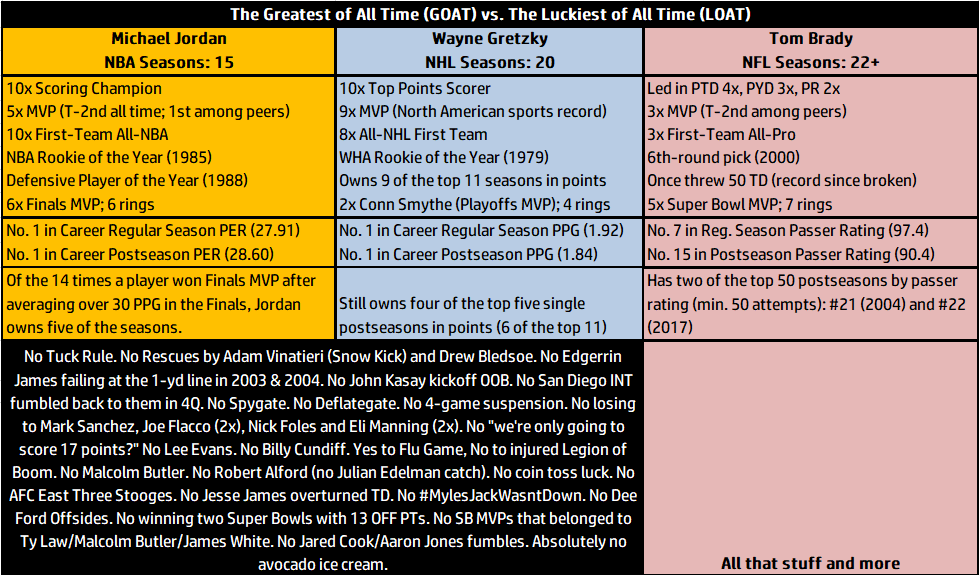
Now compare this to Tom Brady, the LOAT. His first full season as a starter happened to coincide with realignment in 2002 when the Patriots were put in a revamped AFC East with the Jets, Dolphins, and Bills, or as I like to call them, The Three Stooges. From 2002 to 2019, The Three Stooges managed just two 11-5 seasons to challenge Brady in the division. One was by the 2008 Dolphins, a team that shocked the Patriots with the Wildcat in the year Brady tore his ACL in Week 1. The other was the 2010 Jets, who beat Brady in the regular season to get one of their 11 wins, and then shocked him at home in the playoffs in one of the biggest upsets in NFL history.

But for two decades, the best The Three Stooges could do was 11-5, the best they could do at quarterback was Even-Years Chad Pennington, and the best they could do at head coach was probably Rex Ryan. Flash forward to Brady joining the 2020 NFC South. The Falcons and Panthers had two of the worst seasons in NFL history in close games. The Saints with Brees were a worthy foe and they swept Brady to finish 12-4, the first time Brady was ever swept by a division rival. This also means of the only two 11+ win teams Brady’s ever had in his division, he was complicit in them winning that many games. Compare this to Peyton Manning, who swept the 2003 Titans (12-4), 2005 Jaguars (12-4), 2007 Jaguars (11-5), and 2013 Chiefs (11-5) but still watched them win 11-12 games. Wilson was able to hang one loss on the 2015 Cardinals and 2019 49ers. He was swept by the 2018 Rams despite scoring 31 points in both games. Let’s just say not anyone could beat the 2018 Rams by a final of 13-3.

Brady’s division now consists of an Atlanta team that lost all its offensive mojo after hiring Arthur Smith. Matt Ryan has gotten off to the worst start of his career in 2021. With Brees retired, the Saints are weirdly leaning on defense with Jameis Winston throwing for 387 yards in three full games. The Panthers are 3-0 and have never trailed this season, but only time will tell if Sam Darnold, an old foe from The Three Stooges, will turn back to a pumpkin. Go figure, the AFC East only got another elite passer (Josh Allen) the second Brady moved to the other conference.

Wilson and Brady are certainly on two different ends of the spectrum for division rivals. What if Brady had to deal with this NFC West that Wilson has been in since 2012? He is only 5-6 as a starter against those teams in the Wilson era, including playoffs and including Sunday’s loss to the Rams. I plotted every quarterback with at least five starts against Wilson’s NFC West since 2012 through 2020, looking at their win percentage and their Adjusted Net Yards per Pass Attempt (ANY/A).

Wilson has a better winning percentage (.598) against his division than Rodgers (.440), Brees (.474), Brady (.500), and Peyton (.400). Wilson (6.26) and Brady (6.24) are almost identical in ANY/A, though Wilson is not that great statistically here compared to his other top peers. Of course, he’s played 56 division games against teams who know him well compared to 25 for Rodgers, 19 for Brees, 10 for Brady, and five each for Manning and Mahomes. On the other hand, Wilson never has to play his own defense, which has been the strongest of the bunch in this division since 2012, which also explains why the other quarterbacks have lesser records and stats. But it’s an amusing chart.

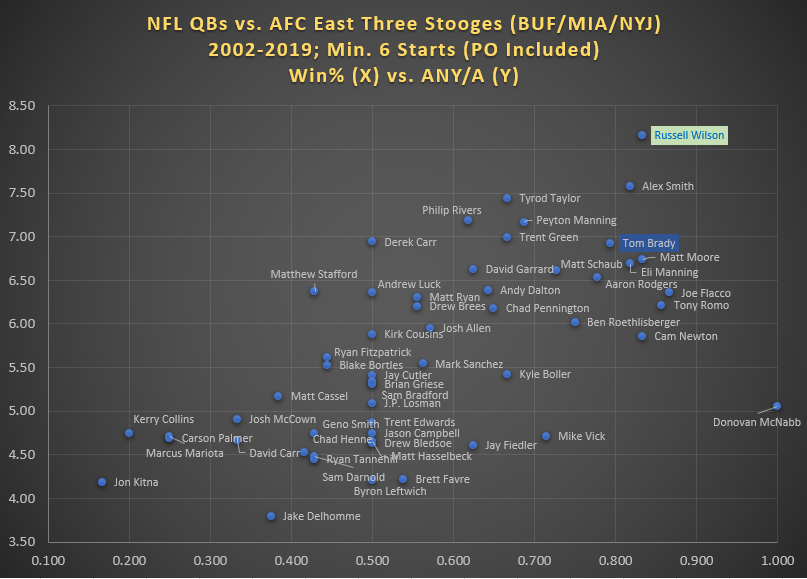
I have better, including this look at how quarterbacks have done against Brady’s Three Stooges in the AFC East from 2002 to 2019. Can you notice anyone who stands out?

Yep, that’s Russell Wilson (8.16) and Alex Smith (7.58) as the only quarterbacks with an ANY/A above 7.5. Brady’s record is 81-21 (.794), but are we really going to pretend his top peers couldn’t replicate that in this division or even improve on it given those ugly upset losses in Miami? The guy once lost 21-0 to Joey Harrington.

I am proud of these next two charts since they visualize what I have been saying for years about these divisions. This looks at 2002-2020 for Wilson, Brady, Peyton, Rodgers, Brees, and Roethlisberger while excluding the full year those quarterbacks missed for injury. The entry that is their full name is every game that quarterback played in 2002-2020. The other entries show what the starting quarterbacks for each division rival cumulatively did in every game while the quarterback was in that division, so that would be the AFC South teams for Peyton in 2002-10 and the AFC West teams in 2012-15. The x-axis is win% and the y-axis is ANY/A.

That cluster of The Three Stooges as losing teams with bad quarterback play that only the Browns 2.0 can rival is perfect.

Finally, here is a similar chart that sums up each quarterback’s division rivals into one entry.

As I have been saying for years, no quarterback has had a bigger advantage over his division rivals than Brady, and it’s due to a lack of competition rather than his play being that much better. Brady ranks third in ANY/A here and is only 0.01 above Brees in fourth, and Brady’s division has the worst win rate (.435) and ANY/A (5.24). Wilson’s division has the best record (.496) and second-highest ANY/A (5.88) behind only Brees (6.05).

You cannot deny that the careers of Wilson and Brady will forever be linked. Super Bowl XLIX was the most pivotal game in the NFL in the last dozen years. The Seahawks were a yard away from repeating and possibly being the next dynasty, while bringing the ring count to 3-2 for Brady vs. Wilson and dropping the Patriots to 3-3 in Super Bowls under Belichick and Brady. Then a call for a pass came in and the rest is history. Brady has won three more Super Bowls since and the Seahawks have not even been back to the NFC Championship Game.

In the lonesome crowded NFC West, Russell Wilson is starting to sound like Cowboy Dan.

I got mine but I want more.

With the way the NFC West is developing, and the Seahawks are decaying under Pete Carroll, we may never see Wilson past the second round of the playoffs again, or at least not with Seattle. Maybe he can replace Rodgers in Green Bay some day, a return to Wisconsin.

Also, I didn’t even mention the potential of Trey Lance in San Francisco.

Shit Luck.

This plane is definitely crashing

This boat is obviously sinking

This building’s totally burning down

And my heart has slowly dried up

NFL Stat Oddity: Week 3

What a Sunday in the NFL for record-long field goal attempts, but there is only one Justin Tucker. You know some games were real shit when you lead with that, but we haven’t seen a ton of close finishes in 2021. Only 22 of the first 47 games have had a fourth-quarter comeback opportunity, including six on Sunday. That is down from 29 games through Week 3 of the 2020 season.

Did favorites have a better week? Not really as 6-9 ATS makes it 17-30 ATS (.362) through Week 3. Home teams were 7-8 SU too, so another losing record there as we watch home-field advantage disintegrate even with the return of crowds.

Maybe we are just having a real “changing of the guard” season after the four teams with the best records in the period of 2013-2020 are all 1-2 right now (Patriots, Chiefs, Seahawks, and Steelers). The Colts have slipped into the basement of the 0-3 teams with the Giants, Jets, Jaguars, and Lions. But don’t worry, Sunday’s Game of the Week should give Jim Irsay the courage to raise another banner.

This season in Stat Oddity:

Buccaneers at Rams: Stafford Delivers in Biggest Game of Career (Take One)

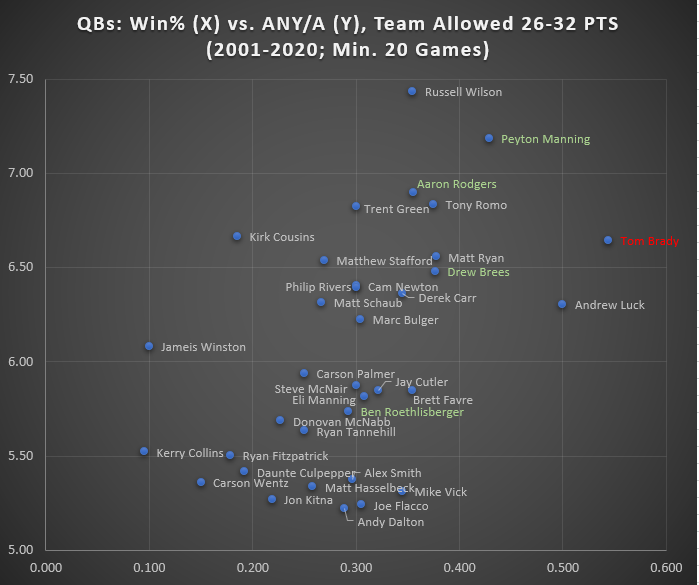
The reverse psychologist in me was hoping that Matthew Stafford and the Rams would take this big opportunity at home against Tom Brady and the Buccaneers to clinch the biggest win for any team in September. I think they did that with a 34-24 win that was not as close as the final score suggests as Stafford threw four touchdowns in a wire-to-wire win while Brady had a hollow 432-yard day. Brady is now 4-17 when his team allows 33-39 points, his least impressive range of high-scoring games, or the one where luck isn’t on his side for a change.

Unless Stafford is so unlucky that the Buccaneers slip to a losing record and this game doesn’t improve on his 8-68 record against winning teams, then this is the biggest win of his career to date. It’s the first time he will have beaten a winning team (I assume) by throwing four touchdowns. It’s the first time he will have beaten a winning team (I assume) by throwing for 300 yards without a giveaway.

In fact, this was a weird game in that it had zero turnovers and started with five punts as both teams looked a little nervous. But once the Rams settled down, they got into some fine play designs, Stafford was unstoppable on third down, Cooper Kupp is Cole Beasley if he turned face and had more talent, and DeSean Jackson went old-school with a 75-yard touchdown and making us nervous by slowly crossing the goal line. Neither team could run the ball, and you know that’s a fact when Brady (14 yards) led Tampa Bay in rushing. The Rams added some numbers in the second half with the lead, but the ground game was not the story here.

The fact is for a hyped-up game, there weren’t that many pivotal moments or memorable spots to talk about. If there is to be a rematch in the playoffs, it will be a matter of whether the Buccaneers, with their injury-ravaged secondary that seems to add a new injury each week, can keep up with these receivers. A sack and a shanked punt really put the Bucs in trouble in the third quarter, leading to a 31-14 lead by the Rams. Brady never touched the ball again with a deficit smaller than 17 points.

It was interesting to see him still in the game with 4:50 and a 34-17 deficit. Bill Belichick pulled Brady from a 38-17 blowout at the hands of the 2009 Saints in New Orleans with 5:26 to play in that one for the Patriots. This is the fourth time since 2019 that Brady was in the ballgame in the final five minutes with a deficit of 17-plus points. He had three such games from all of 2003-2018.

This now marks six times in 19 regular-season games with Tampa Bay where Brady has trailed by at least 17 points. He trailed by 17+ six times in his last four seasons with the Patriots combined (2016-19). He will visit the Patriots and Belichick next Sunday night, but the 10-game winning streak and 30-point streak are over after this one, which I always said was the biggest test of the regular season for Tampa barring an incredible run by Josh Allen when they host the Bills in Week 14.

But Stafford and the Rams passed their first big test of the season and take an early lead towards the No. 1 seed. However, the division games start next week and will be tough. Stafford in the “biggest game of his career” could be something that comes up three or more times this season. If you’re a fan of the Rams, you hope it’s a high number because that means they are likely winning these games.

Packers at 49ers: One-Minute Drills

What was looking like another blowout between these teams turned into one of the best finishes of Week 3. The 49ers used a double score around halftime to turn around a 17-0 deficit and make this a game. The Packers were up 24-21 with the ball late. They faced a fourth-and-4 at the San Francisco 20 with 2:43 left. Had the 49ers been out of timeouts, I would have said go for it. Let Aaron Rodgers end the game with one play as anything converted in bounds would run out the clock in that situation. Don’t kick a field goal and go up by six, inviting them to beat you on a late touchdown.

But the 49ers had four clock stoppages at that point. I think there’s a good chance Green Bay would have settled for the field goal anyway on that drive, so I do support the field goal in that case. Jimmy Garoppolo was shaky on the night, but he got good plays out of his top guys, including George Kittle for 39 yards on another big YAC play.

But after getting to the Green Bay 12 in the last minute, the 49ers needed to think about the clock. Green Bay was out of timeouts. You couldn’t leave Rodgers that much time, only needing a field goal. If I was the 49ers, I would have called a run on first down just to bring the clock under 30 seconds. But San Francisco was not into bleeding the clock. It snapped the ball with 12 seconds left on the play clock, and Kyle Juszczyk fought his way through contact for a 12-yard touchdown with 37 seconds left.

Again, you almost wish he would just go down at the 1 and they could score from there. But he scored, and the Packers had to be somewhat glad about that. Now Rodgers would get his chance. Worse, the kickoff to the end zone was a touchback, so that burned no more time off the clock and put the ball at the Green Bay 25. Why not a hard squib kick or something shorter to make them burn some time? I didn’t like that decision.

Rodgers was able to hit Davante Adams, who took a nasty shot to the head earlier in the quarter, for two plays worth 42 yards. He got the spike off in time and the Packers looked like they had practiced that situation well. Mason Crosby is a shaky kicker in these situations, but he’s no Minnesota kicker. He nailed the 51-yard field goal and the Packers jumped ahead of the 49ers in the standings at 2-1, finally winning a good game against this team even if we’re still not sure how good the 49ers will be this year.

As I said in my top 100 quarterbacks project, Rodgers and the Packers have improved in these clutch situations. Through 2014, he was 12-29 (.293) at 4QC/GWD opportunities, which would be one of the worst records in the league. Since 2015, he is 16-17-1 (.485), which would be the fourth-best career record among active starters (minimum 20 games).

This is the fourth time in Rodgers’ career that he led the Packers on a game-winning drive after taking over in the final 60 seconds. His first three were against the 2011 Giants (38-35 win), 2015 Lions (Richard Rodgers Hail Mary), and the 2016 Cowboys (playoff win).

It is the second one-minute drill in the NFL this season after Derek Carr led the Raiders to one against Baltimore in Week 1 to force overtime. Anymore, you really have to get the clock under 20 seconds if you hope to win after leaving the opponent in position to only need a field goal. It has just gotten too easy to move into field goal range and some kickers are too damn good from long distance these days.

This is an unofficial count of successful one-minute drills in the NFL in the last 40 years, but it’s the best I can do at 5:00 A.M. on a couple hours of sleep this weekend:

  • 1981-89: 30
  • 1990-99: 26
  • 2000-09: 36
  • 2010-21: 68

The Packers are very much alive again, though no more trips to Florida would probably be best.

Chargers at Chiefs: Ruh-Roh

A 1-2 start is certainly cause for concern for the Chiefs, who are now in last place in the AFC West thanks to the Broncos and Raiders as the lone 3-0 teams in the AFC. Even the Chargers are now 2-1 after this win, the biggest one yet in the young career of Justin Herbert, who was great with four touchdown passes in Arrowhead to get this 30-24 win.

I don’t feel like digging through every old tweet and article leading up to this season, but a lot of the things I’ve said about the Chiefs are coming true so far. They blew a fourth-quarter lead for the second week in a row after having none in their previous 29 games. The running game did step up with 100 yards from Clyde Edwards-Helaire, but he fumbled again. The Chiefs had four turnovers in this one including two more fumbles by the skill players inside the opponent 30. Just the preview for this game was accurate in pointing out how the Chargers limit Patrick Mahomes better than most. He had 260 yards on 44 attempts with two picks, which is a very non-Mahomes stat line even if you consider the first one was tipped off a Chief.

But even with the 14-0 deficit and four turnovers, the Chiefs were solid on third down and scored 24 points with Mahomes putting the team ahead 24-21 with 6:43 left. He kept the streak alive of leading in every game. But this defense is a massive sieve and was up to no good again on Sunday. Herbert answered almost immediately with a 43-yard pass to Mike Williams, the longest play of the game, to put the Chargers in range. After having two touchdown passes negated by penalty last week against Dallas, Herbert had another one wiped out here for an illegal shift. The Chargers settled for a game-tying field goal with 2:14 left.

Alright, piece of cake for Mahomes to go get a game-winning field goal, right? Wrong this week. On a third-and-8, he again tried a bit too hard to make something happen and threw a pick on a deep ball. That was equivalent to getting a 32-yard net punt, but it still wasn’t a good decision or play.

The Chargers had the ball at their own 41 with 1:42 left, tied 24-24. They could blow this, right? Wrong this week, though God knows they tried their best to blow it. Herbert moved the ball to the Kansas City 30 and the Chiefs used their second timeout at 54 seconds. While not ideal, the Chargers could have run the ball twice and kicked a ~45-yard field goal with seconds remaining for the win. That would at least deny Mahomes a chance in regulation. Instead, Brandon Staley’s team came up with two incompletions to stop the clock and save the Chiefs their final timeout. Then they were hit with a false start to make it 4th-and-9 and a 53-yard field goal attempt. That was brutal game management. Anthony Lynn would be proud.

But Staley showed some balls by keeping the offense out there and not settling for that long field goal without a great kicker on his side. Herbert threw and the Chiefs were flagged 15 yards for defensive pass interference on a legit call. That secondary is just too handsy at times. Incredibly, Herbert stuck with two more passes to Williams, including a 4-yard touchdown with 32 seconds left. The Chargers missed the extra point, because branding is important, and they led 30-24 with 32 seconds left.

Again, not exactly ideal as Mahomes had a timeout and a chance to win, but it was going to be hard needing a touchdown. He got to the Los Angeles 49 but could not make anything happen on the last three snaps. Some felt the Hail Mary could have been flagged for DPI on the Chargers, which would have been perfect for Chargers BINGO (lose on an untimed down after Hail Mary DPI), but it was not to be this time.

We are going to hear about the “Tampa Bay blueprint” to beat the Chiefs, but I don’t know what blueprint produces multiple fumbles or turnovers a week while still letting this team gain a bunch of yards and score 24-35 points. If you’re not going to blitz Mahomes and play a bunch of two-high safety to take away the big plays, the Chiefs are still producing against that. They just need to protect the ball better, which should be correctable. But this defense leaves little margin for error from the offense, and on Sunday, there were way too many errors.

The Chargers are now a good enough football team to take advantage of that. We’ll see if the Broncos and Raiders are too, and the Chiefs also have a rematch with the Bills coming up soon. If things don’t get better here, I just may be winning that $500 bet sooner than I thought.

Ravens at Lions: Justin Tucker Is One Bad Motherfu…

I guess we must thank Marquise Brown for his big drops and some weird running back rotations for this uninspired Baltimore performance that nearly resulted in a huge Detroit upset, but ultimately resulted in a field goal that can cement Justin Tucker as the baddest motherfvcker to ever play the kicker position.

The Lions were able to take a 17-16 lead with 1:04 left, and the defense had Lamar Jackson down bad on 4th-and-19 with 26 seconds left. But he made some magic happen with a 36-yard pass to Sammy Watkins. After a spike and incompletion, the Ravens turned things to Tucker in the dome.

It was in a 2013 game in Detroit when Tucker made a 61-yard game-winning field goal to help the Ravens to an 18-16 win. I had that at the time as the third-longest game-winning field goal in NFL history. Now Tucker has pushed himself down to fourth with a 66-yard field goal that not only won the game, but it is the longest field goal ever made in NFL history, beating Matt Prater’s record of 65 yards.

Incredibly, Prater, who used to play for the Lions, tried from 68 yards in Jacksonville on Sunday, missed, and it was returned for a touchdown before halftime. But Tucker was good enough to hit it straight and to the crossbar, where it took a fortunate bounce through for the win. An absolute stunner to end the game and the kind of historic field goal that deserves to belong to the best in the business.

By the time the shock in this one wears off, maybe we’ll figure out how the Ravens nearly went from a huge win over the Chiefs to blowing a game to the Lions.

Also, you have to feel bad for Lions fans for… well for many reasons. But of the four game-winning field goals of more than 60 yards in NFL history, three of them have come against the Lions, and two have come from the leg of Tucker.

Bad Afternoon for Rookie Quarterbacks

Early returns have not been good for the 2021 rookie quarterback class. Of the nine times a QB has finished with a QBR under 20.0 this season, six of them were rookies, including the bottom two games by Justin Fields, and Zach Wilson also has two games on the list to join Trevor Lawrence and Davis Mills (his Cleveland game off the bench).

It puts Denver’s 3-0 start into some perspective when the Broncos have feasted on Lawrence and Wilson in the first three weeks, including a 26-0 shutout of the Jets on Sunday. This time Wilson only took five sacks and threw two picks, which I guess is an improvement over Week 1 (six sacks) and Week 2 (four picks).

The Urban Meyer-Lawrence era had its first two-score lead on Sunday over heavily favored Arizona, but that evaporated quickly in the third quarter. It was always a bit of fool’s gold after a 68-yard field goal try was returned for a 109-yard touchdown to end the first half. Lawrence finished the day with four turnovers and contributed just a 3-yard run to the team’s only scoring drive after halftime, a 75-yard march where no pass was thrown. Technically, the game-winning score for Arizona late in the third quarter was the pick-six Lawrence forced on a flea flicker. I mean, who throws a pick-six on a flea flicker? A rookie trying too hard.

Mac Jones also tossed three picks, including a pick-six, against the Saints in a 28-13 home loss for the Patriots. I guess the Saints are destined to not play a normal, close game with reasonable passing yardage this year. Jameis Winston only finished with 128 yards, already matching in three weeks the total number of sub-130 yard passing games (two) Drew Brees had in games he didn’t leave early in 15 years with the Saints. Sean Payton’s idea on limiting Winston’s mistakes seems to be hiding him as much as possible. Even when Winston tried to throw a wild one in the end zone, it went for a touchdown on Sunday. That was a 9-yard drive too, taking advantage of a Jones pick. Man, if only Brees had games against the Packers and Patriots where the Saints were allowing so few points and getting multiple picks.

But no rookie had a rougher Sunday than the one we wanted to see so bad.

Bears at Browns: Cleveland Has Field Day on Fields’ Day

I am not sure if I need to apologize or eat crow for a coach who just saw him team get outgained 418 to 47 in yards, but maybe Matt Nagy had his reasons to not put Justin Fields out there as QB1 so soon. He had to do it on Sunday with Andy Dalton’s injury, but maybe Fields is not ready after taking nine sacks and helping the Bears finish with 1 net passing yard. Fields’ success rate was 5-for-32 on Sunday, an unbelievably bad debut in a 26-6 loss.

Now some expected caveats apply. It’s the Bears, it’s Nagy, we are used to him having bad offenses. But 418 to 47? That’s beyond the pale. The offensive line is also pure trash, but I cannot imagine this happening if Dalton was the quarterback. Nine sacks to 20 throws and three rushing attempts? That’s insane.

The Bears are only the 11th team since the 1970 merger to be outgained by at least 165 yards on the ground and at least 200 yards in the air in the same game. The last time this happened was when the Lions beat up the Packers (without Aaron Rodgers) on Thanksgiving in 2013.

My feeling on this topic is always consistent. It’s that a game like this should not ruin Fields. If he is destined to be a franchise quarterback, then this is just a big bump in the start of the road. You don’t ruin him in September of his first season. But if future games result in games like this, then yikes, they may need to pull him and sit him down.

Of course, it would help if the Bears actually had some semblance of a coaching staff that knows how to get productive offensive out of its roster. That has never been a strong suit for Nagy, and the returns have only been diminishing since his first season ended. The coach who ultimately fixes Fields in Chicago, assuming that happens, may not even be in the organization yet.

A few more games like Sunday’s and Nagy may not have an office in the building much longer. This was horrific.

Bengals at Steelers: I’ve Come to Talk with You Again

Much like last week against the Raiders, I never felt that the Steelers overlooked the Bengals. It didn’t matter that Cincinnati has not beaten them by more than 10 points since 1995, or that Zac Taylor had one road win in his career as head coach. They never thought they’d lose by 14-plus points at home for only the fifth time in Ben Roethlisberger’s career.

It’s not really an upset when you expect it as the Steelers continue their December decay while the Bengals are on the upswing. This is just where these teams are right now.

For anyone singling out Roethlisberger as the problem, and the idea that benching him for bums like Mason Rudolph or Dwyane Haskins will solve anything, just admit you’re not watching this team play. It’s okay. They’re the worst hate-watch I’ve had since NBC’s Revolution. That’s been my experience watching this team for the last three Sunday afternoons and I wouldn’t recommend it to anyone who wants to watch an NFL team capable of doing something good. They’ve had one good half in Buffalo and that was it.

The offense remains historically limited. The Steelers rushed for fewer than 90 yards for the 10th-straight game. Just one more and they can tie the 2002-03 Rams (11 games) for the post-World War II record. The Steelers drafting Najee Harris in the first round is like inviting a rich family to your house for dinner when all you can serve them is stale crackers and tap water in dirty, chipped glasses.

If someone had the energy or interest, they could create a pretty amusing montage of how often Harris is met right at the line (or behind it) by the defense due to a lack of blocking. He had one 20-yard run on Sunday and 20 yards on his other 13 carries combined. I’d say he showed his hands by catching 14-of-19 targets as Ben fell in love with the checkdowns, but Harris also ended the game with multiple drops as the Steelers stumbled badly to a 24-10 loss.

Maybe the most egregious play was when Roethlisberger dumped the ball to Harris almost immediately on a 4th-and-10 in the red zone in the fourth quarter. It lost a yard because it was so bad. What a sad time to see Ben turn into Alex Smith. In past years, he would have chucked that thing to the end zone and not care if it resulted in his third pick. But I guess he never thought things would be this bad, throwing to Ray-Ray McCloud and Cody White with Diontae Johnson and JuJu Smith-Schuster out injured while trying to mount a 14-point comeback against the lowly Bengals.

The Pittsburgh offense self-sabotaged itself all day with eight penalties, constantly putting themselves in poor down-and-distance situations. That should never happen at home. For about the first time since 2018, Roethlisberger took a few sacks because he held the ball too long. But that was an effort to try to make something happen. Too often the protection was poor, and he was hit quickly, like on his first pick. Other times he just looked old and slow, like on his second pick. This offense remains a complete mess and it is criminal in nature to put an old quarterback and a rookie back behind an offensive line this inexperienced and poor.

The defense also has its issues without T.J. Watt, Stephon Tuitt, and a couple more in the front seven. Joe Burrow was pressured one time in the game. Yes, the Cincinnati line allowed one pressure and no sacks, ending Pittsburgh’s record 75-game streak with a sack. Now that record was always asterisk-worthy since it ignores the multiple playoff games where this unit failed to get a sack in that time, but it was a shocker to see zero production against the Bengals.

Outside of one deep ball for a 34-yard touchdown before halftime, Burrow had no other completions of 20-plus yards in the game. He had a 17-yard touchdown to Tyler Boyd that was created by some of the worst tackling effort you’ll ever see from Melvin Ingram. But it’s not like the Bengals piled up 24 points with a younger, more athletic quarterback stretching the field. They just aren’t incapable of doing literally anything well like the Steelers, who even missed a 42-yard field goal on Sunday, are right now.

Ben will go into retirement after the season as the scapegoat, but unless they ever hire a real offensive coordinator from outside the organization and invest in a real starting quarterback, then Mike Tomlin is not going to see another winning season any time soon.

I don’t know how many more weeks I’ll go into detail recapping the latest poor performance, because we have pretty much seen 10 straight games of this.

Colts at Titans: Go for Two Up Seven

The Titans did something cool that coaches almost never do in the NFL: go for two after a touchdown that put you up seven. Head coach Mike Vrabel watched Houston do this to his Titans last year, but it didn’t work out for them. The Titans still won in overtime. This time, Vrabel’s team did it with 12:56 to play. That’s a bit earlier than I’d like to see it as I think the last five or six minutes is the sweet spot for it. But when you’re playing Carson Wentz on two bad ankles, why not? What’s he going to do, lead three field goal drives to beat you?

The Titans converted with a Derrick Henry run to lead 22-13. The Colts answered with a field goal to make it 22-16. The Titans had another long drive for a field goal to make it 25-16 with 2:58 left, which puts the Colts in miracle territory down two possessions. The Colts missed a 51-yard field goal with 57 seconds left and the game was over.

But had the Titans, who have had their share of kicking problems, gone for the extra point and led 21-13, then it easily could have been 24-16 when the Colts got the ball back at 2:58. That’s still a reasonable time – with a good quarterback that is – to tie the game and go to overtime. But at 25-16, you’re pretty much screwed.

The misconception people tend to have here is that the “extra information” of being down nine is going to drastically change how the team approaches things. Except this is the NFL and most coaches are basic bitches. It didn’t change a thing. The Colts moved at the pace you would expect them to when trailing in the fourth quarter, and they didn’t go to the real hurry-up or no-huddle offense until the final three minutes told them they were screwed.

Vrabel had every excuse to be a meathead and failure of a coach, coasting on his past connection to Bill Belichick, but he has been ahead of the pack in trying different things to close out tight games. I applaud him for that.

NFL Week 3 Predictions: Beating the Chiefs Still Hard, But Getting Easier?

Week 3 may have gotten off to a weak start with Panthers-Texans, but the NFL is really in danger of blowing its regular season wad before October. We may have just had the AFC Game of the Year with Chiefs-Ravens last Sunday night, and we could have the NFC Game of the Year on Sunday with Buccaneers at Rams, the biggest game of Matthew Stafford’s career as I covered on Friday in a mini preview.

I’ve also already done previews for Falcons-Giants, Packers-49ers, and Eagles-Cowboys this week.

But the other game I want to touch on in detail this week is Chargers at Chiefs as it has a chance to really crank up the drama in the AFC. The Chargers are a 7-point road underdog, but homefield still looks pretty weak and division games can always be a surprise despite the two teams knowing each other so well.

Chargers at Chiefs (-7)

The phrase “It’s only two games” is something I have to keep reminding myself here, but we are now on a 13-game stretch where the Chiefs have only managed to beat one team (Buffalo, 38-24) by more than six points. Patrick Mahomes has been stellar throughout this stretch, but the Chiefs are looking a lot like Peyton Manning’s old Colts teams where the passing offense is covering up the many flaws on the team while still winning most of the (close) games.

But last week was not a win in Baltimore after the Chiefs blew an 11-point lead in the fourth quarter as Lamar Jackson ran wild and took advantage of two turnovers from the offense, including an inexcusable first fumble by running back Clyde Edwards-Helaire late in the game. It was the worst time yet for the “Obligatory Chiefs Fumble” as I used to call it in my keys to beating the Chiefs before I turned that into table form in January. This is now the 11th loss for Mahomes and the common trends are that the opponent better be a playoff team capable of piling up yards and points to beat him, and it certainly helps to deny him the ball late as Baltimore’s fourth-down conversion run did after the CEH fumble.

Now enter the division rival Chargers, who are 1-1 and lost a close one to Dallas that had a lot more offense than the final score (20-17) suggests. In fact, the Chargers are leading the NFL at 49.38 yards per drive while the Chiefs are No. 3 at 45.65 yards per drive. With these offenses having only 16-17 drives on the season between them, the two lowest amounts in the league, this could be a game that goes under the 54.5 Vegas total due to a lack of possessions with the teams going on long drives. The Chiefs are still the more explosive offense, but the Chargers are averaging a whopping 9.1 plays per drive this season. The next closest team is at 7.3 plays.

Oh yeah, these defenses aren’t stopping much either. The Chiefs are 31st in both yards per drive and points per drive to start the season. They have yet to stop anyone in the red zone from scoring a touchdown after being the worst red zone defense in 2020 too. The Chargers are 27th in yards per drive allowed, but at least they’re 15th in points.

I know this is Brandon Staley’s first season with the team and some other important things have changed from past years with the Chargers. But the truth is Mahomes has some of his worst stats against this team. Mahomes averages 231.4 passing yards per game against the Chargers, his lowest against any team he’s played (even including the teams he’s played once). Mahomes only has three games he’s finished in his career without passing for 200 yards and two of them came against the Chargers in 2019. In the five matchups with the Chargers, Mahomes has never won by more than 10 points, he only completes 61.2% of his passes, and he is barely over 7.0 YPA.

Baltimore finally wised up last week and only blitzed Mahomes four times. This is the way to do it for most teams. Don’t blitz and get your four rushers to play their asses off and chase him around. Joey Bosa has to deliver in this matchup for the Chargers. In the past, the Chargers have never blitzed Mahomes more than five times. They haven’t even done it four times in the last four matchups. Mahomes has 16 regular season games where he failed to gain a first down on at least 36% of his passes. Five of those 16 games are against the Chargers. Again, different coaching staff and some different players — safety Derwin James being back is a big plus — but the Chargers can say they defend Mahomes better than most.

In his first NFL start last year, Justin Herbert took Mahomes to overtime and lost 23-20 in a game with nearly 900 yards but not many points due to the long drives and struggles that Mahomes had in the first three quarters with the pass defense. The saving play that day was a 21-yard scramble by Mahomes on 3rd-and-20 in the final minutes. Herbert is better now and has rarely missed this season. He has been feasting on third down himself, especially on third-and-long, so this could be a really tough matchup for a KC defense that looks lost right now. Sure, the 1 TD to 3 INT ratio looks great for the defense, but I’d be far more concerned with the 72.2% completions and whopping 10.4 YPA allowed. The Chiefs only have three sacks too.

Kansas City is the sixth team in NFL history to start a season by allowing at least 29 points and 450 yards of offense in each of the first two games. The 1994 Patriots, 2016 Raiders, and 2017 Saints still made the playoffs, but they didn’t last very long.

As for the offense, again, I have to remind myself that it’s only been two games. But the revamped offensive line that was supposed to be the biggest addition to the roster this season? I’m not that impressed. Mahomes’ pass protection does not look any better than usual, and pressure on him drew a late sack in Cleveland that could have been costly, and he should have eaten the sack on third-and-12 in Baltimore instead of forcing that pick in the third quarter, about his only mistake so far this season. But the running game is not going anywhere behind this new line so far. The lone run for 10+ yards this year belongs to WR Tyreek Hill. Mecole Hardman also doesn’t look ready to step up as the new WR2 in replacing Sammy Watkins. It was Demarcus Robinson and Byron Pringle who came up with the big touchdowns in Baltimore. At least you can say they’re deep at receiver.

But the passing offense is going to be fine for the Chiefs. I’m just going to be worried that it’s the only thing this team is great at. Even in Week 1, all the Browns needed was one more drive to win the game. Baker Mayfield was intercepted. Lamar didn’t screw up this past week. Herbert may not screw up this week if given the chance.

With the way the Chiefs have been playing over the last 13 games, it’s hard not to see Los Angeles having a chance late. I’m going to hedge on this one with the Chargers covering. I don’t have it in me yet to pick them to hand Mahomes the third losing streak of his career, but if that does happen, then the AFC race is wide open again.

Final: Chiefs 29, Chargers 24

NFL Week 3 Predictions

I got a bit caught up on a stat on Thursday where QBs making their first start since 2001 were 15-3 ATS as an underdog of 8-9 points. I didn’t think the Texans would be that painfully conservative with Davis Mills at quarterback. Oh well.

Some gambling things I really like this week (last week: 4-for-10):

Courtland Sutton has the third-most receiving yards (177) without a touchdown this season. I like him to score his first (plus Broncos ML) since 2019 against the lowly Jets.

Kenny Golladay was screaming at Jason Garrett last week and hasn’t scored a TD yet this season. I like him to get one this week against an Atlanta defense that has already allowed five scores to WRs.

TB-LAR: McVay has gone pass crazy against the Bucs the last two years. Then with Antonio Brown testing positive for COVID, I think this is a Chris Godwin week. I like the over in receiving yards for Cooper Kupp (85.5), Robert Woods (63.5), and Godwin (71.5).

Other TD scorers I like: Justin Fields vs. CLE, Ty’Son Williams vs. DET, Miles Sanders vs. DAL

Upset pick: Justin Jefferson TD/Vikings ML (+270)

Matthew Stafford: 8-68 Vs. Teams with a Winning Record

Maybe the Game of the Year in the NFC is coming to us quickly this Sunday in Los Angeles when the Rams host the Buccaneers. It could be the only major road challenge Tampa Bay, still a 1.5-point favorite, faces all year in this attempt to repeat as Super Bowl champions.

It’s also the biggest game of Matthew Stafford’s career, which no one seems to be playing up like they should.

Forget playing on Wild Card Weekend three times as an underdog with the Lions in seasons they weren’t going anywhere. This is a huge chance in his third game with the Rams for Stafford to show that he can be trusted in a big spot like this one, a game that could go a long way in determining home-field advantage in January.

“I just want to play in big games, you know? … I want to have opportunities to make big-time plays in the fourth quarter against really good teams, in big moments, rather than a one o’clock game on a Sunday somewhere,” Stafford told Seth Wickersham in a feature story on ESPN.

Well here you are, Matthew. There could be future opportunities in Green Bay (Week 12) and Baltimore (Week 17) to show what you’re made of on the road, but this is the defending champions in your building. It doesn’t get any bigger than that in the regular season.

The problem is Stafford played dozens of really good teams when he spent a dozen seasons in Detroit, and he didn’t come away with a dozen wins in those matchups.

The Incredible, Seemingly Impossible Matthew Stafford Record

Stafford is 8-68 (.105) as a starter in games against teams that finished the season with a winning record. It’s such a staggering record that I have to include the table (that barely fits on my screen anymore) of every game to prove that it’s legitimate.

Did Stafford play like an 8-68 quarterback in these games? Of course not. He had a few fine performances that still resulted in a loss because he was on the Detroit Lions and the other team was just better. However, some of those eight wins leave a lot to be desired too. Two were against teams that finished 8-7-1, including a 2013 Packers team that did not have Aaron Rodgers. He got a win over Rodgers in his 2014 MVP season, but it was a 19-7 game where Detroit’s defense carried the team. Stafford threw no touchdowns and two interceptions. His only other win against a team with 12+ wins was against the 2017 Vikings (13-3), and that too was a low-scoring game (14-7) where he failed to throw a touchdown.

While the problems Detroit had in the running game and defense were detrimental to Stafford having success in these games, it’s not like those problems hampered the team enough in every other game against non-winning teams. In fact, since 2001, Stafford joins just Teddy Bridgewater and Kirk Cousins as the only three quarterbacks to win over 70% of their starts against non-winning opponents and under 20% against winning opponents (min. 50 starts). That is plotted below with the trio chilling in the far left of the graph:

In going 8-68 against winning teams, Stafford has an 83.7 passer rating, 6.90 YPA, and 5.72 ANY/A, which factors in sacks. Those are not terrible numbers, but they are not that impressive for a franchise quarterback. I’ve plotted every quarterback’s win% against winning teams vs. their ANY/A in those games.

The fascinating part of this whole Stafford to Los Angeles experiment is to see if Sean McVay can get the best out of him and improve on what has been an eyesore of a resume in big games. Can you really get to a Super Bowl when you need to beat so many good teams along the way to finish with a seed high enough to make it realistic? Can you get through a Brady or Rodgers in January with this guy?

  • Stafford has never won more than one game against a winning team in the same season in his career, and he has never won consecutive games against winning teams in his career.
  • Stafford is 5-35 (.125) at home and 3-33 (.083) on the road against winning teams.
  • Stafford is 2-26 (.071) against teams that finished 12-4 or better.
  • Stafford is 0-48 when Detroit allowed more than 24 points against a winning opponent.
  • Stafford is 2-62 (.031) when Detroit allowed more than 17 points against a winning opponent.
  • Stafford is 39-51-1 (.434) at 4QC/GWD opportunities in his career, but that record drops to 2-34 (.056) against teams with a winning record.

How might this play out when Tampa Bay has won 10 games in a row and scored at least 26 points in all of them? At the very least, Stafford has notched a win over a Brady-led team that went on to win the Super Bowl (2018 Patriots), but the Buccaneers bring a lot more firepower to this matchup.

Stafford also comes armed with his best team. He is getting that McVay play-design boost with more YAC/completion than anyone not named Jimmy Garoppolo this season. For only the second time in his career, he has led his team to at least 27 points without throwing more than 30 passes in consecutive games. But people may be overstating just how great the Rams are. After all, Stafford did have Calvin Johnson and Golden Tate as his receivers with Ndamukong Suh leading the defense in an All-Pro season in 2014, the closest Stafford ever came to winning a playoff game (at Dallas). Now Suh is one of the cogs on Tampa Bay’s defensive line where Vita Vea has been dominant this season. The Bucs have not been scary good on defense yet, but they picked off Matt Ryan twice for touchdowns in the fourth quarter last week.

In Week 1 against the Bears, Stafford got off to a great start and had the first 150-plus passer rating game of his career. Practically a statement that this isn’t Detroit anymore, and he is going to feast on these play-action bombs. However, that Week 2 win in Indianapolis felt like a classic 1 P.M. Detroit win with Stafford. It was close, he had an interception, the special teams had a bad screw-up and gave up a touchdown to fall behind late, and Stafford got the job done and led a game-winning drive. Cooper Kupp was awesome on the day, but it’s not like the running backs (23 carries for 99 yards) were dominant or the defense destroyed Carson Wentz, who left injured and watched the backup throw the game away with an interception.

That Indianapolis game basically led me to believe that this is not going to be a super team with Stafford a la what Peyton Manning brought to the Broncos or Brett Favre to the Vikings in 2009. And yes, what Brady did with Tampa Bay last year, though his two-game start there was inferior to what Stafford has done so far. We have to remind ourselves that this is only two games, and there is no better chance for the Rams to make a statement about their contender status than with a great showing on Sunday.

This would be the kind of win that could reshape the whole outlook on the season.

The Goff Comparison

Of course, the other fascinating part to this matchup and the Stafford experiment is Jared Goff. With McVay as his coach, Goff was 17-16 (.515) against teams with a winning record and he was even 5-12 (.294) against winning teams that scored more than 24 points. Not 0-48.

But the game that really stands out this week was the 27-24 upset win in Tampa Bay last season. Goff led an 80-yard touchdown drive on the road to start it, fell behind 14-7, fought back to a halftime lead, then broke the tie twice in the second half, including a game-winning drive for a field goal. The defense finished off Brady, who was picked twice.

Goff also had two picks on an imperfect night, but McVay put the offense on his shoulders. Goff was 39-of-51 for 376 yards, 3 TD, 2 INT, and he took no sacks while the running game provided just 19 carries for 37 yards. Can Stafford do this against the Bucs this week? Stafford is 1-12 in his career when he throws at least 50 passes. Against teams that won exactly 10 games, Stafford was 1-17, beating the Packers in 2015 after Mason Crosby missed a game-winning field goal. That game is worth highlighting since it is the only time in his career that Stafford beat a winning team despite the Lions not rushing for at least 84 yards. Otherwise, the Lions were 0-46 in such games.

When Goff and McVay met the Bucs in 2019, it was a wild and sloppy 55-40 game with Goff turning it over four times. He threw 68 passes and the Rams ran the ball 11 times for 28 yards. The Bucs are really good at stopping the run and have been for a while now. With Darrell Henderson banged up, it is very likely (even if Henderson was healthy) that the Rams are going to get stopped cold in the running game on Sunday.

So it is going to be on Stafford to outduel Brady, the LOAT. He might catch a break with Antonio Brown testing positive for COVID, but Tampa Bay still has three outstanding receivers to work with and plenty more depth to use as well. Brady and Stafford are two of the least pressured quarterbacks this season, so it could be a passing fest and we’ll see who blinks first.

As much as I’d love to see Stafford destroy a Brady-led team like he did in 2018, I’m just not ready to trust him. I need to see it first, and then maybe I’ll believe he can do it again. But regardless of what happens on Sunday, Stafford is going to have to have big games against top teams in a way he never has in his NFL career if this trade is going to work out for the Rams. The NFC West is shaping up to be the toughest division in the NFL too, but right now the real litmus test in the NFC is facing Stafford and the Rams in the face on Sunday.

Final: Bucs 32, Rams 26

Tom Brady and His Incredible Luck in High-Scoring Games (Part II)

In Part I, I looked at the common breakdown for any Tom Brady statistic or split. He’ll have the best record, but he won’t have the best statistics. When looking at how he does relative to his top peers in games split by points allowed, the only key range where he excels is with 26-32 points allowed. From 0-25 points and anything above 32, Brady does not impress over his peers. His sweet spot is in that 26-32 range where teams struggle to win but it’s still not a hopeless endeavor (NFL average win rate since 2001: 25.7%).

Why is this the case? Let’s continue but be sure to read Part I first if you haven’t, because it explains why 26-32 is a key range. It also shows how Brady faces fewer games with 30 or 40-plus points allowed relative to his peers.

Tom Brady’s 26-32 Range Voodoo Exposed

As a refresher for those who skipped Part I, Brady is easily outpacing his peers in starts from 2001 to 2020 where his team allowed 26-32 points:

  • Tom Brady: 37-31 (.544)
  • Peyton Manning: 21-28 (.429)
  • Drew Brees: 29-48 (.377)
  • Aaron Rodgers: 13-24-1 (.355)
  • Ben Roethlisberger: 12-29 (.293)

Given that Brady’s lone high-scoring game that he left early for playoff rest (28-26 vs. 2005 Dolphins) is included here, he’s more like 37-30 (.552). To be fair, Manning should also have three playoff rest games removed (2005 Seahawks, 2009 Jets and 2009 Bills) to make him 21-25 (.457), or still nearly 10 percentage points behind. Rodgers should have two games removed for early exit after injury (2013 Bears, 2018 Lions) to make him 13-22-1 (.375). Brees should have one injury (2019 Rams) and one playoff rest (2006 Panthers) exclusion to make him 29-46 (.387). Roethlisberger should have one injury exclusion (2019 Seahawks) to make him 12-28 (.300).

Still, this all comes despite a lack of statistical dominance from Brady in his QB stats. I tried to look at every piece of data I had available on these games for these quarterbacks to find where Brady’s team had a glaring advantage, and I was coming up empty. This made me want to look at more quarterbacks for help, so I expanded the list to 35 quarterbacks with at least 20 starts from 2001-2020 (playoffs included) where their teams allowed 26-32 points.

Brady, Andrew Luck (10-10, .500), and Peyton were the only three with a win rate above 38%. I’ve included a scatter plot of these 35 quarterbacks looking at their win % vs. their Adjusted Net Yards Per Pass Attempt (ANY/A). I did not exclude playoff rest games or games left injured for anyone.

Brady’s ANY/A (6.65) is almost identical to that of Kirk Cousins (6.67), but his win% is nearly triple that of Cousins’. Okay, I can understand that one. Cousins is Hollow Stat Man, but how do you explain Peyton and Russell Wilson being the only quarterbacks above 7.0 ANY/A and they still have a losing record?

Now that I had data for 35 quarterbacks, I still could not find what led to such a better record for Brady.

  • Brady (28.3) had the highest scoring average of anyone on the list. Only Luck (27.3) and Peyton (27.3) were also above 26.0 points per game.
  • That can explain them having the three best records, but these rankings for Brady in the other stats among the 35 quarterbacks adds to the confusion of how he got the most points and wins.
  • Brady ranks 20th in completion percentage, 17th in YPA, ninth in passer rating, and seventh in ANY/A. Not quite elite.
  • Brady received an average of 98.6 rushing yards per game, which ranks 21st. His team’s average rushing yardage margin was minus-14.8, which ranks 13th. That’s a lot better than Peyton’s minus-47.2 (second worst), but it’s not like the ground game made a huge difference for Brady’s teams.
  • Brady’s offense converted on third down 43.1% of the time in these games, good for fifth but still trailing Peyton (46.8%, first) and Brees (43.4%, fourth).
  • Brady’s defense allowed the sixth-highest conversion rate on third down (45.0%), which doesn’t help. Still, that’s better than Peyton’s defense allowing 48.3% or Rodgers’ Packers allowing 46.2%, the two worst marks.
  • Brady (-3.9) edged out Roethlisberger (-3.3), Peyton (-3.2), Brees (-2.7), and Rodgers (-2.4) for the highest average spread going into these games, so that should help that they were favored by the most. But a Vegas line says more about expectations than what actually happened once the ball was snapped.
  • Brady’s average opponent won 56.3% of its games on the season, the 13th-highest mark in this group. Their average defensive rank in points per drive allowed was 15.0, also about average. It’s not like he beat up on easier teams than anyone in these games.
  • Brady’s team’s average fourth quarter scoring margin was +0.9, the fourth best in the group, trailing Luck (+2.5), Matt Schaub (+2.2, WTF?), and Peyton (+1.6). Closing certainly helps a ton, but I didn’t see the scoring from Brady and the stops from his defense in the numbers here to suggest his win % should be so much better.

At this point, I can only rely on my ace in the hole: an encyclopedia-like knowledge (and documentation) of the close finishes in the last 20 years in the NFL.

There are facts I know about Brady’s luck that are just not the case for these other quarterbacks. Like how he’s only lost one game in his whole career after a kicker missed a clutch field goal, and that was in a game not in this bin (20-18 vs. 2012 Cardinals). I’m sure Manning would have liked Mike Vanderjagt to make his field goal and take the 2004 Patriots to overtime, 27-27, on opening night instead of a miss in a 27-24 loss. That was one of several missed kicks in the clutch from the liquored-up idiot kicker.

Outdated but still relevant and accurate for Brady (and Manning):

Brady has the lowest percentage of blown fourth-quarter/OT leads against his teams. It’s only happened 21 times despite him holding more late leads than anyone in NFL history. How many of those 21 fall into the 26-32 range? Just five games, including the 29-28 loss in Miami (2004) after Brady threw four interceptions and lost to A.J. Feeley. The Dolphins shocked Brady again in 2019 as a 17.5-point underdog in New England with Ryan Fitzpatrick throwing a late game-winning touchdown. But Brady also had good chances to put away the 2012 Ravens (31-30), 2015 Broncos (30-24 in overtime to lose the No. 1 seed), and 2016 Seahawks (31-24) before failing to close.

How many blown 4Q/OT leads for the other quarterbacks in the 26-32 bin since 2001? Brees (16), Ben (10), Peyton (7), and Rodgers (7 plus one tie) all had more than Brady’s five even though he’s played the most games and had the most leads to blow.

As I said before, in the 26-32 range, Brady is 37-30 and Manning is 21-25 when you remove the playoff rest games for both of them. Manning’s actual record would be worse if you included 1998-2000 for him, but I’ve kept this whole study to the time period of Brady’s career since my game database goes back to 2001, and I am not changing now.

But there is no need for me to write off all 37 of Brady’s wins in this range. That’s pointless, a waste of my time and yours. But if I can just write off four wins as his ass getting lucky when he should have lost? That already puts him under .500. If I just find three should-be wins for Manning, that puts him up to 24-22, a winning record.

I can easily do that. I went right to the 68 games in Brady’s career in the 26-32 points allowed range and simply started remembering what happened and how unique (or exclusive) some of these finishes were.

  • 2020 Packers (W 31-26): Thank Matt LaFleur for kicking that field goal to add this game to the bin. It was 28-10 before this rally attempt came up short, by the way.
  • 2015 Giants (W 27-26): Landon Collins dropped a game-ending interception in the last 2:00. Brady then gets a game-winning 54-yard field goal from Gostkowski.
  • 2013 Browns (W 27-26): Every HOF QB should get one game in their career where an onside kick recovery helps them win. Surprisingly, this was the only one for Brady to help pull off an improbable comeback in the final minutes. Also, a bogus DPI penalty to put the ball at the 1 on the game-winning drive
  • 2003 Broncos (W 30-26): The intentional safety game. Try naming another game in the last 20 years where a trailing team took a safety on purpose in the fourth quarter and still won.
  • 2013 Saints (W 30-27): Brady needed three different game-winning drive opportunities in the final 3:35 after turning it over on downs with 2:46 left and throwing an interception with 2:16 left. This never happens to anyone else.
  • 2010 Colts (W 31-28): After nearly throwing a pick with 2:32 left, Brady let Manning get the ball back again for another improbable 17-point 4QC. But this time Manning was hit as he threw in field goal range and the pass was intercepted to end the game.
  • 2018 Chiefs (W 37-31 OT): Must be nice to get Dee Ford a millimeter offsides to negate a season-ending interception, then win the coin toss in overtime and not see Patrick Mahomes get the ball back because of the worst overtime system in professional sports.
  • 2016 Falcons (W 34-28 OT): Ah, 28-3. Just imagine if Peyton Manning threw a pass to New Orleans’ Tracy Porter in Super Bowl 44, it goes through his hands, and Austin Collie makes a diving catch to secure it before it touches the ground. Then Manning goes on to score a game-tying touchdown, watch his defense hold against Drew Brees, win an overtime coin toss, and never have to see Brees touch the ball, because again, overtime is a broken system. Beyond all the other fuckery the Falcons did in Super Bowl LI after 28-3, this is what Brady did at the end after Robert Alford dropped a game-ending interception, Julian Edelman made that catch, and Brady cemented his legacy as the undisputed LOAT.

That’s eight games and there were several more I could mention. However, to do this properly I need to play devil’s advocate and point out the games among the 30 losses where Brady should have won.

Except that’s incredibly hard to do when Brady just doesn’t have the bad luck of other quarterbacks, especially in the 26-32 range. For starters, in 15 of the 30 losses he failed to score more than 20 points and lost by at least eight points (lost by double-digits 14 times). In a 28-20 loss to the 2005 Broncos, he was down 28-3 and couldn’t luck his way into a win that day. Just like that, I’ve cut the sample of losses in half.

Brady also was outplayed in back-to-back weeks at home in 27-24 losses to the Rams and Chiefs last year, games he never led in the fourth quarter. He’s also been outplayed by Aaron Rodgers and the 2014 Packers (L 26-21), Deshaun Watson and the 2019 Texans (L 28-22), Mark Sanchez and the 2010 Jets in a playoff stunner that wasn’t as close as the final score suggests (L 28-21), and several other games he never sniffed a late lead like the 4-INT night against the 2006 Colts (L 27-20) or losing to Jay Cutler as a 10.5-point favorite in Miami in 2017 (L 27-20).

I simply cannot point to any missed field goals or miracle field goals that went against Brady. Hell, New York’s Daniel Jones just lost a 30-29 game in Washington because of a lame offsides penalty on a missed field goal. Never happens to Brady. He could have lost his first ever comeback win (2001 Chargers) if Wade Richey made a 59-yard field goal, but that didn’t happen. In fact, kickers are 0-for-6 on clutch field goals of 50-plus yards against Brady in his career. Peyton lost three games to Jacksonville alone on 50-plus yard field goals (53 in 2004, 51 in 2008, 59 in 2010). Scobee-Motherfuckin’-Do.

I can’t point to a rare fumble by a teammate like what Clyde Edwards-Helaire just did to Patrick Mahomes in Baltimore. There’s never been a no-call penalty so egregious that Brady went on to lose a championship game 26-23 in overtime like Drew Brees did against the 2018 Rams after that defensive pass interference was missed. That sent the Rams and all three of their points they’d score to the Super Bowl against Brady too. How convenient.

Like I said, there were just five games where Brady had a fourth-quarter lead and he completely shit the bed in the first one (2004 Dolphins). Brady also didn’t get the ball in overtime against the 2015 Jets (L 26-20) after Ryan Fitzpatrick threw a game-winning touchdown, a few rare occurrences mixing indeed, but Brady also needed three drives in the fourth quarter just to get one game-tying touchdown. But I guess we can count that one. It looks better than the 30-27 loss to Geno Smith and the 2013 Jets when Brady did fail in overtime after having a poor game.

It’s not my fault that Brady isn’t a more dominant winner or a more lovable loser. Definitely better than Drew Bledsoe though. Never denied that one.

Now let’s switch gears and do a few Manning losses really quick. I’ve already mentioned a few actually with the 2004 Patriots (27-24), 2009 Saints (31-17), and 2010 Patriots (31-28).

  • 2006 Texans (L 27-24): One of the most underrated losses in regular season history. Manning was limited to just six possessions because of his historically bad run defense, and he even lost one to a running back fumble and settled for a field goal after a third-down drop. He scored 24 points on the other four drives but lost to a last-second field goal after tying the game.
  • 2010 Jaguars (L 31-28): Manning followed Reggie Wayne’s red zone fumble with two touchdown drives to tie it at 28 before the Jaguars won on a 59-yard field goal. Manning also had a superb game against the 2004 Jaguars and lost 27-24 to a 53-yard field goal.
  • 2013 Patriots (L 34-31 OT): Oh look, another Manning-Brady game where the ending was decided by neither quarterback. After seven straight failed drives between the two, Manning expected to get the ball back before Tony Carter muffed the punt, setting Brady up for a game-winning drive where he just sat on the ball at the Denver 13 and the Patriots kicked a field goal. You know, LOAT stuff.
  • 2014 Seahawks (L 26-20 OT): Manning led the first game-tying drive in NFL history where a team was down eight in the final 60 seconds at the start of the drive, doing it in Seattle when the Legion of Boom was healthy. He never saw the ball in overtime as Marshawn Lynch got the 6-yard game-winning run instead of Russell Wilson throwing a slant to Malcolm Butler, because of course that’s what happened.

Again, I could bring up more games, but Brady’s luck is unrivaled in all of NFL history.

Scoring 30 on Brady Usually Requires Him Screwing Up

By going over these games and talking about how infrequently Brady’s teams allow 30 or 40-plus points, I was reminded of something. It used to be that if the Patriots allowed 30 points in a game, they probably had a return touchdown, usually from a Brady turnover, to get over that benchmark. There were very few games when the defense (and we’ll add special teams too in the context of what a quarterback is dealing with from a points allowed perspective) allowed 30 real points on its own.

So, I decided to go through just the 10 seasons where Brady was in the Super Bowl to see how many games got into the higher-scoring bins because of non-offensive scores. I highlighted the six games where Brady’s Patriots allowed 30-plus points thanks to him having a turnover returned for a touchdown.

  • 2001 Chargers (W 29-26 OT): After a Brady three-and-out, the Patriots botch getting a punt off and it’s returned for a touchdown.
  • 2001 Dolphins (L 30-10): A Brady fumble is returned by Jason Taylor for a touchdown to give Miami a 27-10 lead.
  • 2001 Broncos (L 31-20): On a four-INT night for Brady, he throws a pick-six while trailing 24-20 with 2:24 left.
  • 2003 Bills (L 31-0): Brady’s four-INT game includes a pick-six.
  • 2003 Broncos (W 30-26): The aforementioned intentional safety after Brady couldn’t move the offense out of his end zone moved this game into the 26-32 bin.
  • 2004 Steelers (L 34-20): The only game the Patriots allowed 30 all season, it got there because of a Brady pick-six in the first quarter that gave the Steelers a 21-3 lead to end New England’s 21-game winning streak.
  • 2007 Giants (W 38-35): The 16-0 game was the only time all season the Patriots allowed more than 28 points. The Giants needed a kickoff return touchdown and a late touchdown (down 10) to get there.
  • 2011 Bills (L 34-31): Brady threw a pick-six as part of another 4-INT game. It was the only game all season where New England allowed more than 27 points.
  • 2014 Chiefs (L 41-14): One of only seven 40-burgers in Brady’s career, he threw a pick-six down 34-7 to get it there.
  • 2016 Falcons (W 34-28 OT): Lost in 28-3 is that New England held the prolific Atlanta offense led by MVP Matt Ryan to 21 points and 1-of-8 on third down. Brady’s pick-six in the second quarter opened up a 21-0 lead.
  • 2017 Texans (W 36-33): Brady gave up a touchdown on a strip-sack in the second quarter. He later threw a game-winning touchdown after another game-ending interception was dropped.

Brady has even carried this tradition with him to Tampa Bay. The Buccaneers have had three games where they allowed 30-plus points with Brady, and he threw a pick-six in two of them to get them over that mark (34-23 loss in New Orleans and 38-31 comeback win over Chargers).

Remember that this is only using Super Bowl appearance seasons, and that’s still eight games where Brady’s team allowed 30-plus points thanks to him having a return touchdown involved. That’s only one fewer than Manning and Rodgers had combined using their full career starts, as well as how many Roethlisberger has had in his whole career:

  • Drew Brees – 13 games (2006 Ravens, 2006 Bengals, 2007 Titans, 2008 Falcons, 2010 Cardinals, 2010 Browns, 2011 Rams, 2012 49ers, 2012 Panthers, 2013 Seahawks, 2014 Buccaneers, 2014 Ravens, 2014 Falcons) [1-12 record]
  • Ben Roethlisberger – 8 games (2007 Broncos, 2007 Jaguars, 2008 Titans, 2010 Packers, 2012 Broncos, 2012 Chargers, 2013 Bears, 2017 Jaguars) [0-8 record]
  • Peyton Manning – 7 games (1999 Dolphins, 2003 Buccaneers, 2006 Patriots, 2008 Packers, 2009 Saints, 2010 Chargers, 2010 Cowboys) [3-4 record]
  • Aaron Rodgers – 2 games (2015 Cardinals, 2017 Falcons) [0-2 record]

When including Brady’s whole career, the number goes up to 10 games, so 80% of his games came in those Super Bowl seasons. That also means he has the highest rate of 30-points allowed games that he is partly responsible for.

  • Tom Brady – 10/48 (20.8%)
  • Ben Roethlisberger – 8/41 (19.5%)
  • Drew Brees – 13/82 (15.9%)
  • Peyton Manning – 7/53 (13.2%)
  • Aaron Rodgers – 2/51 (3.9%)

Conclusion: Drive Stats Are the (Huge) Missing Piece

Before I even started writing this week, I knew that the best solution to this points allowed area is a huge dataset that I am sad to say I don’t have even though I have been writing about drive stats for as long as anyone out there (cringey lede included).

Drive stats are the best way to go about this. If you had drive stats broken down for every game in the last 20 years, you could learn so much. Which quarterback starts the highest rate of games in a 7-0 hole on his first possession? Who really gets the best field position? The shortest touchdown drives? The longest? Does Brady really do better on a short field than his peers? Does Brady’s defense give up more garbage time touchdowns to create more artificial high-scoring games that he won with ease?

That last point is something I noticed when going through his 26-32 range. Brady beat both the 2012 Texans and 2018 Chargers in the playoffs by the final score of 41-28. However, those were fake high-scoring games. Brady went into the fourth quarter with a 31-13 lead on Houston, grew it to 38-13, then the defense allowed two touchdowns in a 41-28 final. Same thing with the Chargers. The Patriots were up 38-13 after three quarters, which you’d gladly take from your defense against a top offense through three quarters every single time. Then Rivers threw two touchdowns in garbage time for the 41-28 final. The outcome was never in doubt. The threat was never there.

Does this type of game happen more often for Brady? The answer is yes. From 2001 to 2019, the Patriots allowed a league-high 63 touchdowns in the fourth quarter when leading by at least 17 points (three scores), lapping the next closest teams in the Packers (52), Broncos (50), Steelers (47), and Colts (43). But of course they did. Brady’s the only consistently high-scoring quarterback to play with a consistently great scoring defense for two decades.

But if you look at how many of those games went into Brady’s 26-32 bin, the answer is nine games. That’s more than Brees (5), Peyton (3), Rodgers (2), and Roethlisberger (2) ever had.

One day I will have to suck it up and put the drive stats together for the regular seasons, likely using the tools on Stathead as my starting point. But I’ve seen enough data errors in the drive finder there over the years to scare me away from doing that. The thoughts of manually going through 267 games a year are too overwhelming, but I really need to get this data at some point.

If you had really good drive stats, you can map out how these games play out for the quarterback. How many points do they average on their first four drives? How much does the defense allow? Again, what’s the field position impact?

People never seem to want to even acknowledge field position, but it’s not something that all quarterbacks are playing on equal grounds with. Is it any surprise that since 2020, Brady’s Buccaneers average the shortest touchdown drives in the league at 60.8 yards? Mahomes’ Chiefs are the fourth longest at 71.4 yards. Ditto for the period of 2001-2019 when Brady’s Patriots had the sixth-shortest touchdown drives at 62.8 yards. Where were the other great offensive teams? They had the longest average touchdown drives in the league: Colts (66.8), Packers (66.2), Saints (65.6), Chargers (65.5), and the Cowboys (65.2) rounded out the top five. Imagine that.

Maybe dominating the field position battle is the missing piece of data in Brady’s success in the 26-32 range. It has to be something. When it’s clearly not just skill, you look at the advantageous factors out of his control, also known as his luck, and that to me is what he has in spades and no one else has been able to come even close to matching. The excess success in his career is a result of his great luck. That doesn’t mean his whole career is lucky or that luck is the only driving force behind his success. It’s that he gets to win more games and get to more Super Bowls than other quarterbacks because of what’s been around him and what’s happened in his favor.

You can still ignore the data and facts if you want, but nothing I ever say about Brady will be better than the quote the man gave about himself in 2017:

“I know myself as a player. I’m really a product of what I’ve been around, who I was coached by, what I played against, in the era I played in. I really believe if a lot of people were in my shoes they could accomplish the same kinds of things. So I’ve been very fortunate.”

Tom Brady, The Luckiest of All Time

Tom Brady and His Incredible Luck in High-Scoring Games (Part I)

On Sunday afternoon, Tom Brady improved to 92-0 as a starter in games where his team scored at least 35 points, easily the best record in NFL history for a feat that leads to a win about 92% of the time since 2001. Peyton Manning (63-3), Drew Brees (56-5), Aaron Rodgers (42-2), and Ben Roethlisberger (35-4) not only all have multiple losses in games where they scored 35-plus, but they all lost a playoff game (two in Ben’s case) after scoring that much as well.

But never Brady. When the King of Kings puts up points, even if it involves two Matt Ryan pick-sixes as it did in Sunday’s 48-25 win over Atlanta, his teams win the game every time. On Sunday night in Baltimore, Patrick Mahomes just lost his third career game in 56 starts after scoring at least 35 points. He is 15-3 now. Thanks for nothing, Clyde.

I guess Brady’s just better than everyone else in high-scoring games then. End of post. No 5,000 words and graphs necessary.

But that’s just not my style. Instead, I am finally going to provide a deep dive into the data on quarterbacks and points allowed after years of citing these stats without much context. As it turns out, there is a sweet spot on the scoreboard where Brady does in fact outperform his top peers, but like with virtually every Brady stat that’s ever existed, he only outperforms them in team win percentage.

The Background

With roughly 18 years of experience in dealing with Tom Brady’s cult-like following on the internet, I know how his worshippers think better than probably anyone. While the casuals post pictures of his rings, and the weirdos post pictures of Gisele – as if her bank account isn’t the hottest thing about her – it’s easy to just ignore those people. Life is too short and you’re never going to find any substance there.

What better draws my attention is when they try to use any number besides the ring count to justify the case for their alleged GOAT.

Look, I get why they are so defensive and protective of his legacy. It’s really hard to prop up Brady as the greatest thing since sliced bread, which he doesn’t even eat. Would you feel comfortable in telling someone that the greatest football player of all time is someone who has been named first-team All-Pro, the best at their position, just one more time than Rich Gannon?

When someone brings up Michael Jordan or Wayne Gretzky as the GOAT in their leagues, they don’t need to rely on a ring count or team winning percentage to make their case. The individual resume speaks for itself. The record-setting dominance in both the regular season and postseason that still resonates decades after their retirements, as well as the eye test, it all speaks for itself. Just look:

When I come at the king, I don’t miss. Brady just pales in comparison to those two actual GOATs. But enough GOAT talk for today. The point is any pro-Brady numbers argument boils down into something very simple:

First, pick a split. Playoff games, division games, island games, December games, games after a bye week, 4QC/GWD opportunities, games against top 10 defenses, games against playoff/winning teams, games with 50+ pass attempts, games with 3+ interceptions, games taking three sacks, games in freezing temperatures, games with a passer rating under 80, etc.

When you compare Brady to his peers in the split, chances are he will have the best winning percentage, but he won’t have the best individual statistics. Pick any metric (PR, YPA, ANY/A, DVOA, DYAR, QBR, EPA, WPA, CPOE) that’s not the equivalent of an English teacher subjectively grading your Catcher in the Rye essay, and this will be true for just about anything you dig into.

This has always been the case too. He is eternally “Brady Just Wins” and that’s the way he was covered by media for six seasons in the Spygate era. You know, back when he shared a lunch table with Marc Bulger and Matt Hasselbeck when it came to quarterback stats, but the media forced him on us as the best in the game because his team won three Super Bowls by three points each. Jim Nantz would cream his pants weekly on CBS about the latest “Brady record” that was just a graphic of him (grinning pre-plastic surgery) with some crazy win percentage record the Patriots had back in 2001-06 or some “attempts without an interception streak” that Brady would then end with a pick in a playoff game he still went on to win.

But after Spygate came about in 2007, Brady developed into a better player and started playing with loaded offenses and the two most stat-inflating receivers (Randy Moss and Rob Gronkowski) of this era, if not of all time. He’s currently on a Tampa Bay offense that features four Hall of Fame-caliber receivers, three of which he had nothing to do with developing into studs. Keep in mind the 2018-19 Tampa Bay offenses, which did not have Gronk or Antonio Brown, and had error-prone Jameis Winston and Ryan Fitzpatrick at quarterback, threw for over 10,400 yards and 69 touchdowns in those two years. Yet here we are hyping up Brady for a nine-game winning streak with scoring 30 points where three of the games were against the Atlanta Falcons during a pandemic.

But the big-picture stuff can wait for another day as I’m getting off track again. This is about points allowed. Like Bruce Wayne seeing the Bat Signal, I was pointed to a tweet last week about Brady winning high-scoring games better than his peers.

I was asked if the graph was wrong, and initially I thought it was since the curves shouldn’t be that smooth. Then I realized the x-axis was when the “opponent scored at least x points” instead of “opponent scored exactly x points.” It reminded me of this old ESPN article that featured this paragraph:

“NFL teams have won just 23.6 percent of the time since 2001 when they gave up 21-plus points. Brady’s 66-50 record in these higher-scoring games equates to a .569 winning percentage — a whopping 2.4 times better than the league average. No other QB with 50 games played since 2001 has won even half of those tough-to-win games. Brady remains on top as the scoring bar climbs even higher. He is a league-best 20-29 (.408) when the other team scores 28-plus points, far above the .151 league average.”

The graph and this paragraph are both correct, but they are both very misleading. By using a minimum number of points allowed and not putting a cap on the other end, both are ignoring that Brady’s teams do a much better job of not having games where they allow 30+ and 40+ points. I’ve been on this for years.

While teams have won 27.2% of their games during Brady’s career where they allowed 21-plus points (it’s gone up since that 2016 article), that includes games where they allowed 38, 45, or 54 points too. Literally anything 21 or higher would count. However, when teams allow 35-plus points, they win just 7.9% of the time. If you look at games where teams allowed exactly 21 points since 2001, they win those 63.8% of the time. Why? That’s a below-average amount of points in this era. You should win those games, and if you’re a Hall of Fame quarterback, you should win those at a high rate.

In fact, I just tweeted something to this effect on September 3 about Brady, Jared Goff, and games where a QB’s team allowed 28-plus points. While 28 is the minimum, that ignores how far past 28 points the teams went. Sure enough, Brady’s average 28+ game had the lowest average (32.3) of points allowed while Goff’s had the highest (37.7) of the 46 QBs in the study. So, is Brady having the best win% really as impressive as it sounds when you learn that additional information? I don’t think so.

Confession: I too am guilty in the past of presenting these points allowed stats in misleading fashion or at least not with better context.

So, how do we improve on this?

The Key Ranges for Points Allowed

With NFL teams averaging a record-high 24.7 points per game in 2020, these are stats that will have to be adjusted in the future. It was harder to win a game in 2001, Brady’s first year as a starter, when a team allowed 21 points and the league average was 20.3 points scored. Now if you allow 21 points in a league where the average scored is 24.7 points, then you got an above-average game out of your defense in that regard. For reference, teams in 2021 are averaging exactly 24.0 points per game thru Week 2.

My thinking for over a decade on these points allowed stats is to bunch everything under 17 points together as a low-scoring game. Peyton Manning was 89-0 in games he finished when the team allowed fewer than 17 points, which is still the gold standard for that range. His only technical loss was in 2007 against the Titans (16-10) in a Week 17 game where he left very early for his playoff rest. I always figured anything under 17 just means you can score two touchdowns and a field goal and get the win. Should be no big deal for a Hall of Famer.

Then using 24-plus or “more than 24 points” are probably the way I’ve used these stats the most over the years on Twitter. Fans of Alex Smith and Carson Wentz can attest to that. From 2007 to 2019, the average points scored was 22.5 in the NFL. Since teams rarely land on exactly 22 or 23, I viewed 24+ as the minimum standard for a game with above-average scoring, especially since you likely need to land on 27-28 or 30+ to win that day.

My third favorite range of points was to use 27+ or 28+ points. This is basically saying “games where you had to score 30+ to win.” Anything higher and we’re probably stuck in a land of small sample sizes and terrible win percentages.

But with all the data available to us these days, we can do something better than this, right? What’s really the difference between allowing 22 and 24 points? So, I looked at every game for 2001-2020 (playoffs included) and got the winning percentage for each point allowed total. First, a bubble graph that shows the win percentage for each point total.

Obviously, as points allowed goes up, win percentage decreases. But you can see four little outliers with small samples of games (smaller bubbles) at 32, 39, 46, and 51 points allowed where winning percentage is higher than expected. The 46 is when the 2019 49ers won that huge 48-46 game in New Orleans to help them get the No. 1 seed. I think you know what 54-51 is all about.

Now here is the data grouped together in what I am going to consider the six key ranges for points allowed: 0-11, 12-18, 19-25, 26-32, 33-39, and 40+.

0-11: These are the easy games. With the exception of 9 points, these are all above 92% win rates. At 9 points, a few more teams are content with winning after kicking three field goals. Sounds like a Jets thing to me.

12-18: All still winning records above 60%, but we dip under 80% every time except for a bump at 14 points. Why are there bumps at 7, 14, 21, and 28? Those are the more common scores with touchdowns and extra points in this game. If a team scores exactly 14 points, chances are those two touchdowns were all they could get that day, but it wasn’t all they needed. If a team finishes on 13 or 15, they may have only needed a late field goal to win a 13-10 or 15-12 type of game.

19-25: Now we start to see losing records except for at 20 and 21. Why the bump there? Again, the more common scores. If a team scores 19, it could have just won a 19-9 or 19-16 game. You don’t see too many teams down 21-19 lose on a game-tying two-point conversion attempt. Nineteen is just what they needed that day. Similar thing at 23 points when a lot of games could end 23-16 or 23-20. But 23 is the lowest win% here at 36.3%.

26-32: Now we’re dropping under 26.5% except for the expected bump at 28 (35.8%) and the aforementioned outlier at 32 (42.9%) on just 63 games. Every other point total from 19 to 35 has at least 108 games in the sample.

33-39: This is miracle territory as only the outlier at 39 points is above 18%. What do we have to thank for that 6-22 record at 39 points? Thank Dan Quinn’s Falcons for not picking up that onside kick and losing to Dallas 40-39 last year. Thank Dwayne Rudd for taking his helmet off and helping the Browns lose to the Chiefs on opening day in 2002. Also a shoutout to the 2004 Seahawks for this inexplicable choke against the Cowboys on Monday night in a 43-39 loss. Two onside kick recoveries and Rudd keeping his helmet on from making that 3-25 (.107).

40+: I think it’s safe to group everything from 40 through 62 (the night the Saints destroyed the 2011 Colts) together for the last range. The only one with a winning percentage above 6.7% is that outlier at 46 due to the George Kittle play on fourth down in New Orleans in 2019.

Okay, now I have six ranges I feel better about using for this. Again, we’ll have to keep an eye on how things progress in the NFL with scoring. Maybe my days of doing “since 2001” stats can be dialed back once Brady (and Ben and Rodgers) finally retires. Then “since 2008” might become my new standard, since that was the year Ryan and Flacco changed the rookie quarterback expectations, and the 2007 Patriots had an influence on the league with the shotgun-spread offense. Team scoring shot up to 22.0 points per game in 2008 for the first time since 1965. But we’re not there yet, so it’s since 2001 for now.

Brady vs. His Peers in High-Scoring Games

How does Brady fare against his peers in these six different ranges? Unlike the original chart, I’m interested in comparing Brady to the only four quarterbacks who have sustained success with both winning games and accumulating stats on their way to locking up a first-ballot bust in Canton: Peyton Manning, Drew Brees, Ben Roethlisberger, and Aaron Rodgers. I’m sure the day will come when we can add Russell Wilson and Patrick Mahomes to this, but not today.

First, a very telling scatter plot of these five quarterbacks for each of the six key points allowed ranges. The x-axis is their win% as a starter with no games removed for injury (would affect Rodgers and Ben the most) or playoff rest (would affect Manning the most). The y-axis is their Adjusted Net Yards per Pass Attempt (ANY/A) in these games, which takes sacks into account, but does not include rushing touchdowns (would help Rodgers the most) or fumbles (would help Manning the most). This methodology is arguably most beneficial to Brady than the other four given his history of injury/playoff rest games/fumbles/rushing TDs. The original tweet’s graph used 1999-2020, so he also excluded Manning’s rookie year. I am excluding 1999-2000 as well, but that shouldn’t change much here. But for every other quarterback it is their full career minus two games in 2021 for Brady, Rodgers, and Roethlisberger, the last three standing.

Tale as old as time: Brady does not have the best statistics in any of the point ranges, but he has the best winning percentage (or at least a tie for it) in half of the six ranges. However, that’s not as dominant as one would expect from the way the original tweet by a guy named Tucker claimed it to be. You can also see that Brady’s lone sweet spot is the 26-32 range, but again, more on that below.

0-11: These QBs are a combined 248-2 in this range. Ben’s loss was a 9-0 game on MNF to the Jaguars in 2006, his first game after his motorcycle accident and an emergency appendectomy. He was just not healthy enough at that point. Likewise, Rodgers lost a 7-3 game to the 2010 Lions after leaving with a concussion after only 11 pass attempts. Brees had the most dominant stats (110.9 PR, 8.09 ANY/A). Brady (7.51) has the second-lowest ANY/A in this range.

12-18: Manning had the best record here (59-2), even including that playoff rest loss to the 2007 Titans. Brees (.909) and Rodgers (.902) are one game behind Brady (.919) in win%, but Brady has the lowest completion percentage, YPA, and second-lowest passer rating and ANY/A in this range.  The Tuck Rule is literally the difference here in Brady having the second-best win% and the fourth-best win% as he easily could have lost that game 13-10 without that rule and the greatest kick in NFL history. Meanwhile, Rodgers has the Fail Mary as one of his losses here (14-12 in Seattle) and a 2015 game against Detroit that would have been a 19-18 win if Mason Crosby made a 52-yard field goal. Remember, Brady has lost one game in his whole career after a missed clutch field goal (20-18 vs. 2012 Cardinals) and that comes in the next range.

19-25: In this range Brees does drop off statistically with the lowest win% (.629) and second-lowest ANY/A (6.92). Manning (.762) just edges out Brady (.753) for the best win percentage with Rodgers (.733) not far behind. In this range Brady moves up to third in passer rating (97.8) and ANY/A (7.24), but he certainly doesn’t dominate his peers or the stats Rodgers had (107.0 PR and 7.94 ANY/A). While I did mention the Stephen Gostkowski miss against Arizona costing Brady a win here, I raise you Adam Vinatieri missing a 29-yard field goal against the 2007 Chargers (23-21 loss) and Mike Vanderjagt missing a 45-yard field goal against the 2005 Steelers (21-18 loss) in this range for Manning. The point is Brady does not dominate his peers at winning games or how he performed in them at this range (or the first two ranges).

26-32: Every range is pretty tight, but this one has the most separation of them all. Despite Brady firmly ranking third in ANY/A (6.65) behind Manning (7.19) and Rodgers (6.90), he still has a winning record (37-31, .544) in this range while the others are all under 43%. Roethlisberger is especially bad here at 12-29 (.293) and 5.74 ANY/A. Why does Brady have such a winning advantage here despite not blowing away his toughest peers statistically? See Part II. I’ll give you a hint though: 28-3 is a game in this range.

33-39: Brady has the worst record (4-16, .200) and the lowest YPA (6.81), passer rating (85.7), and ANY/A (5.70) in this range. It includes two of his highest-scoring losses of his career in games against Manning: 38-34 in the 2006 AFC Championship Game and 35-34 on 4th-and-2 in 2009, a game that could have ended 34-28 if he didn’t turn into Alex Smith and threw past the sticks on that drive to deny Peyton the ball. But this is a bad looking range for Brady as his teams scored the fewest points (25.6) and allowed the fewest too (34.9). Manning had the best record (5-13) but not the best stats thanks to some of his most improbable comebacks. Not just the Patriots wins but also that 38-35 overtime win in Tampa Bay in 2003.

40+: While Roethlisberger had the lowest ANY/A in the first four ranges, he has the highest ANY/A in both the 33-39 and 40+ ranges. As I wrote in January after the 48-37 playoff loss to the Browns, he has a way of trying his best with huge passing days when the defense completely shits the bed to Baker Mayfield and Blake Bortles. So, this was amusing to see. Manning (1-11) definitely had some incredibly bad days when his team gave up a 40-burger, but it usually was a sign that the whole team imploded like the 41-0 playoff loss to the Jets and the 2013 Super Bowl against Seattle (43-8) that basically fell apart on the first snap over his head for a safety. Not only does Brady (1-6) have the lowest rate of 40+ games in his career, but his teams allowed the lowest average (40.9) above 40 points compared to Manning (43.2), Brees (44.0), Ben (44.6), and Rodgers (46.3). Brady got one win over Mahomes in 2018 (43-40) by virtue of getting the ball last that night. All Brees needed was one defensive stop on fourth down against Kittle in 2019 to beat the 49ers 46-45 and get the No. 1 seed, but he didn’t get it of course. Otherwise, he’d have the best record here at 3-13.

Again, where exactly does Brady shine over his peers? I removed the 26-32 range and summed up all the remaining games and put it in this chart:

Brady has the highest win% despite having the lowest YPA, completion percentage, and the second-lowest passer rating and ANY/A. His team averages the third-most points, but the key thing is his teams still allow the fewest points per game in these five ranges (23.8).

We should try to account for the different distributions of games into each range for the quarterbacks. For example, 23.8% of Brady’s starts have seen his team allow fewer than 12 points. That’s almost double that of Brees (12.2%) and Rodgers (13.8%). If Brees had 23.8% of his starts play out like that, he’d have over 72 such games instead of his actual number of 37. Remember, he was 37-0 when this happened. Likewise, Brady has the lowest percentage of starts with 33-39 points allowed (5.8%) and 40+ points allowed (2.0%).

In giving everyone the same distribution of points allowed as Brady, this is what the numbers look like for all games for 2001-2020:

Brady still has the best record without the best stats, but that’s always a given. Manning is right behind him now and Brees makes a huge leap with an extra 33 wins and raising his win rate nearly 11 percentage points. He’s definitely had the worst defensive support of these five quarterbacks.

Maybe the worst luck too, but when it comes to luck, no one holds a candle to Brady, the LOAT.

Check back for Part II where I find Brady’s voodoo magic in the 26-32 range.