Top 100 NFL Quarterbacks of the 21st Century: Part III (71-51)

Including the playoffs, there are 100 NFL quarterbacks who have started at least 30 games in the last 20 seasons (2001-20). In part I, I began to rank these quarterbacks from No. 100 to No. 87, looking at the worst of the bunch. In part II, I looked at some more serviceable players ranked from No. 86 to No. 72 who may have had one special season in their career.

Part I (#100-87)

Part II (#86-72)

Now we are getting into more players who may have been multi-season starters, but they were usually just average or decent quarterbacks.

71. Jason Campbell

When it comes to first-round picks, someone has to be that line between a success and a bust. Jason Campbell is a great example of what an average first-round quarterback would look like. On this list of 100 quarterbacks, he ranks 62nd in passer rating (81.6) and 73rd in YPA (6.69). With Washington (2005-09) and Oakland (2010-11), he was never a top 10 quarterback, but he was probably never a bottom 10 quarterback either.

He led the NFL in lowest interception rate in 2008, which is not as impressive as it sounds. He threw a career-high 20 touchdowns in 2009, but Washington finished 4-12 that year. He actually had a winning record (11-7) as Oakland’s starter, but the team still moved forward with a Carson Palmer trade in 2011 after Campbell broke his collarbone. Health was never really on his side. Washington made the playoffs in 2007 after Todd Collins took over for an injured Campbell (knee) in December.

Campbell is on a short list of quarterbacks who had a losing record when he threw multiple touchdown passes in a game. He was 10-13, and I certainly remember when he should have beaten the undefeated 2009 Saints before his kicker missed a chipshot, and the 2013 Patriots when he was with Cleveland was another blown opportunity after the Patriots recovered an onside kick. Campbell was 1-3 when he threw three touchdown passes and those were two of the losses. He made 79 starts but those are really the games that I think about.

70. Brian Griese

Since this is looking back to 2001, it just misses his peak season in 2000 with the Broncos when he threw 19 touchdowns to four picks. He would be a little higher if I included that, but it really was an outlier for him since Griese threw 100 touchdowns to 95 picks in the rest of his career combined. He never stayed healthy enough to finish a 16-game season and never played in the postseason.

69. Byron Leftwich

He had a nice quote in 2012. “I’m not a slow quarterback. I’m just the slowest black quarterback.” Yep, the way I remember Leftwich now is that he was just never as good as David Garrard, his more mobile backup and eventual replacement in Jacksonville. Leftwich had some fun comebacks in those 2004-05 seasons and gave the Colts hell a few times, but he never passed for 3,000 yards or more than 15 touchdowns in a season. He also peaked in 2005 and never recovered as a starter after Garrard took his job.

68. Jay Fiedler

Imagine if the Dolphins could have given Dan Marino the defenses that Fiedler had. He went 25-12 as a starter in 2001-03 and Miami somehow turned that into a single wild card loss, missing the playoffs in the other two years. Fielder needed his share of coddling as a limited passer, but he was 5-10 (.333) as a starter when his teams allowed more than 21 points. That is better than the records I usually post with that stat.

67. Vince Young

If Vince Young had Lamar Jackson’s passing skills, he could have been that kind of quarterback in his day. If Jackson had Young’s killer instinct, then he would be damn near unstoppable. In many ways, Young was a precursor to Tim Tebow. They were highly successful college quarterbacks who were struggling passers in the NFL, but if you managed the game and kept it close for them, they can put a team on their back and pull out the win. The fact that Young had a 99-yard game-winning drive against a Matt Leinart-led team in 2009 is just football poetry. That was definitely the most impressive of Young’s 13 game-winning drives in just 61 games.

Young put on a show in the greatest college football game I’ve ever seen, but I was never really buying him as an NFL player. Again, had he come out now in a league where Jackson has rushed for 1,200 yards, then maybe a team could have used him differently. But as a passer, he was never a big threat. Young got to two Pro Bowls before Ben Roethlisberger and Aaron Rodgers did. It would be hard to name a quarterback with two Pro Bowls he was less deserving of than Young, who threw for a combined 4,078 yards and 22 touchdowns in 2006 and 2009.

But with Michael Vick in prison for dogfighting, Daunte Culpepper shredding his knee, and Donovan McNabb bulking up in Philly, Young filled that late 2000s void of a dynamic rushing quarterback. While the “Dream Team” (2011 Eagles) is a good representation of how things surrounding Young never lived up to the hype, you cannot say he was a bust. He just helped pave the way for better passers who can run to come along.

66. Mitchell Trubisky

Oof, if you are reading this chronologically, then that Vince Young line is not the segue I would have wanted for this Son of a Mitch. Trubisky is a tough case, but is he really that out of place when we recently had Blake Bortles and Mark Sanchez? This is his tier.

Trubisky made the Pro Bowl in 2018 with a season that seemed like he was on the right path. Was it pretty from a passing accuracy standpoint? Not necessarily, but he had some decent numbers, decent games, and he was a fun scrambler, which really boosted his QBR. He also should have won a playoff game, but we know what Chicago kickers do. He is 29-23 as a starter with two playoff appearances, but last year’s was a gift as a No. 7 seed with an 8-8 record. Trubisky padded his stats on play-action against lousy defenses late in the year before leading the most irrelevant 99-yard touchdown drive in playoff history in a loss to the Saints.

Now he’s in Buffalo, so he has gone from “Mobile Rex Grossman” to “Josh Allen’s Inferior Cousin.” But no matter where he goes, he will always be the guy who was drafted ahead of Patrick Mahomes.

65. Kyle Orton

If you combined Trubisky’s legs with Kyle Orton’s neck beard, then we might have a quarterback worth something. Orton had that laughably bad rookie season when Chicago’s defense carried him to 10 wins, but he actually developed into a decent passer and got to showcase that in Denver under Josh McDaniels of all people. Who can forget the 6-0 start in 2009 before the shit hit the fan? But Orton was solid throughout and he even helped the lowly Chiefs beat the 13-0 Packers in 2011. He also beat the 2014 Packers with Buffalo, though that was about the defense that day.

If he had that Buffalo defense in Denver, we would be saying the Broncos clearly won that trade involving Jay Cutler.

64. Josh Freeman

Maybe let this be a lesson for declaring victory too soon on young quarterbacks, because after the 2010 season, it sure looked like Josh Freeman, the third quarterback off the board in the 2009 class after Matthew Stafford and Mark Sanchez, was the best choice. Sanchez had the benefit of a great defense while Stafford was always getting hurt early on in Detroit. Freeman made so many of the improvements you’d like to see in that second season, even leading Tampa Bay to 10-6, a win total the team would not see again for a decade. Freeman finished No. 7 in QBR that year, right between the two Super Bowl quarterbacks, Aaron Rodgers and Ben Roethlisberger.

But Freeman regressed in 2011 and by his fourth season, the defense was too ineffective for this to be a winning team. Greg Schiano was also a poor hire as head coach in 2012. By 2013, things soured in the locker room with rumors of Freeman being a coke addict and the week he lost his captainship. The Buccaneers simply cut him. We ended up watching Freeman complete 20-of-53 passes on Monday Night Football with a Vikings team he just joined in a strange game against the Giants. That could have been one of the weirdest final starts to a career, but he ended up starting one late-season game for the Colts in 2015.

Was it a substance abuse problem that ruined his career? Maybe, but we’ll let his career serve as a cautionary tale.

63. Kordell Stewart

The Steelers suffered through three rough, non-playoff years by Stewart before he rebounded in 2001 with a 13-3 season and second AFC Championship Game appearance. It seemed like he finally got on track as a passer, hitting 60% completions and 7.0 YPA for the first time in his career. He was the AFC Offensive Player of the Month in December. He cut his interceptions down to a career-low rate and he even earned an MVP vote.

Then the playoffs came, and it was like 1997 all over again. A so-so performance was covered up by a strong defensive outing against Baltimore. But against the Patriots, Stewart threw three picks at home just like he did against Denver in that title game loss. The Steelers lost 24-17, setting the NFL on a much different path.

In 2002, Stewart struggled for three games before losing his job to Tommy Maddox. That ended his time in Pittsburgh. He had a forgettable stint with the Bears and soon retired. “Slash” brought a lot of excitement to the Steelers in 1997 and 2001, but he was one of the last guys you would ever want to start a playoff game.

62. Drew Bledsoe

Speaking of terrible playoff performers, it’s Drew Bledsoe, everybody. He was the quarterback who just managed the game in that 2001 AFC Championship Game after Tom Brady left injured. Of course, it was Bledsoe’s injury earlier that season that gave way to Brady, a good argument for it being the most consequential player injury in NFL history, if not all of sports.

Bledsoe peaked in the 90s. In this period of 2001-06, he was 35-37 as a starter, had good initial years with Buffalo (2002) and Dallas (2005), but neither resulted in a playoff berth nor ended on good terms. He had that embarrassing loss to Pittsburgh’s backups in Week 17 with the playoffs on the line in his final game in Buffalo. He lost his job to someone named Tony Romo in 2006, and just like that, the rest is history.

People thought Bledsoe could play for more years and challenge some of the passing records since he was such a volume passer, but he had enough and was done after his age-34 season. Let’s just say I was never a fan.

61. Aaron Brooks

There was a time when Brett Favre’s backups in Green Bay went on to be good starters around the league. Ty Detmer was not necessarily good, but he did leave Green Bay for a playoff season with the Eagles. Mark Brunell had good success in Jacksonville, Matt Hasselbeck later had a great run with the Seahawks, but there was also Aaron Brooks, a fourth-round pick in 1999.

Brooks took over late in the season as New Orleans’ starting quarterback. He posted what would be the best efficiency numbers of his career in a small sample size and led the Saints to their first playoff win in franchise history by throwing four touchdowns against the Rams.

Unfortunately, that was the peak for Brooks. Over the next four seasons, he threw for over 3,500 yards and 21-to-27 touchdowns with decent passer ratings for the era. But he had his share of meltdowns and usually threw 15-plus picks too. The Saints were always a game within .500 and never made the playoffs again. Then Hurricane Katrina happened in 2005 and the team was displaced from its home for the season, and Brooks played terribly. He was even worse in Oakland, going 0-8 as a starter in 2006 before retiring.

His backwards pass against the 2004 Chargers will live in infamy.

60. Matt Cassel

The one I call the “High School QB.” It is a wonder that the Patriots ever drafted Cassel in the seventh round in 2005 seeing as how he threw just 33 passes with USC after sitting behind Carson Palmer and Matt Leinart. Granted, that explains why he did not play in those years, but it makes you wonder how such a backup ever got on a team’s draft board. He could have easily just been an undrafted free agent.

Come 2008, Cassel got his chance after Tom Brady tore his ACL early in Week 1. The Patriots won with Cassel and started him the rest of the season, his first starts since high school. By season’s end, he led the offense to 400 points, the most first downs in the league, he finished ninth in QBR, and New England won 11 games, which were not enough for the playoffs for only the second time in the wild card era.

My favorite Cassel stat is that he had back-to-back 400-yard passing games that season. Brady had just one 400-yard game in his first 11 seasons combined. Pretty good for a high school system QB.

When Cassel went to Kansas City in 2009, he fell flat on his face in a terrible year. But he did rebound in 2010 and made a Pro Bowl after Todd Haley brought in former Brady coordinator Charlie Weis to call the offense. Then when Weis took a college coaching job late in the season, Cassel faceplanted again and lost 30-7 to the Ravens in his only playoff start. He continued to play his way out of Kansas City before having a mediocre season with the Vikings in 2013.

Not a bad career at all for a seventh-round pick, but definitely a system player. As his career also shows, some systems are better than others.

59. Robert Griffin III

This is a tricky one since I spent much of the 2012 season and offseason writing how Griffin was not the best rookie quarterback that year despite winning the Offensive Rookie of the Year award. I was much higher on Andrew Luck and Russell Wilson since I thought their success was more impressive and sustainable. However, I must acknowledge that Griffin had one of the better rookie years ever, and he won a division title for a dysfunctional Washington franchise that has been the most joyless, soul-sucking NFL team in the salary cap era.

That team also probably ruined his career. I think he could have had a better career if Mike Shanahan and his staff did not commit coaching malpractice and played him on an injured knee in the playoffs against Seattle, which he re-injured and was clearly ineffective on during the game. Griffin tried again in 2013 and 2014, but he was never the same quarterback as that rookie year.

Again, like with Vince Young, Griffin may have arrived a few years too early before the league has moved towards more RPOs and letting quarterbacks run college-style offenses and use their athleticism to make plays. Maybe Griffin was never going to live up to the draft hype, but I think this is one of those rare cases where you can cite injuries as a rookie as the main cause for a disappointing career.

58. Tyrod Taylor

As a sixth-round pick by the Ravens, Taylor was a Mr. August in the preseason who waited patiently for his shot at a starting job. He took on the task of getting Buffalo back to the playoffs in 2015 and had three solid years there, ultimately reaching the playoffs in that final season despite his coach’s attempt to replace him with Nathan Peterman. That playoff game went poorly, a 10-3 loss against Jacksonville’s tough defense.

Taylor certainly protects the ball well, having never thrown more than six picks in a season. But there were diminishing returns in Buffalo as his QBR decreased each season. The team rightfully moved on with Josh Allen in 2018. Taylor was supposed to be a stopgap for Baker Mayfield in Cleveland and Justin Herbert in Los Angeles, but his stints were short-lived for health reasons, including that ridiculous scene last year when his team doctor punctured his lung with an injection shot before the Week 2 game with the Chiefs.

I honestly believe Taylor could lead a stacked team to a Super Bowl. Before you call me crazy, did you forget that three-year run in the NFC where Nick Foles (Eagles), Jared Goff (Rams), and Jimmy Garoppolo (49ers) got there on stacked teams? Unfortunately, Taylor could now be stepping in to replace this Deshaun Watson mess in Houston, a terribly dysfunctional franchise.

57. Kyler Murray

It is still a bit early for me to know exactly how I feel about Murray in Arizona, so this high placement is probably a hedge on future success. I am encouraged, but I am not feeling overly confident about him being a franchise player.

He just had an impressive dual-threat season, but I still want to see more improvement before I go all in on him.

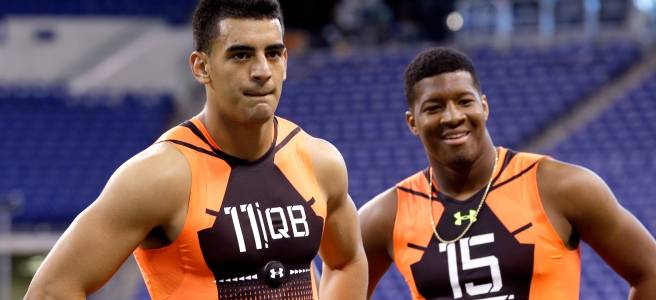
56. Marcus Mariota

Jameis Winston or Marcus Mariota? That was the question of the 2015 draft, but all I remember saying is that you really hope a quarterback who threw 105 touchdowns to 14 picks with 9.3 YPA in college turns out great in the pros. Mariota’s very first game in the NFL was against Winston’s Buccaneers too, and he had a perfect passer rating with four touchdowns on 13-of-15 passing, the best start you can ask for.

It would be a lie to say it was all downhill from there, but it never got to the point you wanted to see from the No. 2 pick in the draft. Mariota showed a lot of promise with 26 touchdowns in his second season, but he ended up throwing more picks (15) than touchdowns (13) in his third season. The Titans still made the playoffs as they were stuck on their 9-7 run, and they even beat the Chiefs in what I call the Forward Progress Game where the Titans got multiple favorable whistles. But Mariota was only 30-33 as a starter and lost his job to Ryan Tannehill in 2019, who took the team to new heights.

Starting in 2018, Mariota was turning into a sack machine with a sack rate of 12.0%. He could pad some stats with dink-and-dunk throws, but the offense was just not working out. He was impressive in his lone game with the Raiders last year, coming off the bench for an injured Derek Carr and taking the Chargers to overtime. We likely have not seen the last of Mariota as a starter, but when it comes to who won the 2015 draft, the answer really is neither team.

55. Jameis Winston

I almost had the gall to sandwich Matt Cassel in between Mariota and Winston but decided against it at the last minute. Replacing Drew Brees in New Orleans is a huge opportunity for Winston to show what he’s made of, especially with his LASIK-improved vision in a Sean Payton offense. But right now, we just have his five years with Tampa Bay where he was 28-42 as a starter to go on.

He was certainly a prolific yardage machine there. He is the first QB ever to throw for 450 yards in consecutive games. Throwing 33 touchdowns and 30 interceptions in the same season is something I did not think I would see in this game. It speaks to the good and the bad of Winston, which has yet to really balance out for a great season by him, but he also does not have what I’d call a poor season on his resume.

Winston’s 7.72 YPA is the ninth highest on this list. There have always been interesting stats to find on him.

I am excited to see what happens this year as Winston could be the wild card of the 2021 season, but I hope this guy eats some more W’s.

54. Mark Brunell

Amusing stat: Mark Brunell had a nine-year streak of seasons where his passer rating ranged from 82.0 to 92.0. No other QB in NFL history had such a streak longer than four seasons (min. 50 attempts). That is some applaudable above-average consistency. Unfortunately, most of that streak came prior to 2001. After that time, Brunell had a couple decent seasons with Jacksonville that did not reach his 90s peak, so the team replaced him with Byron Leftwich.

But in 2005, Santana Moss joined Brunell in Washington and the duo had a very impressive season together, including one of the greatest comebacks I’ve ever seen. That led to the playoffs where Brunell had one of the worst playoff wins I’ve ever seen, and I’ll never forget it since I was sitting in a frozen room in a hoody because the furnace broke that weekend.

Brunell never achieved anything after that 2005 season but doing anything that makes Washington notable is a big plus in my book.

53. Kerry Collins

I stand by the belief that Kerry Collins is the worst 40,000-yard passer in NFL history. But the truth is you still have to be somewhat decent to even play long enough to hit that mark. Collins had some fine moments in his career, and his only 4,000-yard season in 2002 with the Giants should have led to a playoff win in San Francisco before his defense and special teams botched that one.

It still blows my mind that a team with Collins at quarterback and Jeff Fisher as head coach was 10-0 and finished as the No. 1 seed in 2008, but that happened. Collins was also not that bad in the one-and-done playoff loss to a tough Baltimore defense. His skill players lost multiple fumbles.

The standards at the position have changed so much that I do not think Collins would last long in the league if he played today at his level. He also had some immaturity and locker room issues early on that would not fly in today’s social climate. I feel like this ranking is pretty generous, though we are still about 20 quarterbacks away from the tier where I start considering these players to be good and reliable.

52. Teddy Bridgewater

I was definitely Team Teddy in that 2014 draft. I thought he should have been a higher pick and I liked him over Blake Bortles, Johnny Manziel, and Derek Carr. The football gods were less supportive. Bridgewater lost his only playoff game to the 2015 Seahawks after Blair Walsh choked on a short field goal, then he suffered a gruesome knee injury prior to the 2016 season.

It is impressive to see him resume his playing career, and he did some good things for the Saints (2019) and Panthers (2020). But it feels like there has always been this ceiling on his game that prevents him from ever taking the next step. He plays way too safe for my liking. Bridgewater has three seasons where he threw at least 400 passes, and he threw 14 or 15 touchdowns in all of them. That’s not enough in this era.

After updating my stats, I am curious to see if this is the year where Teddy falters badly against the spread with Denver seeing as how he has covered over 70% of the time as a starter. You know the drill. That is a signal to bet the other way as the regression is coming. Going to Denver did not work out well for our last quarterback in part III.

51. Case Keenum

If you have followed me religiously on Twitter for years, then you may recall that there was a user in 2016 who I dubbed “White Dude with Dreads” and he was in love with Case Keenum. This was a season where Keenum finished last in QBR, though teammate rookie Jared Goff would have been even worse if he qualified after taking over for Keenum. But this dude would bash Jeff Fisher and everyone with the Rams while praising Keenum for everything. It was all very amusing to me.

Back when I used to actually watch college football on a weekly basis, I liked catching Keenum games with Houston. He was one of those system quarterbacks in the run-and-shoot offense that put up such prolific numbers, but he looked different than a Timmy Chang or Colt Brennan or Graham Harrell. Like you could actually see this guy releasing the ball quickly and having success in the pros. Keenum had six 500-yard games and even threw nine touchdowns in one game before.

He got to stay in Houston after joining the Texans as an undrafted free agent. He even started the back half of the 2013 season after Matt Schaub’s career imploded there. Keenum finished 0-8 as a starter but definitely played winning football in a few of those games. I was happy to see him have some success after getting an opportunity in the NFL. But with the Rams, I was not seeing much to like from Keenum anymore. He threw four picks in London against the Giants, and that started a three-game streak where he failed to lead the team to more than 10 points, which gave way to the Goff era.

Keenum went to Minnesota to back up often-injured starter Sam Bradford. Sure enough, Bradford’s knee was an issue after just one game, thrusting Keenum into the starting job against Pittsburgh in Week 2. The Steelers won that game 26-9 and I was not impressed with Keenum. A few weeks later, Keenum replaced Bradford for good after Sam’s knee made it impossible for him to play. Little did I expect Keenum to go on one of the greatest outlier, one-year-wonder, flash-in-the-pan, call it what you will seasons in NFL history.

The Vikings finished 11-1 in the last dozen regular season games with Keenum completing 69.3% of his passes with a 99.3 passer rating. It was an awful year for quarterbacks getting injured (Aaron Rodgers, Andrew Luck, Carson Palmer, Ryan Tannehill, Carson Wentz, etc.), and that certainly helped Keenum in the rankings, but he still finished No. 1 in DVOA and No. 2 in QBR. The White Dude with Dreads had already moved on to politics and fighting the good fight against MAGA, but he had to be ecstatic about this unexpected development.

Then the playoffs happened. The Minneapolis Miracle to Stefon Diggs was a fortunate missed tackle that gave Keenum his first and only playoff win, but that happened. It seemed like the Vikings were destined to host the Super Bowl in their home stadium, but maybe I forgot the history of the Vikings that year. In the NFC Championship Game in Philadelphia, Keenum threw a pick-six early that changed the complexion of the game and set off a 38-7 rout.

Even the Vikings had to suspect there was some fool’s gold hidden in that 2017 season, so Keenum was not re-signed and went to Denver while Minnesota made a move for Kirk Cousins. Keenum threw for a career-high 3,890 yards in 2018 with the Broncos, but the team finished 6-10. He was also 1-7 as Washington’s starter in 2019. Now he is Baker Mayfield’s backup in Cleveland.

So, now you know my favorite “One-year Wonder/Crazy Unexpected Peak Year” in the 21st century. We are not quite done with the one-year wonders, but I need another break before getting into this top 50. I already managed to go over 11,000 words with the first 50, so this is taking on more of a time commitment than I expected, but I hope you are enjoying these trips down memory lane.

Part I (#100-87)

Part II (#86-72)

Top 100 NFL Quarterbacks of the 21st Century: Part II (86-72)

Including the playoffs, there are 100 NFL quarterbacks who have started at least 30 games in the last 20 seasons (2001-20). In part I, I began to rank these quarterbacks from No. 100 to No. 87.

Why stop at 87? I am viewing this list in tiers, and those 14 quarterbacks were the worst of the bunch. Here in part II, I will be looking at more serviceable players who never sustained success but may have had that one special season. The fact that half of this top 100 list is comprised of players who either sucked or were nothing special should serve as a reminder of how difficult it is to find a good quarterback.

86. Gus Frerotte

He peaked with Washington back in 1996, but most people will remember him for headbutting a wall and injuring his neck. Frerotte actually had winning seasons as a starter with the 2005 Dolphins (9-6) and 2008 Vikings (8-3), but he was not good in either of those seasons. For a Randy Moss appreciation stat, consider that Frerotte only started two games with Moss as his receiver in 2003, and he threw five touchdowns to him in those two games.

85. Tarvaris Jackson

Remember when the Vikings tried to replace Daunte Culpepper and Randy Moss with Tarvaris Jackson and Troy Williamson? That didn’t quite work as the two connected on one touchdown together. I don’t want to speak ill of the dead here as Jackson unfortunately passed away last year at the age of 36. He was the bridge quarterback between Matt Hasselbeck and Russell Wilson in Seattle, and he won a Super Bowl as Wilson’s backup.

84. Brian Hoyer

The number of times the Patriots have signed, cut, and brought Brian Hoyer back since 2009 is pretty incredible. They just did it again, cutting him before expecting to bring him back prior to Week 1. There was a time in 2013-15 with the Browns and Texans where Hoyer was 15-10 as a starter with 36 TD, 23 INT, 7.3 YPA, and 83.2 passer rating. Not bad for an undrafted QB with poor college stats. He also looked solid for the Bears in 2016, but since that time he is 1-12 as a starter with stats that are not that far off from the line I just posted.

83. Jacoby Brissett

Brissett started 15 games in two different seasons for the Colts due to Andrew Luck’s season-long injury in 2017 and surprise retirement before 2019. He ranked 26th and 21st in QBR in those seasons, but at least he kept the interceptions low and showed he could take fewer sacks under Frank Reich’s offense in 2019. I would not rule out the days of him starting being completely over, but with the way teams draft high picks to play quarterback now, a career backup is the most likely outcome for Jacoby.

82. Sam Bradford

If I was writing this one in true Sam Bradford form, I would require you to pay to read something where even the best parts barely pass for mediocre. I was never on board with Bradford in the NFL. He got praise as a rookie just because he had a high volume of attempts and the team finished 7-9 in one of the worst divisions ever (2010 NFC West won by 7-9 Seattle) a year after going 1-15. Of course, most of the wins were powered by the defense. Bradford regressed in 2011, went through an injury period, had a bump in play in 2012-13, got injured again, then had a misleading stat line in Chip Kelly’s system in Philadelphia before setting an NFL record with a 71.6 completion rate in Minnesota in 2016. But that offense was not good and he still finished with a losing record.

Maybe 2017 would have been the magical year where he finally put it together, but his knee failed him again and Case Keenum stole the spotlight. Bradford joined the Cardinals in 2018 and was abysmal in three starts and cut before the season ended. He still got $15 million guaranteed for that season.

Bradford’s career felt like a Ponzi scheme. Get drafted No. 1 overall, convince people you’re the real deal, then just fleece multiple teams for a decade. Bradford’s rookie contract had a maximum value of $86 million, an absurd amount for someone who had yet to play a down in the NFL. Fortunately, the 2010 draft was the end of that CBA and teams got wiser on rookie deals starting in 2011.

But Bradford was still able to make $130 million in his career. It is practically impossible to name another player who did less and earned more.

81. Shaun Hill

I am still president of the Shaun Hill fan club. #ThatsMyQB.

In all seriousness, Hill was one of the best backups in the league. What made him so interesting to me is the way he outperformed No. 1 overall picks that I never was sold on like Alex Smith and Sam Bradford. He did this while being their teammate too, so you could compare their performance with the same coaches and players around them. He even had a better season with the Lions in 2010 than Matthew Stafford had in his first two injury-plagued seasons.

No team ever really chose Hill to be their intended starter. It was always an injury situation or benching that got him on the field, but for a backup, he was more than solid.

80. Matt Moore

He was no Tony Romo, but as far as undrafted quarterback success stories go, Moore is one of the better ones this century. He had some decent games with the Panthers and Dolphins, even starting a playoff game in place of an injured Ryan Tannehill in the 2016 season. Moore also went 1-1 as a starter for the 2019 Chiefs when Patrick Mahomes dislocated his kneecap. That close win over Minnesota was crucial in keeping the Chiefs in line for the No. 2 seed and a bye, which helped them win a Super Bowl.

Moore averaged 7.13 YPA and a 87.4 passer rating for his career, which makes him the only QB on my list ranked 100 to 64 that broke 7.0 YPA and the second to break 85.0 in passer rating.

79. Derek Anderson

Before he came out as a right-wing meathead on Twitter, Anderson was a one-year wonder in the 2007 season for Cleveland. He really came out of nowhere to throw 29 touchdowns, make the Pro Bowl, and lead the Browns to 10 wins, the team’s best offense and season from 1995-2019.

But I always warned people that his one-year wonder season was closer to a half-season wonder. In the last eight games, Anderson completed 55.6% of his passes with 12 touchdowns, 10 interceptions, 6.22 YPA, and a 73.7 passer rating. That’s the kind of stat line that looks painfully familiar to Browns fans as it is not good enough to win in this league. Cleveland scored 30 points just once in those final eight games after doing so three times in the first half of the season when Anderson’s YPA was a strong 8.20.

Predictably, Anderson turned into a pumpkin in 2008, completing 50.2% of his passes with 5.71 YPA and a 66.5 passer rating. His only highlight with the 2010 Cardinals was this “Nothing is funny to me!” meltdown.

78. Tim Couch

While people often defend No. 1 quarterbacks for underperforming, I usually find myself not buying those defenses. I think David Carr and Sam Bradford were just never going to be good in this league. I think Alex Smith needed an incredible amount of time and talent around him before he finally showed he could be adequate under Jim Harbaugh.

But a No. 1 pick labeled a bust who I always defend is Tim Couch. I think the Browns did a horrible job of building a team around him and hiring good coaches. Yet I always pointed out how the Browns were doing better with Couch as their starter than anyone else.

That was through 2012 but given the way the Browns performed prior to Baker Mayfield’s arrival, I am confident it would show the same results that the Browns won more games and got better QB play with Couch. He was sneaky good with the game on the line, leading the Browns to 10 fourth-quarter comebacks and 11 game-winning drives, including four in that 2002 playoff season where Kelly Holcomb got the playoff start. Before Aaron Rodgers became the ultimate Hail Mary QB, Couch won two games with a Hail Mary touchdown against the 1999 Saints and 2002 Jaguars.

People want to talk about the Texans breaking Carr with the sacks, but let’s look at Couch. He took a league-high 56 sacks as a rookie in 1999 and had a horrific sack rate of 12.3%. He cut that down to 4.4% in his second season. In all five of his seasons, his passer rating ranged from 73.1 to 77.6. Not good, not much progress, but at least there was some consistency there. I truly believe with a better team and better health luck that he could have been a decent starter.

77. Josh McCown

Even before he was a Zoom quarterback and the oldest practice squad player ever in 2020, McCown had one of the strangest careers in NFL history. Perhaps his most memorable moment is when he threw a 28-yard touchdown pass on 4th-and-25 to knock the 2003 Vikings out of the playoffs in Week 17. That was a thrilling moment, and yet, McCown went on to compile one of the worst records in NFL history in crunch time. He was 6-37 (.140) at 4QC opportunities and 7-40 (.149) at game-winning drive opportunities.

The 2017 season with the Jets is McCown’s most prolific year with 2,926 yards and 18 touchdown passes. Otherwise, he never had more than 13 touchdowns in any year. But the best he ever played was in 2013 with the Bears. He threw 13 touchdowns to one interception for a 109.0 passer rating. He finished that season with a positive DVOA under pressure, which almost never happens as all quarterbacks play worse when pressured.

McCown’s only playoff action came at the age of 40 after Carson Wentz was injured in the 2019 wild card against Seattle. It made him the oldest quarterback to ever make his playoff debut. McCown finished the game despite tearing his hamstring off the bone in the second quarter. He was no doubt a competitor, but he was like the RC Cola version of Ryan Fitzpatrick.

Speaking of the Jets…

76. Mark Sanchez

The first quarterback on the list with playoff wins in multiple seasons. But will Sanchez be better remembered for going to two AFC Championship Games or The Butt Fumble? Yeah, I think the answer to that is obvious. It is quite arguably the funniest play in NFL history. And to think Sanchez (94.3) still has a higher career playoff passer rating than Tom Brady (90.4), topped off by his best playoff game coming against one of Brady’s best teams in that 2010 season.

Sanchez had seven game-winning drives in those first two seasons, and a few were really impressive ones in the final minute of the game. He was so erratic, and the run game and defense really carried him at times, but it would still be hard to call him a bust. A disappointment for sure, but much like Brock Osweiler, Sanchez’s existence in this NFL timeline served a few purposes for me that I will always appreciate.

75. Vinny Testaverde

Such a Jets thing to talk about a quarterback with a so-so season who still snuck into the playoffs. Old man Vinny got the Jets there in 2001 after leading five comebacks on the way to a 10-6 finish. They lost in the first round to the Raiders. But that was the end of Testaverde’s success in New York. He started 15 games for the Cowboys in 2004 at the age of 41, which was very unusual at the time. He even started six games at 44 for the Panthers in 2007, the end of his career.

Testaverde (six), Warren Moon (one), and Steve DeBerg (one) are the only quarterbacks to start a game in their age-44 season. None of them were still playing at 45. That would be great if this remained the case…

74. Blake Bortles

On the one hand, Blake Bortles is one of 15 quarterbacks in NFL history who can show their resume has a season with 35 touchdown passes AND that they won a championship or led by double digits in a championship game.

Those things really happened. On the other hand, there is a statistical argument that 2015 Bortles is the worst season with 35 touchdown passes in history as he was a Garbage Time God who led the league in interceptions (18) and sacks (51). As for the 2017 playoff run that nearly gave us a Bortles-Foles Super Bowl, that was Jacksonville taking full advantage of season-ending injuries to Andrew Luck and Deshaun Watson in the division. They then took advantage of a Buffalo team that had no business being in the tournament, but silly tie-breaker rules made it happen, and Bortles won that game 10-3. Of course, his crowning moment was that 45-42 win in Pittsburgh in the divisional round, a game I only wish I could blame Dick LeBeau for since it was the most embarrassing thing since Tebow 316.

But after blowing the lead to the Patriots in the championship game, it was all downhill from there for Bortles. He lost his last eight starts for the Jaguars and was already off the team by 2019. He has not started a game since, but with his mobility and experience, I would not rule out that we’ve seen the last of him in this league.

In a better world where #MylesJackWasntDown, Bortles would have been an unlikely Super Bowl starter.

73. Tommy Maddox

What does Maddox have that the other 27 quarterbacks really could not claim since 2001? He had a good individual season that led his team to the playoffs where he continued to play well. He was not carried by the Pittsburgh defense in 2002 because the defense was poor that year. The offense was too to start the season after Kordell Stewart failed to sustain his success. Maddox replaced Stewart and led a comeback win against the rival Browns in a rare year where they were a winning team.

Maddox kept the job, the offense shifted to a quick passing game that was successful, and he overcame an injury scare to return in December. His first game back against expansion Houston is one of the most infamous shitshows in NFL history. Maddox had three turnovers that were returned for touchdowns in the 24-6 loss. Pittsburgh was a 14-point favorite and lost the game at home despite outgaining Houston 422 to 47 in yards. Proof that you can rush a quarterback too early from injury.

But Maddox regained his composure, and he even went into Tampa Bay and finished 17-of-23 for 236 yards and a touchdown in a 17-7 win. That was against one of the best defenses in NFL history and a team that went on to win the Super Bowl. In the playoffs, the Steelers were down 17 points at home to Cleveland before Maddox led one of the all-time great comeback wins. He passed for 367 yards and three touchdowns in a 36-33 win. A week later in Tennessee, the Steelers were again in a high-scoring game and lost 34-31 in overtime after kicker Joe Nedney flopped to draw a running into the kicker penalty. Maddox played admirably in the loss.

A decade after he was a first-round bust, Maddox came out of nowhere that season to finish third in TD%, fourth in YPA, and 13th in pass DVOA. He failed to repeat this success in 2003 as a 6-10 finish led to the Steelers drafting Ben Roethlisberger in 2004. Maddox started two games in 2005 as the third-string quarterback and played horrifically in two overtime losses that had so much to do with the team only being a sixth seed on their way to winning a Super Bowl.

But as a Steelers fan, you really have to say thanks to Maddox, who changed the course of football forever in Pittsburgh. Thank you for an entertaining 2002 season that put an end to the Kordell era. Thank you for a subpar 2003 that led to drafting Roethlisberger. Thank you for getting injured – relax, it wasn’t serious – in 2004 and letting Roethlisberger take over early. Thank you for playing like ass in 2005 so that the team had proper motivation as a sixth-seed underdog to win Bill Cowher a Super Bowl.

Thank you, Tommy.

72. Jon Kitna

As a Pittsburgh fan, I probably have more respect for Kitna than the average NFL fan. He was clearly never a great quarterback, but his three biggest moments all arguably came against the Steelers. In 2001, he threw the ball 68 times in a 26-23 overtime win against a Pittsburgh team that finished 13-3. It is the only loss in Bill Cowher’s career where the Steelers led by more than 10 points as Cincinnati trailed 14-0 early.

In 2003, Kitna had his finest season right after the Bengals drafted Carson Palmer No. 1 overall. He was down 20-17 in the final minute in Pittsburgh, but after getting the ball at midfield, he only needed two throws to get in the end zone for a game-winning touchdown. Kitna finished that season with 26 touchdowns and the Bengals finished 8-8, a big deal for a team that had been so bad for so long. This paved the way for the Palmer era. But when Palmer was injured on the first drive against Pittsburgh in the 2005 wild card game, Kitna had to step in. He played well early, and the Bengals twice led by 10 points, but the defense faltered and Cincinnati lost. It was Kitna’s final game with the team.

Kitna had back-to-back 4,000-yard passing seasons for Detroit, but under Mike Martz’s scheme, he took a beating in the pocket. Detroit finished 7-9 in 2007, the team’s best record since 2000. But Kitna started four games during the 0-16 campaign in 2008. He later had some decent games with the Cowboys in 2010 after Tony Romo was injured. He may have had a better career if he played for franchises that were not so dysfunctional.

Top 100 NFL Quarterbacks of the 21st Century: Part I (100-87)

As I get ready for the 2021 NFL season, an update to my largest database – stats on every game since 2001 – gave me an opportunity to write about a perfect collection of round numbers.

Including the playoffs, there are 100 quarterbacks who have started at least 30 games in the last 20 seasons (2001-20). If you love top 100 lists, the central limit theorem, or the 21st century, then there is something there for you. As we near the 20-year anniversary of 9/11, I thought this would be a good time before final predictions to reflect on these two decades of football given that 2001 was the first season where I really became a die-hard viewer of all things NFL. It was the season where I started watching far more than just the Steelers game and the occasional Monday Night Football game and the Super Bowl.

So, how about a ranking of those 100 quarterbacks? This is an exercise I like to do every few years to test where my values are in analyzing quarterback play. How does one weigh a career like Josh Allen’s after he blew up in his third season to someone like Matt Schaub, who had several years of solid play (2007-12) but never up to the level of Allen’s 2020?

What really stood out to me about this process was just how difficult it was to sort the quarterbacks ranked 18-86. The top and bottom of the list came together rather easily, but in between there was a lot of mediocrity and tough calls.

But right now, this first part is focusing on the bottom 14 quarterbacks. Remember, a player had to start at least 30 games to make the list. I have seen plenty of worse quarterbacks play in the NFL in the last 20 years: Nathan Peterman, Ryan Lindley, Curtis Painter, Caleb Hanie, JaMarcus Russell, Cody Pickett, Jeff Tuel, etc. Who said you need experience to suck so good? (I can make that joke since being the host of Jeopardy! is not in my future.)

On to the list…

100. Blaine Gabbert

It pains me to see that Blaine Gabbert has more Super Bowl rings than Dan Marino and Andrew Luck (and many others) combined. Even more painful than Cecil Shorts in 2012 (Colts fans know that one). But seriously, Gabbert may be the worst quarterback in NFL history who got to play this many games. By getting in a game against Detroit and throwing two touchdowns so that Tom Brady would not get all the stat-padding, Gabbert broke the 1,500-attempt mark that day to officially qualify for NFL rate stats. His 72.3 passer rating is hardly the worst of all time because the era we are in will not allow it. But his ANY/A+ at Pro Football Reference, which does adjust for sacks and era, is 77, beating out Rick Mirer (80) and Kyle Boller (82) for the lowest among all passers with at least 1,500 attempts.

Gabbert is also such a chickenshit quarterback that he makes Alex Smith look like Aaron Rodgers when it comes to throwing past the sticks on third down. I may have called the stat BLAINE instead of ALEX had I known better. Behind Line Attempts Is Nurturing Existence. It just doesn’t flow as well.

99. Joey Harrington

Yikes, what a draft class in 2002. David Carr went No. 1 to expansion Houston and couldn’t stop taking sacks. Joey Harrington went No. 3 to Detroit and couldn’t get rid of the ball quicker. He wanted no part of that smoke. Harrington still has two of the top 10 seasons in lowest sack% in NFL history. Unfortunately, it made him lead ineffective offenses. Harrington was 1-11 when he threw for at least 255 yards. He was 1-34 as a starter when his team allowed more than 21 points.

My top memory of him was in 2004, his best season. He threw for a season-high 361 yards and what should have been a game-tying touchdown to force overtime with the Vikings. But the Lions botched the extra point and lost 28-27. Harrington looked crushed on the sideline. At least he got some revenge with three touchdowns on Detroit as a member of the Dolphins in 2006. But in six seasons as a starter, Harrington never cracked 6.5 YPA in any season. His 5.79 YPA is still the lowest in NFL history, and if you know how much I like that stat, then you know he was going to rank near the bottom of this list.

98. Kyle Boller

This may be stretching the truth, but let’s go with the alleged story that Brian Billick and the Ravens drafted Boller in the first round because he could throw a football 70 yards from his knees. That sure came in handy as he struggled to throw for 70 yards in the first half of games. But that night in 2007 when this bust nearly upset the unbeaten Patriots was when I knew that team would not go undefeated. Not when you should have lost to Kyle Boller a week after A.J. Feeley gave you a scare.

I did not plan this, but my first three quarterbacks have the lowest YPA of any quarterbacks to enter the league this century and throw at least 1,500 passes. Harrington (5.79) and Boller (5.88) did not even crack 6.0 YPA, but Gabbert (6.08) actually looks worse if you adjust for era.

97. Trent Edwards

Any quarterback known as “Captain Checkdown” will be on my shit list. Oddly enough, Edwards was probably still better in the pros as a third-round pick than JaMarcus Russell and Brady Quinn were in that 2007 class. But I gave up any hope for him after that 2009 opener against the Patriots when the Bills literally coughed up a 24-13 lead by fumbling a kickoff in between touchdowns. All Edwards had to do was lead a game-winning field goal drive, but he took two sacks and that was that. Not sure I ever watched another game from him.

96. Colt McCoy

Fun fact: McCoy has the worst record as a starter against the spread (9-20-1, .317) of any of the quarterbacks in this top 100.

My memories of McCoy are from college when it was so sad to see him injured at the start of a national championship game. In the NFL, I definitely saw his first start against the Steelers in 2010, a 28-10 loss where he was not that bad given the circumstances. Then the Browns upset the Saints and Patriots, but those games were more about the defense and making a Madden cover star out of Peyton Hillis than anything McCoy did.  Sounds like the Seattle upset last year he started for the Giants. He threw for just 105 yards in that one. He is still in the league (Cardinals), but if I had to venture a guess at something McCoy is actually good at, I would go with standing for the national anthem.

95. Christian Ponder

I never believed in Ponder, but it would have been nice if he got to start that 2012 NFC wild card game in Green Bay instead of Joe Webb. Especially since the Vikings beat the Packers in Week 17 with Ponder having arguably the best game of his career. But he was someone who had to be carried by a running game (Adrian Peterson). Ponder had 136.8 rushing yards per start to support him in his career. The only other quarterback in this top 100 with more than 130 yards per game is Jimmy Garoppolo (139.2), but we know Ponder never had a season like Garoppolo had in 2019. He never had a five-game run like Garoppolo did when he joined the 49ers either.

94. Rex Grossman

The Sex Cannon himself. It is still hard to believe the 2006 Bears got to the Super Bowl with this guy. He may have started the “will good [QB name] or bad [QB name] show up today?” with his play being so erratic that year. His performance against the Cardinals on Monday Night Football that year gave us the great Denny Green meme that will live in infamy, and it’s also the worst quarterback performance you will ever see during a 20-point comeback win.

If “Peyton Manning won his only Super Bowl with the Colts against Rex Grossman” is a diss, then maybe Drew Brees and the Saints shouldn’t have lost to them by 25 points in the damn NFC Championship Game. That one always bugs me. Amusingly, Grossman swept the 2011 Giants with Washington. Yep, the same Giants that swept the Patriots that year and won the Super Bowl.

The only positive thing I’ll say is that Grossman had that “fuck it, I’m throwing deep” mentality that is refreshing to see in a league where guys like Gabbert and Edwards play so scared. This is why Grossman is ranked a little higher because he could actually have some decent games. But his lows were also really god damn low.

93. J.P. Losman

If the 2004 quarterback class is compared to the 1983 quarterback class, then I guess Losman is the Todd Blackledge eyesore of the group. Go figure, Buffalo picked the rotten apple. But looking at his stats again, I am amused that he raised his completion percentage from 49.6% in 2005 to 62.5% in 2006, his best season. Wow, I thought only Josh Allen did that kind of increase?

Relax, #BillsMafia. Allen was much better in 2020 than Losman was in 2006, which proved to be fool’s gold as he never got better. But at least that 2006 season was better than anything Captain Checkdown Trent Edwards did for the team.

92. Chad Henne

Man, this guy went 0-4 against Ohio State only to get payback on the Browns in the playoffs 12 years after being drafted. F’n savage. Yes, Henne finally has a career moment after stepping in for an injured Patrick Mahomes last postseason. He scrambled unexpectedly for 13 yards on a third-and-14 before icing the game with a fourth-down completion to Tyreek Hill.

What else can I say about Henne? He is tied with John Elway and Steve McNair for the most seasons in NFL history (three) with no more than 15 touchdown passes on at least 450 pass attempts. Also, I don’t feel like updating this, but Henne has barely played since 2014 so the numbers probably are similar. Apparently, he has had some great fumble luck.

Finally, with the way the game is going statistically, it is very likely that Henne will be the last player who will ever have three seasons with more interceptions than touchdowns (min. 400 attempts).

91. Sam Darnold

I may be hedging a little that he will get better away from Adam Gase and the Jets, but so far, I am not buying anything Darnold is selling except that 46-yard touchdown run against the Broncos last year. That was a sweet play, but overall, he’s a sub-60% passer who takes an inordinate number of sacks and throws too many picks. He has also been trending in the wrong direction, but Carolina is a fresh start for him. Just sweep for ghosts first.

90. Geno Smith

Christ, do you see why the AFC East played out the way it did for two decades? I’m on my 11th quarterback, and so far, we have two draft picks by the Bills, one by the Dolphins, and two by the Jets. Believe it or not, Geno was once thought to be an option for the No. 1 pick to the Chiefs in that dreadful 2013 draft.

Smith led five game-winning drives as a 2013 rookie, but I know somewhere I wrote that they weren’t impressive ones. The one against the Patriots in overtime saw him complete just one 12-yard pass early in the drive. Everything else was a run. Geno just never sold me. He made modest statistical improvement in 2014, but the team got worse, and he only has started two games since. Just a brutal quarterback draft where Smith is in competition with Mike Glennon and EJ Manuel for best in class.

89. Quincy Carter

Carter last played for the Jets (2004), but he was supposed to still be Dallas’ starter that season. However, the team cut him in August after substance abuse problems. This actually saved Tony Romo’s roster spot that year as an undrafted player in his second year. But Carter was carried by the defense to the playoffs in 2003 and was never anything special. His most notable game, which was his only 300-yard game and his only high-scoring win, started with a pick-six actually against the Giants on MNF. The Cowboys won 35-32 in overtime, but just getting there took a 26-yard completion from Carter in the final seconds to tie the game.

To think, we may never have seen Romo do anything in this league if Carter was more professional in his youth.

88. David Carr

Once upon a time, Carr was only the third true rookie quarterback to start 16 games, joining Rick Mirer and Peyton Manning. We did not see this again until 2008 when Matt Ryan and Joe Flacco flipped the script on starting rookies in Week 1. Now, we see it all the time, but it was a bit risky to do that to Carr on an expansion Texans team that was not good like the Panthers and Jaguars were in 1995.

Carr took a beating that first year and was sacked 76 times, an NFL record unlikely to be broken. His 68 sacks in his third season (2005) rank third all time. Carr’s career sack rate (10.54%) is the highest in NFL history by anyone not named Greg Landry.

But I feel like Carr’s career is a good case study in QB statistics. I was in high school when he came into the league, and given all the historic sack numbers he was taking, this led naïve, inexperienced me to believe that sacks are an offensive line stat. It’s all on the line to protect the quarterback. Of course, as I gained experience in studying the game, I saw that sacks are much more of a quarterback stat. He must get rid of the ball in a timely fashion or else you get pressure and sacks. The line obviously still shares some of the responsibility, and quick sacks can be utilized to place proper blame, but overall this is more reflective of the quarterback’s performance than the line’s.

While Houston was absolutely weak in the OL department in Carr’s career, note that he went to Carolina in 2007 and still had a sack rate of 8.7%. I think if we had the advanced metrics for Carr’s Houston career, we would have seen a quarterback who did his line few favors.

Then there is completion percentage. Carr’s 2006 season under new coach Gary Kubiak always felt so fishy to me because he led the league in completion percentage at 68.3%, which was one of the highest seasons ever at the time. But he was 24th in DVOA, 21st in QBR, threw more picks than touchdowns, and the offense was still 20th in yards per drive and 23rd in points per drive. Carr’s other numbers were just bad. It was a lot of dinking and dunking to cut down on sacks and boost that completion percentage. This season felt like a blueprint for Sam Bradford to follow years later and make completion percentage a meaningless metric when depth of target is not taken into account.

So, Carr had a pretty shit career and I think he would have been a bust in any city. With that said, do you think this tweet had anything to do with all three Carr brothers blocking me on Twitter?

Truthfully, I think I was already blocked before it. I’ve pulled no punches in saying that this is the softest family in football. These guys do not handle criticism well at all, and now we see David showing a lot of favoritism for his brother as a media analyst.

So, why even rank him this high? His 2004 season is probably the best season by any of the quarterbacks listed so far. He was not carried to team success like a Ponder or Grossman or Carter. It actually seemed like Carr turned the corner, and despite still taking a league-high 49 sacks, he cut his percentage down and the Texans had somewhat of a functioning offense (14th in yards per drive, 21st in points per drive). This was Andre Johnson’s second year on the team, and there is nothing wrong with giving your young quarterback a legit No. 1 receiver.

Of course, we learned that playing the defenses of the 2004 AFC South and NFC North were very beneficial to putting up great numbers that year, one where all offensive numbers were up after the NFL reminded officials that illegal contact after five yards is still a rule. If that schedule boost helped produce career years for Peyton Manning and Daunte Culpepper, it could also work for Carr and Joey Harrington as both peaked that season and never came close to repeating it.

If Carr was “broken” by his 2002 rookie situation, then 2004 never should have been possible, right? This is why I will never buy into the idea that you can “ruin” a quarterback by playing him too early. The only way that happens is if you physically break him, which is something that could happen in Joe Burrow’s case with Cincinnati’s offensive line. But I’m not even sure we got to October last year before I could confidently say that Burrow will be better in the NFL than this original Carr brother was.

87. Brock Osweiler

If Robert Pattinson was six inches taller and had no discernible talent, he would be Brock Osweiler. This is a hard one since I know that 2016 season in Houston was awful, and the playoff win against the Raiders was some Connor Cook’d up bullshit. But unlike the first 13 players here, Osweiler did serve a role in helping a team win a Super Bowl, and helped my favorite player retire as a champion again.

While I always rejected the notion that Osweiler should have continued to start over Peyton Manning for Denver that year, I do not see an injured Manning getting those pivotal wins against the Patriots and Bengals that helped the Broncos secure the No. 1 seed and homefield in the playoffs.

Still, John Elway’s Tall QB fetish likely cost the Broncos a better shot at a dynasty by drafting Osweiler over Russell Wilson in 2012. He gave rise to a Seattle team that beat the Broncos convincingly in 2013 while screwing with the future of the team in the post-Peyton years. Imagine if Wilson got to step in there once Manning retired, which could have come sooner if 2013 ended with him on top after breaking multiple records that year. But nope, the Broncos won one ring, and when Osweiler came back in 2017, he failed to win a start for the team.

But I have to say his existence in this timeline came with some personal benefits.

Part II: Some of your favorite journeymen and one-year wonders coming soon (#86-51)

NFL Head Coaching Hires Guide for 2006-2021

More research on this to come later, but I wanted to share a graphic I’ve made that has every head coaching hire in the NFL dating back to the 2006 season. Not included are in-season interim coach jobs such as Raheem Morris taking over for the fired Dan Quinn with the 2020 Falcons.

But one thing you can see, teams really need to stop doing the in-house promotion thing and hire a new coach from somewhere else. Freddie Kitchens (2019 Browns) was the last one and we know how well that went. He is also the most recent head coach to go one-and-done.

CLICK TO ENLARGE

Same Old Browns? No, Same Old Steelers

“The definition of insanity is doing the same thing over and over again and expecting different results.”

When Steelers wide receiver JuJu Smith-Schuster brushed off Cleveland as being the “same old Browns” leading up to Sunday night’s game, he seemed to forget which team he was still playing for.

No team in the NFL keeps the status quo in check like the Pittsburgh Steelers. That’s why if they’re not playing down to the competition in a small game like the Bengals in Week 15, they come out looking unprepared for playoff games as well. They expect to win on the strength of their history alone when the other teams have Tim Tebow or Blake Bortles at quarterback or are missing their head coach and could not practice in person due to COVID-19 like the Browns just faced.

Following an 11-0 start, Pittsburgh spent a whole month watching its offense decay and fail to score 20 points. While defenses had caught up to arguably the most one-dimensional offense in NFL history, the Steelers did nothing to make any changes to it. One fortunate second-half comeback against the Colts was enough for the Steelers to blow off Week 17 and rest the stars for the playoff run to come.

“The standard is the standard” is head coach Mike Tomlin’s favorite phrase, and he now has as many one-and-done playoff losses (five) as he has seasons not making the tournament at all. Pittsburgh’s idea of analytics still looks like a random flip of the coin for when Tomlin decides to go for a fourth down or punt like a coward. Not to mention this team had two decades to figure out how to slow down the New England offense and never really did. After going 0-3 to Patrick Mahomes and Josh Allen since 2018, it is hard to believe the Steelers would have reached the Super Bowl anyway this season.

Unlike across the state in Philadelphia, winning that Super Bowl in his second season way back in 2008 has given Tomlin incredible job security and a shield from criticism for all the shortcomings since. Ben Roethlisberger winning his second Super Bowl in that second Tomlin season should have did the same, but off-field incidents from over a decade ago always left him as the scapegoat in Pittsburgh, even getting the brunt of the blame when the team had public falling outs with star players Le’Veon Bell and Antonio Brown.

With JuJu’s ill-advised bulletin board material as the latest proof, Tomlin still has no control over the egos in his locker room. The standard is the standard, and for Tomlin and Roethlisberger, the Steelers painted their masterpiece of disappointment and embarrassment on Sunday night, losing 48-37 to the rival Browns, a team Ben was 24-2-1 against and a team the Steelers had never lost to at home since he was drafted in 2004.

For perhaps the last time in the Roethlisberger era, let’s recap where the Steelers fell short on Sunday night.

For recaps of the other five wild card games, click here.

The Worst First Quarter in Playoff History

If you asked me how the 2020 Steelers were going to lose in the playoffs, I would have predicted a Buffalo rematch next week that looked like the Sunday night meeting the Bills won 26-15. One where the Steelers just didn’t have it offensively and the defense couldn’t get Josh Allen off the field enough. Or something uglier with turnovers like the Cincinnati loss, except against a better quality opponent and quarterback. All in all, a game where Roethlisberger was too inaccurate, and they sucked on third down and threw an obscene amount of passes way short of the sticks with too many drops. You know, like the whole month of struggles we recently saw from this team.

I never would have imagined the Steelers would essentially repeat their 2017 AFC divisional loss, 45-42, to the Jaguars and Blake Bortles. After last week’s 24-22 loss in Cleveland with most of the stars out, this game could not have gone any differently from that one. It looks far worse when Browns coach Kevin Stefanski wasn’t even there because of COVID and this team had not practiced all week.

Simply put, this game was decided in the first quarter, if not the first snap from scrimmage.

Center Maurkice Pouncey snapped the ball well over Roethlisberger’s head and the Browns were able to ultimately recover it for a touchdown just 14 seconds into the game. It’s the first NFL game to start with a fumble by the center since Super Bowl XLVIII, except Denver only gave up a safety to Seattle that time. It seems likely these are the only two times this has happened in NFL playoff history.

The Steelers only appeared to implode from there. Roethlisberger overthrew a short pass under pressure, and it was intercepted at midfield. The defense had a chance to force a three-and-out, but Jarvis Landry caught a short pass on 3rd-and-6 and turned it into a 40-yard touchdown. Landry gained 30 YAC on the play. His season high for YAC on a catch was 23 yards.

Pittsburgh allowed two 40-yard touchdown passes in this game with YAC totals of 30 and 42 yards. The Browns had one such play all season and that was 40 YAC after a 35-yard deep ball to Donovan Peoples-Jones. These were short throws, including a screen later in the game to Nick Chubb. In the regular season, Pittsburgh’s defense only allowed two touchdown passes with at least 15 YAC. They matched that in this one playoff game.

Down 14-0, Pittsburgh’s short-yardage rushing woes struck as Derek Watt was held to no gain on 3rd-and-1. At this point I joked about a long Chubb TD run coming next.

I was close. Chubb started the next drive with runs of 17 and 20 yards. Kareem Hunt finished the drive with an 11-yard touchdown run. The Browns led 21-0 with 4:40 left in the first quarter as the Steelers looked completely lost and unready to play this game in every phase.

To this point, Roethlisberger only made one mistake with the panicked throw getting picked off, yet he was down 21-0 already. I don’t feel that’s being taken into consideration at all when people criticize him for this game. The Steelers were getting dominated on every side of the ball at this point. It was only down 21-0 when he made another mistake that wasn’t even all on him. Diontae Johnson’s drops showed up again as a pass that was a little high above his head clanged off his hands and went to a defender for a second interception. Roethlisberger could have gotten the ball down a little, but there was bad luck to that pick.

That set up the Browns for a 15-yard touchdown drive capped off by Hunt again. Cleveland led 28-0 after the first quarter, a differential that has only happened 14 times since 1940. The only playoff game to start 28-0 after a quarter was when the 6-6-2 Oilers were crushed 56-7 by the Raiders in 1969. Out of the 14 teams to fall behind by 28 through a quarter, only the Steelers last night were able to lose by fewer than 17 points. But the point is they all lost.

You just cannot expect to turn the ball over three times and get outscored 28-0 in the first quarter and still win that game. Pittsburgh outscored the Browns in each of the last three quarters and 37-20 overall, but that first 15 minutes killed the season.

Look, games in this league almost never start out this dominant. We have seen plenty of mismatches over the years (think Chiefs-Jets this season), but 28-0 after a quarter is really hard to do, and it is especially hard to imagine in a playoff game between division rivals. This is only the fourth game where it happened between two teams who finished the season with a winning record.

However, it was just recently when the Browns led the Titans by 31 points at halftime and only won that game by six. So you had to figure the Steelers had a chance at a comeback. It would have been the ultimate Cleveland collapse, but the main reason that didn’t happen was the Pittsburgh defense failed to show up.

Pittsburgh’s Fraudulent Defense Exposed Again

In their last 78 games, the Steelers defense has registered a sack and/or takeaway in 76 of them. The only two games where they didn’t get a sack or turnover were their last two playoff games at home against the Jaguars and the Browns. Cleveland was even missing multiple starters on the offensive line.

Pittsburgh was on a streak of 31 straight games without allowing 30 points, tied for the second-longest streak in the salary cap era (1994-2020). That is really impressive when half the games came this year, the highest-scoring season in NFL history. Of course, Pittsburgh’s defense wasn’t facing Jeff Driskel, Jake Luton, Carson Wentz, Garrett Gilbert, or Ryan Finley last night. They allowed 48 to the talented Browns, the most Pittsburgh has allowed since the Jaguars scored 45 in the 2017 playoffs.

Are you sensing a theme yet?

Cleveland only scored 7 points in Pittsburgh in Week 6 with Baker Mayfield having perhaps the worst game of his career. But he now has his first 200-yard passing game in six starts against the Steelers. I already mentioned the two big YAC plays for 40-yard touchdowns that were so uncharacteristic for the Cleveland offense and Pittsburgh defense this year. Throw in not getting a sack or turnover and you are looking at a flat-out choke by this supposedly great defense. If you told me T.J. Watt and Cameron Heyward sat out this one too like they did in Week 17, I’d have believed it. They were ghosts last night.

Pittsburgh’s defense needed some kind of splash play to get this comeback going last night. It never came. After the Steelers got on the board in the second quarter, the defense had a chance to force a three-and-out and get the ball back. Instead, Mayfield scrambled for a first down on third-and-6 and turned that into a 64-yard touchdown drive. The offense was able to muster a field goal despite only having 28 seconds to work with. Pittsburgh trailed 35-10 at halftime.

The third quarter was Pittsburgh’s best defensively, but still no sacks or turnovers. They forced three punts and two three-and-outs. But when the defense had to get the ball back in the fourth quarter, they may have saved their worst for last, which is shades of the Jacksonville game all over again. Mayfield led an 80-yard touchdown drive with half of it coming on the Chubb screen. Cleveland led 42-23. A quick touchdown made it 42-29 with 11:08 left, so the game wasn’t over. Again, the defense was a major letdown, allowing the Browns to hold the ball for 6:40, gain four first downs, and add a field goal to make it 45-29 with 4:28 left. At that point you’re in total miracle territory and the game is essentially over. Roethlisberger threw his fourth interception with 3:16 left and the rest of the scoring was just going through the motions.

This talk that the Browns were conservative so Pittsburgh’s defense couldn’t get after them is bunk. Ryan Finley threw 13 passes against the Steelers in Week 15 and they still sacked him twice that night. Mayfield didn’t have to air it out 50 times or anything, but he still threw 34 passes and had multiple linemen out. There were chances to make plays for this defense. None were capitalized.

The loss was so eerily similar to the 2017 Jacksonville loss. In that one, Pittsburgh’s offense continued to score and make a game of it, but the Jaguars also scored 17 points in the fourth quarter. You can’t keep matching scores in a huge comeback attempt.

This disappointing defense is par for the course for Pittsburgh in the playoffs. While the offense tends to take the blame, the defense is usually the superior unit (top 10 ranked) in the regular season, only to fail in the playoffs.

  • 2004 (No. 1 scoring D): Allowed season-high 41 points to Patriots in 41-27 AFC Championship Game loss (pick-six included) after never allowing more than 30 points during season. Zero takeaways.
  • 2007 (No. 2 scoring D): Allowed at least 29 points to Jaguars for the second time at home, losing 31-29 in the wild card (pick-six included). Allowed a game-winning drive.
  • 2010 (No. 1 scoring D): Allowed second-most points of season (31; including pick-six) to Green Bay in 31-25 Super Bowl loss. Zero takeaways.
  • 2011 (No. 1 scoring D): Allowed most points since Week 1, including a game-losing touchdown one play into overtime, in 29-23 loss to Tim Tebow (316 yards on 10 completions) and the Broncos.
  • 2016 (No. 10 scoring D): Allowed season-high 36 points in AFC Championship Game loss to Patriots (36-17). Zero takeaways.
  • 2017 (No. 7 scoring D): Allowed season-high 45 points (including fumble return) to Jaguars in 45-42 loss in AFC divisional. Zero takeaways.
  • 2020 (No. 3 scoring D): Allowed season-high 48 points (including fumble return) to Browns after not allowing 30 points all season in 48-37 loss in wild card. Zero takeaways.

Sure, there was a return touchdown allowed in five of those games, but even without them the defense was still at or near season-worst performance levels in these playoff losses.

Note the last three losses in particular. The Steelers are the only team in NFL history to have three straight playoff games where they allowed at least 36 points and had zero takeaways. No other team has even done it in two straight playoff games. This comes as no surprise, but teams who allow 36 points and don’t get a takeaway are 0-38 in the playoffs.

Where are the Takeaways?

I wrote this about the Steelers in the Football Outsiders Almanac 2016 and it still holds true today:

Fans often complain that “we beat ourselves more than the opponent did,” but Steelers fans have the best statistical evidence for this claim. Since 2004, the Steelers are the only team to actually outgain their opponents in yardage (plus-748) in games lost. But they’ve shot themselves in the foot with the worst turnover differential per game (minus-1.6) in losses since 2004.

Updating these numbers through 2020 and last night, the Steelers are still the only team with a positive yardage differential (+80) in their losses. Every other team has been outgained by thousands of yards, including Cleveland (-14,419) at the very bottom.

But Pittsburgh still has the worst turnover differential per game (minus-1.46) in losses since 2004. So when they lose, they usually have a lot of turnovers and not many takeaways.

Since 2002, there have been 16 playoff games where a team scored more than 24 points despite at least three turnovers. The Steelers have five of those 16 games and the only other team with more than one is the Colts (two).

Sloppy, mistake-filled starts have been a problem in the postseason during the Roethlisberger era. Still, the team tends to rebound from those starts and still make a game of it. There’s also this fact:

It’s worth noting that the Steelers rested Roethlisberger and other starters in Week 17 in 2007, 2017, and 2020. There are always counter examples to the rest vs. rust debate, but I cannot help but think some players are hurt more than they are helped from the rest. I get why teams do it, but I have never been a fan of it.

This list also means Roethlisberger is the only quarterback in NFL history to lose multiple playoff games after scoring at least 37 points, and both were as a home favorite. He has thrown for 970 yards and nine touchdowns in his last two playoff games and lost them both. He also threw five interceptions in the two games, so it’s not all been good obviously, but there were positives last night once he got in a rhythm in the second quarter. This offense had not produced such a game like this since late in 2018.

However, I knew late in the first half that he wouldn’t get the help he needed to make this comeback go to completion.

Sure enough, he didn’t. This goes back to a point I made during the 2018 season about Rodgers and Brady. You can’t have a huge comeback without stopping the other team too, and that part is not on the quarterback.

When the 1992 Bills with Frank Reich at quarterback made the all-time comeback of 32 points against the Oilers, they got a lot of help from the special teams. Down 35-3, a bad kickoff set them up at the 50 for a touchdown drive. The special teams then recovered an onside kick to set up another touchdown. Defense forced a three-and-out, a bad punt, and Buffalo again only had to drive 59 yards for a third touchdown to make it 35-24. Then Warren Moon threw an interception to set the Bills up at the Houston 23, leading to another touchdown. There’s your splash play and short field combo to really have a ballgame again at 35-31 with 17 minutes left. I won’t recap the rest, but it was really getting that onside kick and an interception that made that comeback feasible.

Now flash forward to Super Bowl LI, which Sunday night was starting to look like at one point. The Steelers were actually well ahead of New England’s pace in trying to make this 25-point comeback in the second half. Roethlisberger threw a touchdown on fourth down to make it 35-23 with 2:57 left in the third quarter.

In LI, the Patriots were still down 28-3 to Atlanta with the ball at that point. Five minutes into the fourth quarter, Brady took a sack on third down and the Patriots had to settle for a field goal. They trailed 28-12 with 9:44 left, but things still looked dire. That’s when the real play of the game happened and Matt Ryan lost the ball on a strip-sack on a 3rd-and-1 that never should have been a pass play. Not only was it a stop and turnover, but it set Brady up 25 yards away from the end zone with 8:24 left.

There is the huge break that quarterbacks not named Brady just don’t get in this league.

On Sunday, Pittsburgh had possession to start the fourth quarter of a 35-23 game, but faced a 4th-and-1 decision at their own 46. It’s a shame this was after a commercial break, because Roethlisberger should have pulled a Peyton Manning and waved off the punt team to go for this. But Tomlin sent them in, tried to draw the defense offsides, and eventually took a delay of game penalty and punted. Pure cowardice. The worst punt yet, and this is the same coach who punted on 4th-and-1 early in the game and on fourth down inside the Cleveland 40 down 28-0 in the second quarter.

So the coach didn’t have Ben’s back, and then the defense showed it didn’t either. Instead of getting a Baker strip-sack like Brady got, they allowed an 80-yard touchdown drive, half of it coming on the Chubb screen. That made it 42-23 with 12:32 left. It should have been over there, but a quick Pittsburgh touchdown kept it alive at 42-29. Again, this is where the defense is supposed to get the huge turnover like Brady (or Frank f’n Reich) got, right? Nope, Ben must not have willed it to be. Instead, the defense let a long field goal drive happen.

By the time Ben got the ball back, he had 4:28 left and a 16-point deficit from his own 25. The Patriots gave Brady a 16-point deficit and the ball back at the Atlanta 25 with 8:24 left.

There is the difference right there. It has nothing to do with any “clutch” nonsense or the idea that Brady was playing better (he wasn’t). It’s all circumstances out of the quarterback’s control that favored Brady and allowed him a much better shot to win the game. You know, the advantage he tends to have over every other QB in NFL history. And that’s without even getting into Atlanta later having a first down at the New England 22 and punting the ball back.

Had Roethlisberger been able to start that drive with just over four minutes left at the Cleveland 25, then I would actually give a damn if he threw a pick or not. That would at least keep the game winnable. But it’s not wrong to downplay that bad throw with just over three minutes left when the game clearly was in all-time miracle territory.

If you want to bash Ben for that fourth pick, then you better do the same for Brady when he threw a pick down by 14 in Denver (2005) or the two he tossed down 15 points against the Ravens in the 2012 AFC Championship Game.

Is This the End?

Wherever the Steelers go from this one, the choices are obviously quite limited with a quarterback who will be 39 in 2021.

Roethlisberger had a game that will stand out in the record books with infamy, especially if it turns out to be his final playoff game. His 47 completions are an NFL record for any game, regular season or postseason. Roethlisberger threw 68 passes and did not take a single sack – only Drew Bledsoe (1994 Patriots vs. Vikings) has done better than that with 70 attempts in an overtime game.

His final completion, a 7-yard touchdown, put him at 501 yards, extending his record with a fourth 500-yard passing game. However, this is the first time the Steelers lost when he threw for 500 yards. Roethlisberger now has five games with 40 completions in his career, and the Steelers are 3-2 in those games. No other quarterback has more than two games with 500 yards or 40 completions.

The Steelers have a lot of tough roster decisions to make. With the way several players broke into tears after the game, it sure felt like the last hurrah, the end of an era in Pittsburgh. With the Ravens still playing great and the Browns now a playoff winner, this could be the last big game for the Steelers for quite some time.

If only they could have stepped up for the moment and embraced how precious these opportunities are, then maybe they would still be playing this week instead of embarrassing themselves with that first quarter that will go down as the worst any team has had in the playoffs.

Last night did not scar me. I have evolved my fandom enough to where I don’t need the hometown team to be great to keep my interest in the league. But watching the Steelers the last couple of decades lose so many big games by shooting themselves in the foot early, crawling back to make a game of it, provide some hope, then still seeing them lose has probably left a big mark in how I analyze the game.

I’m probably not giving enough credit to Cleveland for this performance with a shorthanded roster and without the coach I’m voting for as Coach of the Year. The Browns clearly wanted it more from the start and were playing great on every side of the ball, overwhelming the Steelers in a way we just don’t see in this competitive league. They’ll have a shot in Kansas City next week.

Pittsburgh’s last playoff win was in Kansas City in the 2016 season. They won 18-16 behind six field goals. The Chiefs immediately drafted Patrick Mahomes in the first round in 2017, and the rest is history. The AFC is moving on with teams like Kansas City, Baltimore, Buffalo and Cleveland headed in exciting, new directions.

Pittsburgh must be open to change or it stands to get left behind and fade into obscurity, much like the Patriots this year and their roster of nameless gray faces. But make the wrong moves, and “same old Steelers” might sound like a nostalgic compliment in the near future.

C’est la vie.

Most Passing Touchdowns and Yards Thru Game X in NFL History (2020 Update)

Now that the 2020 NFL regular season is over, it is time to update the leaders in most passing touchdown and yards through game X in NFL history.

First is the table for touchdown passes, which saw Drew Brees and Tom Brady battle back and forth over the all-time record until Brees’ rib injury cost him four games. But Brees still makes 48 appearances on the list compared to just three for Brady, who did not surpass him until Game #299.

(Click on picture to enlarge)

Take note of Justin Herbert sneaking in there to make it four quarterbacks with 15 touchdown passes through six games. I’m rooting for someone to soon start super hot and throw 16 to clean that cell up a little.

Dan Marino’s days of having a whole column (51-100) to himself are numbered. Patrick Mahomes is currently tied with Marino for the most touchdown passes (114) through 50 games in NFL history. Problem is Mahomes has only played 46 games. Marino’s prime for throwing touchdowns lasted 63 games, so there is a chance he could still hang onto a spot here. Mahomes would have to throw 43 touchdowns in his next 17 games to wipe Marino’s prime out entirely.

Contrary to what happened in 2020, I don’t think 40 touchdown pass seasons grow on trees, though there is a good chance of a 17-game season in 2021. Of course, that may not matter as much if it means the Chiefs are going to end up resting Mahomes again late in the season with the top seed wrapped up.

After a career-high 48 touchdown passes this season, Aaron Rodgers has picked up the pace and is currently wiping out a lot of Drew Brees entries. Rodgers is currently 12 games ahead of Brees’ pace. Whether he can wipe out Brees and Peyton Manning depends on how long Rodgers wants to play. If he played four complete 17-game seasons, that would take him to 265 games through his age-41 season. If he were to average 2.2 touchdowns per start, that would put him at 562 touchdowns through 265 games, easily topping the current mark of 539 by Manning. But projecting out that far with a quarterback who has had multiple collarbone fractures and recent down seasons is tricky. Still, the main takeaway is that he has a shot to take over much of this table.

If reports are accurate, Brees’ regular season career is over at 287 games. He plans to retire after this postseason. It took Brady an additional 12 games to surpass Brees with 573 touchdowns in his 299th game. With one more start in 2021, Brady will be the first QB in NFL history to start 300 regular season games.

Now let’s look at the table for passing yardage leaders, which does not feature as many names as the touchdown pass table.

(Click on picture to enlarge)

So we have Cam Newton for six games before Mahomes takes over. Mahomes has now wiped out all of the old Kurt Warner entries. Mahomes’ lead on Matthew Stafford is actually not that substantial, but he has a good shot to start erasing the beginning of Stafford’s high-volume run.

Stafford just recently took out the little four-game blip that Matt Ryan had taken from Drew Brees before Brees took over for good. Stafford may possibly be done in Detroit, but once he goes to another team he’ll still be able to keep taking spots from Brees. It just seems unlikely that he’ll play long enough to take all of them.

Again, Brees is expected to be finished at 80,358 yards in 287 games. With Brady at 79,204 yards in 301 games, this expects to be another table of mine that he’ll screw up by making me add another column as he surpasses 80k in over 300 games.

There is no denying that longevity plays a huge part in career records.

2020 Still on Pace to Set NFL Scoring Records

The fourth quarter of the 2020 NFL regular season begins Thursday night as all teams have played 12 games. Scoring has been at a historic rate all season, but things have slowed down in recent weeks as some weather games took place and the Broncos played a game without a quarterback.

Still, teams in 2020 are averaging more points per game (24.7), yards per game (357.4), and first downs per game (21.7) than in any season in NFL history. The previous scoring record is 23.4 points per game in 2013, so teams would have to average fewer than 20 points per game over the next month to not set a new benchmark.

Playing defense in a pandemic season without an offseason to prepare sure seems to have that group behind its offensive foes, but you would think by December that would have less of an impact. It also couldn’t have been a huge positive for those offenses too, especially in a year where so many quarterbacks moved to new teams after many seasons in the same place (Tom Brady, Philip Rivers, Cam Newton, Andy Dalton, Teddy Bridgewater, etc.).

Maybe the lack of crowds is having a bigger impact than imagined. Offenses are able to communicate better in silence or limited noise, leading to more effective play. Defenses aren’t getting that adrenaline boost from a roaring crowd on third down when the pass-rush is unleashed. If crowds return in 2021 and the offensive numbers drop to more of their 2018-19 levels, then we might be able to say it was as simple as a lack of an offseason and crowds that produced such an offensive boom.

But here are some interesting numbers to chew on anyway with a quarter of the season to go.

Home-field (Dis)Advantage

In 2020, the home team now has a record of 96-95-1 (.503). That would be the worst home winning percentage in a season since the 1970 merger. The record still belongs to the 1972 season (50.8%).

Again, this one is weird because the record was already one of the worst in 2019, before anyone heard of COVID-19. But it will be interesting to see if we can have a season where the home team has a losing record. This is why the playoffs could be really exciting and unpredictable since home-field just doesn’t mean what it used to.

Third Down Conversions

Offenses are still crushing it on third down this season. We have stats for this back to 1991, and this season’s third-down conversion rate of 41.6% is easily the highest season on record. The previous high is 40.1% in 1995, a notoriously pass-happy season where even the Bears (Erik Kramer) had a passing offense. So this would be only the second season over 40%.

Red Zone Touchdown Rate

Some top teams (Chiefs, Steelers) struggled in the red zone this week, but that is not indicative of the type of season offenses have had in the red zone.

In 2020, teams are scoring a touchdown on 61.5% of red zone opportunities, the highest in any season since 1999. The previous high is 59.1% in 2018.

This is a stat that has been trending upwards over the last two decades, but again we are at a record high this season.

One thing I will point out that bugs me about this stat’s calculation is that it does not exclude drives at the end of the game where a team may be taking a knee and not even trying to score since the win in secure. Sometimes we even see a team get a takeaway or turnover on downs on the loser’s final drive that starts the final possession in the red zone, only for it to be a kneeldown or two. Now I can’t prove that this happens more often in any season than another, but it is something to keep in mind when you see numbers on red zone conversion rates.

Offensive Holding Is Still Way Down

Finally, the stat that may explain everything the best this year is the lack of offensive holding penalties. Through Week 13, there have been 369 offensive holding penalty flags. From 2009-2019, the average through this point of the season was 494 holding penalties. That’s almost 1,200 fewer penalty yards this year, and we know how many big plays can be taken away due to a holding penalty.

Imagine that, a year after we have 596 offensive holding penalties through 13 weeks, the highest total since 2009, the league has really encouraged officials to call things differently this season. “Clear and obvious” has been the standard thrown out there by rules experts on several broadcasts.

Conclusion

If you have fewer holding penalties, that means you are staying out of situations like 1st-and-20 or 3rd-and-goal from the 13. That makes it easier to convert a third down or score a touchdown in the red zone.

I think the lack of holding is heavily related to the historic rates on third down and in the red zone, and the lack of crowds is also a contributing factor to the offensive success.

Add it all together, along with the unmentioned increase in fourth down attempts, and you have the highest scoring season in NFL history.

All I can ask for is a season played to completion where every remaining game has an actual quarterback, even if he sucks terribly. Let’s finish this legitimately and see if any defense steps up in the playoffs.

Why the Saints are Really 8-0 Without Drew Brees Since 2019

Maybe I should wait for the Saints to extend their winning streak to 10 games before writing this, but consider it the beginning of the build-up for possibly the biggest game this regular season when the Chiefs (11-1) face the Saints (10-2) in Week 15.

Both No. 1 seeds could swing on the outcome of that game, and it could end up being the return of quarterback Drew Brees, who has been out with fractured ribs and a collapsed lung.

The Saints have won their last three games without Brees, starting Taysom Hill in his place. You may also recall that the Saints were 5-0 last year with Teddy Bridgewater starting for an injured Brees.

That adds up to an 8-0 record without Brees the last two years, and that’s not something you can sneak past the mainstream media.

It doesn’t take much scrolling in the replies to such tweets to see labels of “system QB” being thrown at Brees. Including 2020 in his record, Brees is now one of four notable QBs I have tracked that saw the backup win over 60% of starts when the starter was out.

The 11-6 record is not too far off from New England’s 13-6 record without Brady. Naturally, the worst football fans on the internet see this as making Brees equally a system QB if Brady is one.

The fact is the Saints have gone 8-0 without Brees the last two seasons by playing great team football against mostly bad teams instead of just relying on great quarterback efficiency.

If a team is well coached with a good roster, then there is a chance for success without the intended quarterback. These teams understand that the defense has to play even better to compensate for the loss of offensive efficiency, provided there is a decline with the backup (there usually is). The running game has to step up too. The special teams need to be solid.

Let’s look at how the Saints have actually done the last two years with and without Brees.

The Passing Stats

Teddy Bridgewater was a starting QB in Minnesota before his horrific knee injury. He’s a starting QB again in 2020 with Carolina. He’s not a top 10 guy and has limitations, but he is a starter in this league. Hill was still recently available as a tight end in fantasy football leagues. He’s a much bigger project than usual for the position — more than backup Jameis Winston would have been — but so far Sean Payton is making it work, and we know he has more confidence and faith in Hill than anyone on Earth.

On the surface, the passing stats for Bridgewater/Hill look respectable compared to Brees the last two years. Brees has completed 74% of his passes at 7.66 YPA (45 TD, 7 INT) while the others are at 68.6% and 7.31 YPA (11 TD, 3 INT). Certainly better numbers than the average backup in this league. Remember, Payton gets paid well to coach too. Those backups also provide more rushing value than Brees as Hill already has five rushing touchdowns this season.

However, once you start factoring in the down-and-distance on these plays, the notable difference in sack rates (3.8% for Brees, 6.5% for Hill/Teddy), and adjust the numbers for opponents, you get a different picture.

By ESPN’s QBR, you get a top 3 season with Brees the last two years that turns into a below-average one with Hill and Bridgewater if they had enough attempts to qualify for the season rankings.

2020 QBR

  • Drew Brees – 81.0 (ranked 3rd)
  • Taysom Hill – 54.3 (would rank 26th)

2019 QBR

  • Drew Brees – 73.3 (ranked 3rd)
  • Teddy Bridgewater – 50.9 (would rank 22nd)

Since joining the Saints in 2006, Brees has never ranked lower than 9th (2017) in a season in QBR.

We don’t have QBR for the days of Johnny Unitas and Roger Staubach, but when Tom Brady missed the 2008 season with a torn ACL, the Patriots led the league in first downs and Matt Cassel, a QB who hadn’t started since high school, finished 9th in QBR (63.4). When Jimmy Garoppolo had to start two games in 2016 for a suspended Brady, his QBR was a scintillating 87.5.

That’s a lot different than when Peyton Manning missed the 2011 season for Indianapolis. Curtis Painter’s 30.9 QBR would have ranked next to last. Dan Orlovsky’s 47.3 QBR would have ranked 22nd. Manning was at his professional worst in his final season with Denver in 2015 (44.2 QBR ranked 28th), but it’s not like Brock Osweiler (54.9, ranked 20th) was a significant upgrade. Manning reclaimed his starting job in Week 17 and the rest is history.

Likewise, Ben Roethlisberger missed the last 14.5 games last season and Mason Rudolph finished dead last in QBR (36.2). Devlin Hodges (31.8) would have ranked even lower if he had a few more plays to qualify. And for those keeping score at home, Brett Hundley (44.8) ranked 24th in QBR for the 2017 Packers when Aaron Rodgers broke his collarbone for the second time. QBR actually despised Green Bay’s Matt Flynn in 2013. His 18.3 QBR would be the second-worst season since 2006, only beating out 2010 Jimmy Clausen (13.8).

If you need that in a chart, then here you go.

This is not the first time I’ve looked at this.

So if you’re questioning why there’s still a stigma with Brady being more of a system QB than the other elites of his era, this is why in a nutshell. You see less of an offensive drop-off when you take him out of things. It’s also because the coach there was Bill Belichick, and love him or hate him, the guy knows how to coach.

The Other Offensive Stats

So we shouldn’t expect the Saints to have the same passing dominance without Brees, but what about the impact on scoring and the other offensive stats to get to 8-0?

Note: This won’t be a perfect comparison since Brees left the 2019 Rams loss early with injury and did not play the second half of the 2020 49ers win due to injury. Also, Taysom Hill is sprinkled into every game, because Sean Payton.

With Brees (15-5 record): 30.2 points per game, 380.1 yards per game, 22.9 first downs per game, 44.9% on third down.

Without Brees (8-0 record): 25.1 points per game, 353.8 yards per game, 20.8 first downs per game, 43.2% on third down.

As expected, the Saints with Brees score over 5 more points per game while averaging more yards, first downs and a higher conversion rate on third down. Not astronomically higher numbers, but still significant.

The scoring also doesn’t factor out return touchdowns. The Saints have five of those since 2019, but two of them came in the 33-27 win in Seattle that Bridgewater started. That helped a lot that day.

The offense has been more than serviceable without Brees, but it’s not the same level of greatness without him. It’s had an interesting effect on the main skill players in this offense too. Michael Thomas has gone over 100 yards in both Atlanta games with Hill as his passer, but Brees has rarely been able to play with Thomas this year because of injury.

The more interesting case is Alvin Kamara, who was having the best receiving season of his career in order to make up for the absence of Thomas (and Emmanuel Sanders some weeks). In three games with Hill as the starter, Kamara has 3 catches for 7 yards. In Week 11 against Atlanta, Kamara had the first game of his career without a reception. He followed that up with -2 receiving yards on one catch against Denver. He had 2 catches for 9 yards in the Atlanta rematch on Sunday.

As for the running game, the Saints averaged 113 yards and 4.26 YPC for Brees compared to 147 yards and 4.55 YPC for the backups. So they are running it more and a little better without Brees, but that can be misleading when Hill is a big part of the running game. He already was before taking over as the starter, but since Brees’ latest injury, Hill is getting over 10 runs a game now. He had 14 carries for 83 yards on Sunday in Atlanta, his most prolific rushing game yet. Again, these numbers can be difficult to present since Payton loves Hill so much and was playing him while Brees was the quarterback. For instance, Hill had 54 rushing yards, his second-highest game, in the 38-3 rout of the Buccaneers this year.

Ultimately, everything with this offense without Brees points to still being solid, but not as great. So what’s the real reason for 8-0?

The Defense and the Schedule

While the Saints lose over 5 points per game in scoring without Brees, they more than make up for it on defense.

  • Points allowed per game with Brees: 23.1
  • Points allowed per game without Brees: 15.0

Can a big-time offensive mind get his team to go 8-0 when they’re only allowing 15 points a week? Absolutely. The Saints won two games last year when they didn’t score 14 points (12-10 vs. Dallas, 13-6 at Jaguars). They have one such win with Brees since 2006.

Seth Galina had a breakdown of the EPA for the defense in these games:

By Pro Football Reference’s EPA measure, the Saints’ five best defensive games this season are their last five games (top six are the last six too). It has been quite a run, and sure, getting to play the 2020 Broncos without a quarterback helps juice the numbers, especially for the pass defense. But isn’t that part of the reason this split exists? They probably beat Denver with Drew Lock anyway, but it’s likely not a 31-3 win that covered up a poor game by Hill.
  • With Brees: Saints’ average spread is -6 since 2019 (10-10 ATS)
  • Without Brees: Saints’ average spread is -1.5 since 2019 (8-0 ATS)

Vegas doesn’t like the Saints as much without Brees, but they are an impressive 8-0 ATS without him. However, this is where the schedule and improved play on defense intersect. The Saints are not beating good teams without Brees. In fact, out of the eight opponents, only the 2019 Seahawks made the playoffs as a wild card team. We know the 2020 Falcons (4-8) and Broncos (4-8) are not going to finish with a winning record. Brees played at least seven likely playoff teams (maybe eight if Las Vegas makes it) in his 20-game sample.

That Seattle win was the first game without Brees and it was the one with the worst point spread for the Saints (+5). It was also the game where the Saints scored two return touchdowns and built a 33-14 lead before Russell Wilson led a couple late touchdown drives to make it look closer at 33-27. The last touchdown came on the final snap, an untimed down at that. Bridgewater passed for 177 yards with 146 of them going to Kamara (92) and Thomas (54). He was solid, but not spectacular. The Saints also had a 28-yard touchdown drive set up by the Seahawks turning the ball over on downs.

It was a great team win for New Orleans, but it’s also the only game where you wonder if the Saints would have won if Brees was the quarterback. Would they have still scored two return touchdowns if they thought they could just rely on the offense to do its normal thing? We’ll never know.

Beat the Chiefs with Hill and Then We’ll Talk

What’s next for the Saints? Why, of course, they get the 3-8-1 Eagles with rookie Jalen Hurts making his first start. Now this could be a trap game as Doug Pederson will want to look good on his decision to bench Carson Wentz. The Eagles have been within one score in the fourth quarter of every game this season, and there was a spark provided by Hurts in Green Bay on Sunday. So it’s an interesting game for multiple reasons, but it’s also one where you think the Saints would win comfortably if Brees was the quarterback.

For the Saints to continue the winning streak and keep Green Bay out of the No. 1 seed, they will have to get Brees back in the lineup. It is hard to see Hill outscoring Patrick Mahomes in Week 15, but then again, 2020 has been anything but predictable.

NFL MVP Update: Why Not Kyler Murray?

Just past the midpoint of 2020, I always like to weigh in on the NFL MVP race around this time. In my first non-game preview piece for Sportsbook Review, I looked at the MVP cases for the three leaders according to the oddsmakers at Bovada: Russell Wilson (+185), Patrick Mahomes (+200), and Aaron Rodgers (+333).

How close is this thing? I wrote that article just before MNF and the odds have changed again as the bets pour in. Mahomes (+180) is the favorite, followed by Wilson (+225), Rodgers (+300), and Kyler Murray (+550) has crept up to fourth after Sunday’s memorable comeback win. Murray was +700 on Monday night, by the way.

Since I was trying to stay under a word limit, I wanted to add a little more context to my piece here, including some answers to tweets about it. Also, I have a table to share that probably would look like crap on that site as it barely fits on here well because of how wide it is.

This is a table of MVP winners (QB only) back to 1987 that I’ve maintained for several years now as a fine litmus test to see who is in the running. I included the four 2020 quarterbacks at the bottom with their ranks in ESPN’s QBR, YPA, the FO efficiency stats, and the drive stats that I always push as being important. Remember, you can build a very good QB ranking list from just looking at the average rank in offensive yards per drive for the careers of these quarterbacks.

You can see leading the league in these metrics (#1, darkest green) is a great way to justify winning MVP as a quarterback. Perhaps the most telling one is that no one has been able to win MVP without finishing in the top five in points per drive, and even 2003 Steve McNair, a co-MVP who should not have gotten a share of it with Peyton Manning, was the only season that finished fifth.

This also leads credence to the way I wrote about the race: it’s mostly between Mahomes and Rodgers as Wilson is trending downwards.

As for why not Murray, he certainly could win the award when it’s all said and done. I think he would have to throw for 4,000 yards, rush for 1,000 yards, and finish with over 40 total touchdowns to have a case. Winning the division would also really help. That’s doable, but when I pitched this article a week ago it looked like a three-man race to me, the oddsmakers agreed, and then only until a crazy Hail Mary that DeAndre Hopkins came down with did we really start to think of Murray in this conversation.

But the numbers also show why I think the Murray MVP talk is premature. He’s not in the green for any stats, and he would have the lowest rank of any MVP winner for most of them, especially the passing ones.

Now you can say what about his rushing value? Why isn’t that factored in? You can’t say it’s not factored in as QBR certainly looks at that, and we’ve already seen this play out with 2015 Cam Newton and 2019 Lamar Jackson. The difference is Jackson was still very efficient as a passer last year, certainly more than Murray has been this year through nine games. As for Newton, well you can see why I have always been on the Carson Palmer bandwagon for 2015 as the best quarterback start to finish that season. Newton is an outlier on this MVP table, and 2015 is an outlier in his career as well.

So I am interested to see how the rest of this one plays out with several interesting matchups left, including the next game on Thursday night between Wilson and Murray. That could be the game where Murray leapfrogs Wilson in the standings for good, or it could also be Wilson regaining the lead going into the weekend. This is far from decided.

Finally, I’ll just say that throwing $10 on Ben Roethlisberger (+2500) wouldn’t be the worst bet you can make this week. I still don’t think 16-0 is going to happen for the Steelers. They will slip up at least once. But if he got them there with about 40 touchdown passes, and the running game continues to stink, then that’s going to be a really hard case to ignore.

Imagine that, the season where Russell Wilson was finally going to get MVP votes turns into a year where Big Ben gets his first and wins it all.

I know, it’s 2020, this is going to end horribly with Tom Lucky Fvcking Brady winning MVP, but just let me have some nice thoughts.

Steelers on Historic 3-Game Winning Streak

No, the title is not a typo. The Steelers are 9-0 this season, but their 3-0 start to November has been historic for a reason that may only excite the anti-running game crowd.

The Steelers are the first team in NFL history* to win three straight games without rushing for 50 yards in any of them.

*Since 1940, but given the way offenses ran the ball prior to that, it’s safe to assume this is a record for all time.

They rushed for 48 yards in Baltimore, 46 yards in Dallas, and 44 yards at home against the Bengals, a lousy run defense, on Sunday. At this rate, the Steelers will attempt to go 19-0 by rushing for 24 yards in the Super Bowl.

This is so unusual that the Steelers already tied the single-season record for most wins without rushing for 50 yards (3). It has been done by five other teams with the 2008 Colts the last to do it.

But this is three games in a row, which has never been done. The 2020 Chiefs actually are on the doorstep of doing this too. They rushed for 50 yards against the Jets and 36 yards against the Panthers in their last two wins. So if we adjust it to “50 or fewer yards” and the Chiefs do it again on Sunday night against the Raiders, then they would join the Steelers.

Maybe it’s just something about this pass-happy pandemic season, but it is concerning that the Steelers couldn’t grind out more yards against Dallas and Cincinnati defenses that rank 30th and 31st in rushing yards per carry. Pittsburgh’s running game has been inconsistent all season, but at least James Conner would break some long runs here and there in the first six games. It hasn’t happened since and the offensive line is also not getting the job done in short-yardage situations. The Steelers rank 21st in short-yardage runs.

On the flip side, the Steelers were playing from behind for much of the Baltimore and Dallas games. No chance to pad the numbers late on the ground. But Sunday, that game was a rout and they still couldn’t run for anything.

Pittsburgh is in Jacksonville this week. When they met in 2018, the Steelers erased a 16-0 deficit for a 20-16 comeback win by rushing only 11 times for 26 yards. Ben Roethlisberger went from having one of his worst three-quarter starts ever to one of his best finishes in his career. The Steelers would like to avoid a repeat of that game script this week.

While Pittsburgh has a respect for the tradition of running the ball that maybe only Chicago can rival, there has never been a season where it’s probably less important to run than this one. Passing numbers are off the charts and Roethlisberger has been feasting with the quick, short passing game. He has already thrown 22 touchdown passes to four interceptions and has four solid wide receivers and a tight end (Eric Ebron) to choose from.

If the lack of a running game dooms Pittsburgh’s season, it’s going to happen because they are too slow or bullish about it to stick with the pass and avoid killing drives with runs. But given this team’s history in the Roethlisberger era, a running back fumble or failure to convert a 4th-and-1 is more likely to hurt the team in the playoffs than any arbitrary rushing total they finish the game with.