In Week 4, the NFC West takes center stage with two standout matchups in the late afternoon slot: Cardinals/Rams and Seahawks/49ers. These are the first division games of the year in what is shaping up to be the best division race in the league just like we expected coming into 2021.
But the Seahawks (1-2), winners of last year’s race, are in danger of slipping to 1-3 for the first time in the Russell Wilson era. While Wilson has some impressive stats again this season, he has the lowest QBR ranking – 55.6 is only good for 15th – of the four quarterbacks in the NFC West, and the Seahawks (15th) are the only NFC West offense not ranked in the top eight in points per drive through three games.
Russell Wilson's 2021 *Leads NFL in PR (133.6) and YPA (10.4) *7 TD, 0 INT *0 fumbles *8.5% sack rate (career: 8.3%) *73.3% complete
Matthew Stafford and Kyler Murray both have their teams at 3-0, top four in points, and both are top five in QBR with Stafford (82.6) leading the whole NFL so far. If they keep this up, we might see multiple quarterbacks in the NFC West get MVP votes before Wilson ever gets one in his career.
It’s almost like Wilson is becoming the forgotten man in the division that he has been the top star of for a decade now.
But this is nothing new for Wilson. Ever since his rookie year in 2012, he has had to share the spotlight with several quarterbacks in his division as they led their teams to great success too. This has made Wilson’s path to the Hall of Fame a bumpier ride than most of his great peers.
Russell Wilson vs. His Peers vs. Their Division Rivals
It would be wrong to say that Russell Wilson is the only top quarterback to face a real challenger from every team in his division in the last decade.
Ben Roethlisberger faced the Ravens (2014), Bengals (2015), and Browns (2020) in wild card playoff games in the last seven seasons, losing two of them at home. Aaron Rodgers had his toughest division competition early in his career when the 2009 Vikings had Brett Favre and the 2010 Bears gave Jay Cutler a great defense. But in the last decade, he has seen playoff seasons from the Lions with Matthew Stafford, Mike Zimmer’s Vikings with Teddy Bridgewater/Case Keenum’s one-year wonder/Kirk Cousins, and a couple Chicago seasons when Mitchell Trubisky managed Matt Nagy’s offense to something better than 1 net passing yard.
In the NFC South, Drew Brees watched Cam Newton (2015 Panthers) and Matt Ryan (2016 Falcons) win MVP and lose the Super Bowl, while the Saints lost to Tom Brady and the 2020 Buccaneers in the final game of Brees’ career, a pivotal divisional round game that launched Tampa Bay on the path to a Super Bowl win.
However, Wilson has experienced multiple runs and at least one elite season from his NFC West counterparts in addition to some strong quarterback seasons and some of the most successful new coaching hires in the NFL in the last decade.
San Francisco: The 49ers were in the middle of a three-year run to the NFC Championship Game under head coach Jim Harbaugh when Wilson joined the division in 2012. Led by the dynamic Colin Kaepernick, the 49ers lost the Super Bowl that year and lost a tight game to Wilson’s Seahawks in the 2013 NFC Championship Game. Things were bad after that, but after hiring Kyle Shanahan and acquiring Jimmy Garoppolo from the Patriots, the 49ers rebounded with a great 13-3 season in 2019, clinching the No. 1 seed in the season finale after stopping Wilson’s Seahawks at the 1-yard line. The 49ers blew a 10-point lead in the fourth quarter against the Chiefs in Super Bowl 54.
Arizona: The least successful team in the division, but the Cardinals won at least 10 games in every season from 2013 to 2015 under head coach Bruce Arians. He had a good thing going when Carson Palmer was healthy, and in 2015, Palmer had what I will always say was an MVP season, leading the Cardinals to a 14-4 record and the NFC Championship Game where they lost to Carolina. Things declined after, but now with Kliff Kingsbury and 2019 No. 1 pick Kyler Murray, the Cardinals could be heading back to the playoffs as long as Murray stays healthy. He had a great start to 2020 before his health diminished his play in the second half.
Los Angeles: The Rams were in rough shape with Jeff Fisher as the coach when Wilson joined the league, but they started acquiring talent like the best defender in the game, Aaron Donald. Once they drafted Jared Goff No. 1 overall and hired Sean McVay as the head coach, the team immediately took off. McVay has never had a losing record and is looking to make the playoffs for the fourth time in five years. Goff had great seasons in 2017-18 and the Rams were in the Super Bowl in 2018 before losing 13-3 to the Patriots. They leaned on their defense last year to make the playoffs and beat Wilson’s Seahawks in Seattle in the wild card round. Now they have the top-ranked offense with Matthew Stafford poised to have a career year. It’s just another huge challenge for Seattle.
Outside of 2016 when the Seahawks won the NFC West with ease, Wilson has always had to deal with at least another 10-win team in his division. Outside of 2016 and last year when the Rams finished 10-6 thanks to a late loss to the Seahawks, Wilson has always had to deal with an 11-win team or better.
Since 2002’s divisional realignment, the NFC West is the only division where every team has won at least 13 games in a season. That is thanks to the Seahawks (2013), Cardinals (2015), Rams (2018), and 49ers (2019) all finishing 13-3. The Lions, Bengals, Jets, Buccaneers, Texans, and Browns (AAFC excluded) have never won 13 games in their franchise’s history, so it never could have happened for the two North divisions, the two South divisions, or any version of the AFC East. That also disqualifies the defunct AFC and NFC Central divisions. It technically has happened for the original NFC West (49ers/Rams/Falcons/Saints), but the Saints didn’t hit 13 wins until the Brees era (2009), or well after realignment and long after Joe Montana and Steve Young retired.
In fact, the only other divisions that can say all four of their teams have won 13 games before are the AFC West and NFC East. Given that the Raiders haven’t done it since 1976 and the Chiefs didn’t do it until 1995, no one has a career that spanned that long to say they were in a division where all four did it. The Seahawks also used to be part of that AFC West and didn’t win 13 games until 2005 in the NFC West.
As for the NFC East, it hasn’t happened for the Giants since 1990 and for Washington since 1991. Dallas first won 13 games in 1992, so you might think, hey, this probably happened to a young Troy Aikman or an old Phil Simms. Nope, because the Eagles never won 13 games until 2004, or after they were long retired.
This puts Wilson and his division in unprecedented territory as it confirms he is the only quarterback in NFL history to play in a division where every team actively won 13 games in a season. Goff and Garoppolo weren’t in the NFC West prior to 2016 when Seattle and Arizona did it, and Palmer was retired before the Rams and 49ers did it. So there you have it. History.
If Only Wilson Had Tom Brady’s Division Luck…
Now compare this to Tom Brady, the LOAT. His first full season as a starter happened to coincide with realignment in 2002 when the Patriots were put in a revamped AFC East with the Jets, Dolphins, and Bills, or as I like to call them, The Three Stooges. From 2002 to 2019, The Three Stooges managed just two 11-5 seasons to challenge Brady in the division. One was by the 2008 Dolphins, a team that shocked the Patriots with the Wildcat in the year Brady tore his ACL in Week 1. The other was the 2010 Jets, who beat Brady in the regular season to get one of their 11 wins, and then shocked him at home in the playoffs in one of the biggest upsets in NFL history.
But for two decades, the best The Three Stooges could do was 11-5, the best they could do at quarterback was Even-Years Chad Pennington, and the best they could do at head coach was probably Rex Ryan. Flash forward to Brady joining the 2020 NFC South. The Falcons and Panthers had two of the worst seasons in NFL history in close games. The Saints with Brees were a worthy foe and they swept Brady to finish 12-4, the first time Brady was ever swept by a division rival. This also means of the only two 11+ win teams Brady’s ever had in his division, he was complicit in them winning that many games. Compare this to Peyton Manning, who swept the 2003 Titans (12-4), 2005 Jaguars (12-4), 2007 Jaguars (11-5), and 2013 Chiefs (11-5) but still watched them win 11-12 games. Wilson was able to hang one loss on the 2015 Cardinals and 2019 49ers. He was swept by the 2018 Rams despite scoring 31 points in both games. Let’s just say not anyone could beat the 2018 Rams by a final of 13-3.
Brady’s division now consists of an Atlanta team that lost all its offensive mojo after hiring Arthur Smith. Matt Ryan has gotten off to the worst start of his career in 2021. With Brees retired, the Saints are weirdly leaning on defense with Jameis Winston throwing for 387 yards in three full games. The Panthers are 3-0 and have never trailed this season, but only time will tell if Sam Darnold, an old foe from The Three Stooges, will turn back to a pumpkin. Go figure, the AFC East only got another elite passer (Josh Allen) the second Brady moved to the other conference.
Wilson and Brady are certainly on two different ends of the spectrum for division rivals. What if Brady had to deal with this NFC West that Wilson has been in since 2012? He is only 5-6 as a starter against those teams in the Wilson era, including playoffs and including Sunday’s loss to the Rams. I plotted every quarterback with at least five starts against Wilson’s NFC West since 2012 through 2020, looking at their win percentage and their Adjusted Net Yards per Pass Attempt (ANY/A).
Wilson has a better winning percentage (.598) against his division than Rodgers (.440), Brees (.474), Brady (.500), and Peyton (.400). Wilson (6.26) and Brady (6.24) are almost identical in ANY/A, though Wilson is not that great statistically here compared to his other top peers. Of course, he’s played 56 division games against teams who know him well compared to 25 for Rodgers, 19 for Brees, 10 for Brady, and five each for Manning and Mahomes. On the other hand, Wilson never has to play his own defense, which has been the strongest of the bunch in this division since 2012, which also explains why the other quarterbacks have lesser records and stats. But it’s an amusing chart.
I have better, including this look at how quarterbacks have done against Brady’s Three Stooges in the AFC East from 2002 to 2019. Can you notice anyone who stands out?
Yep, that’s Russell Wilson (8.16) and Alex Smith (7.58) as the only quarterbacks with an ANY/A above 7.5. Brady’s record is 81-21 (.794), but are we really going to pretend his top peers couldn’t replicate that in this division or even improve on it given those ugly upset losses in Miami? The guy once lost 21-0 to Joey Harrington.
I am proud of these next two charts since they visualize what I have been saying for years about these divisions. This looks at 2002-2020 for Wilson, Brady, Peyton, Rodgers, Brees, and Roethlisberger while excluding the full year those quarterbacks missed for injury. The entry that is their full name is every game that quarterback played in 2002-2020. The other entries show what the starting quarterbacks for each division rival cumulatively did in every game while the quarterback was in that division, so that would be the AFC South teams for Peyton in 2002-10 and the AFC West teams in 2012-15. The x-axis is win% and the y-axis is ANY/A.
That cluster of The Three Stooges as losing teams with bad quarterback play that only the Browns 2.0 can rival is perfect.
Finally, here is a similar chart that sums up each quarterback’s division rivals into one entry.
As I have been saying for years, no quarterback has had a bigger advantage over his division rivals than Brady, and it’s due to a lack of competition rather than his play being that much better. Brady ranks third in ANY/A here and is only 0.01 above Brees in fourth, and Brady’s division has the worst win rate (.435) and ANY/A (5.24). Wilson’s division has the best record (.496) and second-highest ANY/A (5.88) behind only Brees (6.05).
You cannot deny that the careers of Wilson and Brady will forever be linked. Super Bowl XLIX was the most pivotal game in the NFL in the last dozen years. The Seahawks were a yard away from repeating and possibly being the next dynasty, while bringing the ring count to 3-2 for Brady vs. Wilson and dropping the Patriots to 3-3 in Super Bowls under Belichick and Brady. Then a call for a pass came in and the rest is history. Brady has won three more Super Bowls since and the Seahawks have not even been back to the NFC Championship Game.
In the lonesome crowded NFC West, Russell Wilson is starting to sound like Cowboy Dan.
I got mine but I want more.
With the way the NFC West is developing, and the Seahawks are decaying under Pete Carroll, we may never see Wilson past the second round of the playoffs again, or at least not with Seattle. Maybe he can replace Rodgers in Green Bay some day, a return to Wisconsin.
Also, I didn’t even mention the potential of Trey Lance in San Francisco.
Maybe the Game of the Year in the NFC is coming to us quickly this Sunday in Los Angeles when the Rams host the Buccaneers. It could be the only major road challenge Tampa Bay, still a 1.5-point favorite, faces all year in this attempt to repeat as Super Bowl champions.
It’s also the biggest game of Matthew Stafford’s career, which no one seems to be playing up like they should.
Forget playing on Wild Card Weekend three times as an underdog with the Lions in seasons they weren’t going anywhere. This is a huge chance in his third game with the Rams for Stafford to show that he can be trusted in a big spot like this one, a game that could go a long way in determining home-field advantage in January.
“I just want to play in big games, you know? … I want to have opportunities to make big-time plays in the fourth quarter against really good teams, in big moments, rather than a one o’clock game on a Sunday somewhere,” Stafford told Seth Wickersham in a feature story on ESPN.
Well here you are, Matthew. There could be future opportunities in Green Bay (Week 12) and Baltimore (Week 17) to show what you’re made of on the road, but this is the defending champions in your building. It doesn’t get any bigger than that in the regular season.
The problem is Stafford played dozens of really good teams when he spent a dozen seasons in Detroit, and he didn’t come away with a dozen wins in those matchups.
The Incredible, Seemingly Impossible Matthew Stafford Record
Stafford is 8-68 (.105) as a starter in games against teams that finished the season with a winning record. It’s such a staggering record that I have to include the table (that barely fits on my screen anymore) of every game to prove that it’s legitimate.
Did Stafford play like an 8-68 quarterback in these games? Of course not. He had a few fine performances that still resulted in a loss because he was on the Detroit Lions and the other team was just better. However, some of those eight wins leave a lot to be desired too. Two were against teams that finished 8-7-1, including a 2013 Packers team that did not have Aaron Rodgers. He got a win over Rodgers in his 2014 MVP season, but it was a 19-7 game where Detroit’s defense carried the team. Stafford threw no touchdowns and two interceptions. His only other win against a team with 12+ wins was against the 2017 Vikings (13-3), and that too was a low-scoring game (14-7) where he failed to throw a touchdown.
While the problems Detroit had in the running game and defense were detrimental to Stafford having success in these games, it’s not like those problems hampered the team enough in every other game against non-winning teams. In fact, since 2001, Stafford joins just Teddy Bridgewater and Kirk Cousins as the only three quarterbacks to win over 70% of their starts against non-winning opponents and under 20% against winning opponents (min. 50 starts). That is plotted below with the trio chilling in the far left of the graph:
In going 8-68 against winning teams, Stafford has an 83.7 passer rating, 6.90 YPA, and 5.72 ANY/A, which factors in sacks. Those are not terrible numbers, but they are not that impressive for a franchise quarterback. I’ve plotted every quarterback’s win% against winning teams vs. their ANY/A in those games.
The fascinating part of this whole Stafford to Los Angeles experiment is to see if Sean McVay can get the best out of him and improve on what has been an eyesore of a resume in big games. Can you really get to a Super Bowl when you need to beat so many good teams along the way to finish with a seed high enough to make it realistic? Can you get through a Brady or Rodgers in January with this guy?
Stafford has never won more than one game against a winning team in the same season in his career, and he has never won consecutive games against winning teams in his career.
Stafford is 5-35 (.125) at home and 3-33 (.083) on the road against winning teams.
Stafford is 2-26 (.071) against teams that finished 12-4 or better.
Stafford is 0-48 when Detroit allowed more than 24 points against a winning opponent.
Stafford is 2-62 (.031) when Detroit allowed more than 17 points against a winning opponent.
Stafford is 39-51-1 (.434) at 4QC/GWD opportunities in his career, but that record drops to 2-34 (.056) against teams with a winning record.
How might this play out when Tampa Bay has won 10 games in a row and scored at least 26 points in all of them? At the very least, Stafford has notched a win over a Brady-led team that went on to win the Super Bowl (2018 Patriots), but the Buccaneers bring a lot more firepower to this matchup.
Stafford also comes armed with his best team. He is getting that McVay play-design boost with more YAC/completion than anyone not named Jimmy Garoppolo this season. For only the second time in his career, he has led his team to at least 27 points without throwing more than 30 passes in consecutive games. But people may be overstating just how great the Rams are. After all, Stafford did have Calvin Johnson and Golden Tate as his receivers with Ndamukong Suh leading the defense in an All-Pro season in 2014, the closest Stafford ever came to winning a playoff game (at Dallas). Now Suh is one of the cogs on Tampa Bay’s defensive line where Vita Vea has been dominant this season. The Bucs have not been scary good on defense yet, but they picked off Matt Ryan twice for touchdowns in the fourth quarter last week.
In Week 1 against the Bears, Stafford got off to a great start and had the first 150-plus passer rating game of his career. Practically a statement that this isn’t Detroit anymore, and he is going to feast on these play-action bombs. However, that Week 2 win in Indianapolis felt like a classic 1 P.M. Detroit win with Stafford. It was close, he had an interception, the special teams had a bad screw-up and gave up a touchdown to fall behind late, and Stafford got the job done and led a game-winning drive. Cooper Kupp was awesome on the day, but it’s not like the running backs (23 carries for 99 yards) were dominant or the defense destroyed Carson Wentz, who left injured and watched the backup throw the game away with an interception.
That Indianapolis game basically led me to believe that this is not going to be a super team with Stafford a la what Peyton Manning brought to the Broncos or Brett Favre to the Vikings in 2009. And yes, what Brady did with Tampa Bay last year, though his two-game start there was inferior to what Stafford has done so far. We have to remind ourselves that this is only two games, and there is no better chance for the Rams to make a statement about their contender status than with a great showing on Sunday.
This would be the kind of win that could reshape the whole outlook on the season.
The Goff Comparison
Of course, the other fascinating part to this matchup and the Stafford experiment is Jared Goff. With McVay as his coach, Goff was 17-16 (.515) against teams with a winning record and he was even 5-12 (.294) against winning teams that scored more than 24 points. Not 0-48.
But the game that really stands out this week was the 27-24 upset win in Tampa Bay last season. Goff led an 80-yard touchdown drive on the road to start it, fell behind 14-7, fought back to a halftime lead, then broke the tie twice in the second half, including a game-winning drive for a field goal. The defense finished off Brady, who was picked twice.
Goff also had two picks on an imperfect night, but McVay put the offense on his shoulders. Goff was 39-of-51 for 376 yards, 3 TD, 2 INT, and he took no sacks while the running game provided just 19 carries for 37 yards. Can Stafford do this against the Bucs this week? Stafford is 1-12 in his career when he throws at least 50 passes. Against teams that won exactly 10 games, Stafford was 1-17, beating the Packers in 2015 after Mason Crosby missed a game-winning field goal. That game is worth highlighting since it is the only time in his career that Stafford beat a winning team despite the Lions not rushing for at least 84 yards. Otherwise, the Lions were 0-46 in such games.
When Goff and McVay met the Bucs in 2019, it was a wild and sloppy 55-40 game with Goff turning it over four times. He threw 68 passes and the Rams ran the ball 11 times for 28 yards. The Bucs are really good at stopping the run and have been for a while now. With Darrell Henderson banged up, it is very likely (even if Henderson was healthy) that the Rams are going to get stopped cold in the running game on Sunday.
So it is going to be on Stafford to outduel Brady, the LOAT. He might catch a break with Antonio Brown testing positive for COVID, but Tampa Bay still has three outstanding receivers to work with and plenty more depth to use as well. Brady and Stafford are two of the least pressured quarterbacks this season, so it could be a passing fest and we’ll see who blinks first.
As much as I’d love to see Stafford destroy a Brady-led team like he did in 2018, I’m just not ready to trust him. I need to see it first, and then maybe I’ll believe he can do it again. But regardless of what happens on Sunday, Stafford is going to have to have big games against top teams in a way he never has in his NFL career if this trade is going to work out for the Rams. The NFC West is shaping up to be the toughest division in the NFL too, but right now the real litmus test in the NFC is facing Stafford and the Rams in the face on Sunday.
In Part I, I looked at the common breakdown for any Tom Brady statistic or split. He’ll have the best record, but he won’t have the best statistics. When looking at how he does relative to his top peers in games split by points allowed, the only key range where he excels is with 26-32 points allowed. From 0-25 points and anything above 32, Brady does not impress over his peers. His sweet spot is in that 26-32 range where teams struggle to win but it’s still not a hopeless endeavor (NFL average win rate since 2001: 25.7%).
Why is this the case? Let’s continue but be sure to read Part I first if you haven’t, because it explains why 26-32 is a key range. It also shows how Brady faces fewer games with 30 or 40-plus points allowed relative to his peers.
Tom Brady’s 26-32 Range Voodoo Exposed
As a refresher for those who skipped Part I, Brady is easily outpacing his peers in starts from 2001 to 2020 where his team allowed 26-32 points:
Tom Brady: 37-31 (.544)
Peyton Manning: 21-28 (.429)
Drew Brees: 29-48 (.377)
Aaron Rodgers: 13-24-1 (.355)
Ben Roethlisberger: 12-29 (.293)
Given that Brady’s lone high-scoring game that he left early for playoff rest (28-26 vs. 2005 Dolphins) is included here, he’s more like 37-30 (.552). To be fair, Manning should also have three playoff rest games removed (2005 Seahawks, 2009 Jets and 2009 Bills) to make him 21-25 (.457), or still nearly 10 percentage points behind. Rodgers should have two games removed for early exit after injury (2013 Bears, 2018 Lions) to make him 13-22-1 (.375). Brees should have one injury (2019 Rams) and one playoff rest (2006 Panthers) exclusion to make him 29-46 (.387). Roethlisberger should have one injury exclusion (2019 Seahawks) to make him 12-28 (.300).
Still, this all comes despite a lack of statistical dominance from Brady in his QB stats. I tried to look at every piece of data I had available on these games for these quarterbacks to find where Brady’s team had a glaring advantage, and I was coming up empty. This made me want to look at more quarterbacks for help, so I expanded the list to 35 quarterbacks with at least 20 starts from 2001-2020 (playoffs included) where their teams allowed 26-32 points.
Brady, Andrew Luck (10-10, .500), and Peyton were the only three with a win rate above 38%. I’ve included a scatter plot of these 35 quarterbacks looking at their win % vs. their Adjusted Net Yards Per Pass Attempt (ANY/A). I did not exclude playoff rest games or games left injured for anyone.
Brady’s ANY/A (6.65) is almost identical to that of Kirk Cousins (6.67), but his win% is nearly triple that of Cousins’. Okay, I can understand that one. Cousins is Hollow Stat Man, but how do you explain Peyton and Russell Wilson being the only quarterbacks above 7.0 ANY/A and they still have a losing record?
Now that I had data for 35 quarterbacks, I still could not find what led to such a better record for Brady.
Brady (28.3) had the highest scoring average of anyone on the list. Only Luck (27.3) and Peyton (27.3) were also above 26.0 points per game.
That can explain them having the three best records, but these rankings for Brady in the other stats among the 35 quarterbacks adds to the confusion of how he got the most points and wins.
Brady ranks 20th in completion percentage, 17th in YPA, ninth in passer rating, and seventh in ANY/A. Not quite elite.
Brady received an average of 98.6 rushing yards per game, which ranks 21st. His team’s average rushing yardage margin was minus-14.8, which ranks 13th. That’s a lot better than Peyton’s minus-47.2 (second worst), but it’s not like the ground game made a huge difference for Brady’s teams.
Brady’s offense converted on third down 43.1% of the time in these games, good for fifth but still trailing Peyton (46.8%, first) and Brees (43.4%, fourth).
Brady’s defense allowed the sixth-highest conversion rate on third down (45.0%), which doesn’t help. Still, that’s better than Peyton’s defense allowing 48.3% or Rodgers’ Packers allowing 46.2%, the two worst marks.
Brady (-3.9) edged out Roethlisberger (-3.3), Peyton (-3.2), Brees (-2.7), and Rodgers (-2.4) for the highest average spread going into these games, so that should help that they were favored by the most. But a Vegas line says more about expectations than what actually happened once the ball was snapped.
Brady’s average opponent won 56.3% of its games on the season, the 13th-highest mark in this group. Their average defensive rank in points per drive allowed was 15.0, also about average. It’s not like he beat up on easier teams than anyone in these games.
Brady’s team’s average fourth quarter scoring margin was +0.9, the fourth best in the group, trailing Luck (+2.5), Matt Schaub (+2.2, WTF?), and Peyton (+1.6). Closing certainly helps a ton, but I didn’t see the scoring from Brady and the stops from his defense in the numbers here to suggest his win % should be so much better.
At this point, I can only rely on my ace in the hole: an encyclopedia-like knowledge (and documentation) of the close finishes in the last 20 years in the NFL.
There are facts I know about Brady’s luck that are just not the case for these other quarterbacks. Like how he’s only lost one game in his whole career after a kicker missed a clutch field goal, and that was in a game not in this bin (20-18 vs. 2012 Cardinals). I’m sure Manning would have liked Mike Vanderjagt to make his field goal and take the 2004 Patriots to overtime, 27-27, on opening night instead of a miss in a 27-24 loss. That was one of several missed kicks in the clutch from the liquored-up idiot kicker.
Outdated but still relevant and accurate for Brady (and Manning):
Career losses w/missed clutch FG/XP by kicker (4Q/OT, tied or down 1-3 pts) Drew Brees – 10 (1 PO game, 1 XP returned for 2PC vs. 2016 DEN) Peyton Manning – 6 (2 PO games) Aaron Rodgers – 6 (plus one tie vs. 2018 MIN) Tom Brady – 1 (2012 ARI)
Brady has the lowest percentage of blown fourth-quarter/OT leads against his teams. It’s only happened 21 times despite him holding more late leads than anyone in NFL history. How many of those 21 fall into the 26-32 range? Just five games, including the 29-28 loss in Miami (2004) after Brady threw four interceptions and lost to A.J. Feeley. The Dolphins shocked Brady again in 2019 as a 17.5-point underdog in New England with Ryan Fitzpatrick throwing a late game-winning touchdown. But Brady also had good chances to put away the 2012 Ravens (31-30), 2015 Broncos (30-24 in overtime to lose the No. 1 seed), and 2016 Seahawks (31-24) before failing to close.
How many blown 4Q/OT leads for the other quarterbacks in the 26-32 bin since 2001? Brees (16), Ben (10), Peyton (7), and Rodgers (7 plus one tie) all had more than Brady’s five even though he’s played the most games and had the most leads to blow.
As I said before, in the 26-32 range, Brady is 37-30 and Manning is 21-25 when you remove the playoff rest games for both of them. Manning’s actual record would be worse if you included 1998-2000 for him, but I’ve kept this whole study to the time period of Brady’s career since my game database goes back to 2001, and I am not changing now.
But there is no need for me to write off all 37 of Brady’s wins in this range. That’s pointless, a waste of my time and yours. But if I can just write off four wins as his ass getting lucky when he should have lost? That already puts him under .500. If I just find three should-be wins for Manning, that puts him up to 24-22, a winning record.
I can easily do that. I went right to the 68 games in Brady’s career in the 26-32 points allowed range and simply started remembering what happened and how unique (or exclusive) some of these finishes were.
2020 Packers (W 31-26): Thank Matt LaFleur for kicking that field goal to add this game to the bin. It was 28-10 before this rally attempt came up short, by the way.
2015 Giants (W 27-26): Landon Collins dropped a game-ending interception in the last 2:00. Brady then gets a game-winning 54-yard field goal from Gostkowski.
2013 Browns (W 27-26): Every HOF QB should get one game in their career where an onside kick recovery helps them win. Surprisingly, this was the only one for Brady to help pull off an improbable comeback in the final minutes. Also, a bogus DPI penalty to put the ball at the 1 on the game-winning drive
2003 Broncos (W 30-26): The intentional safety game. Try naming another game in the last 20 years where a trailing team took a safety on purpose in the fourth quarter and still won.
2013 Saints (W 30-27): Brady needed three different game-winning drive opportunities in the final 3:35 after turning it over on downs with 2:46 left and throwing an interception with 2:16 left. This never happens to anyone else.
2010 Colts (W 31-28): After nearly throwing a pick with 2:32 left, Brady let Manning get the ball back again for another improbable 17-point 4QC. But this time Manning was hit as he threw in field goal range and the pass was intercepted to end the game.
2018 Chiefs (W 37-31 OT): Must be nice to get Dee Ford a millimeter offsides to negate a season-ending interception, then win the coin toss in overtime and not see Patrick Mahomes get the ball back because of the worst overtime system in professional sports.
2016 Falcons (W 34-28 OT): Ah, 28-3. Just imagine if Peyton Manning threw a pass to New Orleans’ Tracy Porter in Super Bowl 44, it goes through his hands, and Austin Collie makes a diving catch to secure it before it touches the ground. Then Manning goes on to score a game-tying touchdown, watch his defense hold against Drew Brees, win an overtime coin toss, and never have to see Brees touch the ball, because again, overtime is a broken system. Beyond all the other fuckery the Falcons did in Super Bowl LI after 28-3, this is what Brady did at the end after Robert Alford dropped a game-ending interception, Julian Edelman made that catch, and Brady cemented his legacy as the undisputed LOAT.
That’s eight games and there were several more I could mention. However, to do this properly I need to play devil’s advocate and point out the games among the 30 losses where Brady should have won.
Except that’s incredibly hard to do when Brady just doesn’t have the bad luck of other quarterbacks, especially in the 26-32 range. For starters, in 15 of the 30 losses he failed to score more than 20 points and lost by at least eight points (lost by double-digits 14 times). In a 28-20 loss to the 2005 Broncos, he was down 28-3 and couldn’t luck his way into a win that day. Just like that, I’ve cut the sample of losses in half.
Brady also was outplayed in back-to-back weeks at home in 27-24 losses to the Rams and Chiefs last year, games he never led in the fourth quarter. He’s also been outplayed by Aaron Rodgers and the 2014 Packers (L 26-21), Deshaun Watson and the 2019 Texans (L 28-22), Mark Sanchez and the 2010 Jets in a playoff stunner that wasn’t as close as the final score suggests (L 28-21), and several other games he never sniffed a late lead like the 4-INT night against the 2006 Colts (L 27-20) or losing to Jay Cutler as a 10.5-point favorite in Miami in 2017 (L 27-20).
I simply cannot point to any missed field goals or miracle field goals that went against Brady. Hell, New York’s Daniel Jones just lost a 30-29 game in Washington because of a lame offsides penalty on a missed field goal. Never happens to Brady. He could have lost his first ever comeback win (2001 Chargers) if Wade Richey made a 59-yard field goal, but that didn’t happen. In fact, kickers are 0-for-6 on clutch field goals of 50-plus yards against Brady in his career. Peyton lost three games to Jacksonville alone on 50-plus yard field goals (53 in 2004, 51 in 2008, 59 in 2010). Scobee-Motherfuckin’-Do.
I can’t point to a rare fumble by a teammate like what Clyde Edwards-Helaire just did to Patrick Mahomes in Baltimore. There’s never been a no-call penalty so egregious that Brady went on to lose a championship game 26-23 in overtime like Drew Brees did against the 2018 Rams after that defensive pass interference was missed. That sent the Rams and all three of their points they’d score to the Super Bowl against Brady too. How convenient.
Like I said, there were just five games where Brady had a fourth-quarter lead and he completely shit the bed in the first one (2004 Dolphins). Brady also didn’t get the ball in overtime against the 2015 Jets (L 26-20) after Ryan Fitzpatrick threw a game-winning touchdown, a few rare occurrences mixing indeed, but Brady also needed three drives in the fourth quarter just to get one game-tying touchdown. But I guess we can count that one. It looks better than the 30-27 loss to Geno Smith and the 2013 Jets when Brady did fail in overtime after having a poor game.
It’s not my fault that Brady isn’t a more dominant winner or a more lovable loser. Definitely better than Drew Bledsoe though. Never denied that one.
Now let’s switch gears and do a few Manning losses really quick. I’ve already mentioned a few actually with the 2004 Patriots (27-24), 2009 Saints (31-17), and 2010 Patriots (31-28).
2006 Texans (L 27-24): One of the most underrated losses in regular season history. Manning was limited to just six possessions because of his historically bad run defense, and he even lost one to a running back fumble and settled for a field goal after a third-down drop. He scored 24 points on the other four drives but lost to a last-second field goal after tying the game.
2010 Jaguars (L 31-28): Manning followed Reggie Wayne’s red zone fumble with two touchdown drives to tie it at 28 before the Jaguars won on a 59-yard field goal. Manning also had a superb game against the 2004 Jaguars and lost 27-24 to a 53-yard field goal.
2013 Patriots (L 34-31 OT): Oh look, another Manning-Brady game where the ending was decided by neither quarterback. After seven straight failed drives between the two, Manning expected to get the ball back before Tony Carter muffed the punt, setting Brady up for a game-winning drive where he just sat on the ball at the Denver 13 and the Patriots kicked a field goal. You know, LOAT stuff.
2014 Seahawks (L 26-20 OT): Manning led the first game-tying drive in NFL history where a team was down eight in the final 60 seconds at the start of the drive, doing it in Seattle when the Legion of Boom was healthy. He never saw the ball in overtime as Marshawn Lynch got the 6-yard game-winning run instead of Russell Wilson throwing a slant to Malcolm Butler, because of course that’s what happened.
Again, I could bring up more games, but Brady’s luck is unrivaled in all of NFL history.
Scoring 30 on Brady Usually Requires Him Screwing Up
By going over these games and talking about how infrequently Brady’s teams allow 30 or 40-plus points, I was reminded of something. It used to be that if the Patriots allowed 30 points in a game, they probably had a return touchdown, usually from a Brady turnover, to get over that benchmark. There were very few games when the defense (and we’ll add special teams too in the context of what a quarterback is dealing with from a points allowed perspective) allowed 30 real points on its own.
So, I decided to go through just the 10 seasons where Brady was in the Super Bowl to see how many games got into the higher-scoring bins because of non-offensive scores. I highlighted the six games where Brady’s Patriots allowed 30-plus points thanks to him having a turnover returned for a touchdown.
2001 Chargers (W 29-26 OT): After a Brady three-and-out, the Patriots botch getting a punt off and it’s returned for a touchdown.
2001 Dolphins (L 30-10): A Brady fumble is returned by Jason Taylor for a touchdown to give Miami a 27-10 lead.
2001 Broncos (L 31-20): On a four-INT night for Brady, he throws a pick-six while trailing 24-20 with 2:24 left.
2003 Bills (L 31-0): Brady’s four-INT game includes a pick-six.
2003 Broncos (W 30-26): The aforementioned intentional safety after Brady couldn’t move the offense out of his end zone moved this game into the 26-32 bin.
2004 Steelers (L 34-20): The only game the Patriots allowed 30 all season, it got there because of a Brady pick-six in the first quarter that gave the Steelers a 21-3 lead to end New England’s 21-game winning streak.
2007 Giants (W 38-35): The 16-0 game was the only time all season the Patriots allowed more than 28 points. The Giants needed a kickoff return touchdown and a late touchdown (down 10) to get there.
2011 Bills (L 34-31): Brady threw a pick-six as part of another 4-INT game. It was the only game all season where New England allowed more than 27 points.
2014 Chiefs (L 41-14): One of only seven 40-burgers in Brady’s career, he threw a pick-six down 34-7 to get it there.
2016 Falcons (W 34-28 OT): Lost in 28-3 is that New England held the prolific Atlanta offense led by MVP Matt Ryan to 21 points and 1-of-8 on third down. Brady’s pick-six in the second quarter opened up a 21-0 lead.
2017 Texans (W 36-33): Brady gave up a touchdown on a strip-sack in the second quarter. He later threw a game-winning touchdown after another game-ending interception was dropped.
Brady has even carried this tradition with him to Tampa Bay. The Buccaneers have had three games where they allowed 30-plus points with Brady, and he threw a pick-six in two of them to get them over that mark (34-23 loss in New Orleans and 38-31 comeback win over Chargers).
Remember that this is only using Super Bowl appearance seasons, and that’s still eight games where Brady’s team allowed 30-plus points thanks to him having a return touchdown involved. That’s only one fewer than Manning and Rodgers had combined using their full career starts, as well as how many Roethlisberger has had in his whole career:
When including Brady’s whole career, the number goes up to 10 games, so 80% of his games came in those Super Bowl seasons. That also means he has the highest rate of 30-points allowed games that he is partly responsible for.
Tom Brady – 10/48 (20.8%)
Ben Roethlisberger – 8/41 (19.5%)
Drew Brees – 13/82 (15.9%)
Peyton Manning – 7/53 (13.2%)
Aaron Rodgers – 2/51 (3.9%)
Conclusion: Drive Stats Are the (Huge) Missing Piece
Before I even started writing this week, I knew that the best solution to this points allowed area is a huge dataset that I am sad to say I don’t have even though I have been writing about drive stats for as long as anyone out there (cringey lede included).
Drive stats are the best way to go about this. If you had drive stats broken down for every game in the last 20 years, you could learn so much. Which quarterback starts the highest rate of games in a 7-0 hole on his first possession? Who really gets the best field position? The shortest touchdown drives? The longest? Does Brady really do better on a short field than his peers? Does Brady’s defense give up more garbage time touchdowns to create more artificial high-scoring games that he won with ease?
That last point is something I noticed when going through his 26-32 range. Brady beat both the 2012 Texans and 2018 Chargers in the playoffs by the final score of 41-28. However, those were fake high-scoring games. Brady went into the fourth quarter with a 31-13 lead on Houston, grew it to 38-13, then the defense allowed two touchdowns in a 41-28 final. Same thing with the Chargers. The Patriots were up 38-13 after three quarters, which you’d gladly take from your defense against a top offense through three quarters every single time. Then Rivers threw two touchdowns in garbage time for the 41-28 final. The outcome was never in doubt. The threat was never there.
Does this type of game happen more often for Brady? The answer is yes. From 2001 to 2019, the Patriots allowed a league-high 63 touchdowns in the fourth quarter when leading by at least 17 points (three scores), lapping the next closest teams in the Packers (52), Broncos (50), Steelers (47), and Colts (43). But of course they did. Brady’s the only consistently high-scoring quarterback to play with a consistently great scoring defense for two decades.
But if you look at how many of those games went into Brady’s 26-32 bin, the answer is nine games. That’s more than Brees (5), Peyton (3), Rodgers (2), and Roethlisberger (2) ever had.
One day I will have to suck it up and put the drive stats together for the regular seasons, likely using the tools on Stathead as my starting point. But I’ve seen enough data errors in the drive finder there over the years to scare me away from doing that. The thoughts of manually going through 267 games a year are too overwhelming, but I really need to get this data at some point.
If you had really good drive stats, you can map out how these games play out for the quarterback. How many points do they average on their first four drives? How much does the defense allow? Again, what’s the field position impact?
People never seem to want to even acknowledge field position, but it’s not something that all quarterbacks are playing on equal grounds with. Is it any surprise that since 2020, Brady’s Buccaneers average the shortest touchdown drives in the league at 60.8 yards? Mahomes’ Chiefs are the fourth longest at 71.4 yards. Ditto for the period of 2001-2019 when Brady’s Patriots had the sixth-shortest touchdown drives at 62.8 yards. Where were the other great offensive teams? They had the longest average touchdown drives in the league: Colts (66.8), Packers (66.2), Saints (65.6), Chargers (65.5), and the Cowboys (65.2) rounded out the top five. Imagine that.
Maybe dominating the field position battle is the missing piece of data in Brady’s success in the 26-32 range. It has to be something. When it’s clearly not just skill, you look at the advantageous factors out of his control, also known as his luck, and that to me is what he has in spades and no one else has been able to come even close to matching. The excess success in his career is a result of his great luck. That doesn’t mean his whole career is lucky or that luck is the only driving force behind his success. It’s that he gets to win more games and get to more Super Bowls than other quarterbacks because of what’s been around him and what’s happened in his favor.
You can still ignore the data and facts if you want, but nothing I ever say about Brady will be better than the quote the man gave about himself in 2017:
“I know myself as a player. I’m really a product of what I’ve been around, who I was coached by, what I played against, in the era I played in. I really believe if a lot of people were in my shoes they could accomplish the same kinds of things. So I’ve been very fortunate.”
On Sunday afternoon, Tom Brady improved to 92-0 as a starter in games where his team scored at least 35 points, easily the best record in NFL history for a feat that leads to a win about 92% of the time since 2001. Peyton Manning (63-3), Drew Brees (56-5), Aaron Rodgers (42-2), and Ben Roethlisberger (35-4) not only all have multiple losses in games where they scored 35-plus, but they all lost a playoff game (two in Ben’s case) after scoring that much as well.
But never Brady. When the King of Kings puts up points, even if it involves two Matt Ryan pick-sixes as it did in Sunday’s 48-25 win over Atlanta, his teams win the game every time. On Sunday night in Baltimore, Patrick Mahomes just lost his third career game in 56 starts after scoring at least 35 points. He is 15-3 now. Thanks for nothing, Clyde.
I guess Brady’s just better than everyone else in high-scoring games then. End of post. No 5,000 words and graphs necessary.
But that’s just not my style. Instead, I am finally going to provide a deep dive into the data on quarterbacks and points allowed after years of citing these stats without much context. As it turns out, there is a sweet spot on the scoreboard where Brady does in fact outperform his top peers, but like with virtually every Brady stat that’s ever existed, he only outperforms them in team win percentage.
The Background
With roughly 18 years of experience in dealing with Tom Brady’s cult-like following on the internet, I know how his worshippers think better than probably anyone. While the casuals post pictures of his rings, and the weirdos post pictures of Gisele – as if her bank account isn’t the hottest thing about her – it’s easy to just ignore those people. Life is too short and you’re never going to find any substance there.
What better draws my attention is when they try to use any number besides the ring count to justify the case for their alleged GOAT.
Look, I get why they are so defensive and protective of his legacy. It’s really hard to prop up Brady as the greatest thing since sliced bread, which he doesn’t even eat. Would you feel comfortable in telling someone that the greatest football player of all time is someone who has been named first-team All-Pro, the best at their position, just one more time than Rich Gannon?
When someone brings up Michael Jordan or Wayne Gretzky as the GOAT in their leagues, they don’t need to rely on a ring count or team winning percentage to make their case. The individual resume speaks for itself. The record-setting dominance in both the regular season and postseason that still resonates decades after their retirements, as well as the eye test, it all speaks for itself. Just look:
When I come at the king, I don’t miss. Brady just pales in comparison to those two actual GOATs. But enough GOAT talk for today. The point is any pro-Brady numbers argument boils down into something very simple:
First, pick a split. Playoff games, division games, island games, December games, games after a bye week, 4QC/GWD opportunities, games against top 10 defenses, games against playoff/winning teams, games with 50+ pass attempts, games with 3+ interceptions, games taking three sacks, games in freezing temperatures, games with a passer rating under 80, etc.
When you compare Brady to his peers in the split, chances are he will have the best winning percentage, but he won’t have the best individual statistics. Pick any metric (PR, YPA, ANY/A, DVOA, DYAR, QBR, EPA, WPA, CPOE) that’s not the equivalent of an English teacher subjectively grading your Catcher in the Rye essay, and this will be true for just about anything you dig into.
This has always been the case too. He is eternally “Brady Just Wins” and that’s the way he was covered by media for six seasons in the Spygate era. You know, back when he shared a lunch table with Marc Bulger and Matt Hasselbeck when it came to quarterback stats, but the media forced him on us as the best in the game because his team won three Super Bowls by three points each. Jim Nantz would cream his pants weekly on CBS about the latest “Brady record” that was just a graphic of him (grinning pre-plastic surgery) with some crazy win percentage record the Patriots had back in 2001-06 or some “attempts without an interception streak” that Brady would then end with a pick in a playoff game he still went on to win.
But after Spygate came about in 2007, Brady developed into a better player and started playing with loaded offenses and the two most stat-inflating receivers (Randy Moss and Rob Gronkowski) of this era, if not of all time. He’s currently on a Tampa Bay offense that features four Hall of Fame-caliber receivers, three of which he had nothing to do with developing into studs. Keep in mind the 2018-19 Tampa Bay offenses, which did not have Gronk or Antonio Brown, and had error-prone Jameis Winston and Ryan Fitzpatrick at quarterback, threw for over 10,400 yards and 69 touchdowns in those two years. Yet here we are hyping up Brady for a nine-game winning streak with scoring 30 points where three of the games were against the Atlanta Falcons during a pandemic.
But the big-picture stuff can wait for another day as I’m getting off track again. This is about points allowed. Like Bruce Wayne seeing the Bat Signal, I was pointed to a tweet last week about Brady winning high-scoring games better than his peers.
Sure, Tom Brady's had some great defenses over the years, but even when controlling for opponent points scored, he's *consistently* outperformed his contemporaries in terms of win percentage. pic.twitter.com/6eiYHOEia5
I was asked if the graph was wrong, and initially I thought it was since the curves shouldn’t be that smooth. Then I realized the x-axis was when the “opponent scored at least x points” instead of “opponent scored exactly x points.” It reminded me of this old ESPN article that featured this paragraph:
“NFL teams have won just 23.6 percent of the time since 2001 when they gave up 21-plus points. Brady’s 66-50 record in these higher-scoring games equates to a .569 winning percentage — a whopping 2.4 times better than the league average. No other QB with 50 games played since 2001 has won even half of those tough-to-win games. Brady remains on top as the scoring bar climbs even higher. He is a league-best 20-29 (.408) when the other team scores 28-plus points, far above the .151 league average.”
The graph and this paragraph are both correct, but they are both very misleading. By using a minimum number of points allowed and not putting a cap on the other end, both are ignoring that Brady’s teams do a much better job of not having games where they allow 30+ and 40+ points. I’ve been on this for years.
Colts allowed 38+ points for the 13th time during an Andrew Luck start.
While teams have won 27.2% of their games during Brady’s career where they allowed 21-plus points (it’s gone up since that 2016 article), that includes games where they allowed 38, 45, or 54 points too. Literally anything 21 or higher would count. However, when teams allow 35-plus points, they win just 7.9% of the time. If you look at games where teams allowed exactly 21 points since 2001, they win those 63.8% of the time. Why? That’s a below-average amount of points in this era. You should win those games, and if you’re a Hall of Fame quarterback, you should win those at a high rate.
In fact, I just tweeted something to this effect on September 3 about Brady, Jared Goff, and games where a QB’s team allowed 28-plus points. While 28 is the minimum, that ignores how far past 28 points the teams went. Sure enough, Brady’s average 28+ game had the lowest average (32.3) of points allowed while Goff’s had the highest (37.7) of the 46 QBs in the study. So, is Brady having the best win% really as impressive as it sounds when you learn that additional information? I don’t think so.
Since 2001, 46 QBs have started at least 20 games where their team allowed 28+ points.
Best records 1. Tom Brady 27-39 (.409) 2. Jared Goff 8-14 (.364) 3. Peyton Manning 19-39 (.328)
Best record when opponent scores < 26 points since 2001 (min. 50 games) 1. Peyton Manning 147-17 (.896) 2. Tom Brady 198-24 (.892) 3. Andrew Luck 43-8 (.843) 4. Russell Wilson 79-16-1 (.828) 5. Ben Roethlisberger 142-31-1 (.819) 6. Aaron Rodgers 92-22 (.807) (Romo/Brees .800)
Career record when team allows 25+ points Patrick Mahomes 3-1 (.750) Jared Goff 6-8 (.429) Andrew Luck 13-28 (.317) Dak Prescott 2-9 (.182) Deshaun Watson 1-5 (.167) Russell Wilson 3-26 (.103) Carson Wentz 1-11 (.083)*
*Nick Foles got the 4QC/GWD credit vs. 2017 Rams (W 43-35)
With NFL teams averaging a record-high 24.7 points per game in 2020, these are stats that will have to be adjusted in the future. It was harder to win a game in 2001, Brady’s first year as a starter, when a team allowed 21 points and the league average was 20.3 points scored. Now if you allow 21 points in a league where the average scored is 24.7 points, then you got an above-average game out of your defense in that regard. For reference, teams in 2021 are averaging exactly 24.0 points per game thru Week 2.
My thinking for over a decade on these points allowed stats is to bunch everything under 17 points together as a low-scoring game. Peyton Manning was 89-0 in games he finished when the team allowed fewer than 17 points, which is still the gold standard for that range. His only technical loss was in 2007 against the Titans (16-10) in a Week 17 game where he left very early for his playoff rest. I always figured anything under 17 just means you can score two touchdowns and a field goal and get the win. Should be no big deal for a Hall of Famer.
Then using 24-plus or “more than 24 points” are probably the way I’ve used these stats the most over the years on Twitter. Fans of Alex Smith and Carson Wentz can attest to that. From 2007 to 2019, the average points scored was 22.5 in the NFL. Since teams rarely land on exactly 22 or 23, I viewed 24+ as the minimum standard for a game with above-average scoring, especially since you likely need to land on 27-28 or 30+ to win that day.
My third favorite range of points was to use 27+ or 28+ points. This is basically saying “games where you had to score 30+ to win.” Anything higher and we’re probably stuck in a land of small sample sizes and terrible win percentages.
But with all the data available to us these days, we can do something better than this, right? What’s really the difference between allowing 22 and 24 points? So, I looked at every game for 2001-2020 (playoffs included) and got the winning percentage for each point allowed total. First, a bubble graph that shows the win percentage for each point total.
Obviously, as points allowed goes up, win percentage decreases. But you can see four little outliers with small samples of games (smaller bubbles) at 32, 39, 46, and 51 points allowed where winning percentage is higher than expected. The 46 is when the 2019 49ers won that huge 48-46 game in New Orleans to help them get the No. 1 seed. I think you know what 54-51 is all about.
Now here is the data grouped together in what I am going to consider the six key ranges for points allowed: 0-11, 12-18, 19-25, 26-32, 33-39, and 40+.
0-11: These are the easy games. With the exception of 9 points, these are all above 92% win rates. At 9 points, a few more teams are content with winning after kicking three field goals. Sounds like a Jets thing to me.
12-18: All still winning records above 60%, but we dip under 80% every time except for a bump at 14 points. Why are there bumps at 7, 14, 21, and 28? Those are the more common scores with touchdowns and extra points in this game. If a team scores exactly 14 points, chances are those two touchdowns were all they could get that day, but it wasn’t all they needed. If a team finishes on 13 or 15, they may have only needed a late field goal to win a 13-10 or 15-12 type of game.
19-25: Now we start to see losing records except for at 20 and 21. Why the bump there? Again, the more common scores. If a team scores 19, it could have just won a 19-9 or 19-16 game. You don’t see too many teams down 21-19 lose on a game-tying two-point conversion attempt. Nineteen is just what they needed that day. Similar thing at 23 points when a lot of games could end 23-16 or 23-20. But 23 is the lowest win% here at 36.3%.
26-32: Now we’re dropping under 26.5% except for the expected bump at 28 (35.8%) and the aforementioned outlier at 32 (42.9%) on just 63 games. Every other point total from 19 to 35 has at least 108 games in the sample.
33-39: This is miracle territory as only the outlier at 39 points is above 18%. What do we have to thank for that 6-22 record at 39 points? Thank Dan Quinn’s Falcons for not picking up that onside kick and losing to Dallas 40-39 last year. Thank Dwayne Rudd for taking his helmet off and helping the Browns lose to the Chiefs on opening day in 2002. Also a shoutout to the 2004 Seahawks for this inexplicable choke against the Cowboys on Monday night in a 43-39 loss. Two onside kick recoveries and Rudd keeping his helmet on from making that 3-25 (.107).
40+: I think it’s safe to group everything from 40 through 62 (the night the Saints destroyed the 2011 Colts) together for the last range. The only one with a winning percentage above 6.7% is that outlier at 46 due to the George Kittle play on fourth down in New Orleans in 2019.
Okay, now I have six ranges I feel better about using for this. Again, we’ll have to keep an eye on how things progress in the NFL with scoring. Maybe my days of doing “since 2001” stats can be dialed back once Brady (and Ben and Rodgers) finally retires. Then “since 2008” might become my new standard, since that was the year Ryan and Flacco changed the rookie quarterback expectations, and the 2007 Patriots had an influence on the league with the shotgun-spread offense. Team scoring shot up to 22.0 points per game in 2008 for the first time since 1965. But we’re not there yet, so it’s since 2001 for now.
Brady vs. His Peers in High-Scoring Games
How does Brady fare against his peers in these six different ranges? Unlike the original chart, I’m interested in comparing Brady to the only four quarterbacks who have sustained success with both winning games and accumulating stats on their way to locking up a first-ballot bust in Canton: Peyton Manning, Drew Brees, Ben Roethlisberger, and Aaron Rodgers. I’m sure the day will come when we can add Russell Wilson and Patrick Mahomes to this, but not today.
First, a very telling scatter plot of these five quarterbacks for each of the six key points allowed ranges. The x-axis is their win% as a starter with no games removed for injury (would affect Rodgers and Ben the most) or playoff rest (would affect Manning the most). The y-axis is their Adjusted Net Yards per Pass Attempt (ANY/A) in these games, which takes sacks into account, but does not include rushing touchdowns (would help Rodgers the most) or fumbles (would help Manning the most). This methodology is arguably most beneficial to Brady than the other four given his history of injury/playoff rest games/fumbles/rushing TDs. The original tweet’s graph used 1999-2020, so he also excluded Manning’s rookie year. I am excluding 1999-2000 as well, but that shouldn’t change much here. But for every other quarterback it is their full career minus two games in 2021 for Brady, Rodgers, and Roethlisberger, the last three standing.
Tale as old as time: Brady does not have the best statistics in any of the point ranges, but he has the best winning percentage (or at least a tie for it) in half of the six ranges. However, that’s not as dominant as one would expect from the way the original tweet by a guy named Tucker claimed it to be. You can also see that Brady’s lone sweet spot is the 26-32 range, but again, more on that below.
0-11: These QBs are a combined 248-2 in this range. Ben’s loss was a 9-0 game on MNF to the Jaguars in 2006, his first game after his motorcycle accident and an emergency appendectomy. He was just not healthy enough at that point. Likewise, Rodgers lost a 7-3 game to the 2010 Lions after leaving with a concussion after only 11 pass attempts. Brees had the most dominant stats (110.9 PR, 8.09 ANY/A). Brady (7.51) has the second-lowest ANY/A in this range.
12-18: Manning had the best record here (59-2), even including that playoff rest loss to the 2007 Titans. Brees (.909) and Rodgers (.902) are one game behind Brady (.919) in win%, but Brady has the lowest completion percentage, YPA, and second-lowest passer rating and ANY/A in this range. The Tuck Rule is literally the difference here in Brady having the second-best win% and the fourth-best win% as he easily could have lost that game 13-10 without that rule and the greatest kick in NFL history. Meanwhile, Rodgers has the Fail Mary as one of his losses here (14-12 in Seattle) and a 2015 game against Detroit that would have been a 19-18 win if Mason Crosby made a 52-yard field goal. Remember, Brady has lost one game in his whole career after a missed clutch field goal (20-18 vs. 2012 Cardinals) and that comes in the next range.
19-25: In this range Brees does drop off statistically with the lowest win% (.629) and second-lowest ANY/A (6.92). Manning (.762) just edges out Brady (.753) for the best win percentage with Rodgers (.733) not far behind. In this range Brady moves up to third in passer rating (97.8) and ANY/A (7.24), but he certainly doesn’t dominate his peers or the stats Rodgers had (107.0 PR and 7.94 ANY/A). While I did mention the Stephen Gostkowski miss against Arizona costing Brady a win here, I raise you Adam Vinatieri missing a 29-yard field goal against the 2007 Chargers (23-21 loss) and Mike Vanderjagt missing a 45-yard field goal against the 2005 Steelers (21-18 loss) in this range for Manning. The point is Brady does not dominate his peers at winning games or how he performed in them at this range (or the first two ranges).
26-32: Every range is pretty tight, but this one has the most separation of them all. Despite Brady firmly ranking third in ANY/A (6.65) behind Manning (7.19) and Rodgers (6.90), he still has a winning record (37-31, .544) in this range while the others are all under 43%. Roethlisberger is especially bad here at 12-29 (.293) and 5.74 ANY/A. Why does Brady have such a winning advantage here despite not blowing away his toughest peers statistically? See Part II. I’ll give you a hint though: 28-3 is a game in this range.
33-39: Brady has the worst record (4-16, .200) and the lowest YPA (6.81), passer rating (85.7), and ANY/A (5.70) in this range. It includes two of his highest-scoring losses of his career in games against Manning: 38-34 in the 2006 AFC Championship Game and 35-34 on 4th-and-2 in 2009, a game that could have ended 34-28 if he didn’t turn into Alex Smith and threw past the sticks on that drive to deny Peyton the ball. But this is a bad looking range for Brady as his teams scored the fewest points (25.6) and allowed the fewest too (34.9). Manning had the best record (5-13) but not the best stats thanks to some of his most improbable comebacks. Not just the Patriots wins but also that 38-35 overtime win in Tampa Bay in 2003.
40+: While Roethlisberger had the lowest ANY/A in the first four ranges, he has the highest ANY/A in both the 33-39 and 40+ ranges. As I wrote in January after the 48-37 playoff loss to the Browns, he has a way of trying his best with huge passing days when the defense completely shits the bed to Baker Mayfield and Blake Bortles. So, this was amusing to see. Manning (1-11) definitely had some incredibly bad days when his team gave up a 40-burger, but it usually was a sign that the whole team imploded like the 41-0 playoff loss to the Jets and the 2013 Super Bowl against Seattle (43-8) that basically fell apart on the first snap over his head for a safety. Not only does Brady (1-6) have the lowest rate of 40+ games in his career, but his teams allowed the lowest average (40.9) above 40 points compared to Manning (43.2), Brees (44.0), Ben (44.6), and Rodgers (46.3). Brady got one win over Mahomes in 2018 (43-40) by virtue of getting the ball last that night. All Brees needed was one defensive stop on fourth down against Kittle in 2019 to beat the 49ers 46-45 and get the No. 1 seed, but he didn’t get it of course. Otherwise, he’d have the best record here at 3-13.
Again, where exactly does Brady shine over his peers? I removed the 26-32 range and summed up all the remaining games and put it in this chart:
Brady has the highest win% despite having the lowest YPA, completion percentage, and the second-lowest passer rating and ANY/A. His team averages the third-most points, but the key thing is his teams still allow the fewest points per game in these five ranges (23.8).
We should try to account for the different distributions of games into each range for the quarterbacks. For example, 23.8% of Brady’s starts have seen his team allow fewer than 12 points. That’s almost double that of Brees (12.2%) and Rodgers (13.8%). If Brees had 23.8% of his starts play out like that, he’d have over 72 such games instead of his actual number of 37. Remember, he was 37-0 when this happened. Likewise, Brady has the lowest percentage of starts with 33-39 points allowed (5.8%) and 40+ points allowed (2.0%).
In giving everyone the same distribution of points allowed as Brady, this is what the numbers look like for all games for 2001-2020:
Brady still has the best record without the best stats, but that’s always a given. Manning is right behind him now and Brees makes a huge leap with an extra 33 wins and raising his win rate nearly 11 percentage points. He’s definitely had the worst defensive support of these five quarterbacks.
Maybe the worst luck too, but when it comes to luck, no one holds a candle to Brady, the LOAT.
Check back for Part II where I find Brady’s voodoo magic in the 26-32 range.
Trust me, the title sounds way more ambitious than what the post is actually going to be. I’m settling into this new role of writing more on this blog during the season, but it’s going to come in the form of quick data dumps of interest rather than epic-length projects like the 43,000 words I wrote in a week on my top 100 quarterbacks of the 21st century.
Today’s topic is quarterback rivalries. These often drive the league’s intrigue, though we haven’t always seen a lot of great quarterbacks meet numerous times in the past with the way schedules used to work. For example, Dan Marino and John Elway were both drafted to the AFC in 1983, both active through 1998, both on a lot of winning teams, yet they only met a total of three times and two of those happened in 1998 when they were old. That’s just stunning. We’re about to see Round 4 of Patrick Mahomes vs. Lamar Jackson Sunday night, and Round 3 of Mahomes vs. Allen in Week 5.
But it’s not a real rivalry until the other side starts to win too, and that’s where we are stuck waiting right now.
The AFC: Patrick Mahomes vs. ?
I keep stressing that this is a transition period in the NFL, and perhaps the biggest story in the whole league is the reshaping of the AFC. We need to find the best challengers to Patrick Mahomes and the Kansas City Chiefs as the best QB and team in the conference. He just beat Baker Mayfield and Cleveland again. He has yet to lose to Josh Allen/Buffalo and Lamar Jackson/Ravens. He also will have his second meeting with Justin Herbert and the Chargers, who took him to overtime last year after Herbert got the surprise start following a team doctor’s incompetence.
Someone has to step up here, or Mahomes and the Chiefs are going to have an easy run to the Super Bowl year after year a la what we’ve seen recently with Tom Brady and LeBron James in the NBA. But even Brady needed his rival in Peyton Manning, who stopped him from getting to the Super Bowl more often than the other way around, and LeBron had the Golden State Warriors as a super team to deny him Michael Jordan’s ring count. Even Magic Johnson had a Larry Bird to deal with in the 80s. You need that rival or else it’s one-sided and the results are too predictable. It gets boring, even if watching Mahomes operate is anything but boring right now.
Oddly enough, Brady and his teams have been the biggest Mahomes stoppers so far, taking away a potential three-peat in 2018-20 for the Chiefs. These teams very well could meet again in February.
The NFC: The Future Is What Exactly?
Brady’s run is unlikely to go on forever, though his quack trainer Alex Guerrero has done a magnificent job of keeping the Lazarus Pit running for him. As for Aaron Rodgers, I swear he looked like he aged five years this weekend and I don’t even mean by the way he played, which was terrible in the first 35-point loss of his career. I mean when I saw the teaser for his FOX interview, he looked like a 44-year-old quarterback in the NFC. Maybe he just got out of practice and skipped makeup and a shower, but he just looked haggard to me.
With Brees tapped out and those two probably not far behind, it will soon look different in the NFC. But is it too soon to predict a Matthew Stafford vs. Russell Wilson showdown now that they’re in the same division? Or are we headed for a Trey Lance vs. Justin Fields run where Wilson still doesn’t get MVP votes and Stafford still can’t beat teams with winning records? It’s probably going to have to be those two rookies as the future unless Kyler Murray is ready to take that next step or Jalen Hurts in Philadelphia. You know I love Dak too, but that coaching combo of Mike McCarthy and Dan Quinn is bound to fail.
Not only has the AFC taken Mahomes, 2019 MVP Lamar Jackson, and 2020 MVP runner-up Josh Allen, but the AFC has drafted Trevor Lawrence and Joe Burrow with the last two No. 1 picks. Baker Mayfield was No. 1 in 2018 and even if you’re not sold on him yet, he’s really not that bad of a quarterback. The AFC also recently drafted Tua, Mac Jones, Zach Wilson, Herbert, and would have another stud in Deshaun Watson if he wasn’t an alleged sexual predator.
With respect to Dak possibly throwing for 6,000 yards this year to make up for his defense, there’s just not a lot of intrigue built into the NFC yet. We have to see how Winston and Stafford continue to do with their upgraded coaching and team situations. It’s only been one week.
The Sweet Sixteen to Meet a Dozen Times
Finally, the data dump. From 2001 to 2020, there were 16 quarterback matchups that had at least a dozen meetings when you include playoff games. I gathered the stats on win% and ANY/A (so I can account for sacks) for each quarterback in the matchup, so this chart has 32 points on it.
CLICK TO ENLARGE
I have some good news for fans of the Falcons and Giants. Brees vs. Ryan and Romo vs. Eli are the only two matchups where the winning QB (Brees and Romo) had a lower ANY/A than the losing QB. No two quarterbacks were closer in ANY/A than Eli and Romo (0.14), though Manning-Brady (0.22) was a close second on the list. Considering this doesn’t adjust for the quality of the defense faced, that looks very good for the Manning brothers.
No matchup was more lopsided than Rodgers vs. Jay Cutler. Rodgers was 11-2 and +3.37 in ANY/A over Cutler, the biggest gap on the list. Rodgers vs. Stafford was also the second-biggest difference in ANY/A at +2.46 for Rodgers. We’ll see if Stafford can close that a little this year. The closest matchup by record was Philip Rivers going 7-6 vs. Derek Carr in the AFC West despite a difference of 1.27 ANY/A in Rivers’ favor. That speaks to the Chargers blowing games late while Carr inexplicably wins a lot of those games.
How many of these 16 matchups are still possible in the future? Brady-Fitzpatrick, Rodgers-Stafford, Ben-Brady, Ben-Dalton are about the only four realistic ones. Maybe something with Cam Newton if he ever gets another job and plays Matt Ryan again. Stafford vs. Rodgers is scheduled for Week 12 this year. The Bears are in Pittsburgh in Week 9, but Fields has to take over for Dalton by then, right? Fitzpatrick could face Brady in Week 10 if he doesn’t already lose the job to Taylor Heinicke by then. Hey, Brady could get a second win over Heinicke in that case.
But this was a great era with a lot of memorable and important games in that chart. New rivalries will emerge, but nothing is certain in this league. If you thought Mahomes-Watson in 2019 would be the first of several playoff meetings between the two, no rational person would have disagreed at the time. Now? Oof.
And if you’re a disappointed Ravens fan not looking forward to the Chiefs this week, then just remember that Manning’s Colts lost six straight to Brady’s Patriots in 2001-04 before turning that one around. For it to be a real rivalry, the other side has to start winning at some point. Maybe Sunday night is that turnaround moment for the Ravens.
In my last post about the high number (52) of fourth down attempts in Week 1 of the 2021 season, I briefly mentioned that it was a bad weekend for costly fumbles too. Lamar Jackson’s second lost fumble, something he’s only done in one other game (Pittsburgh last year), put the bow on Week 1 as it led to the Raiders’ game-winning drive in overtime.
In total, there were 22 lost fumbles in Week 1 of the 2021 season. That is something we’ve seen happen plenty of times in the NFL, but there were also just 17 interceptions, tied for the second-lowest total in the 32-team era (since 2002) when all 32 teams were in action. That fumble-to-INT ratio of 1.29 sounds unusually high.
But is it?
Since I’ve compiled so much data to get ready for this season, I figured I’d better start sharing it more frequently. If we look at the 172 weeks where all 32 teams were in action, this Week 1 is only the 17th week where there were more fumbles lost than interceptions thrown. Here is a chart in chronological order of the weekly fumble-to-INT ratio in the 32-team era:
Week 1’s 1.29 fumble-to-INT ratio ranks second behind only the 1.35 in Week 2 of the 2015 season when there were 31 fumbles and 23 interceptions. That Week 2 in 2015 was most memorable for Peyton Manning leading a comeback in Kansas City in prime time and Derek Carr throwing a game-winning touchdown pass in the final minute of the game to beat the Ravens.
So, I guess six years later, some things never change. But with interceptions continuing to be harder to come by for defenses, we may start to see more weeks where the fumble, whether it’s a strip-sack or a lucky recovery of a botched snap, becomes the No. 1 way for a defense to take the ball back.
With Week 1 of the 2021 NFL season in the books, we certainly saw some different things again. Underdogs won nine games and produced a winning record (9-7) for the first time in Week 1 since 1983. It was also a big week for costly fumbles as fans of Dalvin Cook, Antonio Gibson, Damien Harris, Nick Chubb, Josh Allen, Carson Wentz, and Lamar Jackson can attest to. Daniel Jones fans, if they exist, are simply used to this while Chris Godwin had a good luck charm on his side to alleviate his screw-up. Deebo Samuel was just fortunate to be playing the Lions.
But something else that really stood out in going over the games was just how many fourth downs some teams were trying. The Falcons, Packers, and Titans all had three attempts on fourth down as they were trying to make huge comebacks after horrible performances. Buffalo was another team that had three attempts after getting stuck in no man’s land a few times.
In total, 11 teams tried at least three fourth downs, the most in any single NFL week since at least 2001. Overall, there were 52 fourth-down attempts in Week 1, the second-most in any week since at least 2001. Back in Week 14 of the 2009 season, there were 53 fourth down attempts, the only other week over 50 since 2001.
This chart looks at how many fourth downs were attempted around the league, in chronological order, for all 172 weeks since 2002 when all 32 teams were in action.
Given the deep conservative roots in football, and the fact that there were fewer teams/games before this period, it is probably safe to say that these are the only two weeks in NFL history where over 50 fourth downs were attempted.
How did the offenses fare on fourth down this week? They were 25-of-52 for a not-so-special conversion rate of 48.1%.
Will we see more of this? Teams like the Falcons, Titans, and Packers probably won’t play as terribly on offense again to make that necessary, but we also saw teams like the Browns and Broncos use some aggressive fourth downs to their advantage on Sunday.
It’s just another thing to keep track of this season.
Finally, the top five in my top 100 NFL quarterbacks of the 21st century. Something that started as a thought exercise last Tuesday has turned into an eight-part trip down memory lane totaling over 43,000 words. If you missed the beginning of the series, there is a recap with links below, and here is where the list stands from No. 100 to No. 6:
Including the playoffs, there are 100 NFL quarterbacks who have started at least 30 games in the last 20 seasons (2001-20). In part I, I began to rank these quarterbacks from No. 100 to No. 87, looking at the worst of the bunch. In part II, I looked at some more serviceable players who may have had one special season in their career. In part III, the players included more multi-year starters who still may have only had that one peak year as well as some younger players still developing. In part IV, I had an especially difficult time with slotting quarterbacks I have criticized for years, but who definitely had a peak year. In part V, we got into some MVP winners and a few quarterbacks I have struggled to root for over the years. In part VI, we had a few Hall of Famers and some players who may have gotten there had it not been for injuries. In part VII, I unveiled the first half of the top 10, including a detailed story on witnessing Ben Roethlisberger’s whole career unfold as a local.
I do not know if Green Bay fans are still mad at me, but they might be after reading this. On the other hand, maybe the last decade has worn them down to say, “he was onto something after all.”
Ten years ago, Aaron Rodgers was on top of the NFL world having just won Super Bowl MVP honors and leading the Packers back to championship glory in his third season as a starter. I was just a newbie writer covering my first NFL season as a freelancer, and I was known as “the comebacks guy” for my work on fourth-quarter comebacks and game-winning drives, the latter stat being officially adopted into record by the NFL after my work went viral.
One of the first times I ever did a 6,000-word opus was a piece called Aaron Rodgers: Front-runner Extraordinaire for Cold Hard Football Facts. The link no longer works, but basically I defined what a front-runner is, if it’s a bad thing or not, and how Rodgers and the Packers have an incredibly low number of comebacks and game-winning drives despite their overall success under head coach Mike McCarthy. At the time, Rodgers was 3-16 at 4QC opportunities with one of the wins against the 0-16 Lions in 2008.
I mentioned the long list of crucial interceptions the defense made off Michael Vick, Matt Ryan, Caleb Hanie, and Ben Roethlisberger in that 2010 Super Bowl run, and concluded with “Is it a repeatable strategy? Probably not, as that was a heavy reliance on key interceptions. But if they can figure it out and get more team performances like the Atlanta game, then this could be the league’s next dynasty.”
Well, the defense never returned to 2010’s level, and not only did they fail to become a dynasty, but we have gone 10 seasons and the Packers have yet to return to the Super Bowl with Rodgers. They are 0-4 in the NFC Championship Game. He has still never had more than three game-winning drives in any season (including playoffs), something that has been done 92 times by other quarterbacks since 2008.
Right after I wrote that article, the 2011 Packers started 13-0 without trailing once in the fourth quarter. Combined with their similar six-game winning streak to end 2010, that marked 19 straight wins without trailing in the fourth quarter, an NFL record. The previous record was 13 games by a World War II-era Washington team, so Green Bay smashed it. Greatest front-running team ever just like I said.
When a bad Chiefs team punched the Packers in the mouth that year, they folded and lost for the first time. Then in the playoffs against the Giants, they lost another game that was within one score early in the fourth quarter before New York won in shocking fashion, 37-20.
The whole time my thought process was that we need to slow down before proclaiming Rodgers as the next GOAT when I was able to pick up on this pattern throughout his first three seasons as a starter that showed up again in spades in 2011, his first MVP season. I knew from my research and general study of quarterback play that he could never reach GOAT status if he continues to practically never win any close games. When is front-running a bad thing? When it’s the only thing you do. I tried to tell Green Bay fans that if this continues, it is going to cost your team wins, division titles, higher playoff seeds, and ultimately Super Bowls.
I’d say I rest my case with the last decade as proof, but there’s so much more here to unpack. In 2012, the Packers again blew three close games early in the season to the 49ers, Seahawks (Fail Mary), and Colts (Andrew Luck’s coming out party). I continued to write about this close game subject at all the sites I was working with at the time, including Bleacher Report when I shared that Rodgers was 0-18 at 4QC opportunities against teams better than .500. The line “To reach the goal of another Super Bowl, the 2013 Packers will be looking for the balance the team had in 2010 between the offense and defense” could literally be reused every year for the last decade for Green Bay.
In 2013, Rodgers had a rough outing in Cincinnati in Week 3 and Green Bay blew a lead in a 34-30 loss. He came up short again on the final drive. I immediately wrote about “Aaron Rodgers’ Hidden Weakness” for a piece on ESPN Insider. “Rodgers is 9-26 (.257) when he has to score the winning points in the fourth quarter or overtime, but 49-5 (.907) in all other games, meaning the Packers are often on the winning end of blowouts. That .650 difference in winning percentage is the largest I have found in a sample of 67 quarterbacks.” I concluded by saying that for Rodgers to earn the status as the best quarterback in the league, he has to deliver more in these moments.
Shortly after, I was made aware that ESPN’s First Take did a segment about my Rodgers article. There has probably been nothing more surreal in my career than watching Stephen A. Smith and Skip Bayless holding a printout of my article in their hands as they screamed at each other about it on TV.
For better or worse, I got this comeback talk into the mainstream media. Rodgers broke his collarbone that season and missed seven starts. The team mostly flopped without him, but it sure was interesting when backup Matt Flynn led a comeback tie against Minnesota after trailing by 16 points and a 23-point comeback win over the Cowboys. These were the kind of games Green Bay never had with Rodgers at quarterback. So that started creeping into my stats, because Flynn also had a 9-point comeback against the 2011 Lions when he threw for 480 yards and six touchdowns in Week 17.
Soon you started seeing me put out stats with tables like this one:
Eventually, Rodgers snapped that 0-for streak with a Hail Mary win in Detroit in 2015. But it was during that 2015 season that things changed drastically in Green Bay. Rodgers won his second MVP in 2014’s “Relax” run. A deserving choice, though I think Tony Romo at least had a case. In 2015, he lost Jordy Nelson to a torn ACL, but the Packers were still 6-0 and his numbers were what you expect and in line with his peak of 2009-2014. However, the team then went on a bye week and came back and played Denver’s outstanding defense on Sunday Night Football. Rodgers looked lost and threw for 77 yards in a 29-10 loss. Without that Hail Mary in Detroit, which followed a bullshit facemask penalty on the Lions, the Packers would have lost five out of six following a 6-0 start.
What the hell kind of Palm Springs cave did Rodgers stumble into during that bye week that sapped him of his powers?
It was all pretty peculiar as Rodgers continued to rely on Hail Mary passes late that year just to keep the team competitive. He hit one in the playoffs in Arizona to force overtime, though I think the play on 4th-and-20 that preceded it was far more impressive. The Packers never touched the ball in overtime, losing on the final play for the third postseason in a row.
In 2016, the Packers started 4-6 with Rodgers continuing to underwhelm from what we’re used to seeing from him. There were also some uncharacteristic losses that weren’t even close games. My other advice for Green Bay fans about the front-running critique was to treat it as a positive since it shows that your team is in almost every game with Rodgers. No one blows him out. From 2008 to 2012, the Packers had a nice 69-game streak of being at least within one score in the fourth quarter. The 2012 Giants ended that one with a 38-10 blowout. The only longer streak in NFL history that I’ve found was 98 games by Seattle in 2011-16.
But now the Packers were not keeping it close, and Rodgers still had no comebacks in 2016. However, he talked about running the table, and that kicked off an eight-game win streak where he was hot and in his MVP form, reaching the NFC Championship Game again after an impressive game-winning drive in Dallas in the divisional round. But the real MVP that season, Matt Ryan, lit up Rodgers’ defense and the Packers lost 44-21. Prior to that game, I unveiled a crazy Rodgers stat that I have since regretted posting because of how Brady fans have used it so recklessly. I’m not repeating it here, but if you’re curious, you can click those links.
In 2017, Rodgers had the Packers off to a solid 4-1 start, but another collarbone injury derailed his season. Again, the team flopped without him, but boy was it amusing to see Brett Hundley lead a 14-point 4QC win against Cleveland. There was no magic this time when Rodgers returned late in the season, and the team missed the playoffs for the first time since his 2008 season.
In the 2018 opener against the Bears, the Packers were down 20-3 to start the fourth quarter. Rodgers’ success rate was 0-for-10 in the first half, and he suffered what looked like a season-ending injury. But something crazy happened. Rodgers returned after being carted off the field, and he led the biggest comeback of his career and the Packers won 24-23. It ended a record of 0-31 when Rodgers trailed by double digits in the fourth quarter.
That was Rodgers’ sixth game-winning drive in his last 16 appearances, the hottest clutch streak of his career. Maybe 2018 was going to be the turning point. In Week 16, Rodgers led a 15-point 4QC against the Jets. He finished the season with 25 touchdowns to two interceptions. If I told you that Rodgers led two 15+ point 4QCs and had that touchdown-to-interception ratio, you would predict a great season, right? Wrong. The Packers finished 6-9-1 with a middling offense as Rodgers was too conservative with taking sacks and making throwaways to keep his picks down that season. In the end, Mike McCarthy was fired as his stale offense was often the scapegoat for Rodgers’ decline.
Whatever the cause, the change from Peak Aaron Rodgers (2009-14) to Not Peak Aaron Rodgers (2015-19) was fascinating to see and unprecedented for a player of this caliber.
The craziest table I made in FOA 2018 shows the decline in YPA for Aaron Rodgers since 2015. 1st downs, 1st quarters, play-action, vs. blitz, all big problems for this offense. pic.twitter.com/XD1r8hHNYW
That does not have the numbers updated for 2018-19, but they could not have been much better. Even after bringing in Matt LaFleur as the head coach in 2019, the Packers were still middling on offense and Rodgers had his lowest QBR (52.5) yet, which ranked 20th in the league. The difference in going 13-3 was that the defense played better, and the Packers hung on from ahead in a lot of one-score games in the fourth quarter. But the 49ers pushed them around twice and beat them badly, 37-20, in the NFC Championship Game.
Last year, Prime Aaron Rodgers made his unexpected but triumphant return for his third MVP season despite the biggest offensive change being Robert Tonyan taking over for Jimmy Graham at tight end. I detailed that rise here. I feel like it was the weakest of his MVP seasons, and his record for 1-yard touchdown passes (eight) in a season did not impress me. But overall, it was a great season, I can understand why he won the award, and it was good to see him back to playing at that level. I just wish he didn’t implode in Tampa Bay, because that sure seemed to give the Buccaneers confidence that they could win in Green Bay in the title game. Rodgers played much better that second time around, but the uncharacteristic red-zone struggles hurt on a day the Packers needed more touchdowns. But nothing hurt more than the play of corner Kevin King and Aaron Jones’ fumble, the double whammy in the middle of the game that led to a 28-10 deficit.
We could have had two straight Super Bowls with Rodgers vs. Mahomes, but instead we are still hoping to see their first matchup this regular season. The Packers have been swept out of the playoffs seven times since the 2012 season. They just never seem to figure out these teams that get the best of them in the regular season.
Being pushed around by those NFC West and NFC South teams has really taken over as my preferred talking point on the Rodgers-era Packers. He tends to own his division and Dallas and the crummy East, but the 49ers (2012-13, 2019), Seahawks (2014), Cardinals (2015), Falcons (2016), and Buccaneers (2020) are the seven NFC teams that have swept Green Bay since 2012.
There is still a shortage of comebacks in Green Bay, but I can say that Rodgers has at least improved his record and my expectations of him in that department. Through 2014, he was 12-29 (.293) at 4QC/GWD opportunities, which would be one of the worst records in the league. Since 2015, he is 15-17-1 (.470), which would be just behind the career records of Ben Roethlisberger (51-56-1, .477) and Russell Wilson (35-39-1, .473) near the top of the league.
I have often said that Rodgers’ A-game is as good as any quarterback in the history of the NFL. From a pure talent standpoint, he has to be right up there with Mahomes and Steve Young as the best players. His highlight reel could run the longest of anyone on this list, which speaks to his skill and longevity.
But when it comes to having to brush off a bad start or when the game does not go according to plan, I still have a hard time trusting Rodgers as much as I do some other quarterbacks. The lack of comebacks has always bugged me with him, but beyond that, I think the abyss he fell into during 2015-19 eliminates him from the conversation of the greatest to ever play. That kind of thing just does not happen.
When Peyton Manning became an elite quarterback in his second season (1999), he basically stayed that way until his quad injury late in 2014. When Tom Brady finally started producing good numbers (2004) and he then had his statistical down years (2006, 2013, 2019), he didn’t let it linger beyond those seasons. When Drew Brees broke out in 2004, he basically rode that wave all the way through retirement after 2020 with only a couple short-lived slumps. For five whole seasons, Rodgers basically had his six-game hot streak to start 2015 and his eight-game hot streak in 2016. The rest of the time he was hovering around mediocrity, which is unacceptable for someone this talented.
We’ll see just how long Peak Aaron Rodgers 2.0 sticks around too. Was it just a one-year revival, or does he do it again this year, which could very well be his last with Green Bay? Does he go to another team in 2022 and add to his legacy a la Manning and Brady? The book isn’t finished here, but I’ve sure as hell written a good draft for my time in covering the one and only Aaron Rodgers.
4. Drew Brees
That’s right, we have a change at the top of my list. In December 2019, I wrote about how Drew Brees was the Hypothetical GOAT. Already the passing king with records for touchdowns and yards, Brees also dominates the metrics that look at passing accuracy (things like CPOE and plus-minus), so he has a good argument as the most accurate quarterback of all time. But he also could have been the biggest playoff winner with the best playoff stats of his era as well, not to mention hold records for the most comebacks and game-winning drives. That’s the hypothetical part.
“Imagine if Brees was 5-0 in Super Bowls with wins over Peyton (2009), Roethlisberger (2010), and 3-0 against Brady (2011, 2017-18). He’d be considered the GOAT for sure, also having kept Rodgers to zero rings. Remember, it was Rodgers’ run in 2010 that propelled him ahead of Brees during the year where Brees was supposed to join the Manning/Brady tier after 2009’s win.”
How did I get to that? All I did was change five outcomes in his career that had nothing to even do with his play, including a 29-yard field goal being made instead of missed, three defensive stops instead of scores allowed, and a flag for pass interference on the 2018 Rams. It’s really that simple and that thin of a margin between the multiple Super Bowls he played well enough to make and only the one appearance he got.
That was my epiphany moment on Brees’ career as he was having another stellar season in 2019 and Brady was floundering at the end of his run in New England. That led me to rank Brees ahead of Brady on my all-time list for the first time, putting Brees at No. 4 and Brady at No. 5. I’m really going to test people’s patience with reading full articles with this one as they’re going to complain on Twitter that I wrote one sentence about Brady below, but the fact is he’s sprinkled throughout this top five and in great detail below.
But my prediction that Brees will probably jinx me and have his worst postseason proved true. The Saints lost to the Vikings in overtime in the wild card round. Last year, Brees looked noticeably weaker at getting the ball down the field, then he suffered multiple fractured ribs (starting at the hands of Brady’s Tampa Bay defense) and a collapsed lung. He was never quite the same when he came back and he had arguably his worst game in a Saints uniform in the playoffs against Tampa Bay, a 30-20 loss in the divisional round that sent him into retirement.
Brees really did not have my back on this one, so after seeing him tap out at 41 and play a huge role in Brady winning a Super Bowl with Tampa Bay, I feel like I can no longer justify ranking him ahead of Brady. That doesn’t mean I wouldn’t pick a 22-year-old Brees over a 22-year-old Brady to start a fictional team from scratch, but that’s a whole different argument than something like this, which I’ve always based on a mixture of achievement and ability. Hell, the list of quarterbacks I’d take over a 22-year-old Brady would be massive, but again, that’s a different perspective.
I’ll certainly miss Brees in New Orleans. I’ve talked about a quarterback’s A-game multiple times already, and we know that when Brees was playing in the Superdome in prime time, he was absolute money for over a decade. That was him in his element. It’s also not like the Saints spent a ton of draft resources on offense or always had high-priced free agents on that side of the ball. Brees helped so many receivers to ridiculously high catch rates and great receiving metrics with his accuracy. There will almost certainly be more Hall of Fame teammates from the four years that Brees started in San Diego than there will be from his time in New Orleans. I just wish Sean Payton would have cared more about coaching defense and they could have had more success on that side of the ball.
In five seasons with serious Super Bowl aspirations, Brees watched Rex Grossman (2006), Alex Smith (2011), Case Keenum (2017), Jared Goff (2018), and Kirk Cousins (2019) get the most significant win of their careers against his Saints. Otherwise, those quarterbacks were 3-13 as playoff starters. That’s a tough pill to swallow, and that doesn’t even include the “Beastquake” loss to the 7-9 Seahawks in 2010 or his only playoff game with San Diego, an overtime loss to the Jets after Nate Kaeding missed a makeable overtime field goal.
Brees goes down as the king of the lost comeback, or games where he led his team from behind to a lead in the fourth quarter, but the team still lost the game. He did that 19 times, the most in NFL history and more than Brady (nine) and Manning (seven) combined.
With Brees retired, I did want to update these numbers from that 2019 article through 2020. These are their adjusted records in the clutch if every go-ahead FG/XP was successful and every go-ahead drive was held up by the defense. (Note that if a kick would have just tied the game, we’re sticking with that as a loss.)
Revised Career 4QC/GWD Opportunity Records with All Leads Upheld and 100% FGs
Drew Brees: 86-44 (.662) from 57-73 (.438)
Tom Brady: 74-37 (.667) from 63-48 (.568)
Peyton Manning: 70-44 (.614) from 58-56 (.509)
That last head-to-head game won by Tampa now gives Brady the edge in adjusted win rate, but Brees still has by far the largest total of wins and the biggest increase in wins from his actual record (+29).
As for why I still put Brees ahead of Rodgers, it’s because I don’t think Brees had a slump that lasted longer than four games in the 17-year period of 2004-20. He did take longer to shine than Rodgers, who was already good in his first year as a starter, then great in 2009. But once Brees broke out in 2004, I see very few cracks in his game outside of a rough four-game start to 2007 and a few too many multi-pick games in 2010. He definitely didn’t have a 2015-19 run on his resume, and even when the Saints weren’t making the playoffs in those 7-9 seasons, it was because Brees had the worst team support (D/ST) of these top five quarterbacks in his career. Also, yes, he is better with the game on the line than Rodgers and I think he’s performed better in the postseason. The fact that both have only reached one Super Bowl while never meeting in the playoffs is mind blowing to me. It’s not like they were holding each other back. Rodgers still has time to pass Brees for me.
Brees’ place in history figures to be as the best quarterback to never win an MVP, but he deserves better than that. My concern is with the 17-game season, 5,000-yard passing seasons are going to become more common and people are going to overlook just how prolific Brees was in a league with great competition at his position.
3. Tom Brady
Pretty good for a sixth-round pick who only got his start because Drew Bledsoe was injured.
2. Patrick Mahomes
Did you guess it? I may have let it slip a month ago on Twitter.
Crazy to think the two best QBs in NFL history have the same initials: PM
While I might not be able to bring myself to rank Mahomes second in all of NFL history after 54 starts, I have no doubt that no other quarterback has been this great so soon in their career. It also could be the best 54-game stretch any quarterback has ever had. Definitely the best 53-game streak.
Yes, that 31-9 loss in Super Bowl LV has removed Mahomes’ invincibility. It was the first time he lost a game by more than eight points and the first time he did not lead a touchdown drive. But in reviewing the game, I still have a hard time saying he was bad that night given the pass rush and two potential dropped touchdowns. It was a dreadful game for his standards, but his standards are so ridiculously high. If this game or the Atlanta game in Week 16 is what a “bad” Mahomes game looks like, then I guess his bad games are still decent.
But one thing I am certain of is that Mahomes has no discernible weakness in his game. Your basic rebuttal of “just pressure him like the Raiders and Bucs did last year” is not exposing a weakness. All quarterbacks do worse under pressure vs. not pressured. But guess who the best quarterback under pressure has been? Mahomes.
When I reviewed the 2020 offense, I found just how hard it is to stop Mahomes.
“By the numbers, the Chiefs are more likely to score than be stopped with Mahomes this season. In 160 drives with him including the playoffs, the Chiefs have scored 85 times (56 touchdowns and 29 field goals) and did not score 75 times. Even the 75 non-scoring drives include positive offensive results such as three missed field goals and running out the clock on three opponents, including the Buccaneers in Week 12.
The Chiefs just may be their own worst enemy. They missed out on seven extra touchdowns this season just because of dropped passes (four) or penalties that wiped out scores (three). Mahomes has turned the ball over eight times this season via interceptions (six) or lost fumbles (two), but he is more likely to see a drive end because of a dropped pass that would have extended the drive, which happened 11 times to the Chiefs this year. The skill players have also lost six fumbles and the short-yardage offense has been stopped nine times when trying to move the ball without Mahomes.”
I could spend a lot of time sharing crazy Mahomes stats and facts:
Patrick Mahomes: *44-9 as a starter *37-1 when the Chiefs allow < 29 points *41-3 when the opponent doesn't have the ball 35+ minutes *11-2-1 ATS as underdog or small favorite *21-4 when KC doesn't score first *11-1 when his passer rating is UNDER 90https://t.co/GbHWoHb7My
The bottom tweet is from November, but compare that to what I wrote about Mahomes coming out of college in 2017. His college losses were statistically really close to his wins.
Mahomes has been all "peak" so far, but how many players come out of the gate this hot?
Here's the same stat just based on the player's first 36 starts since 2001. So not always first 36 career starts if they started pre-2001. Mahomes still easily in first. https://t.co/EXadYVw0FNpic.twitter.com/cfyIwvLJwu
I’m sure there will be more to come soon. We’re already getting to the point where the nitpicking on Mahomes will be things like “he’s never had to play a road playoff game” and “he’s never had a great four-quarter performance in a Super Bowl!” While both are true, if that’s the best thing you can come up with after 54 games….
The only real concern about Mahomes at this point would be his health. He’s narrowly avoided a season-ending injury two years in a row with his dislocated kneecap and that scary situation against Cleveland only costing him about a dozen quarters of action combined. Health is always the No. 1 thing for every quarterback. Look at how many careers I wrote about here that were negatively impacted by injuries. So, let’s hope Mahomes is one of the more durable players at his position.
I guess the other thing I would caution is that he’s been all instant peak. The quarterbacks who peaked so high right out the gate had a difficult time ever finding their way back to that level of play. Think Johnny Unitas after 1959, Dan Marino after 1987, and Kurt Warner after 2001.
For as great as Mahomes has been in the last three years, can he keep that pace up for another eight or 12 years? Can he stay this dominant when Travis Kelce is no longer his tight end or Andy Reid is not the head coach? Remember, Aaron Rodgers was at a ridiculous level for six seasons and six games before he fell off in 2015. But when it comes to keeping up a ridiculous prime for over a decade, someone else is still the gold standard, and that is why Mahomes cannot be ranked No. 1 yet.
1. Peyton Manning
Simply put, Peyton Manning is the most valuable player in NFL history. Just in the 10 seasons he was active from 2003 to 2013, he won five MVP awards (most ever) and was named first-team All-Pro seven times (most ever). That is an insane run that we may never see again. Even Mahomes is only 1-for-3 in winning those honors so far.
Honestly, he should have won eight of each, but fatigued voters still loved their running backs (2005, 2006, 2012) instead of true value, and someone so clueless picked Marc Bulger to rob Manning of the All-Pro nod in 2006, still his best season ever in my eyes. I do not say that because it was his only Super Bowl win in Indy. His drive engineering was never better than in 2006, his third-down performance was record breaking (peep the QBR), he was at his physical peak in throwing downfield and moving in the pocket better after that 2005 Pittsburgh loss made him improve that area of his game. He had bigger statistical years (2004, 2013), and he carried weaker teams in 2008-09, but 2006 was the all-around greatest Peyton Manning season. It’s also the last time since 1999 Kurt Warner that the best quarterback in the regular season won the Super Bowl that year.
Pick your proprietary metric – QBR, DVOA, DYAR, EPA, WPA, ANY/A – and he’s going to outshine his peers. He led the most efficient offenses on a per-drive basis of any quarterback, and his units often did great on third down and in the red zone. He had the career records for comebacks and game-winning drives, including a record seven comeback wins in that 2009 season as the team started 14-0. Along with Dan Marino, he was the hardest quarterback to pressure and sack because of how quick he released the ball, making him able to succeed with any offensive line. He was one of the most durable quarterbacks of all time before a Gregg Williams defense got to his neck. Only missed one play due to injury from 1998 to 2010. He got to his final of 539 touchdown passes in fewer games and pass attempts than Brees and Brady did. He broke the touchdown record twice with 49 and 55 touchdown passes. Breaking a significant record like that twice is unheard of and unlikely to ever happen again.
Like having a coach on the field, you will never see another quarterback go to four Super Bowls with four different head coaches and two different teams, becoming the first quarterback to win one with two teams. His Super Bowl teams were among the most imbalanced winners ever as one great offense (2006 Colts) and one great defense (2015 Broncos). Even his other two appearances were two of the biggest one-man show runs to the big game, which does a lot to explain why those were not wins. He always drew the toughest matchup possible in all four of his Super Bowls too.
Mahomes may be raising the standard for a quarterback avoiding bad games, but Manning rarely had cold streaks. When he threw 11 interceptions in a three-game losing streak for the Colts in 2010, it was headline news in the NFL. He shook it off with a four-game winning streak that led the Colts to the playoffs one last time. In the 17 seasons he started, he made the playoffs and won 10+ games 15 times. The only times he didn’t were the seasons where he had the bottom ranked scoring defense in the league and schedules loaded with playoff teams.
He was awful for his first six games as a rookie, but once he settled down and figured out how to play in the NFL, he basically rode that wave until late in 2014 when his body started to fail him. A quad injury exacerbated by the four neck surgeries as he had to adjust his mechanics to account for the lost arm strength. Manning was never physically the same quarterback in Denver as he was in Indy, but his anticipation on throws got even better to compensate. The fact that he could throw 55 touchdowns and 5,477 yard (both records) in 2013 with such limited arm strength is amazing.
In watching the state of defense continue to decline in the NFL since Manning retired, you only wonder what kind of numbers he would put up if he was getting his start now. While the position is moving to athletic playmakers who can run and pass, Manning’s intelligence, preparation, accuracy, and ability to get rid of the ball would make him a great success in any era. He is his own offensive system.
The Lousy Arguments vs. Manning
What I loved about Manning is that he disproved every garbage argument thrown his way in his career.
“He’s only good cause he has Edgerrin James at running back and defenses bite on the play-action and stretch plays.”
Edge left in 2006 and Manning immediately won a Super Bowl. Indy’s running game disappeared in 2007 and he continued to thrive and win MVP awards.
“He’s only good cause he has Tarik Glenn at left tackle.”
Glenn retired after 2006, the Colts put a turnstile named Tony Ugoh in his place, and the 12-win seasons and MVP awards kept coming. Manning could make any offensive line combination work out.
“He’s only good cause he has Marvin Harrison.”
Harrison was also one of the worst playoff receivers in NFL history as I’ve documented before. As soon as he left, Manning won his fourth MVP in 2009, but people love to ignore 88’s contributions to the down years in the playoffs.
If the best wide receiver in NFL history isn’t Jerry Rice, then it’s the guy who was Manning’s No. 1 wide receiver. That’s part Marvin, part Reggie Wayne, and part Demaryius Thomas in Denver. Put those numbers together and they are outstanding, because that’s what a consistently accurate elite passer can do for his receivers. Manning got many guys paid after big seasons, including the likes of Brandon Stokley, Jacob Tamme, Pierre Garcon, Austin Collie, Eric Decker, Emmanuel Sanders, Julius Thomas, etc.
This also speaks to the weak “he threw to first-round picks” argument, especially since that argument is most beloved by people who worship a sixth-round pick at quarterback and advocate for Julian Edelman to make the Hall of Fame.
The truth is Harrison (1.19), Wayne (1.30), Dallas Clark (1.30), Anthony Gonzalez (1.32), and Demaryius Thomas (1.22) were all chosen 19th or later in the first round, making them more of a crapshoot to succeed. It is a fact that players in the lower portion of the first round have inferior careers, on average, to players at the top of the draft. The only thing keeping those averages closer is Manning’s contributions to helping those players have several of the best careers for players drafted in the bottom half of the first round. But he never played with a surefire receiver like Julio Jones, Calvin Johnson, Larry Fitzgerald, or A.J. Green. He played with a lot of shorter, possession receivers who ran great routes, but did not do much after the catch. The ball was expected to be on time, and it often was as Manning was never a “just throw it up and hope something good happens” passer. His offense was built on precision, timing, and exploiting matchups pre-snap.
“His stats are inflated by the dome.”
Ah, the dome quarterback. This one always pisses me off because it shows no understanding of the game. For one, only a few quarterbacks (Manning, Brees, Ryan, Stafford, maybe Warren Moon back in the day) ever get this label because there aren’t that many domes in the NFL. Also, you must actually be good to get this criticism. No one has ever said “Joey Harrington would suck in Detroit if he wasn’t a dome QB.” No, Joey Harrington would suck on every playing surface known to man because he was a shit quarterback. I could say the same about Sam Bradford, who played for the Rams, Vikings, and Cardinals.
When someone like Brady or Rodgers has great stats in games played indoors, it’s because that’s a small sample of games against a fixed, limited set of opponents who often have bad defenses (Saints, Lions, Vikings, Falcons, etc.). But for someone like Manning or Brees, they played at least half their seasons indoors for extended periods of their careers. They faced all different types of defenses in home games doing that, including elite ones. So, if you’re going to compare indoor stats, compare apples to apples and compare only indoor road games for the quarterbacks who have an indoor home stadium.
Plus, Manning proved it quite well in Denver that he didn’t need an indoor stadium to dominate. He also was one of the best cold weather quarterbacks, but people who act like the only games that matter are two snowy playoff games in New England missed that fact.
With Manning and Brees retired, Ryan aging, and Stafford moving to LA, it will be interesting to see where the future of dome passing stats go. Especially in an AFC that has totally retooled the quarterback position with guys in outdoor stadiums (Mahomes, Allen, Lamar, Baker, Burrow, Tua, Herbert, Lawrence, Z.Wilson, Mac Jones, etc.). Things may not look so hot if Jameis Winston, Jared Goff, Kirk Cousins, Derek Carr, and Carson Wentz are our new indoor passers.
“Best regular-season QB ever, but he was a playoff choker!”
While he absolutely disproved this on the field, to this day too many people still believe it. I have written about the topic extensively on this blog, on ESPN Insider, and in two parts on FO where I think I really solved it. Manning’s teams blew a record six fourth-quarter leads in the playoffs, and most of them came in the first game of a playoff run, which explains why he had the record for nine one-and-done postseasons. No other quarterback has seen his team blow that many playoff leads. Then when you do it right in the first game, there’s no next week after that. When Manning’s teams got past the first game of the playoffs, they were very good. Ask Rodgers and Brees how hard it is to get to more than one Super Bowl.
But Manning was one of the best playoff performers in NFL history. How else do you explain his first three AFC Championship Game wins that were some of the best games of his career? The way he dominated the Broncos in back-to-back years, beating the Chiefs in Kansas City in a game without any punts.
Yet when he threw the interception to Tracy Porter in Super Bowl 44, people treated it as him doing what he always does in the playoffs. What pattern is that when it’s literally the first time in his playoff career that he turned the ball over in a 4QC/GWD opportunity? Are people pretending that throwing picks when you’re down 34-0, 41-0, and 20-3 in the final minute of the fourth quarter are what lost those games to the 2002 Jets and 2004 Patriots? Manning was 6-6 when he threw zero interceptions in a playoff game, still the most losses in playoff history doing that.
From 1998-2010, Manning’s Colts were 1-5 (.167) in the playoffs when they had zero turnovers. The rest of the NFL was 43-4 (.915). Chew on that one for a minute.
If these articles won’t work, I guess a documentary is the next step for me, but unfortunately, we live in an era where people can be shown video evidence and facts and still not change their beliefs. They see what they want to see. Worse, Manning’s career took place during Tom Brady’s career, and there is no quarterback who gets his worshippers more riled up to defend his honor than the King of Kings himself.
I’ve Been Coming at the King for Two Decades
That’s right, Brady fans. If you think I was only going to leave him at one sentence above, then you clearly don’t know any better. I’m going to go over the whole origin story of why I think he’s the most overrated player ever.
RIP Michael K. Williams
They say first impressions are everything.
I caught my first Tom Brady game on January 19, 2002. All I knew about him was that he was a sixth-round pick who took over after Drew Bledsoe was injured early in the season. I heard he was supposed to be decent, but the Patriots had a bunch of players I never heard of while I saw the likes of Jerry Rice, Tim Brown, and Charles Woodson on the Raiders. I wasn’t into rooting for either team, but it was a big playoff game and the snow looked cool on our new 27-inch TV.
Late in the game, it looked like the Raiders had wrapped it up, 13-10 with a strip-sack fumble recovery. But there was a review, and from there I learned all about things like Walt Coleman’s pro-Patriots past and this new rule called the Tuck Rule. It no longer exists because it never made any sense, it has been applied liberally and inconsistently, and to this day, that looks like a fumble to me. Game over. But the Patriots kept the ball, Brady completed only one more pass, and Adam Vinatieri was tasked with a super difficult field goal to tie the game. He hit it from 45 yards away and it is still the greatest kick in NFL history if you ask me.
The Patriots won the overtime coin toss, they dinked and dunked down the field, and Vinatieri hit a game-winning field goal, another weak element of the game that had to go years later. I read a recap online after the game that the Patriots got really lucky, which I thought was obvious. Then I saw this snotty quote from Brady about the play that saved his bacon. “You know, he hit me. I wasn’t sure. Yeah, I was throwing the ball. How do you like that? Damn right. Damn right.”
How do I like that? This low-rent Matt Damon looking mug couldn’t even admit he got away with one. I was looking forward to seeing the Steelers face this team since I thought the Raiders would have been a tougher out in the AFC Championship Game.
Of course, Kordell Stewart pulled his usual big-game display with three picks. The special teams got absolutely hosed on a missed penalty that should have negated a touchdown return. And Brady? He dinked and dunked, then he left the game injured in the second quarter and they hung on with Drew Bledsoe finishing the game. Brady led his offense to 29 points in the entire postseason. He started in the Super Bowl against the Rams, a team I was fond of at the time for their high-flying offense. It was supposed to be a rout, which the Super Bowl usually was in those days, but it turned out to be a huge upset. However, if you watch that game now, it’s pretty boring. The Patriots would back the Rams up, they’d get a few first downs, then either stall or turn the ball over and set the Patriots up on short fields.
Brady didn’t even break 70 air yards in that game, and he never converted a third down. He led his offense to 13 points, but that was good enough for the win as Ty Law, who should have been named MVP, had a pick-six. The Rams tied it up, John Madden gave horrible advice on sitting on the ball that teams did not follow even back then, and then I watched Brady throw three dump passes, get away with intentional grounding, make one nice pass to Troy Brown, and before you know it there’s Vinatieri kicking a 48-yard field goal that somehow took seven seconds off the clock to end the game.
Aside from the U2 halftime show, that was not a fun night. It was hard to tell a difference between what Brady did that postseason and what Trent Dilfer did with Baltimore the year before.
The Patriots missed the playoffs in 2002 and started 0-1 in 2003 after letting Lawyer Milloy go before the season. Brady threw four picks in that opener, a 31-0 loss to Buffalo. I used to watch ESPN in the afternoon at the time and they would have talking heads like Sean Salisbury ask if the players hate Bill Belichick as their coach. But soon enough, this team embarked on a record 21-game winning streak that looked like the luckiest damn thing I’d ever seen in football.
They won a game 19-13 in overtime in Miami after Olindo Mare missed two 35-yard field goals in crunch time. At least one was blocked, but he flat out missed the game-winner in overtime. That was Game No. 3 and it proved to be the difference in making a record.
In Game No. 5 in Denver, they took an intentional safety while trailing 24-23 late in the game as Belichick did not want to punt from his own 1. That felt ballsy. Denver gave the ball back in record time, and Brady only had to go 58 yards for the game-winning touchdown. You rarely see the intentional safety work out that well.
Game No. 8 in Indianapolis was the real ball buster and the true beginning of the Manning-Brady, Colts-Patriots rivalry. New England led 31-10 in the third quarter, but Manning turned a couple of Brady picks into touchdowns and quickly tied the game up at 31 in the fourth. Just when you expect a good finish, Bethel Johnson has a 67-yard kick return to give Brady great field position for another touchdown. Johnson also had a 92-yard kick return touchdown to end the first half, which you almost never see in this league.
The Colts were down 38-34 late with the ball. They got a first-and-goal at the 2-yard line. Edgerrin James ended up getting stuffed three times, including a loss on fourth down. Linebacker Willie McGinest, who ran off the field “injured” on the drive, returned to make that tackle before high-stepping in celebration. There was my introduction to faking an injury in the NFL.
In Game No. 13, the Patriots hosted the Titans in the AFC divisional round. Now I hated the Titans as an old division rival of the Steelers, but I kinda felt myself rooting for them in this one because of how annoying the narrative was on this Patriots team. ESPN was already moving onto the “Brady just wins” crap that would only get worse. Keep in mind this was a season where the Patriots had the No. 1 defense, ranked 16th in points per drive on offense, and Brady was on the fringes of the top 10 in passer rating and YPA behind the legendary Jon Kitna. I mean, I hated Jeff Fisher and his team, but I was fine with seeing them win this one.
It was a freezing cold night, but the offenses started hot before tanking. It was 14-14 in the fourth quarter when Vinatieri once again enhanced his legacy and connected on a 46-yard field goal. Steve McNair had so much time to answer, but pressure did him in, resulting in penalties for grounding and holding. He had to go for it on a 4th-and-12. He threw a pass to Drew Bennett, but Bennett dropped it down the field and the game was over. The Patriots had another playoff win by three points.
January 18, 2004 – This was the day that changed the course of NFL history, how quarterbacks are judged in the mainstream media, and it had a huge impact on me as well.
Peyton Manning was co-MVP with McNair that year, but after winning his first two playoff games in dominant fashion, he was ready to go into New England with a Super Bowl on the line. I was really excited for this one.
I actually watched several Brady games before I watched a full Manning game in the NFL. Sounds shocking, but that’s the truth. I knew his name for years and that his dad played for the Saints in the paper bag over the head days. I knew he was a highly touted player and “the next Dan Marino” and all that. I knew from playing Madden that he was a pain in the ass with the audibles, and in one of my franchise modes, he actually suffered a career-ending injury, the only time I remember seeing one that notable in my game.
But outside of some highlights, I never really saw him play a whole game. That changed in October 2002 when the Steelers hosted the Colts on MNF. Expecting to see something great, the game was a rout. The Steelers were up 21-0 in the second quarter while Manning had a few passes knocked away and Mike Vanderjagt missed a field goal. Manning ended up throwing three interceptions and the Colts lost 28-10 in a forgettable game.
But I knew new coach Tony Dungy was a Pittsburgh guy and someone my family wanted to root for. A year later, the Steelers were off to a lousy start and disinteresting me in the season. I watched Manning throw six touchdowns in New Orleans on SNF in a 55-21 win. I hadn’t seen anything like it since Steve Young threw six touchdowns in the Super Bowl against the Chargers, which is my earliest Super Bowl memory. As it turns out, Manning’s six touchdown night in New Orleans was the first one in the NFL since that Young Super Bowl win. Young (and Rice) was my favorite non-Pittsburgh player in the 90s.
I was excited to see this 4-0 Colts team take on the Buccaneers in Tampa Bay the next Monday night. I was not happy that Tampa Bay won the Super Bowl the previous year and liked to root against Warren Sapp and company. The pre-game show focused on it being Dungy’s birthday, his return to Tampa, and that he never started 5-0 before. Well, it looked like a bad night with the Bucs up three touchdowns early. Manning threw a pick-six with just over five minutes left and Tampa Bay led 35-14. That’s game over for sure.
I was watching it with my grandma, and we decided to let it finish before calling it a night. I was a senior in high school and usually went to bed late anyway. The Colts got a 90-yard kick return and a short touchdown run on fourth down. No big deal. Then they recovered an onside kick, which I had almost never seen done to that point. It got interesting again after Manning threw a 28-yard touchdown to Harrison on 4th-and-6. The defense got the ball back, and there goes Harrison again for 52 yards. They were really doing this. The Colts scored a touchdown and forced overtime after blocking a 62-yard field goal attempt. Each team touched the ball once. Manning was able to complete three third downs in a row and set up a field goal attempt to win it. The Vanderjagt kick was no good, but a penalty was called on Simeon Rice for leaping. Leaping? What the hell is that? I didn’t even know that was a penalty. Vanderjagt got another chance from 29 and he nearly choked that one away too, but it doinked in for the stunning win.
I went to school the next day and a kid who sat at my lunch table had his Mike Alstott jersey on. He clearly didn’t stay up and watch the end of the game like I did with my grandma. That remains the only game in NFL history where a team down 21 points in the final five minutes won. I was hooked from there. I started following along with the live play-by-play updates on the NFL website during games, running from the living room to the dining room computer to see what the Colts were up to. Seeing every updated Manning to Harrison touchdown was exciting.
CBS cut live to the end of the Colts-Patriots game in Week 13. I was bummed at that ending, but maybe they would meet again. In the playoffs, Manning was about as perfect as any quarterback has ever been through two playoff games. He was 22-of-26 for 377 yards and five touchdowns against Denver. He had another 300-yard game in Kansas City, a 38-31 win where neither team punted. He was on a roll.
Then we get to the 2003 AFC Championship Game in New England. The Patriots had a far better defense than the Colts and it was snowing, so that’s a really bad mixture for a “soft dome team” as the Colts were at the time. The Patriots scored on their opening drive. Manning hit a pass for 32 yards on his first play. But on a third down from the NE 5, Manning got careless and forced a pass into the end zone. Rodney Harrison intercepted it and that ended his perfect postseason run. Manning’s next pass was intercepted by career nemesis Ty Law. The Colts also botched a punt for a safety and Marvin fumbled in the red zone before halftime. The team was a mess and trailed 15-0.
While the Colts eventually got the deficit to 21-14 and had the ball late, Manning’s drive came up empty quickly. The Patriots played the receivers very physically all game long, but it especially looked like they held tight end Marcus Pollard on consecutive plays. Walt “Tuck Rule” Coleman was the referee, there were no flags, and the Patriots took over on downs and added a cheap field goal for a 24-14 final.
The league later admitted that those should have been flags on New England on third and fourth down, and there were several other missed calls in the game as well that favored the Patriots. With similar tactics used by Carolina in Philadelphia that day, the league ended up making a league-wide reinforcement of illegal contact in 2004. That opened up the passing game again as the stats were down in 2003.
As for the game itself, Manning had his worst playoff game ever with four interceptions. Law really got the best of him and even got a pick on a pass Manning was trying to throw away. However, I watched the same game as everyone else and I couldn’t believe how careless Brady was with the ball against a far lesser defense. He tried to match Manning pick for pick, and the only reason the game was still close late is a Brady interception in the red zone. But seriously, just watch this video I made years ago of Brady floating the ball out there to the defense. Even Phil Simms goes on about the Patriots having so much luck and catching breaks that year.
After watching Brady start 5-0 in the playoffs with five pretty damn mediocre games, I was beyond annoyed with the way the media fawned over this team. After he finally had a great game in the Super Bowl against Carolina, it was still one where he threw a red-zone pick, arguably got outplayed by Jake Delhomme, and got a John Kasay kickoff out of bounds to start his game-winning drive at the 40. That hasn’t happened in the last 2:00 of any tied NFL game since.
Then 2004 started on opening night with the Patriots hosting the Colts. Once again, Manning played very well against a far better defense, and it was a tight game late. Down 27-24 after a Brady pick, Manning had his offense with first-and-goal at the 1. Edge got the carry and fumbled with 3:43 left. Are you kidding me? After getting the ball back, Manning hit a 45-yard pass right away. On a third down, McGinest was somehow unblocked and came in for a 12-yard sack. Vanderjagt, one of the biggest choker kickers in NFL history, came out and missed a 48-yard field goal to end the game. Does Vinatieri miss there? I think not.
Two years in a row the Colts finished 12-4 and the Patriots finished 14-2 with the Patriots beating the Colts, then beating them again in snowy New England in January. Yet if Edgerrin James could just score from the 1-yard line in both games, that could be two playoff games in Indy instead. The quarterback with homefield was 5-0 in the Manning-Brady playoff games. And those Edge runs had nothing to do with Manning or Brady, yet they were so critical at that point in the rivalry. Despite Manning winning both MVPs in 2003-04, the Patriots won all four head-to-head meetings and both Super Bowls to lock up dynasty status with three rings in four years.
The talking heads like Salisbury just ate this “Brady just wins” shit up. I knew I could do better analysis than this. Meanwhile, I had started to collect data on quarterbacks in those pre-Pro Football Reference days and kept track of things like points allowed and what they did in one-score games, and nothing was adding up for me. How can the best quarterback in the league be someone with stats barely distinguishable from Matt Hasselbeck, Aaron Brooks, and Marc Bulger?
So, I just continued watching games and collecting game logs and even moved on to downloading torrents of games and going through play-by-play data. Learning what I can about this game as guys like Brees and Roethlisberger started to come into the fold as well. I tracked down Manning’s oldest playoff games and I’m watching his receivers drop 7-8 passes against the Titans and Jets. In his first playoff game against the 1999 Titans, Manning watched Jerome Pathon drop a first down on 3rd-and-10, Harrison drop one on 3rd-and-22, and Edge drop one on 4th-and-4. That’s just one quarter of one game the Colts went on to lose 19-16 after Eddie “3.0 YPC” George ran wild. In 2000 against Miami, I watch Pathon drop a touchdown on another third down, and saw how Vanderjagt sent that game-winning attempt into the parking lot that day. He did the same thing against the Steelers in the 2005 AFC Divisional Round.
At least by that weekend in January 2006, Brady had his first playoff loss after starting 10-0. He threw a brutal pick in the end zone that Champ Bailey returned 100 yards, but it didn’t go for a pick-six because athletic tight end Ben Watson tracked him down and tackled him short. To this day, I kind of feel like that ball went through the end zone and it should have gone to New England on one of the dumbest rules in sports, but god damn, New England had enough breaks already.
You just start thinking about these things. Vinatieri makes a 45-yard field goal in the snow after the Tuck Rule while Vanderjagt can’t make a 45-yard field goal indoors against Pittsburgh after Manning caught a rare break with the Jerome Bettis fumble. Vinatieri makes a 46-yard field goal in 4-degree temperatures against Tennessee while Vanderjagt can’t make a 49-yard field goal in Miami weather that he told his coach he could make. All because of four swings of the leg by these two kickers, one quarterback gets to go 6-0 in the playoffs and the other comes out 0-2 those years.
And guys in suits arguing with each other on TV can’t see this stuff for what it is? They have to talk up one player being a better leader or “more clutch” to justify the outcome on the scoreboard that fell in the lap of another player? Fuck that. We can do better.
Fortunately, in 2005-06, the Colts were 3-0 against the Patriots, twice winning in Foxboro to set up an AFC Championship Game in Indy. We all know how that one started and ended, and while I could tell a great story about it, I’ll save that for another time.
The fact is the Colts got over the New England hump and Manning won a Super Bowl that year. But in that same postseason, I watched Brady throw three picks against San Diego and still win a playoff game. I saw him do it again a year later in the AFC Championship Game too. Hell, we just watched him do it in Green Bay this January but forget about recent times for a second. When Manning lost to the Chargers in back-to-back postseasons (2007-08) and his only turnovers were tipped balls off his own receiver’s hands, I was livid again.
After watching Brady flop in Super Bowl 42, self-destruct at home against the 2009 Ravens, and have a shockingly terrible game against the 2010 Jets one month after 45-3, I had seen enough. Not only was Brady not a great playoff quarterback, but Manning was better. Look at where they were through 19 playoff starts through 2010 before Manning left for Denver. It’s even wilder when you consider how the Colts receivers dropped so many more passes (including some tipped picks) and Manning threw more interceptions in garbage time.
Rather than continue writing about each season, I will just show you a graphic I put together of how their careers overlapped when they were competing against each other. Nothing but facts.
Manning and Brady played the same team in the playoffs five times (2007 Chargers, 2009 Ravens, 2010 Jets, 2012 Ravens, and 2014 Colts). Manning played a better game than Brady every time but the last against the Colts. That’s why 2014 is the only season on this chart where I think Brady comes out looking much more favorable than Manning based on the way they both played.
While the rivalry between the teams was one sided at the beginning, I never believed it was like that between the quarterbacks. By the time he retired, Manning was 3-2 in the playoffs and 3-1 in the AFC Championship Game against Brady. He was eliminated in the playoffs as often by Philip Rivers (with an assist from Billy Volek) as he was by Brady.
Manning was actually more detrimental at limiting Brady’s playoff success than vice versa. The NFL needed this rivalry for competitive balance. In the seasons from 2002 to 2015 where both played, Manning’s teams had five No. 1 seeds compared to four for Brady. It was also tied 7-7 as far as which team had a deeper run with each getting an easy win in the year the quarterback missed for injury. I gave Manning the tie-breaker in 2005 since they both lost in the divisional round, but the top-seeded Colts were eliminated on Sunday and lost a closer game to Pittsburgh than the Pats did to Denver.
Once Manning retired after 2015, Brady has admittedly enhanced his playoff legacy, getting to four more Super Bowls and winning three more, including matching Manning’s feat of winning one with a second franchise. A worthy successor in the AFC failed to step up and challenge the Patriots, because we know the Steelers sure as hell weren’t prepared to do it. Andy Reid’s Chiefs were the best option, and you’d expect that now with Mahomes, but we have seen his only two playoff losses come at the hands of Brady-led teams. Dee Ford a centimeter offsides and not getting the ball in OT was one thing two years ago, but 31-9 is a gut punch. Just wait until you see my 2021 season predictions too.
Conclusion (No, Really)
Manning (seven) has as many first-team All-Pro seasons than Brady (three), Rodgers (three), and Brees (one) combined. Is that because he’s more talented than all of them combined? Of course not. But is it because of his effort and unrivaled consistency that he earned those honors with his individual play? Yes, it was.
Brady (seven) has more Super Bowl rings than Manning (two), Brees (one), and Rodgers (one) combined. Scratch that, he has as many as them since 2014 alone compared to their whole careers (53 seasons). Is that because he’s more talented than all of them combined? No, he’s the least talented of the group. But is it because of his effort and that he’s played that much better than those guys in the regular season and postseason?
No, not at all. It’s because Brady had better team support and is the luckiest quarterback of all time. He’s the LOAT, not the GOAT.
Outside of Brady actually being Faust, it beats me why the football gods have chosen this guy as the one who gets the best coaching, the best defenses, the best starting field position, the best special teams, the most clutch kicking, a poverty division of historic proportions for two decades, and almost any other break he could ask for.
Brees played 20 years and gets one postseason with Tracy Porter saving the day with two picks. Any other year, it was someone making a mockery of his defense. Marcus Williams against Stefon Diggs, anyone? Rodgers has seen the same thing in Green Bay where the defense was only dominant and clutch in the playoffs in that 2010 season. Otherwise, we think of things like Brandon Bostick on the onside kick recovery in Seattle or what Kevin King was doing in January against Tampa Bay. But Rodgers is holding out hope for a second act by his defense in the playoffs. Manning got one in Denver with Von Miller dominating in 2015. Now if only he willed Rahim Moore to pick off Flacco in 2012…
We don’t talk up Alvin Kamara or Aaron Jones for what they do in the playoffs. Instead, they are used against those quarterbacks to say that they have a Pro Bowl back and ignore their weak production or fumbles in the big games. Meanwhile, LeGarrette Blount is the clutch running back or “Playoff Lenny” Fournette is a sensation again in Florida. Hell, Julian Edelman caught as many touchdowns (two) in his playoff debut as Marvin Harrison had in 16 playoff games combined. Even though they’ll argue that Edelman should be in the HOF, “Brady has no weapons” somehow remains a thing even though he’s the only one who played with the most stat-inflating wideout (Randy Moss) and tight end (Rob Gronkowski) of the 21st century. And the most clutch kicker (Adam Vinatieri) ever, and the best coach ever (Bill Belichick). But no help.
Mahomes could play 300 games and Super Bowl LV might be the only one he doesn’t score a touchdown in. Brady: best two-way player ever. Hasn’t given up a touchdown in his last two Super Bowls. Held two all-time great offenses to 12 points.
While we talk about Marcus Williams, Kevin King, Rahim Moore, and trigger PTSD in fans of Brees, Rodgers, and Peyton, with Brady we can bring up Ty Law (twice), Rodney Harrison, Malcolm Butler, and Stephon Gilmore, all of whom should have won a Super Bowl MVP for the Patriots. That’s not including Sterling Moore, who helped make Lee Evans drop a game-winning touchdown in the end zone in the 2011 AFC Championship Game for Baltimore. Brady didn’t get a ring out of that one, but he still got to another Super Bowl after one of his defenders saved him again.
The Brady difference is the things that have nothing to do with the quarterback. The things that are out of his control that still benefit him. The textbook definition of luck. He has that in spades.
It’s been an exhausting two decades, hasn’t it? I only thought about doing this a week ago as a project with some one-liners about 100 quarterbacks, and here I am 86 pages into a 43,000-word document. I took a nice five-month break from football this year, but it is cathartic for me to get this out before the season starts.
I’d compare Brady to Tim Duncan, but the thing is Duncan was actually great in the playoffs. There really is no comparison for Brady. If you bring up Michael Jordan, you’re ignoring how dominant and record-setting he was, and how great he was in those Finals MVP runs. The best Brady may have ever played in a full playoff run was in 2017, a year that did not end in a championship. Go figure.
Manning’s career has a lot in common with that of LeBron James, another generational talent we are fortunate to have experienced. They came into their leagues with so much hype and expectations, and somehow, they lived up to it and even exceeded them. Yet because their record in the final round and their ring count aren’t the greatest ever, they still get criticized for that.
I know that no one else would have been able to take the teams they played with and had more success than they did. That is why they are the best players in their respective sport in the 21st century, or at least, that is how I have viewed the last 20 years. That concludes this trip down memory lane.
If this is somehow still on the internet decades from now, and you’ve managed to read it all, I just want to say thank you, and I’m sorry.
All those moments will be lost in time, like tears in rain.
If you missed the beginning of my series on the top 100 NFL quarterbacks of the 21st century, there is a recap with links below, and here is where the list stands from No. 100 to No. 11:
Including the playoffs, there are 100 NFL quarterbacks who have started at least 30 games in the last 20 seasons (2001-20). In part I, I began to rank these quarterbacks from No. 100 to No. 87, looking at the worst of the bunch. In part II, I looked at some more serviceable players who may have had one special season in their career. In part III, the players included more multi-year starters who still may have only had that one peak year as well as some younger players still developing. In part IV, I had an especially difficult time with slotting quarterbacks I have criticized for years, but who definitely had a peak year. In part V, we got into some MVP winners and a few quarterbacks I have struggled to root for over the years. In part VI, we had a few Hall of Famers and some players who may have gotten there had it not been for injuries.
I am going to miss Philip Rivers in the NFL. I’ll miss the shot-put throwing motion, the epic rivalry with beating the 40-second play clock, and all the games he pulled out and the jokes about the times he didn’t pull out of his wife. I’ll miss the memes and GIFs, the sideline reactions, and the post-game interviews where he did his best to be fiery while avoiding swear words.
But I’m really going to miss predicting all the game-ending interceptions as he was one of the safest bets for that. Rivers had 82 games with a failed game-winning drive opportunity in his career, an NFL record. When you combine that fact with a shoddy playoff resume (5-7 record, 59.4% complete, 85.3 PR) and this fact below, it is why I would vote no on Rivers for the Hall of Fame.
Since Rivers was drafted (2004), a total of 20 QBs have either won an MVP or started a Super Bowl (or both) and he's not one of them.
I am content with drawing the line just above Rivers and making him the best QB not in the Hall of Fame. He’s probably still going to end up there, but I’m just explaining why I placed him 10th and would vote no. He just never had that one special year where everything came together, and that stings extra hard in an era where just about every other notable quarterback won an MVP or got to a Super Bowl (or both). Rivers clearly peaked early with his initial run as starter in 2006-10 back when the Chargers were considered the most talented team in the league. His 2008-09 seasons specifically were him at his best.
But he never had that great playoff run like Eli and Roethlisberger, his 2004 classmates, did to get to Super Bowls. He was a hell of an ironman and competitor, but he lacked the mobility to make plays that way and a great pass rush could really disrupt him. He loved throwing to running backs more than anyone not named Drew Brees, and he certainly played with many of the most talented to catch the ball. He also loved Antonio Gates in the red zone and throwing deep to really tall receivers, but I felt like there was something lacking in the more intermediate ranges. When Keenan Allen became his best receiver, those offenses were just not as special as the ones he led in his prime.
It was in that 2010 season where I think he started becoming more of a hollow stat QB and the struggles in all those close games piled up. He finished 36-82 (.305) in game-winning drive opportunities, a record only surpassing Ryan Fitzpatrick (18-49-1, .272) among experienced starters. Vintage Rivers only really showed up again in those 2013 and 2018 seasons. He was steady with the Colts and gave them a good effort last year before retiring.
I can acknowledge that Rivers did not have an easy job sharing a conference with Manning, Brady, and Roethlisberger, then later sharing a division with Manning (2012-15) and Patrick Mahomes (2018-19). While the Chargers had the Colts’ number in the 2000s, they were usually had by the Patriots and Steelers. Rivers was 0-8 against the Patriots with Brady at quarterback. In a cruel twist of fate, Rivers started 252 consecutive games, the second longest streak in history behind only Brett Favre. But in the biggest game of his career, the 2007 AFC Championship Game in New England, he played through it on a torn ACL and was very ineffective in a 21-12 loss. Also, being saddled with a choker kicker (Nate Kaeding) did not help Rivers in his prime.
Could Rivers have won a Super Bowl under better circumstances? Of course he could. But when you look at the paths all 15 champions had to take since 2006, I really struggle to see Rivers winning with most of those teams. Not when most of them had to go through the Patriots or overcome their offensive line (2008 Steelers, 2013 Seahawks, 2015 Broncos) or win a lot of close games.
I just don’t trust Rivers not to screw things up eventually. And we know he is really damn good at screwing. Enjoy retirement, king.
9. Matt Ryan
Ah, the NFC’s answer to Philip Rivers. I have always been intrigued by Matt Ryan ever since he threw a 62-yard touchdown pass on his first dropback in 2008 and won Offensive Rookie of the Year. You see, unlike Rivers, Ryan had that instant success, he had a historic number of comebacks and game-winning drives at one point, and he had an all-time peak season in 2016. Including the playoffs, Ryan’s YPA never dipped below 7.9 in any game that year, a completely absurd and consistent season. It was one that should have ended in a Super Bowl MVP and maybe the best postseason run since 1989 Joe Montana, but Atlanta did what Atlanta does. 28-3.
@coltsinsider@AdamSchefter I look at Ryan as a poor man's Peyton. Definitely seems to be influenced by Peyton.
For a solid eight years, I called Ryan the Poor Man’s Peyton. That was about the closest comparison for his playing style as someone who plays from the pocket and does a really good job of avoiding sacks and fumbles. Ryan had his own early playoff struggles, but he still had a flair for the dramatic with 32 4QC/GWD in 2008-15 (several starting in the final 60 seconds of the game), and we watched his Falcons blow a 17-point lead in the 2012 NFC Championship Game.
The 2016 Falcons also blew a lot of leads, which is why that team was only an 11-5 No. 2 seed despite Ryan’s historic season. But never could I have expected they would blow a 28-3 lead in the Super Bowl. I’ve written before about the many breaking points in that game where if just one play went right for Atlanta, the Falcons win. Many of those plays had nothing to do with Ryan too. While I cite the Hightower forced fumble on a third down strip sack as the biggest turning point, we know the blame is more on OC Kyle Shanahan for calling a pass on third-and-short in the first place.
Alas, that’s in the past. While Rivers is retired, Ryan’s career continues with a new head coach and weapon in tight end Kyle Pitts. For his career, Ryan’s average offense ranks 6.8 in yards per drive, trailing only Peyton (4.5) and Brees (5.8) at the top. Ryan’s average offense ranks 8.8 in points per drive, trailing only Rodgers (7.8), Brady (6.0), Brees (5.4), and Peyton (5.1).
Some updated numbers on offensive yards per drive and points per drive.
Ryan has continued to put up very good numbers in the four seasons since 28-3, but Atlanta continues to blow leads and not win enough games. He has thrown for over 4,000 yards in 10 straight seasons, but the Falcons have missed the playoffs six times in that span. I think he is going to need one more deep playoff run under Arthur Smith to really cement a Hall of Fame spot in the future. People are so generally unenthused by Ryan that even in 2016 he only got 25 MVP votes when it should have been a bigger margin of victory. He cannot continue to miss the playoffs and just retire in a couple years and expect voters to pound the table for him. He needs that noteworthy part in his final act to get over the top.
8. Tony Romo
If Tony Romo needed to hire an apologist, I could have filled that role during his playing career. Some of my earliest articles were in defense of him. I’d share the links, but they are no longer active, unfortunately. However, one of the posts was so good that Dallas radio host Chris Arnold blatantly plagiarized it in 2013, and you can still read that absurd example of plagiarism right here as I broke it down.
That happened right after the all-time Tony Romo game against the 2013 Broncos, a 51-48 loss. He threw for 506 yards, five touchdowns, but the defense blew the lead late, and when he was asked to break the NFL record for yardage in a game to break this 48-48 tie, he threw an interception that set up Denver’s winning field goal. You got the full Romo experience in that one.
I think Romo is the greatest undrafted success story of the 21st century in the NFL (Kurt Warner was 20th century). Yet he still got criticized so much, and I think the main reasons for that are that people hate Dallas and love to root against Jerry Jones, and since they are in prime time so often, we see them a lot in high-profile games. Romo was already a “future Hall of Famer” after throwing five touchdowns on Thanksgiving in 2006, his fifth start. People get annoyed with that stuff. So, when he has a boneheaded moment like the botched hold on the field goal against Seattle in the playoffs, millions are watching that and taking delight in his failure. That play likely was the impetus for teams ending the practice of using their quarterback as the holder. If Romo started his career now, he’d never be in that position.
When Romo throws a game-ending interception against the Giants in the playoffs a year later as the No. 1 seed, people take note of that too. When he loses 44-6 to the Eagles in Week 17 in 2008 and misses the playoffs, a lot of people probably watched that game. So, for years you had a quarterback who had a lot of his bad moments in front of national audiences, and a lot of his clutch moments and game-winning drives were in the early Sunday afternoon games that not so many eyes were on, especially in the pre-RedZone era.
I think that created a lot of the negative stigma for Romo, who did end up leading 25 4QC and 30 GWD in his career, both franchise records. He was 30-34 (.469) at all 4QC/GWD opportunities, which ranks very favorably to Ben Roethlisberger (51-56-1, .477), Drew Brees (57-73, .438), Russell Wilson (35-39-1, .473) and Aaron Rodgers (27-46-1, .372) to name a few.
Romo had a slight case for MVP in 2014, his best overall season, and you better believe #DezCaughtIt. But just when it seemed like Romo was going to be healthy and had things figured out, his body started giving out in 2015, limiting him to four starts. Then it happened again in 2016 and the team moved on with Dak Prescott, who was so good as a rookie that it just made it clear that Romo should retire before his age-37 season. Now he is a beloved announcer, though frankly I liked him better as a quarterback.
If you include all 16 games in 2016, then Romo missed 43 starts due to injury in his career. That’s after he was a bench player for his first three seasons and the beginning of his fourth in 2006. We basically got a decade of Romo (2006-2015) with a couple of throwaway seasons (2010 and 2015) in that mix. For that reason, I would not vote him into the Hall of Fame since I don’t think he excelled long enough.
But when Romo was at his best, he was fun to watch, he was a great quarterback, and his playmaking ability separates him from Rivers and Ryan for me. Now if only he had their durability combined with the fact that most people just don’t care enough to hate on the Chargers and Falcons.
7. Russell Wilson
Wilson is one of the very few quarterbacks in the top 15 with a chance to still add to his legacy. Since I started writing about the NFL on a full-time basis in 2011, that makes his career among the first of the great ones that I got to cover from the start. I have been a very big fan since his rookie season in 2012, and again, the links are dead now, but I had articles about people overlooking him for his height and how he was a better rookie than RGIII. And in case you forgot, I also infamously defended Golden Tate’s game-winning touchdown, The Fail Mary, against Green Bay as a touchdown.
I have also written that Wilson threw the costliest interception in NFL history in Super Bowl 49, and that his zero career MVP votes has been totally justified. Frankly, I am still mystified that the Seahawks threw in that situation and how last year ended after Wilson had the best start of his career. If two MVP awards were handed out for each half season, I think Wilson would have about four by now (2012 2H, 2015 2H, 2019 1H, 2020 1H).
Seattle’s record competitive streak of 98 games of being at least within one score in the fourth quarter never happens without a quarterback like Wilson joining the team.
Wilson has the most fourth-quarter comeback wins (27) and game-winning drives (35) through a quarterback’s first nine seasons in NFL history. Not only does Wilson have a flair for the dramatic, I swear he and head coach Pete Carroll get off on playing these really tight games. It has mostly worked out for them but had Marshawn Lynch needed an extra run at the goal line to score on the 2012 Falcons (NFC Divisional) and if Lynch got multiple carries at the goal line against the 2014 Patriots, we could be talking about a three-peat for this team. Alas, the Seahawks have not been back to the NFC Championship Game ever since Malcolm Butler, and they remain only a DVOA Dynasty and not the real thing, which I once predicted they would be prior to the 2013 season.
During the 2012 season, Wilson was one of the hyped young quarterbacks who used their legs to aid their success. But when you look at what’s happened to the careers of Colin Kaepernick (regressed, blackballed), Cam Newton (regressed, injuries), Robert Griffin III (regressed, injuries), and even Andrew Luck (injuries, retired), Wilson looks like a unicorn in retrospect given his size and durability. He has started all 160 games of his career despite taking 443 sacks and running the ball over 880 times when you include the playoffs. That is remarkable.
But I have also made many comparisons between Wilson and Ben Roethlisberger over the years as they are probably the two best quarterbacks in NFL history to never receive a single MVP vote. Both had to earn respect as elite quarterbacks who did not throw the ball a ton at the beginning of their careers on teams that featured the run and a top scoring defense. Both were very efficient passers who made things happen off script, but they did take their share of sacks too as it’s a double-edged sword. Both showed they can still handle a bigger volume of passes and maintain their efficiency while leading the team to the playoffs without a top defense. Was there as much playoff success when that happened as the defenses eroded? No, but that’s just how the NFL works.
Now Wilson needs to follow Roethlisberger’s lead from 2012 (his ninth season) when he began to get rid of the ball quicker and cut down on the sacks after the Steelers replaced Bruce Arians with Todd Haley. Wilson is going into his 10th season and has a new offensive coordinator too. While he doesn’t need to adopt Ben’s 2020 style of treating the ball like a hot potato, Wilson does need to start cutting down on the sacks to make sure he extends his career deep into his thirties and maybe beyond.
With the youth movement at quarterback right now, Wilson could soon be the elder statesman of the NFC. Maybe then he’ll get that MVP vote.
6. Ben Roethlisberger
Ben Roethlisberger is the Rodney Dangerfield of the NFL. No respect. All he’s done since his NFL debut in 2004 is put himself on the path to being a first-ballot Hall of Famer. It is no coincidence that the Steelers have not had a losing record in the 17 years since he was drafted. While his days are numbered now, he has changed the standard forever for future quarterbacks in Pittsburgh. As someone who grew up with no choice but to watch Neil O’Donnell, Mike Tomczak, Kordell Stewart, and Tommy Maddox, I am grateful for Roethlisberger’s career.
So, why does he not get more respect?
You can say it was his off-field issues that turned people sour on him, but a lot of that stuff was unknown to the public or didn’t even happen until 2009. By then, he had already led the Steelers to two Super Bowls wins, including the first run by a No. 6 seed where he played fantastic on the road, and his game-winning touchdown pass in Super Bowl 43 to Santonio Holmes, capping off one of the all-time drives. In the years since, Roethlisberger grew into a better leader, started a family, and the only stories you hear about him nowadays are him playing up his injuries or someone in the media fabricating team drama. Given the way Le’Veon Bell, Martavis Bryant, and Antonio Brown have acted since leaving Pittsburgh, it’s ridiculous to paint Roethlisberger as the villain there.
But it has always been difficult on Roethlisberger to carve out his place in an NFL that has always had someone better to promote at the top. Timing is so important to success in life, and most of the time things happen out of your control. While Roethlisberger’s 2004 rookie season was incredible, it was overshadowed by a year where MVP Peyton Manning threw 49 touchdowns, Drew Brees had his breakout year in San Diego, and Tom Brady had his best statistical season yet in leading the Patriots to a third ring in four years.
Roethlisberger would spend his career in their shadows (as well as a few others).
While Roethlisberger had his own incredible run to the Super Bowl in 2005, people may have missed just how good his season was since he missed four games to injury. He led the NFL in TD%, YPC, and YPA in leading the most vertical passing game in the league. He was outstanding on the road in the playoffs against the Bengals, Colts, and Broncos, and his tackle of Nick Harper after Jerome Bettis fumbled is the best non-traditional quarterback play someone at his position has ever made in this sport. But since he had a down game in the Super Bowl against Seattle, people can look past the build up to that game even despite a win. A 22.6 passer rating does not care about his rushing touchdown or that he converted eight third downs, including a third-and-28, still a Super Bowl record.
If 2006 was his time to shine, then his carelessness to ride a motorcycle without a helmet was his own undoing. His accident put his season in question, then an emergency appendectomy delayed his season debut. He really struggled with zero touchdowns and seven interceptions as he started 0-3. But after shredding the Chiefs and Falcons for six quarters, things looked back on track. Then he had a concussion in Atlanta and had to leave that game. He came back too soon – recall the Tommy Maddox game in 2002 against Houston – and threw four picks against an awful Oakland team in another loss. The hole was too big to climb out of that year.
Roethlisberger returned with a great 2007 season, throwing 32 touchdowns and a 104.1 passer rating. But Brady’s 50 touchdowns and New England’s 16-0 season overshadowed everything that year. When Brady tore his ACL in Week 1 of 2008, that opened the door in the AFC for the Steelers. They came through with a Super Bowl win with Roethlisberger leading that masterful touchdown drive.
But if he was ready to jump into the Manning-Brady conversation, that offseason put a pause on things when a woman accused him of sexual assault in a hotel room. In March 2010, another woman came forward with allegations after an encounter in a nightclub bathroom in Georgia. Roethlisberger was suspended for six games, reduced to four, to start the 2010 season. Had this happened now, I’m not sure he would have been able to continue his career in Pittsburgh or any NFL city. I guess we’ll see how things are handled with Deshaun Watson, though that’s a whole different level with 22 accusers. You can read the case details on Roethlisberger and draw your own conclusions. I’d compare my thoughts on what Roethlisberger, Kobe Bryant, and Watson did, but that seems beyond foolish to say publicly in 2021. None of us know the truth.
Back to the field, Drew Brees and Aaron Rodgers both won Super Bowl MVP honors in the 2009 and 2010 seasons while Roethlisberger missed the playoffs and was outplayed by Rodgers in Super Bowl 45. Instead of joining Manning and Brady, Roethlisberger was lucky if he could get a No. 5 ranking behind that foursome.
But I’ve always had him with those four guys. Many people have tried to hype other quarterbacks ahead of Ben in the last decade or longer. I never bought the idea that Rivers, his 2004 classmate, was better. If you want rings, you can go with Eli. If you want stats, you could go with Rivers. If you want both, you take Ben in that draft class.
Then what good did that prove when people tried to put Cam Newton, Matthew Stafford, Colin Kaepernick, Robert Griffin, Andrew Luck, Derek Carr, Carson Wentz, etc. above a future first ballot HOFer? Luck could have been one, but we know what happened there.
That’s because health is definitely a big deal, and Roethlisberger has struggled in that department. However, 2019 was the only long-term injury he had. Like with Russell Wilson, Roethlisberger never receiving an MVP vote is totally justified. For starters, he only made it through a full 16-game season four times in 17 years, and one of those seasons (2008) was his worst statistically when he battled multiple injuries and left multiple games injured. He was great as a rookie in 2004, but Peyton threw 49 touchdowns. He was great in Mike Tomlin’s first year in 2007, but Brady threw 50 touchdowns. He was great in 2009 and 2014, but so were most of the top quarterbacks in those two years. He had a darkhorse MVP shot in 2017, but the NFL’s pathetic catch rule screwed Jesse James out of a game-winning touchdown against the Patriots, leading to a tipped Roethlisberger interception that gave the Patriots the No. 1 seed and locked up MVP for Brady that year.
Then you add Patrick Mahomes, Lamar Jackson, and Josh Allen as fresh blood to the AFC in the last few years, and it’s just really hard for Roethlisberger to carve out his own records and history in this golden era of passers that spans his whole career.
He has some though. When he was on his A-game, Roethlisberger was incredible. Roethlisberger has four 500-yard passing games, or as many as Brees (2) and Brady (2) combined. No other quarterback has more than one, and Roethlisberger’s first three 500-yard games were all wins against teams with winning records. The one he had against the 2014 Colts is as good as any game you’ll see a quarterback play. He was 40/49 for 522 yards, six touchdowns, no picks, and no sacks. A week later against Baltimore, he threw six touchdowns again, the first QB to do that in consecutive games. He joins Peyton as the only quarterbacks to hit a “perfect” 158.3 passer rating four times.
He also completed an NFL-record 47 passes in his last outing, a playoff loss to the Browns. That was not a good night, but I wrote about Pittsburgh’s baffling history of falling apart on defense in the playoffs. Roethlisberger’s defense is responsible for the best playoff moments in the careers of David Garrard, Aaron Rodgers, Tim Tebow, Blake Bortles, and now Baker Mayfield. Rodgers is one thing, but the rest are ridiculous. That’s also just quarterbacks as I did not point out the atrocity of letting New England’s Chris Hogan go for 180 yards and two touchdowns in the 2016 AFC Championship Game.
Finally, I would point out that no quarterback has seen his career more impacted by running back fumbles. Jerome Bettis lost three big ones in the 2004-05 playoffs, and had Roethlisberger not saved his ass on that Nick Harper play in Indy, I honestly don’t think Bettis or Bill Cowher ever make the Hall of Fame. Then there was the Rashard Mendenhall fumble to start the fourth quarter of Super Bowl 45 when it looked like the Steelers were driving for the lead. That’s a real legacy changer if Ben gets to three Super Bowl wins and keeps Rodgers at zero. Then in 2015, Cincinnati’s Jeremy Hill fumbled late in the game, allowing Ben to re-enter the game after being injured and leading a game-winning drive. But a week later in Denver, Fitzgerald Toussaint fumbled for the Steelers with a 13-12 lead in the fourth quarter when Pittsburgh was driving. Denver went on to score the game-winning touchdown. Roethlisberger, without Antonio Brown, played better against Denver’s tough defense than Brady and Newton did that postseason.
A lot of legacy-changing moments in there just based on which team recovers a fumble. That’s the breaks in the NFL. By the way, Rodney Dangerfield died two days after Ben’s second career start, so if you believe in reincarnation…
No one expects Roethlisberger to go out on a high note. It wouldn’t surprise me if this is the year the wheels fall off entirely. But in the future when you catch the Steelers in an island game and some bum like Mason Rudolph is struggling for four quarters, maybe then you’ll have some respect for what Roethlisberger brought to the Steelers.
Coming in the part VIII finale: you know the five names, but you probably won’t predict the order I am going with.
Including the playoffs, there are 100 NFL quarterbacks who have started at least 30 games in the last 20 seasons (2001-20). In part I, I began to rank these quarterbacks from No. 100 to No. 87, looking at the worst of the bunch. In part II, I looked at some more serviceable players who may have had one special season in their career. In part III, the players included more multi-year starters who still may have only had that one peak year as well as some younger players still developing. In part IV, I had an especially difficult time with slotting quarterbacks I have criticized for years, but who definitely had a peak year. In part V, we got into some MVP winners and a few quarterbacks I have struggled to root for over the years.
After sleeping on it, I realized I messed up here, but it is too late for an edit. Matt Hasselbeck should be closer to where Trent Green (No. 28) is. When the Peyton Manning-Tom Brady rivalry really took off after 2003 and the two camps of stats vs. rings formed, Hasselbeck was on a short list of quarterbacks who had multiple playoff seasons and could compare favorably to Spygate-era Brady. He just didn’t have the defensive support, his receivers (Koren Robinson, Darrell Jackson) were known for dropping the ball, his star running back (Shaun Alexander) was also known as The Tiptoe Burglar, and he had that “we want the ball and we’re going to score” moment in the playoffs in Green Bay. He scored alright, throwing a pick-six in overtime.
But from 2002-07, Hasselbeck was a very good quarterback in Mike Holmgren’s West Coast Offense in Seattle. He was 52-32 as a starter, 133 TD, 76 INT, 7.2 YPA, and 88.0 passer rating. Seattle made the playoffs five years in a row, including Super Bowl XL. Hasselbeck threw a critical interception in that Super Bowl that not a lot of people seem to remember because of the bogus penalty that was tacked onto the end of it for a low block, but he still threw one in the fourth quarter at the Pittsburgh 27, down 14-10. One drive later the Seahawks were down 21-10 and that was the ballgame.
Hasselbeck’s last big season was in 2007. He started to regress in Seattle but did manage a playoff berth for that 7-9 team in 2010. He had arguably the best playoff game of his career when he threw four touchdowns against the Saints in one of the bigger upsets of this era. He also had a solid season for the Titans in 2011 that just missed out on the playoffs.
Russell Wilson has since arrived to be the best quarterback in Seahawks history, but Hasselbeck had a run to appreciate there in the 2000s. I just went a little too high in slotting him into the top 20.
19. Rich Gannon
Gannon is basically here on the strength of just two seasons in 2001-02. The timeframe here hurts him more than most since it cuts off half of his four-year Pro Bowl run with the Raiders at ages 34-37. Gannon had achieved very little in a long career prior to joining Jon Gruden in Oakland in 1999, but he ended up accumulating two first-team All-Pro seasons, an MVP award in 2002, and he got the Raiders back to the Super Bowl.
Gannon could run and he was a very effective dink-and-dunk quarterback who could move an offense without a running game. I still remember him shredding the Steelers in 2002 when he threw 64 passes and completed 43 of them for 403 yards in a game the Raiders led for more than 45 minutes. He led the NFL with 4,689 yards that year.
But Gannon suffered some real playoff heartbreak during his run too. He was injured in the 2000 AFC Championship Game against Baltimore, a 16-3 loss. He lost to the 2001 Patriots in the snowy Tuck Rule game after he never got the ball in overtime and after Adam Vinatieri bailed out the Patriots with the greatest kick ever, only made possible by that horrible rule being applied. Then when he got to the Super Bowl in 2002, he just so happened to face an all-time great pass defense (2002 Buccaneers) with his former head coach (Gruden) calling out his plays. Gannon had that “deer in the headlights” look after he threw five picks that night in a blowout loss.
After the Super Bowl, Gannon only started 10 more games before retirement. But the Raiders have not had a quarterback as good as him ever since then.
18. Daunte Culpepper
Get your roll on, Pep. Before he tore his ACL in 2005 and it ruined his career, Daunte Culpepper was one of the most exciting quarterbacks to watch. Was he as consistent as you’d like? Absolutely not. He followed up his breakout year in 2000 with a so-so season in 2001, then he fumbled 23 times and threw 23 picks in 2002. Yikes. But in 2003, he had another strong Pro Bowl year, and the Vikings missed the playoffs after the defense allowed Josh McCown to throw a game-winning touchdown pass on 4th-and-25 in Week 17.
I personally liked Culpepper more than the other mobile quarterbacks of that era because his size made his runs a little more impressive, and he was still a high completion rate passer (64.4% with Minnesota) who got the ball to his wide receivers down the field. Sure, having Randy Moss helps a ton for that, but Moss was injured or ineffective for a huge portion of that 2004 season when Culpepper was at his best with 39 touchdowns and a 110.9 passer rating. Had his defense not been so terrible and if Peyton Manning didn’t throw 49 touchdowns, that could have easily been an MVP year for Culpepper.
Culpepper’s 2005 season was also a teaching moment for me that the NFL preseason is bullshit and should not be taken seriously. That August, Culpepper looked MVP ready again without Moss as he completed 81.8% of his passes for 520 yards and 11.82 yards per attempt. Nothing was going to stop him in his prime. Flash forward to Week 2 in September and the Vikings were 0-2 while Culpepper had zero touchdowns with eight interceptions. Oof. Things were that bad before the ACL tear, which just made him a shell of his former self when he went to the Dolphins, Raiders, and Lions.
With smaller quarterbacks starting to dominate the league, we may never see another one who was 6-foot-4, 260 pounds, and could throw it deep while also running for first downs like Culpepper.
17. Carson Palmer
This must be the section for ridiculously skilled passers with amazing peaks who were ruined by injuries in the 2005 season. Carson Palmer had all the accolades from college as a Heisman winner and No. 1 overall pick, but the Bengals made us wait a year to see him. His debut in 2004 was not good after 10 games, but then he played the Browns and threw four touchdowns in a 58-48 win. Then he led an incredible comeback win against a very good Baltimore defense, throwing for 382 yards and three touchdowns. Then he played well against New England before leaving the game injured and his season was over. This would be a precursor of things to come.
The young quarterback seemed to figure things out in those last three games. In the 2005 preseason, he was the opposite of Daunte Culpepper, who had those incredible stats I just referenced. Palmer only completed 52.2% of his passes with 6.45 YPA that August. It didn’t look pretty, but then again, neither did the preseason for rival Ben Roethlisberger in Pittsburgh. He was 16-of-36 and averaged 4.03 YPA. The Colts were also 0-5 that preseason. I remember being worried about all these things, then the real games started. Culpepper was awful, Palmer and Ben were terrific, and the Colts started 13-0 that season. So yeah, 2005 was the end of taking preseason seriously for me.
Palmer had a stellar season in leading the Bengals to a division title. His passer rating was over 100.0 in 11 of the first 12 games. He won the pivotal game in Pittsburgh that regular season. The Bengals were the No. 3 seed and finally back in the playoffs. Then disaster struck on the first drive against Pittsburgh as Palmer was rolled into after completing a 66-yard pass on his first dropback. He tore both his ACL and MCL and his season was over.
Palmer had good numbers in 2006-07, but he was never quite up to his 2005 level. Then injury cost him 12 games in 2008, he had a ton of close wins in 2009 that led to another wild card loss, then a ton of close losses after regression hit hard in 2010. Just like that, he demanded a trade out of Cincinnati and was with the Raiders where he did nothing of value. Palmer wound up with Bruce Arians in Arizona in 2013 and had a so-so season that still resulted in 10 wins, but no playoffs. In 2014, he was 6-0 as a starter, but once again injury took him out early and the team was stuck with Ryan Lindley come postseason time.
In 2015, Palmer seemed to put it all together again for the first time since 2005. He led the league’s most vertical offense and led the NFL in YPA (8.7), YPC (13.7), and QBR (76.4). He had big-time wins in prime time against the Seahawks and Bengals in consecutive weeks. He was the most consistently great quarterback from Week 1 to Week 17 that year, which is why I will always say he should have won MVP over Cam Newton.
But that injury to his index finger late in the season seemed to bother his performance down the stretch. Palmer barely got past the Packers in the divisional round, a 26-20 overtime win, for the first and only playoff win of his career. I made a naïve bet on a message board back in 2005 or 2006 that Palmer would never win a playoff game in his career. It was foolish, but damn if I didn’t nearly win that one. Sack-less Packers should have gone for two after the Hail Mary.
I was hyped for the NFC Championship Game in Carolina, but the Cardinals didn’t bother to show up. Palmer threw four picks and it was a blowout loss. The team lost too many close games in 2016 to return to the playoffs, then Palmer was injured again in 2017 and missed nine games before retiring.
It is very unusual to see a quarterback have his two peak seasons a decade apart, but Palmer did that. He helped lift two franchises in Cincinnati and Arizona that we are used to seeing struggle. But his career definitely leaves you wanting more as there were just too many injuries. With some better health, he had a shot at the Hall of Fame.
16. Lamar Jackson
I’m not sure if I have been vague or clear as day with my thoughts on Lamar Jackson so far. He is obviously ranked very high after only three seasons and 41 starts. There are outstanding numbers everywhere from his record (31-10) to his passing stats (68 TD-18 INT, 7.5 YPA, 102.6 PR) to rushing for over 1,000 yards in back-to-back seasons. He could easily eclipse Michael Vick’s rushing if he stays healthy, and I think he’s much further along as a passer. His unanimous MVP was 100% legit and earned in 2019.
Yet, timing is not on his side as he’s doing this in the shadow of Patrick Mahomes, who has taken the position over since 2018 and is a far better passer than Jackson. While Mahomes succeeds in multiple ways, I still feel like Jackson has a limited number of game scripts that he can follow to success. You don’t want him throwing a lot or getting into a shootout or needing a big comeback. The Ravens are a front-running team, and when they match up with Mahomes and the Chiefs, Jackson just can’t keep up.
I’m also worried that Buffalo with Josh Allen could leapfrog the Ravens as the main rival to the Chiefs in the AFC if January’s playoff game is any indication. Jackson leading the Ravens to their lowest point total of the season in three straight playoffs is very concerning. I also still have my doubts that he can maintain this rushing volume over an extended period without suffering significant injuries. As we have seen with other quarterbacks, those injuries can really wear a quarterback down and limit his career success.
I want to see Jackson improve his passing ASAP because he has definite Hall of Fame potential already.
15. Donovan McNabb
McNabb is a perfect example of a quarterback who was able to improve his passing and rely less on his legs when he got older and more experienced. From 1999-03, he only completed 57% of his passes and was at 6.2 YPA. The Eagles won largely on the back of a great defense while McNabb relied on his legs and a lot of screen passes and timely calls from Andy Reid. Even though he went to four straight Pro Bowls after his rookie season, I was not as impressed with him as McNair or Culpepper from that era.
There were also the postseason losses where you can count on McNabb to have multiple turnovers as he did all seven times he lost. Having as many picks as points (3) in the 2003 NFC Championship Game loss at home was worse than his uneven performance against the Patriots in Super Bowl 39.
But it was in that 2004 season where McNabb was at his best after he got Terrell Owens. While it never got better than that year, McNabb improved his time in Philadelphia (2004-09) by getting his completion percentage up to 60.6% and his YPA up to 7.5. He was still never the most accurate passer, and I used to joke that his ground ball incompletions were attempts at killing Earthworm Jim. His inaccuracy combined with a tendency to scramble and take an above-average number of sacks kept his interceptions down.
McNabb was mostly healthy through 2004, but injuries started to plague him after the Super Bowl loss. I can recall a sports hernia (2005) and a torn ACL (2006). He had one more NFC Championship Game run left in him in 2008, but he was outdueled by Kurt Warner in that one. He never won another playoff game and his chances for the Hall of Fame went in the toilet after Philadelphia traded him to Washington in 2010. Getting benched for Rex Grossman there and giving way to Christian Ponder in Minnesota in 2011 was the end of the line for McNabb.
But he was definitely one of the top quarterbacks in the 2000s. He just did not deliver enough in crunch time outside of that one time the Packers lost Freddie Mitchell on 4th-and-26.
14. Eli Manning
I’ve been warning people for a long time that the Eli Manning Hall of Fame debate is going to brutally linger in the room for years. It seemed like no matter how bad he played down the stretch of his career, people want to make his induction inevitable while I think it is a real challenging debate.
I’m not going to lay out the debate today because I only have a few days left to write four game previews, a full season preview, and get ready for Thursday’s opener, but even my placement of Eli at 14th was very difficult for me.
On the one hand, we should be bowing down to this guy for his superhero act of taking out the Patriots in the Super Bowl twice, especially sparing us a world where that team finished 19-0 in 2007. I’ve said Eli led the greatest drive in NFL history in Super Bowl 42 and I’m sticking to it. That drive four years later with the throw to Mario Manningham was pretty sweet too, his eighth game-winning drive in 2011, Eli’s best season in the NFL.
On the other hand, when Eli wasn’t going on those incredible Super Bowl runs, he was either 0-4 in the playoffs with shoddy numbers or failed to get there at all. He finished 117-117 as a starter in the regular season, which is a fairly accurate representation of his career. He had weeks where he could look like Peyton, then he had weeks where he looked like Cooper Manning. Hell, he had quarters where he could fluctuate between those levels of play. He was just not the mark of consistency like his older brother, though he was quite durable and a total flatliner no matter the situation.
From 2005-12, Eli was 77-51 as a starter in the regular season, always leading the Giants to a record of .500 or better. He had the volume stats but never the great efficiency stats. Combined with the two Super Bowl runs, that may not be the foundation for an elite quarterback, but it is the foundation for a Hall of Fame career. But starting in 2013 when he threw 27 interceptions, Eli finished just 39-60 as a starter with pretty bland numbers while the rest of the league’s averages only got higher. He had a losing record in six of his last seven seasons, and that 2016 playoff season was nothing to write home about.
Look, I love that Eli’s career happened, but I just would not vote him into the Hall of Fame. But I’m sure there will be much more to say about this going forward.
13. Andrew Luck
Luck might be the hardest player to rank in the whole list because I have to balance the expectations of what we thought he was coming into the league, what he actually did when he was here, and the potential of what he could have been if he had better health and support from the Colts.
When Luck shocked everyone and retired before the 2019 season, I wrote about my top 10 Luck moments, so you should read that here since I don’t want to repeat them now. But since I started this list by saying that 2001 was my first full season watching the whole league, I missed out on any of the pre-draft hype for Peyton Manning in 1998. As we know, a lot of people considered Luck the best prospect since Manning or even since John Elway in 1983. By coming out of Elway’s alma mater (Stanford) and going to the Colts to replace Manning, it just seemed like the stars were aligning for Luck to be a generational talent and player. Someone who was smart and could lead an offense like Peyton did, but with more mobility and athleticism.
The truth is Luck was closer to a young, sandlot football Ben Roethlisberger than he was to an accurate, methodical Manning. He was a gunslinger and sometimes he shot wildly. Luck had his share of dumb interceptions and sacks where he was trying to play hero ball. Maybe starting out in a Bruce Arians offense had that effect on him, but it carried on after Arians left in 2013.
But even if the passing efficiency was never quite what we wanted to see with Luck, there was no denying he could carry a team like only the all-time greats did. Luck could catch fire and lead a comeback with the best of them. The Colts were unrecognizable from the Manning days as much of the roster was turned over, and head coach Chuck Pagano was less than an asset, but Luck put that team on his back for three straight 11-5 seasons to begin his career. I’m not sure how many other quarterbacks in the league at that time would have been able to do that with those rosters.
With the passing numbers exploding around the league, maybe Luck won’t look that interesting to future generations. But for someone who twice threw for over 4,500 yards and 39 touchdowns, that puts him in rare company with only Marino, Peyton, Brees, and Brady.
It still is shocking that Luck walked away from the NFL before his age-30 season at a time when the Colts finally looked to have an offensive line and good coach in place for him. His best was yet to come, but as we get ready to start a third season without him, the sad reality is that we’re all out of Luck.
12. Kurt Warner
This list has gone through many strange career arcs from Tommy Maddox, Matt Cassel, Case Keenum, Ryan Fitzpatrick, Ryan Tannehill, Nick Foles, and Michael Vick. But no one can match the magic of Kurt Warner’s story: something so surreal that it has been turned into a Hollywood movie.
From undrafted to the Arena Football League to bagging groceries to taking over in the preseason as an unknown and winning Super Bowl MVP after one of the finest seasons ever, even just the first part of Warner’s career sounds like a movie. But then he led one of the most prolific three-year runs of offense in league history, won his second MVP in 2001, and nearly won his second ring after a spirited comeback in the Super Bowl against the Patriots.
Then the injuries started, the fumbilitis took over, the sacks piled up, the scoreboard dried up, and he was benched for Marc Bulger, Eli Manning, and Matt Leinart in three different cities. Well, it’s a good thing Leinart always enjoyed the hot tub, because in 2007, Warner won his job back in Arizona and was able to prove that there was still something in the tank.
In 2008, Warner nearly had another MVP season after starting every game, but he settled for going 3-for-3 at making the Super Bowl every time he started 16 games in a season. He once again nearly had another epic Super Bowl comeback, but the defense let down against Ben Roethlisberger and Santonio Holmes. Warner still had one more playoff season and 51-45 playoff win over Aaron Rodgers left in him before getting injured against the Saints, his final game.
Warner only started more than 10 games in six seasons, but he had two incredible peaks with the Rams and Cardinals, lifting two of the weakest franchises in the NFL in the process. That is why he is in the Hall of Fame and one of the game’s great legends. He would be higher here if I was putting emphasis on 1999-00. To this day, 1999 Warner is still the last player to win MVP and a Super Bowl in the same season.
11. Brett Favre
More than anyone on this list, Favre is hurt by the emphasis on since 2001. It was before that period in the first 10 seasons of his career when he won three MVPs in a row, started two Super Bowls in a row, and led the league in touchdown passes three times and yardage twice.
In the last 10 years of his career, Favre led the league in interceptions (2005, 2008) more times than he did touchdown passes (2003). But it was still a very notable decade where he went 95-62 as a starter, was MVP runner-up multiple times, and he threw 253 touchdowns and 37,132 yards. Four times he led his team to 12 or more wins in the second half of his career, or something he did twice in the first half.
It’s just that those postseasons ended so badly, which is why I do not have him in the top 10. Favre threw six picks against the 2001 Rams, lost 27-7 at home to the 2002 Falcons, threw an awful pick in overtime against the 2003 Eagles (4th-and-26 game), threw four picks at home against a lousy 2004 Vikings defense, threw the big interception in overtime against the 2007 Giants in the NFC Championship Game, and threw a pick to Tracy Porter late in regulation against the 2009 Saints in the NFC Championship Game. The Vikings lost in overtime after Favre never touched the ball again. Favre also flopped late in the season with the Jets in 2008 after an 8-3 start. He also just had generally bad non-playoff seasons in 2005, 2006, and 2010 before he retired for good.
Favre gave us a lot of moments in that decade. The game against the 2003 Raiders the night after his father died was an incredible performance under any circumstances, but even more amazing under those. With the 2009 Vikings, his sweep of the Packers and the Hail Mary winner to beat the 49ers were must-see moments.
Favre was a lock for Canton before this portion of his career even started. Would he have made it just based on these last 10 years? I don’t think so. But that’s why I have him at No. 11 on my list.
Coming in Part VII (10-1): the top 10 are revealed. You probably know who I have at No. 1, but can you guess the top five?


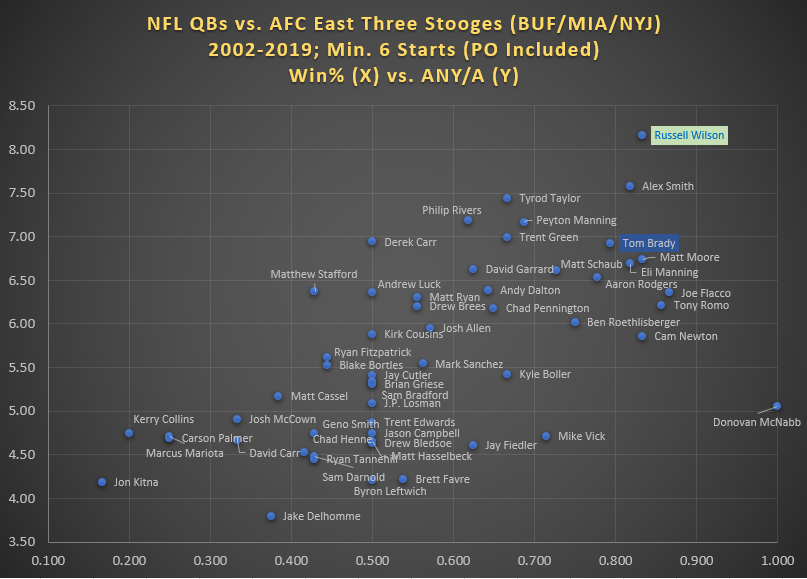


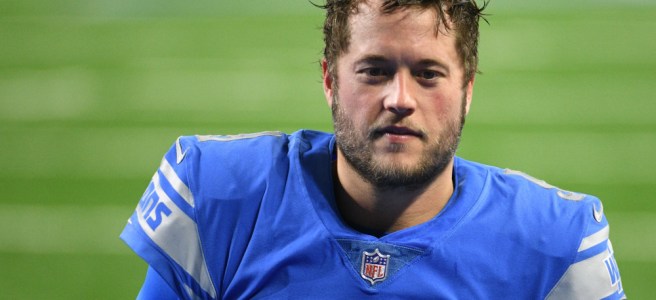


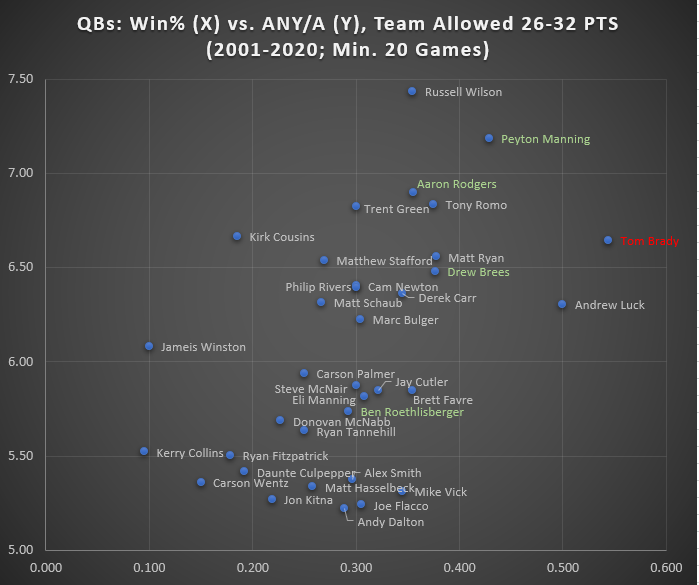

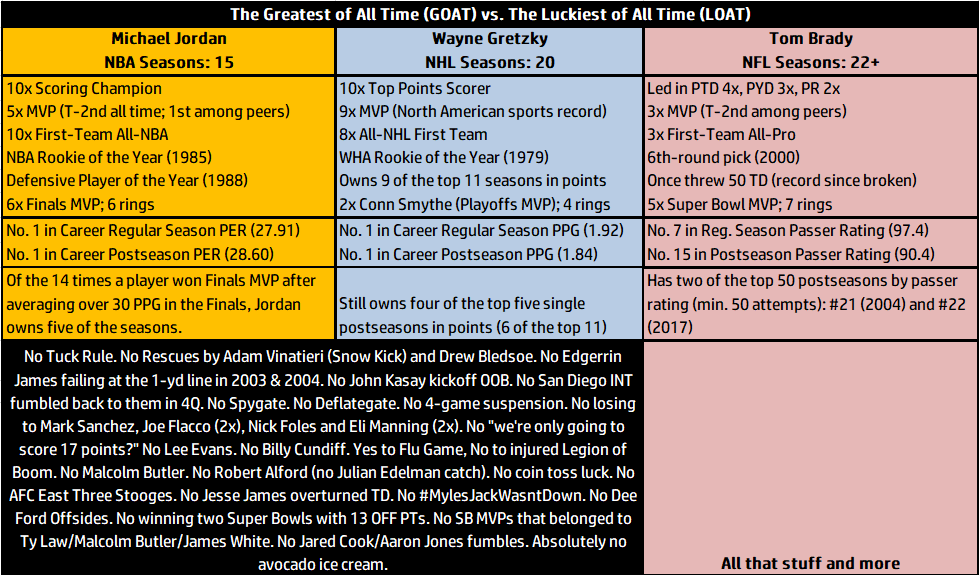


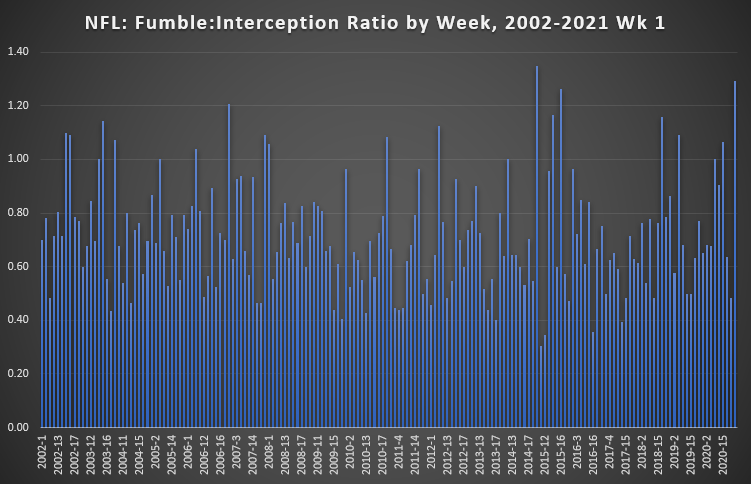
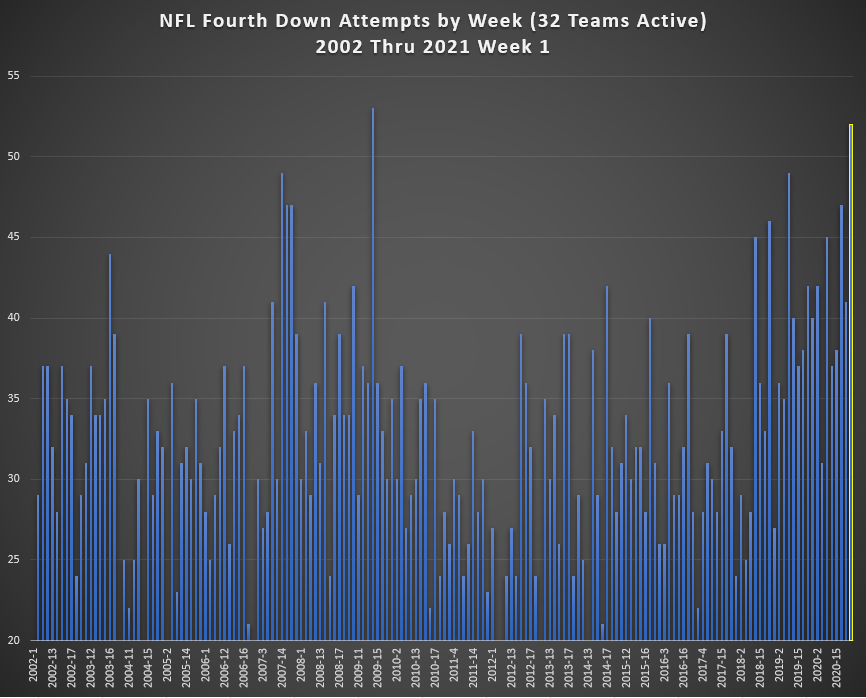





 Captain Comeback: NFL Analysis by Scott Kacsmar