
I recently shared one of my old articles on Kurt Warner’s HOF case, and it’s something I’d like to keep doing with some of my most important pieces that are no longer accessible on the internet unless you know the exact link and plug it into the Wayback Machine.
One of those pieces is from early February 2016 right before Super Bowl 50 between the Broncos and Panthers, otherwise known as Peyton Manning’s final NFL game. With Manning holding a 13-13 playoff record going into what would ultimately be his second championship win and one of the least effective games of his career, I looked at his playoff career in retrospect with tons of data on him, his peers, and some past greats.
This was a two-part piece that had over 10,500 words, and I’ve included both pieces below with all of the original tables and GIFs of plays. Almost everything is left as is going into that Super Bowl 50 game, though I did leave a couple of 2026 notes like the sad news of what happened to Teddy Bridgewater’s career after this post.
But I did want to quickly note some of the things that have happened in the 10 years since this piece came out, a piece where I found that the simplest way to explain the shortcomings of Manning’s teams in the playoffs was too many blown leads late in the game in the first playoff game of the season, hence the record number of one-and-done performances. When Manning got past that first game, he was 14-4 in the playoffs with four Super Bowl appearances.
But that’s way too many close losses right away where he was rarely the culprit.
- To this day, the six blown leads for Manning are still the playoff record.
- Tom Brady had four, Drew Brees had three, and Aaron Rodgers has four.
- Josh Allen is now second with 5 playoff losses with a fourth-quarter lead, though only one of his saw Buffalo leading in the final 40 seconds (The 13 Second Game) compared to four such losses for Manning’s teams.
- Manning is still the only quarterback to lose two playoff games after a clutch field goal was missed.
- Manning will always be the first quarterback to have two lost comebacks in the playoffs, though he’s not alone with two. Drew Brees, Tom Brady, and Josh Allen have all joined him with two lost comebacks in the playoffs.
- Even with Patrick Mahomes’ playoff success since this article with a 17-4 record, his record is largely what it should be with one lost comeback (2018 AFC-CG) where he didn’t get the ball in overtime, a terrible second-half finish in another home OT loss to the 2021 Bengals, and two Super Bowl blowout losses.
- Manning remains the only quarterback in NFL history to have a fourth-quarter lead in 13 straight playoff games in 2006-13, though his team only having a 2-5 record during the playoff games in 2007-12 is a shockingly bad record and as big a reason as any as to why he only won one ring in his prime.
- Manning was able to get the fitting legacy as the first quarterback to win a Super Bowl with two teams, and it’s beyond fitting that both of his rings came in the only two postseasons where his team stepped up around him as this is the ultimate team game.
- While Brady ate up in an AFC without Manning after this piece, Brees, Roethlisberger, Wilson, and Rodgers to this day never reached another Super Bowl since 2015. Manning’s feat of four Super Bowls with four different coaches and two different franchises is unlikely to ever be matched as he was the system.
With challenges from Brady and Mahomes, Manning’s legacy as the best regular-season quarterback still looks pretty safe with 5 MVPs, 7 first-team All-Pro seasons, and plenty of advanced metrics still favor his high level of play for so long. While playing his last four playoff games with a torn quad (2014) and plantar fasciitis (2015) tanked some of his playoff efficiency, he remains one of the best quarterbacks statistically in the postseason too.
Manning didn’t get to a Super Bowl until Year 9 and he still got to four in his career. With Josh Allen going into Year 9 and still seeking his first appearance in Buffalo, Manning remains the only precedent for him to aspire to. But if people are going to start equating Allen with Manning’s playoff struggles and claiming he’s the superior performer because he beats up on No. 7 seeds in an era without two first-round byes, just direct them towards this piece.
I didn’t refer to it as Manning’s Law for no reason. What ever could go wrong for Manning’s teams in the playoffs usually did whether it was the blown leads in crunch time, crucial dropped passes, Marvin Harrison playing terrible football, no shows from the running game, protection issues, ugly weather, an idiot kicker, horrific moments on special teams, a conservative coach, a poor run defense, dropped interceptions on defense, Hank Baskett on the surprise onside kick flub, or the refs swallowing every whistle in the 2003 AFC-CG.
Even Nick Harper’s wife stabbing him the day before he didn’t go down the sideline with Jerome Bettis’s fumble, allowing Big Ben to make the tackle. No one has a resume like this to say nothing of all the positive things Manning did in the playoffs too.
That’s why I said for years he was the GOAT, and until I see enough evidence otherwise, I’m sticking with that view.
But this was an important piece for me, the groundwork of it first showed up on ESPN Insider, and I was able to get it out the week of Manning’s final NFL game, which was also the last live NFL game I watched on TV with my grandma at home. It has a lot of good information that still holds up today, including some of my earliest points about the role of luck shaping quarterback legacies even on plays that they have no control over.
I’m happy to host this one here.
Solving the Peyton Playoff Puzzle (Part I)

Peyton Manning is going to retire well short of winning the most Super Bowls in NFL history. He can become the 12th quarterback with multiple rings with a win over the Carolina Panthers in Super Bowl 50. He would also finish with a 14-13 record, making him a winning quarterback in the postseason.
Seventeen quarterbacks have started at least 12 playoff games and Dan Marino (8-10) is the only other player without a winning record. A victory on Sunday may be enough for some, but there will always be those who look at Manning’s playoff career as a disappointment. That is a fair viewpoint, but how much of the disappointment should fall on the player versus his teams?
Somehow, the phrase “greatest regular-season quarterback ever” has become the ultimate backhanded compliment to Manning’s career. That title really is not up for debate either. Manning is the most decorated quarterback in NFL history with five MVP awards, seven first-team All-Pro selections, 14 Pro Bowls and a ton of records. When you call him the greatest regular-season quarterback ever, you only leave a few quarterbacks in the field who can argue they had a better career, and that is even with an overemphasis on the postseason.
So how does one of the best quarterbacks ever spend the majority of his career without a winning playoff record?
This Peyton Manning playoff puzzle has existed for years, but no one ever put in much effort to solve it. They have called him a choker, even though countless other big-name quarterbacks have flopped in big games and crucial moments. They have said his style of offense does not translate to January and that he is too robotic, too studied to succeed in the playoffs. This ignores all the stellar playoff games he has had, or the fact that he is the only quarterback to have a fourth-quarter lead in 13 consecutive playoff games.
When you put the pieces together, you start to see the picture of a great playoff resume, but that piece for the win-loss record just does not fit. After years of research and an offseason of clarity on the subject, I am ready to solve this puzzle for good.
Note: parts of this article previously appeared on ESPN Insider. References to win probability are from Brian Burke’s calculator.
The Playoff Resume You Never Hear About
The standard Manning set in the regular season was always going to be tough to meet in the playoffs. With each passing year, a quarterback’s legacy grows and stigmas become harder to shake. Manning lost his first three playoff games, took six seasons to win a playoff game, and nine seasons to win a Super Bowl. His stats were not very Manning-like during that Super Bowl run. Since then he had a couple of high-profile losses, including two Super Bowls. Add it all together and you have an easy target for years of playoff criticism. The good parts get brushed to the side, because they do not fit the narrative.
However, the thought that Manning has had a bad playoff career or even merely an average one is one of the silliest things I have come across in 13 years of football research.
There have been 215 quarterbacks — well, one was a true running back — to start the 525 playoff games in NFL history. I do not expect the average analyst to talk about a bell-shaped curve, but you would have to have a pretty repugnant idea of distribution to think Manning’s playoff career is anything close to average.
He will be just the seventh quarterback to start at least four Super Bowls. Thirty-one quarterbacks have won a Super Bowl and only 20 were named Super Bowl MVP. That should at least get Manning in the above-average category, especially when you start ignoring some of the ridiculous small sample size issues. Mark Sanchez and Alex Smith have some better playoff marks than Manning and Tom Brady. Enough said.
When you get into the stats, Manning’s QBR ranks sixth in the playoffs since 2006, according to ESPN. We have observed in the past that his playoff stats are very similar to his stats against playoff teams in regular-season games, a sample size of 98 games now. Despite his last four playoff games not being too hot, Manning still holds the No. 8 passing DVOA since 1989. We hope to add 1986-88 very soon.

Even Manning’s criticized Super Bowl run in 2006 when he threw three touchdowns and seven interceptions holds up here. His DVOA that postseason was 29.8%, because it was the only time a team beat the top three defenses in the same postseason. His QBR, which is not adjusted for opponents, was still well above average (71.9).
How did the Colts win with that stat line from Manning? Five of his interceptions were thrown while leading, and four were thrown on third-and-10 or longer, which usually does less damage. How rare is the latter? No other quarterback has thrown more than three such interceptions in the playoffs since 1994, let alone four in a single postseason. Manning’s most damaging pick (Asante Samuel’s pick-six) was the one he made up for best with 35 points the rest of the game.
Since 1989, Manning has three of the top six playoff games in DYAR. He has the most playoff games with at least 200 DYAR (six). He is 4-1 in the AFC Championship Game with his first three wins among the best games of his career. He led the largest comeback (18 points) in any championship game in NFL history. He threw five touchdown passes and had a perfect passer rating against the 2003 Broncos. A year later, he threw for 458 yards against Denver in a wild-card win. He has three 400-yard playoff games, tied with Drew Brees for the most in NFL history.
The only area where Manning’s playoff resume looks average is the record – dead average at 13-13.
Victim of His Own Success
No one likes to lose a playoff game, but is it not still better to make the playoffs than to miss them entirely? With respect to the butterfly effect, Manning’s playoff record could be 13-9 (.591) if he did not lead some of his weaker Indianapolis teams to double-digit wins, including 2000 (started 7-6), 2002 (started 4-4), 2008 (started 3-4) and 2010 (started 6-6). Those four teams lost in the wild-card round, including two overtime losses and another game decided on the final snap.
There, puzzle solved. Worse play down the stretch from Manning in those four seasons and he is four games above .500 in the playoffs. Who said this needed a complex solution?
Joking aside, continuously making the playoffs really is a main reason why Manning holds the records for most playoff losses (13) and most one-and-done losses (nine). The only formula for keeping him out of the playoffs (1998 and 2001) has been for the Colts to go 1-9 against playoff teams and for the defense to allow the most points per drive. When you make the playoffs year after year, often with a flawed team (eight of Manning’s playoff defenses ranked 15th or worse in DVOA), you are going to accumulate many playoff losses unless you become a dynasty.
Worse, if you go one-and-done, you have to win at least two games the next time just to finish even at .500. When you earn a first-round bye as often as Manning’s teams have (eight times; second only to Brady’s 10), two wins means a trip to the Super Bowl. Those opportunities do not grow on trees. The eight byes essentially serve as eight wild-card wins, but the quarterback’s record does not reflect that advancement.
Name a quarterback with a lot of playoff losses and I will show you one of the best to ever play the game. I wrote an article about that two years ago. Eli Manning’s record still sparkles at 8-3, because the Giants missed the playoffs in six of the last seven years. But hey, that means no one-and-done, or no interceptions in the clutch in January. All of that goes out the window when you lose enough games in the regular season.
The Bengals are the latest example of this ass-backwards thinking, because they are deemed a laughingstock for losing in the wild-card round five years in a row. Yet, nearly half of the league would trade places with Cincinnati in the last five years. At least they kept winning and gave themselves a shot in the tournament.
Some quarterbacks can only make the playoffs when their team is good, and some can only win in the playoffs when their team is playing great. If you are one of the elite few who can drag just about any roster into the playoffs year after year, you are going to experience some disappointing losses. Just being there should be rewarded, but instead you get branded with a one-and-done loss while the other player who missed the playoffs entirely gets nothing. Oh, and if his name is Sam Bradford or Ryan Tannehill, maybe he gets a raise.
That is just one of many reasons why a quarterback’s win-loss record for the postseason is such a poor indicator of performance. In the regular season, there is some value to it. Over a large enough sample size, you would be hard-pressed to find a good quarterback with a losing record.
But in the playoffs, the record becomes more misleading than ever thanks to the one-and-done system. Come playoff time, you are no longer playing the Browns and Rams. Most of the bad defenses have been eliminated. Beating good teams is harder, and there is no next week when you lose. Many games are ultimately decided by plays where the quarterback is not even on the field.
Big games are not just limited to the playoffs, because the regular season is crucial to NFL success. Manning’s season would likely already be over had the 2015 Broncos not earned a No. 1 seed – let’s give some big credit to Brock Osweiler there in Manning’s absence this time. But as far as navigating the regular season to get to the playoff goes, Manning has done it as well as anyone in his career.
Only 62 quarterbacks have even started in four different postseasons. That number shrinks to five for 10 postseasons.

By simple math, Manning is the quarterback most likely to hold the record for most playoff losses. He holds the record for most appearances with 15 – two more than the next closest quarterback. Marino was the first to 10 losses, and he was surpassed by Brett Favre (11). For Manning to have avoided this record, he would have needed to win a record five Super Bowls – an unrealistic goal for anyone (2026 note: Unless you’re the LOAT).
The L Word
“See, the luck I’ve had can make a good man turn bad.”
So far we have shown Manning’s impressive playoff resume and explained the record number of playoff losses as a result of his consistency at leading teams into the playoffs. But why only 13 playoff wins? People wanted to see more wins from his career, and given the individual success, there should have been more.
Bringing the element of luck into this might be like throwing a hand grenade, but we are going to do it carefully. I have said in the past that I consider Manning the unluckiest quarterback in playoff history based on having the most close losses, among other things like poor starting field position. On a percentage basis, Manning probably is not the unluckiest. That may be Bernie Kosar or Warren Moon.
For a cruder single-game example, Teddy Bridgewater has a legit claim with his first playoff game. It was spoiled by brutal weather conditions (one year before Minnesota gets a new roofed stadium), Adrian Peterson’s fumble led to Seattle’s game-winning field goal, and Blair Walsh shanked the shortest do-or-die field goal in playoff history. Ouch. I did not even mention Seattle’s 9-point comeback started thanks to a botched snap sandlot play from Russell Wilson. Fortunately, Bridgewater is just 23 and has plenty of time to change things (2026 note: Whoops.), but there is no guarantee that luck evens out in a playoff career.
Let’s be clear in how luck is defined in the context of a quarterback’s playoff career. From Merriam-Webster: “the events or circumstances that operate for or against an individual.” The other important part is that these events are happening out of the quarterback’s control. Over the course of a three-hour game, there are a lot of things that could qualify, but we usually just focus on the most important events that have the biggest impact on the game, such as the Peterson fumble and the Walsh field goal in that Bridgewater example.
The plays from late in the game tend to be the most significant due to the lack of time left to overcome them. There is also a preference to look at plays that have a general low probability of happening, such as a return touchdown, dropped pass or blocked punt. If a quarterback throws a pass right to a defender for an interception, that is not bad luck for the quarterback. That is a bad play and it is bad luck for his teammates that they have to absorb the consequences of his actions.
For Manning, we can list a ton of unlucky circumstances that were out of his control. He has 26 playoff games after all but just look at his three Super Bowls.
A game generally known for good weather, Manning’s win in Super Bowl XLI was the most weather-affected Super Bowl of them all with the Miami rain leading to six fumbles from the Colts and Bears. Manning’s receivers dropped six passes, but he still got the MVP anyway. Devin Hester started that one with the then-fastest score in Super Bowl history with his kick return touchdown 14 seconds into the game.
The record was shortened to 12 seconds by Seattle against Manning’s Broncos in Super Bowl XLVIII when miscommunication on the first snap from scrimmage saw the bail sail over Manning for a safety. The two quickest deficits in Super Bowl history happened to Manning without him even touching the ball. Then when you mention the most significant surprise onside kick in NFL history, it was Sean Payton’s call to start the second half in Super Bowl XLIV. Hank Baskett botched the recovery and the Saints, down 10-6 at the time, went on to score a big touchdown.
Again, due to the sheer volume of playoff games he has, we can go a book’s length on this type of bad luck for Manning. But we are looking for the most significant moments for each quarterback, and some of this stuff is just neat context more than anything game-deciding.
The fact is there probably isn’t much that has happened to Manning’s teams in the playoffs that has not also happened to other teams, but good luck finding someone else that has experienced all of these things in his playoff career like Manning has. That is where I am coming from when I say he has been the unluckiest quarterback in playoff history.
I can actually thank some random Patriots fans for providing me with the proper clarity on this subject last offseason after New England’s fourth Super Bowl win. The usual line of “Brady would have six rings without the Giants’ two catches” came up, which deserves the usual reply of “he would have one if not for Adam Vinatieri.” But the enlightened response of “Brady always has them in position” was my lightbulb moment.
Many of the best quarterbacks always seem to have their team in a position to win a playoff game, but many times the game-deciding play is out of their control. Andy Dalton gets crucified for his postseason history for reasons well beyond his 0-4 record. Not only were the Bengals not close to winning those games, but his stats are horrific.
You saw the table above with the DVOA rankings. However, there are 10 active quarterbacks with a DVOA of at least 16% in the playoffs. There are eight active quarterbacks with a Super Bowl ring, the most at one time in NFL history. Brady is not the only quarterback capable of having his team in position to win playoff games with respectable individual statistics. We see it from several other quarterbacks, past and present. The more you can make the playoffs and do that, the more respect you’ll earn, but the real driving force behind the wins and losses tends to be someone other than the quarterback.
Nothing is stopping us from keeping track of this stuff for every game (I already do), but at the very least we can do it for the playoffs, which are supposed to be so much more important for legacies. We can keep track of when the quarterback made the decisive play, good or bad, and when someone else did. It usually is going to be someone else.
Everyone knows about Joe Montana’s breakout playoff moment culminating in “The Catch” to Dwight Clark in the 1981 NFC Championship Game, but did you know Montana turned the ball over four times that day, including an interception on the drive before Clark’s catch? He may have been a little spooked from a pre-game death threat, but that was a shaky performance.
Despite the great drive, it would have gone for naught had the 49ers not finished the game on defense, leading 28-27. Danny White hit a pass to the San Francisco 44 with 38 seconds left. One more good throw and the Cowboys would have been in range for a game-winning field goal, but White was sacked and Jim Stuckey recovered the fumble to clinch the win. Montana’s moment lives in lore, but we should still make note of the interception he threw on his previous drive and the fumble from White.
When fans talk about Manning’s crunch-time turnovers in the playoffs, they speak as if there is a long history of them. Do you know why they only bring up the Tracy Porter pick-six in Super Bowl XLIV and the overtime interception against the 2012 Ravens? Those are the only two times in the playoffs when Manning has turned the ball over in the fourth quarter or overtime, tied or down by one score.
Brett Favre has done that in three different NFC Championship Games (1995, 2007 and 2009). Colin Kaepernick had three turnovers in the fourth quarter of the 2013 NFC Championship Game. Mistakes happen.
We can do a better job of charting the close playoff games. The following table breaks down close games for 28 quarterbacks with at least 10 playoff starts. Only starts were included, and games where the quarterback did not play in the fourth quarter due to injury were excluded for Tom Brady, John Elway, Jim Kelly, Donovan McNabb, Kurt Warner and Joe Montana.
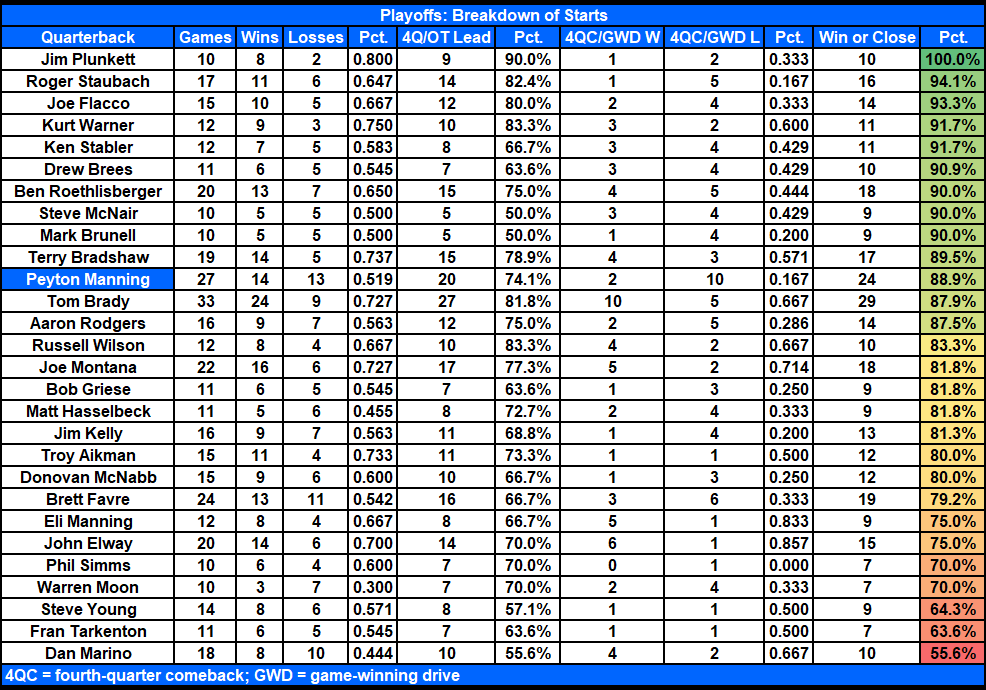
The “Win or Close” column is basically how often the quarterback “put his team in position,” whether by winning the game or having possession in the fourth quarter or overtime with the score tied or a one-score deficit. Outside of poor Marino, who had eight blowout losses with Miami, most of the quarterbacks were above 80 percent.
Only three of Manning’s playoff losses were not close games late, but a few other things really stand out from this table. For starters, Manning’s abysmal 2-10 record at 4QC/GWD opportunities is nothing like the great 56-46 (.549) record he has in the regular season. While you might think that fuels the “choker” narrative, note that Manning had 19 fourth-quarter leads, yet only 13 playoff wins. Now we are onto something.
No quarterback in NFL history has lost more playoff games (six) after leading in the fourth quarter than Manning. Moon is the next closest at four games. Manning saw his team lose after leading in the final 40 seconds in four games. Again, only 28 quarterbacks have even been to the postseason six times.
This is actually worse than it sounds. Earlier, I glossed over Manning’s record of nine one-and-done seasons, five more than any other quarterback. Yes, the 15 playoff appearances do a lot to explain why he has this record, but why such a high number like nine? Why not just five or six? Why didn’t Manning’s teams do better in the first playoff game?
The blown leads fill in so much of the playoff puzzle. Here is a list of every quarterback with at least two playoff losses after leading in the fourth quarter. The last column shows how many of those losses resulted in a one-and-done postseason.

Five of Manning’s six blown leads resulted in a one-and-done postseason, two more than any other quarterback in NFL history. While you can argue it hurts more to a fan to lose a lead in the later rounds like in the case of Brady, that does not hurt the playoff record as much as going one-and-done does. Just look at all the times Manning was denied a shot at more AFC Championship Games or Super Bowls because of an early exit. His teams are an impressive 13-4 in the playoffs when they were able to get past the first game, but more often than not they stumbled out of the gate, hence a record number of one-and-done years.
If Manning’s blown leads – his bad luck – were distributed more evenly to the other rounds, he would have a better playoff record with more wins. But you do not get to go to the AFC Championship Game when your defense lets backup Billy Volek drive 78 yards for the go-ahead touchdown and then watch Dallas Clark do this on fourth-and-ballgame.
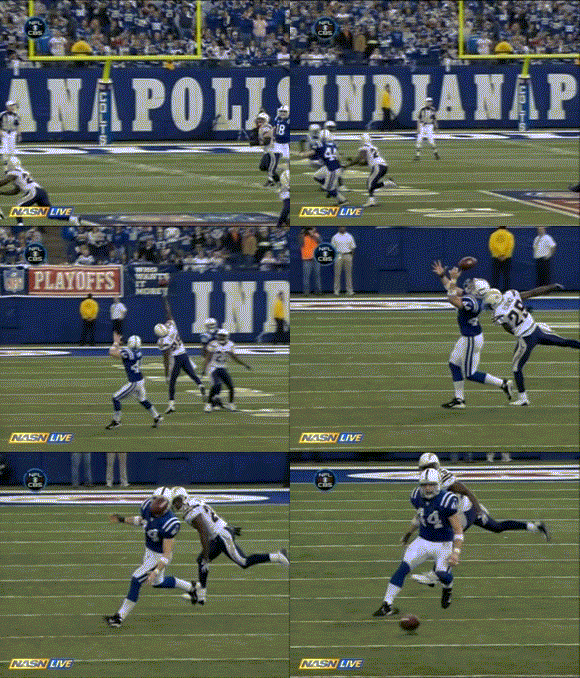
It is not as if Manning was only able to lead two go-ahead drives in 12 games with opportunities for his teams. A “lost comeback” is a game where the quarterback brought his team from behind in the fourth quarter to a lead, but still went on to lose the game. There have been 38 of these in postseason history. Manning is the only quarterback to have two playoff lost comebacks (against the 2007 Chargers and 2010 Jets), and naturally they were both one-and-done seasons.
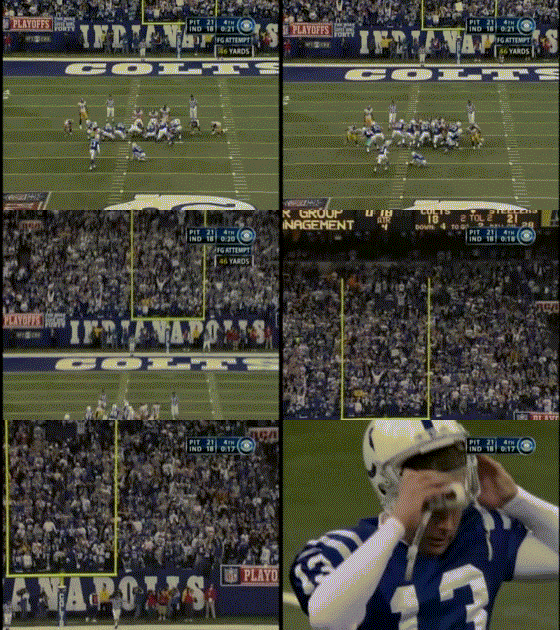
Manning is also the only quarterback to lose two playoff games after his kicker missed a clutch field goal (tied or down by 1-3 points in fourth quarter or overtime). Mike Vanderjagt was the culprit both times, with kicks that were closer to the parking lot than the uprights. And yes, both resulted in a one-and-done ending for the Colts (2000 and 2005).
Manning is one of six quarterbacks in playoff history to lead a go-ahead touchdown drive in a tied game (for a 7-point lead), and still go on to lose the game. That was with the 2012 Broncos, his highest DVOA team that still went, you guessed it, one-and-done.
Manning is one of seven quarterbacks to lose a playoff game in overtime with his offense never getting a possession. That was the one-and-done for the 2008 Colts in San Diego after Mike Scifres had perhaps the greatest punting night ever, pinning the Colts inside the 10-yard line five times.
While Manning is the master of experiencing the improbable losses, his playoff career lacks the improbable wins other quarterbacks have enjoyed. There is no Immaculate Reception (Terry Bradshaw), Hail Mary (Roger Staubach) or Music City Miracle (Steve McNair) for him. Hell, he basically lost a win on a Joe Flacco Hail Mary and had to play those Music City Miracle Titans, a 13-3 wild-card team.
No kicker did a Billy Cundiff (Tom Brady) or Scott Norwood (Jeff Hostetler) for him. Manning’s “idiot kicker” is in that same club. Tracy Porter did not pull a Lewis Billups and drop that fateful interception in the fourth quarter of a 7-point Super Bowl as Joe Montana’s luck would have it.
Manning’s defense never snatched victory from the jaws of defeat such as Red-Right 88 (Jim Plunkett), The Butler Did It at the 1-yard line (Brady, again) or Sterling Moore on Lee Evans (Brady, a third time). Lest we forget, little brother Eli was able to lead two game-winning drives in overtime of NFC Championship Games without completing a single pass on either one. Thanks, Brett Favre (2007) and Kyle Williams (2011).
This is the part where you expect me to talk about how Manning did get lucky in the 2006 AFC Championship Game, or else he may not have a ring to this day. But that will have to wait until next time. For now, just soak in the fact that circumstances out of Manning’s control – luck, if you will – are what have kept him at .500 in the playoffs. No one is saying his record should be excellent, but he definitely played winning football in the postseason more often than not.
In Part II tomorrow, we will look at how even Manning’s good playoff luck had a poor distribution that did not help his two best teams advance. The meat of the piece will focus on how changing one play not involving the quarterback can drastically alter their playoff fortune. Not only will we look at Manning, but we’ll also go through Tom Brady, Aaron Rodgers, Ben Roethlisberger and Russell Wilson, as well as last words on Manning’s playoff career as he heads into what is likely his final game.
Solving the Peyton Playoff Puzzle: Part II
In Part I, we solved the puzzle of how Peyton Manning is a .500 quarterback in his postseason career despite the highest standard of regular-season play and an underrated individual playoff resume.
Getting to the playoffs more than anyone, no matter how flawed the team, was one problem. The record six losses after leading in the fourth quarter show he could have easily been above .500. The biggest problem was the distribution of those blown leads: Five times in one-and-done situations. Had the blown leads still happened, but been more evenly distributed over the rounds, Manning would have that precious winning record in the playoffs.
The distribution of stats is an area where I feel we could be doing a better job as analysts. If a defender sacked a quarterback on three consecutive plays, it would be a great spectacle to watch, but those three sacks only destroyed one drive in the game. Unless it was the last drive of a tight game, that is not ideal. Had the defender been able to sack the quarterback on three different drives, he would help his team more by impacting three drives instead of one.
This can be applied to most counting stats, or even a concept like luck, which we defined in a context of events that work for or against a quarterback that were out of his control. The good luck in Manning’s playoff career often came in bunches, but some was also offset by some of the worst moments for his best teams.
In this part we are going to experiment with the frailty of playoff win-loss records for Manning and four other Super Bowl-winning quarterbacks from this year’s divisional round. The goal of this was never to try to make Manning have an incredible playoff record. It was to show just how misleading a quarterback’s playoff record can be, and how one of the better playoff performers at the position has dealt with a career of criticism for that record in spite of his play.
Note: parts of this article previously appeared on ESPN Insider. References to win probability are from Brian Burke’s calculator.
Why So Many Close Losses for Manning’s Teams?
Most games can be grouped into four categories: win big, lose big, win close, and lose close. You might be able to work in a “comfortably” category for games that stayed at a two-score margin for the fourth quarter.
Manning’s playoff game results are different from most quarterbacks in that he has a lot of comfortable or big wins. For example, nine of his 13 playoff wins were wire-to-wire while only two of the other four were fourth-quarter comebacks. Then he has the 10 close losses out of 13 total. Compare that to his current boss, John Elway, who had 14 wins with six game-winning drives and five wire-to-wire wins. Out of the six losses he finished as a starter, only the first one was a tight game in the fourth quarter. While the Super Bowl losses were routs, Denver’s defense was 7-0 in Elway’s era when holding a one-score lead in the fourth quarter.
Before these last two games when Manning’s Denver defense held up leads of 7 and 8 points, his teams were an abysmal 5-6 when having to defend a one-score lead. That includes a stop against the 2003 Chiefs, who trailed 38-31 and only had eight seconds left to drive 73 yards. That also includes stopping the 2009 Jets on one drive before Manning extended the lead to a comfortable10 points with another touchdown pass.
A blown fourth-quarter lead does not guarantee the offense is free of criticism, nor does it always mean the team should have won. We expected that 1-point lead in Super Bowl XLIV would not hold up against Drew Brees and the Saints, but that’s the only blown lead for a Manning team that did not come in a one-and-done scenario. The leads were usually more solid than that.
While most offenses turn towards the run in these situations, we can look at playoff stats for our select group of quarterbacks to see how they did with a one-score lead in the fourth quarter. The sample sizes are small as you would expect, but the results are still interesting. Success rate (SR) is included, though failed completions actually hold a little more value here than usual since you want to run clock.
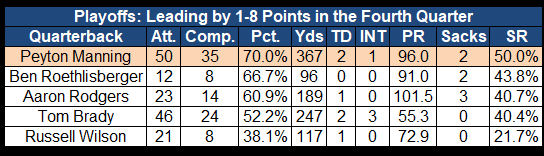
Protecting the lead still usually comes down to your defense, but these numbers certainly do not instill much confidence in the offenses to close things out. They also do not fit the playoff choker narrative with Manning having the best statistics.
His interception did not hurt as it served as a 49-yard punt on third-and-17 against the 2006 Ravens. The missed play of significance from a loss was the sack Manning took on third-and-2 with a chance to ice the game in San Diego in 2008. However, tight end Gijon Robinson (among others) botched the snap count on the play and left an easy path for Tim Dobbins to get Manning down. San Diego tied the game, Manning only had 24 seconds to answer, and then never got the ball in overtime. You just do not see ones like that too often.
Whether it was the defense having to come up with the key stop, or Mike Vanderjagt needing a big kick, or Marvin Harrison needing to make a catch on third-and-22, or when you expect to get a penalty call go your way, those plays often backfired against Manning’s teams. Those mistakes will usually catch up to you in a tight game.

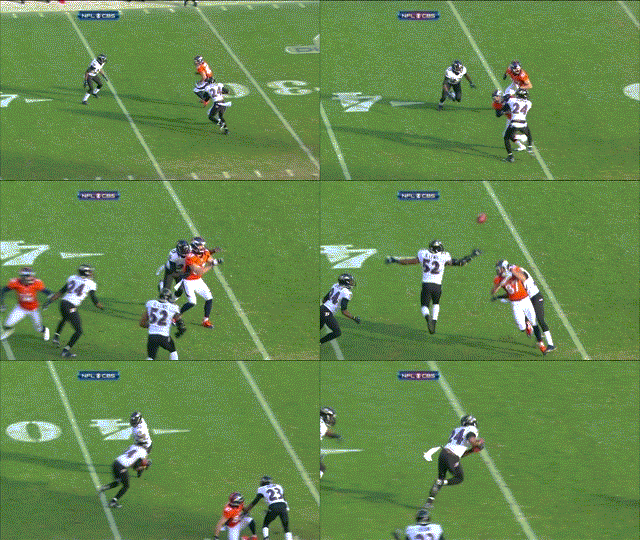

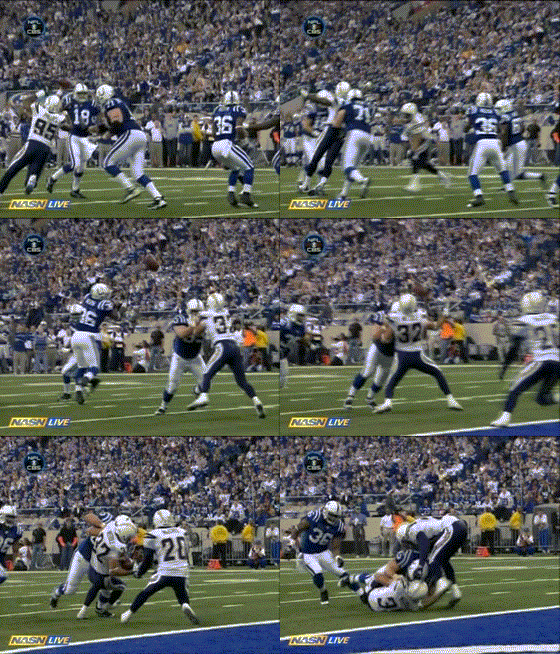

A Play to Glory; A Play to Ruin
Most quarterbacks are going to have some playoff games they won where they probably should have lost, and games they lost where they probably should have won. When I wrote this glory vs. ruin concept for ESPN Insider, someone in the comments section – he’s not getting any name pub here – complained that I only focused on the former for Tom Brady, and the latter for Manning. Keep in mind that piece was very much a comparison between the two.
The fact is those are the types of playoff games those quarterbacks have an abundance of. It is hard to take away from Manning’s wins, and it is pretty easy to take away from Brady’s (and some of these other quarterbacks we are looking at). This goes back to getting breaks in the earlier rounds to have longer runs while most of Manning’s bad luck happened in first-round playoff games.
I came up with the idea of glory vs. ruin as looking at what happens when you change the significant plays that have impacted the quarterback’s playoff win-loss record the most. The most important part is the play you select to change must be something out of the quarterback’s control.
We are not going to give Manning a retry on the Tracy Porter pick-six. We might if it happened due to a tipped ball or something fluky, but this is usually stuff involving teammates. As discussed in part I about luck, we focus on plays that come late in the game since you have the least time to overcome them. We usually focus on low-probability events such as return scores, drops or difficult field goals, so someone doesn’t say “boy, [quarterback] sure is lucky his defense didn’t give up a 90-yard touchdown pass on the last play!” No, he would be extremely unlucky if they did give up such a play. A stop there is expected.
If you tried to do this with Cam Newton’s five playoff games, you wouldn’t be able to change any of the outcomes. You would basically have to restart the games from scratch. It just so happens that Manning and Brady are the easiest examples since they have the most (and most close) playoff games. Another rule I put in is to change no more than three plays in either direction, though it’s hard to change even one for some players.
Obviously we can play the “what if?” game all day, but I like to think it can be done sensibly. Scott Norwood made the field goal to win the game or he didn’t. Earnest Byner fumbled at the goal line or he didn’t.
Sure, we can say Rex Grossman had the ball in a 22-17 game against Manning’s Colts in Super Bowl XLI, but it is too far into fantasy land to say “instead of a crushing pick-six, the Sex Cannon throws a 62-yard touchdown to take a lead with 11:44 left and Manning never wins a ring!” For one, that’s a lot of time left in what would probably have been a 23-22 or 25-22 game. Two, we can easily watch this game today. The only way a Chicago touchdown is coming out of that Kelvin Hayden interception is if he fumbled it. Grossman threw a terrible jump ball. Again, the less you have to distort the reality of the play, the better.
Let’s start with Manning. When I did this for ESPN, my choices were to basically swap the playoff fates of Manning and Brady. I wanted Adam Vinatieri to shank two field goals from 45 and 46 yards away in brutal kicking conditions the same way Mike Vanderjagt shanked kicks from 49 yards away in Miami and 46 yards away in the RCA Dome. There is a lot of equivalency there, and lest we forget, Vanderjagt was one of the most accurate kickers in history.
Even better, I wanted the two to switch defenders named Moore and how they defended a crucial Joe Flacco pass. Sterling Moore knocked the ball away from Lee Evans in the end zone with the Patriots nursing a 23-20 lead in the 2011 AFC Championship Game. Rahim Moore had that terrible judgment on the deep ball for Jacoby Jones with Denver ahead 35-28 in the 2012 AFC divisional round. Make Manning’s Moore do his job, and voila, you have two quarterbacks with a similar playoff record now.
What was interesting to me was how the two best teams of Manning’s career, the 2005 Colts and 2012 Broncos (yes, DVOA agrees), suffered two of the most devastating playoff losses this century. Had they come through in the end, you had to like their chances of going the distance with some favorable matchups in the next two rounds. But they blew it, and we now see another parallel in that Manning’s two weakest teams during his best runs (2006 Colts and 2015 Broncos) may be in the best positions for titles.
The other thing about the 2005 Colts and 2012 Broncos is that Manning had some damn good fortune going in those games. Against Pittsburgh, he erroneously got the overturned Troy Polamalu interception from the referees with 5:26 left, and he got a massive gift from his defense by forcing Jerome Bettis to fumble with just over a minute left. This was going to be Manning’s Tuck Rule game, a controversial finish headed to overtime. But Vanderjagt embarrassingly shanked that field goal and that was the end of Manning’s best Indianapolis team. Like I said earlier, even when he got lucky, he still got unlucky in the end and lost.
The same thing happened with the 2012 Broncos. Manning got two return touchdowns from Trindon Holliday on special teams. In 26 playoff games, Manning’s teams only have three return touchdowns, and here were the last two. That’s great, but Denver never really took advantage with some questionable calls (and a no-call) on pass interference leading to two Baltimore touchdowns. But nothing was bigger than the epic letdown by Moore in coverage when it looked like the Broncos had it wrapped up (win probability: 0.94).
In the ESPN article, I still gave Manning a loss for the Pittsburgh game, because I did not want to speculate on overtime had Vanderjagt made the kick. Having gone through the games of the other quarterbacks, I say give him the win now, and make it on Nick Harper’s fumble return going down the sideline for a touchdown instead of getting tackled by Ben Roethlisberger. It would be one of the cheapest, most controversial and memorable outcomes ever, but any other player would take it.
Did we not just see this year where Roethlisberger got a very similar Jeremy Hill fumble break, followed by those two moronic penalties from Vontaze Burfict and Adam Jones? Did Carson Palmer’s first playoff win not come after another dropped interception in the red zone and a deflected pass going for a touchdown?
Some teams double down on luck in the playoffs. Remember when the 2000 Ravens beat Tennessee by returning a blocked field goal for a touchdown and Ray Lewis had a pick-six after Eddie George tipped a pass? By the way, in this alternate universe where Vanderjagt comes through in Miami, the 2000 Colts would have gone to No. 1 seeded Tennessee that week instead of the Ravens.
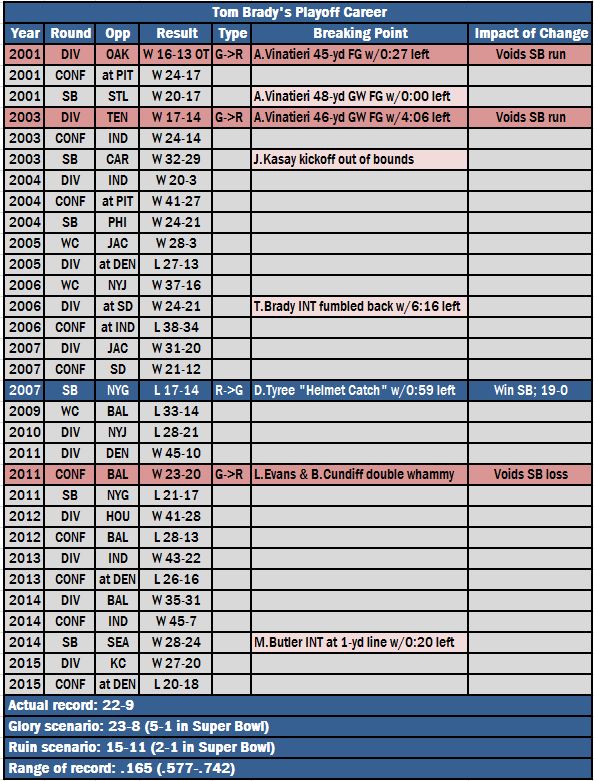
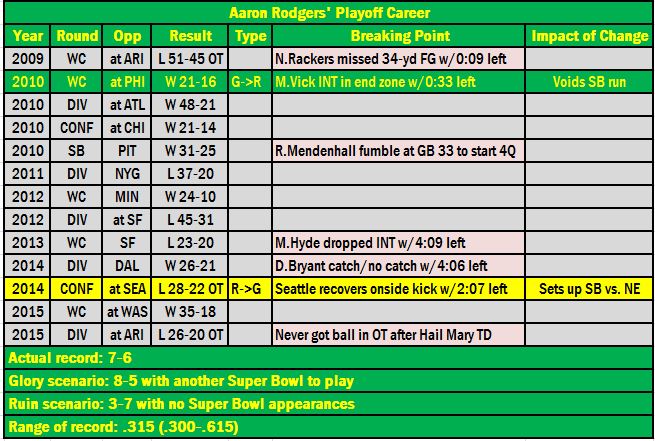
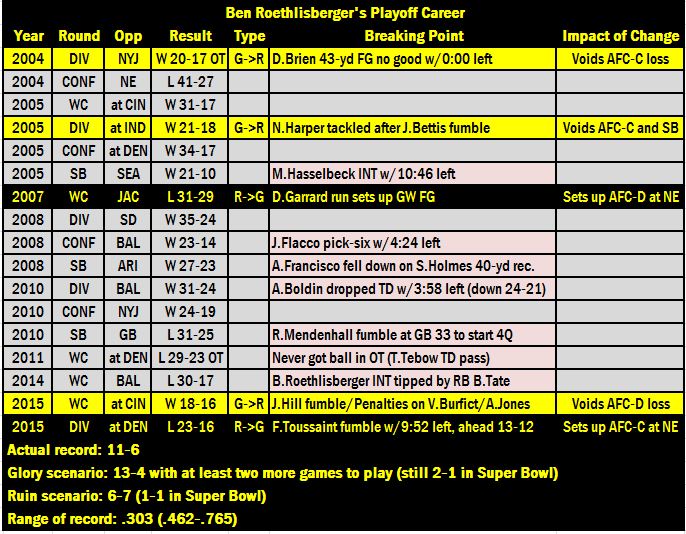
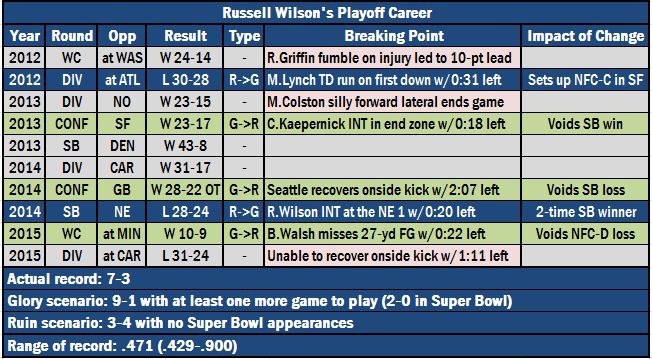
Here is what Manning’s playoff career looks like with the ruin-to-glory (R->G) and glory-to-ruin (G->R) plays changed. Some other noteworthy plays are in red. The “Breaking Point” is the play out of the quarterback’s control that would change in this scenario. You can see what the records would then look like whether it was a path to glory or ruin, along with the range. I do not speculate on any of the additional games that would have been earned with these wins.
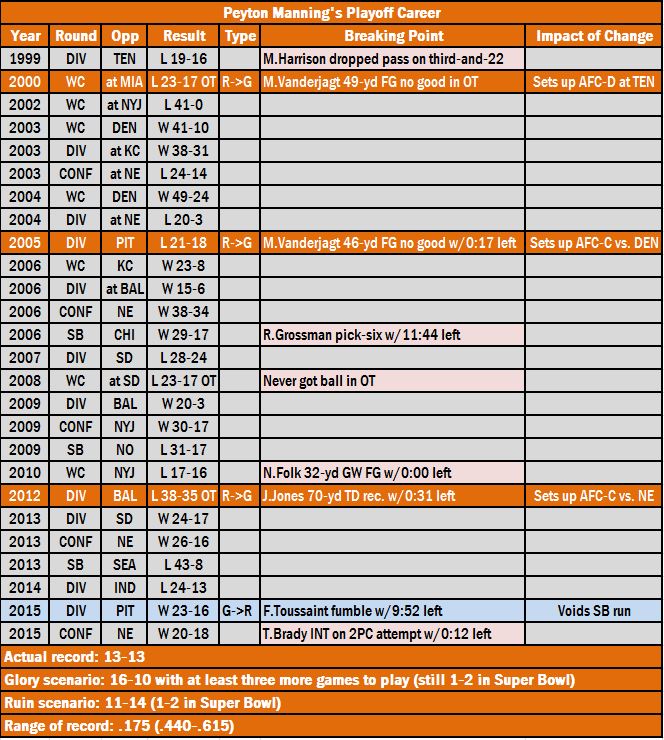
We spent enough time on the R->G plays, so let’s look at which win we took away from Manning. I say win, because upon further review, I could not find a breaking point from the 2006 AFC Championship Game that makes sense. Luck is really not a proper term to describe that final quarter. More than anything, it was the Patriots failing to take advantage of the Colts’ incompetency.
There are three plays worth mentioning from that quarter. Some would say Dominic Rhodes fumbling at the 1-yard line with 13:24 left was a breaking point with the Colts down 28-21. Center Jeff Saturday recovered for a game-tying touchdown. However, the Patriots scored on a similar fumble in the first quarter, so consider them even. Later with the scored tied at 28, the Colts left Reche Caldwell completely uncovered for at least 10 seconds. By the time Brady got the pass to him, Antoine Bethea was in a good position for the tackle. Caldwell dropped the ball anyway.
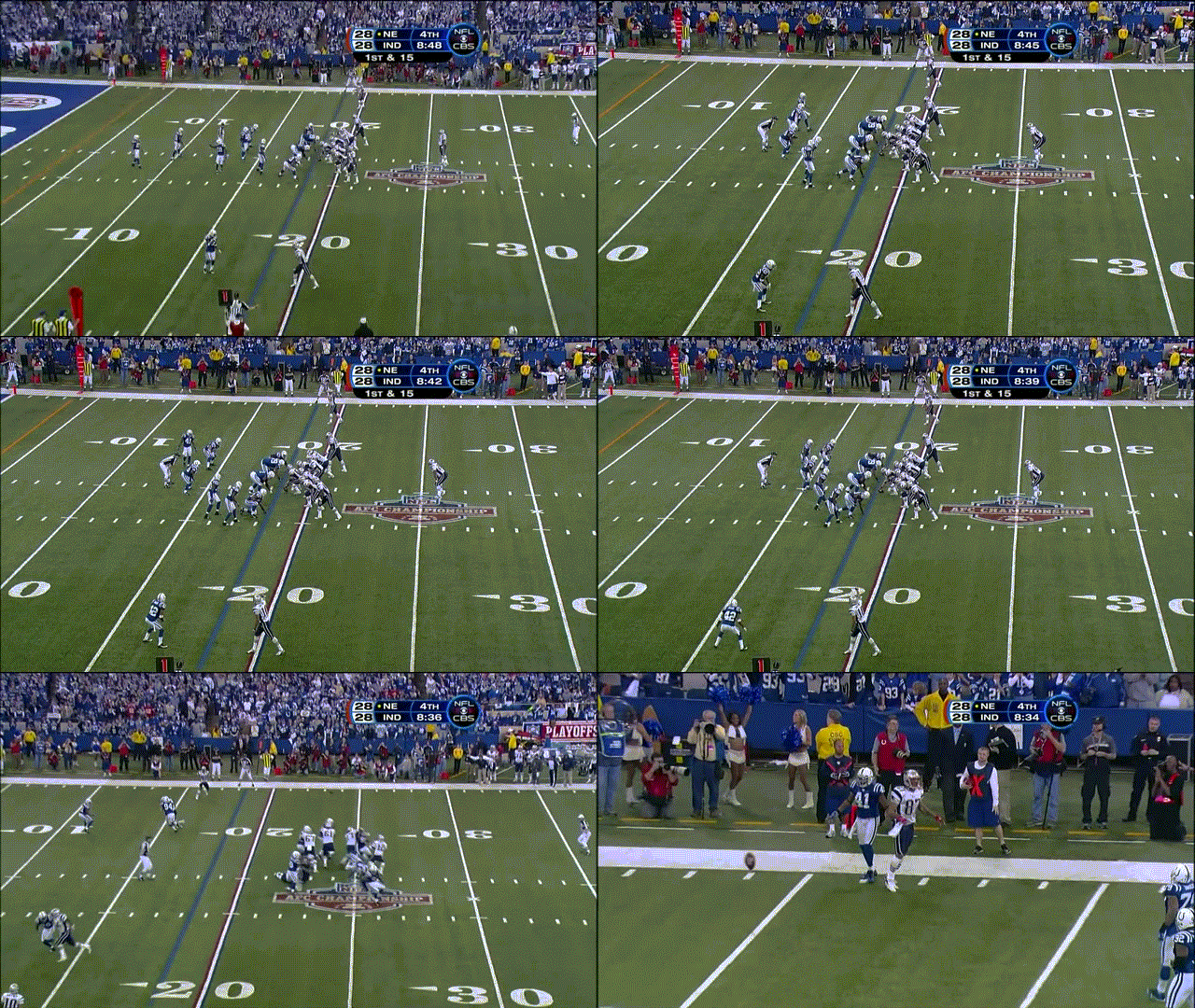
All this time I thought this was a third-down play that would not have scored, but it would have extended the drive. However, this was first-and-15 and Caldwell at best would have made it second-and-medium. That’s not a breaking point. The Patriots kicked a field goal on the drive, and you can definitely argue the Colts got away with some pass interference in the end zone on third down.
Finally, in the last two minutes Reggie Wayne is running well after the catch and loses control of the ball in the air. Manning and company talk a lot about this play in the America’s Game for the 2006 Colts, but it was really a moot point since the Patriots were penalized for a (weak) roughing the passer call. Still, I find it odd that this is not credited as a fumble in the play-by-play.
So to recap, Manning’s running back fumbled at the 1-yard line, his defense did not even bother to cover the leading receiver on the field, and Wayne got loose with the ball in scoring territory in a 3-point game. Had the Colts lost for any of those reasons, it would have just cemented Manning as the unluckiest quarterback ever, and this game was nine years ago. I thought Caldwell gave us a reason to credit this win away, but he just gave us an incredible facial expression.
Glory-to-Ruin Play No. 1: 2015 AFC Divisional vs. Pittsburgh
I fundamentally disagree with taking away this one too, but that just shows that even Manning’s closest wins are on steadier ground than most. Pittsburgh was driving with a 13-12 lead when Fitzgerald Toussaint fumbled. Manning turned that into a 65-yard game-winning touchdown drive and 20-13 lead.
If Pittsburgh recovered the fumble that went backwards, it would have been third-and-medium, slightly out of field-goal range. Let’s even just say Toussaint does not fumble and sets up third-and-1 at the Denver 31 with just under 10 minutes left (win probability: 0.72). Maybe Pittsburgh gets a touchdown to go up 20-12 or a field goal to go up 16-12. Maybe the kick is no good. Maybe Roethlisberger throws a pick-six to Aqib Talib on the next play. The uncertainty is rather high here, but it was definitely a big blow for the Steelers to lose that fumble.
If you think about it, this could go down as the biggest break that was capitalized on in Manning’s playoff career.
Tom Brady: Should Trade Last Names with Andrew Luck
Take your pick. The most important application of the controversial Tuck Rule ever? Check. Beneficiary of only the second missed field goal in a do-or-die situation in championship game history? Check. In fact, no quarterback has benefitted from more clutch field goals going his team’s way in the playoffs than Brady, but maybe not so much for clutch extra points.
You want to start a game-winning drive in the Super Bowl after the opponent’s kickoff goes out of bounds? Brady did it. How about throwing a fourth-down interception that gets fumbled back to you in good field position late in the fourth quarter? Only Brady. What about when the team with “Beast Mode” in the backfield throws a pass at the 1-yard line to Ricardo Lockette with the Super Bowl on the line? Brady celebrated that interception, the costliest in NFL history.
Those moments did not make our list of changes either. I won’t detail Brady’s ruin path, since we know it as basically Manning’s real path. Vinatieri misses his two big clutch field goals, Brady never gets the ball in overtime against the 2003 Titans should it have come to that, and he starts his playoff career 0-2 instead of 6-0.
Then the Sterling-turned-Rahim Moore defense fails on Lee Evans, keeping Brady out of Super Bowl XLVI, which is a game I refuse to add to his glory path. Even if Wes Welker made that (rare) deep catch, there were over four minutes left and the Giants had two clock stoppages. Eli Manning’s pass to Mario Manningham was a beautiful throw and catch. At worst, it falls incomplete, but that would have only made it second-and-10 as it was the first play of the drive. There is a far easier change to make from the other Super Bowl loss here.
Ruin-to-glory Play No. 1: Super Bowl XLII vs. New York Giants
My play is not the Asante Samuel “dropped” interception, because I am not sold he gets both feet in bounds even if he managed to catch the ball. More than that, the pass hit off of his fingertips while his arms were fully extended and he had both feet off the ground. It would have been an incredible pick, but not one you would even chart as a dropped interception.
I go to the David Tyree catch, which probably would have best served the Patriots if “in the grasp” had been called by Mike Carey (yes, him), setting up a fourth-and-13 or so. If the pass was incomplete, then it is hard to say the Giants lose for sure, because fourth-and-5 is a favorable conversion. It is still hard to say which part was more unbelievable: Eli escaping the sack or Tyree pinning the ball to his helmet. Both happened and that is why it is one of the all-time breaking points in playoff history.
Aaron Rodgers: Sideline Viewer Extraordinaire
It sounds hard to believe now, but there was a time when Aaron Rodgers got the ball last in a playoff game. It was his first game, and he caught a huge break too when Arizona’s Neil Rackers missed a 34-yard field goal with nine seconds left in the 2009 NFC wild card.
However, in overtime Rodgers missed a wide-open Greg Jennings for a deep touchdown before coughing up the only fumble-six in playoff overtime history. Rodgers would look better had Rackers just made the kick. The next year Rodgers started watching Green Bay’s pivotal playoff moments from the sideline. The defense was fantastic at creating takeaways and return scores in the 2010 Super Bowl run, but not much has gone right since in the playoffs for Green Bay outside of drawing a home game against Joe Webb.
Rodgers is the only quarterback in NFL history to lose two playoff games in overtime without getting a possession. That is two out of the eight times it’s ever happened, and that is Green Bay’s last two postseason losses (in Seattle and Arizona).
Rodgers also watched a last-second field goal by the 49ers in 2013. In that one, Colin Kaepernick got away with an interception dropped by Micah Hyde with 4:09 left. That might have led to the Packers taking a late lead, but it was not decisive enough to include here.
When I did that table of Rodgers having five “never got ball back (NGBB)” losses in his career, three of them are his last three playoff losses. That is pretty incredible, though we still see the problem where Green Bay does not do a good job when the chance to win the game is there. Rodgers is good at getting the team a tie, but when it was 17-13 in Arizona this year, he short-hopped a pass on fourth down, basically gifting the Cardinals a field goal. That is why his incredible Hail Mary only forced overtime instead of winning the game.
I only changed one play both ways for Rodgers, and it was not the Dez Bryant catch in the 2014 NFC divisional. Sure, I still think a play like that should be a catch, but it would have been first-and-goal from the 1 with just over four minutes left again. Maybe the Cowboys go up 29-26 or 27-26 and win, or maybe Green Bay comes right back for the winning drive. Or maybe DeMarco Murray fumbles at the 1-yard line. Dallas’ win probability was just about 0.50 had that been ruled a catch, so we’ll just leave it as is.
Glory-to-Ruin Play No. 1: 2010 NFC Wild Card at Philadelphia
There have been some really huge passes thrown into the end zone in the last few postseasons, and the offenses are rarely ever catching them. Michael Vick, trailing 21-16 with 44 seconds left, had a chance to be the hero in his best season for the Eagles. From the 27-yard line, he may have gotten a little greedy in going for it all, but there was single coverage from Tramon Williams on Riley Cooper, who could have fought more for the ball.

There is the game-ending interception to prevent the Packers from a quick wild-card exit. Vick needed to get more air on that ball towards the back pylon and Cooper had a great shot. The 2010 defense still remains by far Dom Capers’ best work with Green Bay.
Ruin-to-Glory Play No. 1: 2014 NFC Championship Game at Seattle
The Packers had a lot of chances to put away Seattle, but recovering an onside kick with 2:07 left could have been enough. Brandon Bostick blew the recovery and Seattle had life, down 19-14. Amazingly, it was Green Bay that had to score again just to force overtime, and Rodgers led a drive for a field goal.
He just never got the ball back again as Russell Wilson threw a 35-yard touchdown to Jermaine Kearse in overtime. Assuming Rodgers would get healthier for the Super Bowl, Green Bay would have had a decent shot to beat New England again in a rematch from the regular season and Super Bowl XXXI.
Ben Roethlisberger: The Running Back Fumbles
Trailing 17-10 just two plays into the fourth quarter of his first playoff game, Roethlisberger handed the ball off to Jerome Bettis, only to see him fumble at the Jets 23. Little did the rookie quarterback know how big a role running back fumbles would play in his postseason career. Since 2004, there have been 34 lost fumbles (any position) in the fourth quarter or overtime in the playoffs within a 16-point window. The Steelers have been involved in 11 of those 34 plays (five on offense, six on defense).
Oddly enough, perhaps the two most egregious playoff fumbles since the aforementioned Byner play came in two wins for the Steelers. Both occurring in the final 100 seconds, Bettis fumbled in Indianapolis in 2005 and Jeremy Hill lost the ball this year in Cincinnati.
Roethlisberger was able to save the day with a tackle the first time before seeing Mike Vanderjagt miss a game-tying field goal. Roethlisberger was the hero again this year, coming off the bench to lead a game-winning drive that was helped tremendously by two unbelievable penalties on the Bengals. Chris Boswell did not miss his field goal.
But two more running back fumbles did hurt Roethlisberger in losses. We already went over the Fitzgerald Toussaint fumble in Denver this year. In Super Bowl XLV, the Steelers trailed 21-17 to start the fourth quarter and had a second-and-2 at the Green Bay 33. Clay Matthews forced Rashard Mendenhall to fumble and the Packers recovered, going on to score a touchdown. We do not want to use this as a breaking point either since the whole quarter remained and the Steelers were still over 30 yards away from the end zone, but that was definitely a big play.
It was extremely hard to find extra wins for Roethlisberger. I could not even throw him a bone for the “Tebow 3:16” game. A Willis McGahee fumble set up Pittsburgh’s tying touchdown drive, and Roethlisberger took a horrible sack when he had a chance to put the Steelers in position for the win. That is why the game went to overtime where Demaryius Thomas went 80 yards for the walk-off touchdown. We split hairs by giving him the latest Denver loss back.
Glory-to-Ruin Play No. 1: 2004 AFC Divisional vs. New York Jets
Roethlisberger overcame Bettis’ fumble by leading a game-tying touchdown drive. Jets kicker Doug Brien hit the crossbar on a 47-yard field goal with 1:58 left. At Heinz Field, that is definitely a tough kick. However, Roethlisberger threw a terrible interception on the next play that should have sunk the Steelers. Incredibly, Brien was wide left from 43 yards away as time expired. The Jets punted in overtime and Roethlisberger led a game-winning drive. By giving Brien his redemption, Roethlisberger loses out on a 4QC/GWD and picks up a home one-and-done.
Glory-to-Ruin Play No. 2: 2005 AFC Divisional at Indianapolis
Obviously, Roethlisberger did nothing wrong on the famed Bettis fumble. The handoff was good, and the tackle was just right on the ball to pop it out. Roethlisberger’s tackle was fantastic and saved Bettis’ Hall of Fame bust, but the most common reaction to the play is why didn’t Nick Harper just go down the sideline? He kept looking to his left before actually cutting right into the path of Roethlisberger instead of going to the right for what could have been a most devastating touchdown with just over a minute left.
Without this early Super Bowl run on his resume, Roethlisberger might still be looking at an uphill battle for Canton.
Ruin-to-Glory Play No. 1: 2007 AFC Wild Card vs. Jacksonville
Roethlisberger led an 18-point comeback in the fourth quarter, but Pittsburgh only led 29-28. Jacksonville faced a fourth-and-2 at the Pittsburgh 43 with 1:56 left. A failure to convert would end the game. David Garrard scrambled for a 32-yard run, setting up Josh Scobee for a 25-yard game-winning field goal with 37 seconds left. Months after the game, Mike Pereira oddly admitted officials missed a holding call on the run that would have set up fourth-and-12 (win probability: 0.17). Gee, nice timing.
Maybe Jacksonville still pulls out the 31-29 win, or maybe Roethlisberger can say he led the largest fourth-quarter comeback in playoff history. Either way, the Steelers likely would have been annihilated in New England the following week.
Glory-to-Ruin Play No. 3: 2015 AFC Wild Card at Cincinnati
Don’t the Bengals deserve a break? This one looked over with Roethlisberger’s injured shoulder and Landry Jones having just thrown a terrible pick with 1:36 left. But the Steelers had three timeouts. You never expect Hill to fumble right away, but he did thanks to Ryan Shazier.
Had he not fumbled, the Bengals could have just run out the clock or at least kicked a field goal to take a 19-15 lead with barely a minute left. Good luck to Roethlisberger driving a long field with no timeouts and an aching right arm. We could just go right to the foolish Vontaze Burfict penalty for a cheap shot, which directly led to the Adam Jones penalty, gifting the Steelers a 35-yard field goal to win the game.
Ruin-to-Glory Play No. 2: 2015 AFC divisional at Denver
Again, we are not too sure what the outcome would have been without Toussaint’s fumble with 9:52 left in a 13-12 game, but it could have gotten as good as a 20-12 lead for Pittsburgh. Just as we were stretching to find a loss for Manning, we are just going to include this as a way to get Roethlisberger another win. Just like 2004 and our “Earth 2” version of 2007 here, it probably would have meant getting crushed by the Patriots again the following week.
Russell Wilson: Red Zone Danger
Just a four-year pro, Wilson has already had a very eventful postseason career with a 7-3 record and two trips to the Super Bowl. Six of his playoff games have featured a team inside the opponent’s 40-yard line in the final minute of the fourth quarter in a one-score game.
A few more Marshawn Lynch runs at the goal line and Wilson may have been to three Super Bowls to begin his career. The only real thorough loss was his last game after falling into a 31-0 hole in Carolina. No onside kick magic that time, but Wilson’s Seahawks sure have seen some crazy outcomes already.
Glory Play No. 1: 2012 NFC Divisional at Atlanta
Seattle trailed 27-7 to start the fourth quarter, but Wilson led an impressive comeback. The Seahawks had first-and-goal from the Atlanta 2 with 34 seconds left (three timeouts). If there was ever a time to be inefficient at scoring, this was it. Lynch scored on first down, leaving Matt Ryan enough time to set up Matt Bryant for a 49-yard game-winning field goal in Atlanta’s 30-28 win.
This was definitely a defensive letdown as Atlanta’s win probability was just 0.12 to start its drive, but had Lynch taken an extra run or two to score, Ryan likely would have never had enough time to drive for the win. The Seahawks would have then traveled to San Francisco for the NFC Championship Game. Given the way that series has gone, Wilson had a decent shot at becoming the first rookie quarterback to ever start a Super Bowl, but he instead takes a loss here in one of his best career games.
In fact, Wilson has the two highest QBR scores in playoff losses since 2006: 90.6 in Atlanta and 87.7 in Super Bowl XLIX. He also has two of the three lowest QBR scores in playoff wins: 16.8 vs. 2014 Packers and 21.3 in Minnesota this year.
Ruin Play No. 1: 2013 NFC Championship Game vs. San Francisco
Wilson could only watch from the sideline as Colin Kaepernick was driving the 49ers with a 23-17 deficit in the final minutes. The 49ers reached the Seattle 18 with 30 seconds and two timeouts left, but Kaepernick got a little greedy and went for the dagger with a throw to Michael Crabtree in the end zone. Richard Sherman tipped the pass to Malcolm Smith for a game-clinching interception with 22 seconds left and the 49ers were history. Wilson advanced to the Super Bowl, but Seattle came this close to blowing another fourth-quarter lead.
On a side note, how different would Kaepernick’s career look with a couple of better throws to Crabtree in the red zone?
Ruin Play No. 2: 2014 NFC Championship Game vs. Green Bay
Seattle trailed 19-7 with 3:52 left, but got the first touchdown it needed. An onside kick was crucial with one timeout remaining and Green Bay’s Brandon Bostick botched the recovery with 2:07 left. Had the Packers recovered, their win probability was 0.95. Seattle’s last hope would have been having just over 70 seconds to drive a long field for a game-winning touchdown.
Instead, the short field touchdown worked and a crazy two-point conversion pass from Wilson to Luke Willson gave the Seahawks a 22-19 lead. Green Bay forced overtime, but the Seahawks got the ball first and won on Wilson’s pass to Jermaine Kearse. There was a small chance the Seahawks could still win this one in regulation without the recovery, but any time you get an expected onside kick recovery, you should thank your lucky stars.
Glory Play No. 2: Super Bowl XLIX vs. New England
You might be wondering why the costliest interception in NFL history is on this list since Wilson threw it, but that is the whole problem. Why were the run-heavy Seahawks throwing the ball at the 1-yard line with Lynch in the backfield? The strategy should have been to run, run and run on fourth down if you had to. People will say the Kearse catch to get them down there was lucky, and it was, but that also set up this botched finish since Seattle burned a timeout there.
Had the Seahawks gotten down there in a different fashion, we may have seen an ending similar to Super Bowl XLII, but instead Malcolm Butler is immortalized.
Ruin Play No. 3: 2015 NFC Wild Card at Minnesota
The ramifications of this one were limited after Seattle’s loss in Carolina, but what an ending. Minnesota had three cracks at erasing a 10-9 deficit, and the third appeared to be the charm. But that was when Blair Walsh shockingly missed a 27-yard field goal wide left with 22 seconds left to effectively end the game. It is the shortest do-or-die field goal miss in the Super Bowl era.
We know Wilson says his prayers, but they seem to be answered a lot.
Conclusion: I Feel My Luck Could Change
If it wasn’t for bad luck, Manning would not have any luck in the postseason.
That was going to be the first line to this piece when I started working on it a few weeks ago, but perhaps Manning’s luck is changing before our eyes. Despite the worst season of his career, Manning finally has a defense that can carry him to success. Despite missing six games with injury, Manning was healthy for Week 17 just in time to clinch a No. 1 seed for the Broncos that would not have been possible without the Patriots losing in Miami that afternoon.
Instead of drawing a Kansas City team that knocked him out of commission in Week 10, Manning drew the Steelers, who were missing their leading receiver, leading rusher and had the lowest-ranked pass defense in the AFC playoff field. The Broncos were able to rally in the fourth quarter to set up another AFC Championship Game with Brady and the Patriots, who are now 2-7 in Denver since 2001. Manning’s defense rose to the occasion by stopping the most pivotal two-point conversion attempt we have ever seen in Denver’s 20-18 win.
Sunday night appears to be Manning’s swansong to a remarkable career. He enters in the rarest of roles: Underdog and a game manager. One last vintage performance to finish on top as the oldest quarterback to win a Super Bowl would be right out of a Hollywood screenplay, but that’s on the table for Manning even though Carolina is another tough matchup.
A second ring should get the critics to ease up on Manning’s playoff resume, which would then only trail the likes of quarterbacks from the dynasty teams: Bart Starr, Terry Bradshaw, Joe Montana, Troy Aikman and Brady.
One player does not make a dynasty, yet Manning’s achievement of reaching four Super Bowls with four different head coaches and two franchises may never be equaled. While he will not win four Super Bowls, becoming the first quarterback to win a Super Bowl with two different teams would be the most fitting accomplishment in his career. The fact that he could win it all the two times his team stepped up for him just reinforces the NFL as the ultimate team game where the margin between winning and losing is razor thin.
There will always be the fans that place the most importance on rings and playoff records. Then there are the people who just care about how the player performed. Did he put his team in a position to win the game? Manning did that with the best of them. Greatest regular-season quarterback? Check. Greatest playoff quarterback? We saw only glimpses of that, but that is enough for some of us when appreciating the full picture after the puzzle is finished.


I really appreciated how the article cut through the noise by comparing Manning’s playoff efficiency—not just wins—to contemporaries like Brady and past legends using actual drive-level data. The breakdown of his 2015 postseason performance versus his peak 2004–06 stretch made it clear how much context matters when judging legacy. It’s rare to see such a balanced take right before a historic final game. <a href=”https://itypelab.com/en “>mbti workplace</a>