How to Blatantly Plagiarize an NFL Article

Tony Romo did something dramatic on Sunday against Denver, which of course everyone has something to say about. I have written plenty about Romo and the Dallas Cowboys in the past, which has often been well-received. Maybe I should have done it as a book so I could have better protection of my work after the most blatant example of plagiarism I have ever seen was brought to my attention this morning.

I was linked to an article written by Chris Arnold on CBS Fort Worth/Dallas from 10/9/2013. If you know my work very well, you may recognize a lot of familiar lines. It’s because this thing is literally loaded with copying and pasting directly from my Romo article on Cold, Hard Football Facts from July 12.

Now I’m always flattered when someone uses my data/facts in an article, but usually the person has the decency to cite me as the source either by name and/or link. You know, the professional way to do things. I never heard of Chris Arnold before this evening. He’s never contacted me. He sure didn’t seem to think there might be something wrong about this.

If it was just a paragraph in a long article, I wouldn’t care much at all. That happens in this business. But as I’m about to show, this thing was literally a copy-and-paste job with the audacity to call the work his own “Next-Level Analysis”. Oh I have already e-mailed CBS DFW to have it removed (Update: it was removed sometime in the morning or early afternoon), but here’s a picture of the article header just for keepsake:

romoca

Hey that’s nice. Nearly 10,000 likes on Facebook and over 700 tweets. Must be good to have a big company that feels like it can do as it pleases. Sure, I’m always ripping on CBS for their awful collection of TV series, but no writer should be ripped off this badly.

I’ve given the links to the articles for comparison. Now I’m going to show just how much is a rip off of my work by pasting Arnold’s paragraphs, word for word and comparing them to mine from CHFF. I will put his work in red and mine (from JULY)  in just bold.

ARNOLD: Damned Tony Romo! Because he’s the quarterback for America’s Team, where Jerry Jones sets the bar at “Super Bowl or bust” every season. Romo is damned if he does or damned if he doesn’t.

KACSMAR: Romo is the NFL’s best modern-day example of “damned if he does, damned if he doesn’t.”

ARNOLD: The problem is this, Romo is held to a ridiculously high standard that no other quarterback is held to. Nothing short of a Super Bowl MVP season would make detractors realize Romo is a very good quarterback on a not so good team. The bottom line is Romo can never be a Super Bowl MVP without a better team around him. Period.

KACSMAR: Nothing short of a Super Bowl MVP season would make detractors realize this is a really good quarterback on a not so good team. The problem is Romo can never be a Super Bowl MVP without a better team around him.

ARNOLD: For “Next Level Analysis”, let’s check the numbers:

We know Romo isn’t a bus driver. He has thrown for over 300 yards a total of 41 times and has 51 games with a passer rating over 100.0 (minimum 15 attempts). His 7.94 yards per attempt is the seventh highest in NFL history. He’s not conservative..

KACSMAR: We know Romo isn’t a caretaker. He has thrown for 300 yards a total of 40 times and has 48 games with a passer rating over 100.0 (minimum 15 attempts). His 7.94 yards per attempt is the seventh highest in NFL history.

Kacsmar 10/11/2013 note: The cutest thing here? He added the 500-yard game to get to 41 and the three 2013 games with a rating over 100, but apparently updating the YPA to 7.95 was too difficult of a calculation.

ARNOLD: Romo has seven straight seasons with a passer rating of at least 90.0 (minimum 200 attempts). Only Steve Young (1991-98) and Peyton Manning (2003-10) have ever done that. Romo’s 95.6 passer rating is fifth all time.

KACSMAR: Romo has seven straight seasons with a passer rating of at least 90.0 (minimum 200 attempts). Only Steve Young (1991-98) and Peyton Manning (2003-10) have ever done that. Romo’s 95.6 passer rating is fifth all time.

ARNOLD: In the only season Romo had a top 10 defense (2009), he won a playoff game. Coincidence? Hmm… Maybe he needs a better team around him? He’s historically productive, efficient, wins more than he loses and he has the rare skills to buy time in the pocket and make big plays.

KACSMAR: In the one season Romo had a top 10 defense (2009), he won a playoff game. That’s probably not a coincidence.

He’s historically productive, efficient, wins more than he loses and he has rare skills to buy time in the pocket and make big plays.

ARNOLD: Tony Romo has the franchise record for most come from behind victories with 18. Yep, more than Aikman, Staubach and Meredith. Still not good enough, huh? How about this fact: Romo has the 2nd most  4th quarter comeback wins in the NFL since 2011 with 9! Only Eli Manning had more with 10. You want more? Romo has 9  game-winning drives (3rd behind Eli’s 11 and Matt Ryan’s 10) since 2011.

KACSMAR: The facts show Dallas as a competitive, sometimes clutch team in recent seasons. Since the original look at Romo’s history in the clutch from nearly two years ago, all he’s done is the following:

  • Led nine fourth-quarter comeback wins (2nd behind Eli Manning’s 10) since 2011.
  • Led nine game-winning drives (3rd behind Eli’s 11 and Matt Ryan’s 10) since 2011.

Romo’s five comebacks in 2012 are a franchise record for a season. His 18 career fourth-quarter comeback wins set the new Cowboys record, surpassing Troy Aikman (16) and Roger Staubach (15).

ARNOLD: In fact, Romo became the first quarterback in team history to lead 3 consecutive comebacks and game-winning drives in Weeks 13-15. The 9-point comeback Romo led in Cincinnati was the only time the Bengals allowed 20 points in their final nine games. He followed that up with a 14-point comeback in the final 4:45 to force overtime with New Orleans before going on to lose 34-31. But all everyone remembers is the last game against the Redskins and his last pick.

KACSMAR: Romo became the first quarterback in team history to lead three consecutive comebacks and game-winning drives in Weeks 13-15. He followed that up with a 14-point comeback in the final 4:45 to force overtime with New Orleans before going on to lose 34-31.

The nine-point comeback Romo led in Cincinnati was the only time the Bengals allowed 20 points in their final nine games.

But it’s that Week 17 disappointment on another big, national stage that people are going to remember.

ARNOLD: Like clockwork, Romo had one of his worst moments when the Nielsen ratings were at their highest. His interception late in the fourth quarter with Dallas trailing 21-18 was a killer. All the hard work put in, all the successful drives wasted with one snap. And like that, Romo further securing his ridiculous national choker status.That’s Romo’s problem. He’s good enough, often great even, to put Dallas in positions to do something, but it just seems like the errors come when everyone in the nation’s watching.

KACSMAR: Like clockwork, Romo had one of his worst moments when the Nielsen ratings were at their highest. His interception late in the fourth quarter (against that same blitz Washington kept using) with Dallas trailing 21-18 was a killer.

All the hard work put in, all the successful drives were wasted with one snap. Romo just further secured his national choker status.

This continues to be Romo’s problem. He’s good enough, often great even, to put Dallas in these positions to do something, but it just seems like the errors come when everyone’s watching.

ARNOLD: Nobody cares that the Cowboys started last season 3-5, that Romo led the Cowboys from a 23-0 deficit to the Giants, only to lose the greatest comeback win in team history by the size of Dez Bryant’s fingers. Or that they lost on the final play of the game against eventual champion Baltimore on a missed Dan Bailey field goal 31-29. Those games, like the Denver game this season, do nothing to boost Romo’s reputation because they are all losses.

KACSMAR: While many bash Dallas for choking, the Cowboys were a very resilient team last season after starting 3-5. The only reason they were in playoff contention in Week 17 was a league-high five comeback wins in the fourth quarter in 2012.

Would a team of chokers do that?

Dallas even erased a 23-0 deficit at home to the Giants in Week 8 before losing in the fourth quarter. Dez Bryant was literally inches away from delivering an all-time great game-winning touchdown in that game. When a team like the 49ers went down big at home to the Giants last year, they lost 26-3.

Dallas came up a play short in Baltimore against the eventual champions. Dan Bailey missed a 51-yard field goal with two seconds left in a 31-29 loss.

ARNOLD: Romo’s clutch track record is too good to only remember the bad plays. His records at comebacks and game-winning drive opportunities put him right there, compared to reputation, with today’s current top quarterbacks, especially the likes of Drew Brees, Philip Rivers and Aaron Rodgers.

KACSMAR: Romo’s clutch track record is too good to only remember the bad plays. His records at comebacks and game-winning drive opportunities put him favorably, compared to reputation, among today’s active players (minimum 10 games), especially the likes of Drew Brees, Philip Rivers and Aaron Rodgers

ARNOLD: Let’s take a “Next Level Analysis” look at Romo in the clutch. Tony Romo has 19 career game wining drives since he became a starting quarterback. Looking deeper, he has 10 turnovers in 27 games that the game winning drive failed. Sounds like a choke huh? Welp, let’s look at Phillip Rivers who also became a starter in 2006. Rivers has 22 turnovers in 36 game winning drive failures. That’s 10 vs  22!  Also, Rivers was 2-19 in game winning drives going into this season. Who’s the better quarterback?

KACSMAR: We have yet to fully sink our teeth into the choking dog Rivers has become, but just consider these incredible facts:

  • Rivers has gone an unfathomable 2-19 (.095) at game-winning drive opportunities since losing in the 2009 playoffs to the Jets.
  • In those 19 losses, Rivers has turned the ball over 16 times (11 interceptions and five lost fumbles) in the fourth quarter or overtime with a 0-8 point deficit.
  • In his last 27 games (close or not), Rivers has 13 turnovers in clutch situations.

In Romo’s 27 losses with a failed game-winning drives in his career, he has a total of 10 turnovers (nine interceptions, one lost fumble) in clutch situations.

Even if we count the infamous botched snap on the field goal in Seattle, that’s 11, or two fewer for his career than Rivers has had since October 23, 2011. It has been uncanny how Rivers turns the ball over with such consistency in these situations the last few years.

Both quarterbacks made their first start in 2006. Rivers has a total of 22 turnovers (16 interceptions and six lost fumbles) in the clutch in 36 losses with a failed game-winning drive. So it’s 22 against 10. There is no comparison here.

ARNOLD: It’s no different for Aaron Rogers and Drew Brees, who each won a Super Bowl when their defense stepped up with several critical takeaways and stops during the postseason.

KACSMAR: That is no different for Aaron Rodgers and Drew Brees, who only won a Super Bowl when their defense stepped up with several critical takeaways and stops in the postseason.

ARNOLD: The national media and pro football fans ignore the fact that Rogers is an amazing 0-18 in 4th quarter comebacks against teams that are .500 or better in his career! They ignore that Drew Brees has only made the playoffs 5 times in 12 years and has 20 turnovers in clutch drive ending losses (compared to Romo’s 10). Those quarterbacks get the pass because they have a ring. Rivers? His reputation as being clutch is fiction.

KACSMAR: Since they did, the national media ignores the fact that Rodgers is 0-18 at fourth-quarter comebacks against teams .500 or better in his career. They ignore that Brees has made the playoffs five times in 12 years and has 20 turnovers in the clutch in losses.

Those quarterbacks get the pass because they have the “precious” ring. Why someone like Rivers gets a pass is a mystery.

ARNOLD: No one’s trying to put Romo in the Hall of Fame or on the same pedestal as Peyton Manning and Tom Brady, but the facts remain that he’s very good and gets held to one of the more ridiculous standards in the league. There are other quarterbacks blowing games more often than Romo, and there aren’t as many giving their team a chance to win as Romo. Yet Romo,  who delivers more times in the clutch than many others, is considered a choke artist.

KACSMAR: No one’s trying to put Romo in the Hall of Fame or on the same pedestal as Peyton Manning and Tom Brady, but the facts remain that he’s very good and gets held to one of the more ridiculous standards in the league.

There are other quarterbacks blowing games more often than Romo, and there aren’t as many giving their team a chance to win so often.

ARNOLD: In a league that savors top picks at quarterback, we should be celebrating Romo as one of the best undrafted quarterbacks in NFL history. His success story should be something for all kids who dream of possibly making it in the NFL one day. Instead he gets held to all or nothing standards. Why do we hold Romo to a higher standard than most quarterbacks who are drafted in the first round? It must be a Cowboys bias. I shake my head.

KACSMAR: In a league filled with top 40 picks at quarterback, we should be celebrating Romo as one of the best undrafted quarterbacks in NFL history. His success story should be something young kids hold onto as they dream to make it in the NFL one day.

Instead he gets held to the harshest of standards that not even some recent No. 1 picks who were drafted to be saviors fall under.

ARNOLD (Last paragraph): So to come full circle. Men lie. Women lie. Even media and fans lie. Numbers don’t lie. Tony Romo is one of the most clutch quarterbacks in the NFL today, and with a better team around him he could get a Super Bowl ring and maybe his true reputation will be celebrated. Until then, perception continues to distort reality. Damn.

————————————————————————————————————————————————————————————————

(This post is over 2,500 words, so that gives you an idea of just how much was stolen)

Numbers don’t lie, but they have an origin and people who actually put in work to come up with them. These aren’t all your everyday numbers one could quickly look up on a stat site either. If CBS wanted my article, they should have paid me to write it. Accepting this as an original work without doing any fact-checking is stunning to me. Makes me wonder if this guy has screwed other people over before.

If Chris Arnold thinks stealing my work and calling it his “Next-Level Analysis” is okay, then I can only say good luck to him when he goes looking for his next job.

Damned if I remove this page any time soon.

NFL Week 4 Predictions: I Don’t Care If Aaron Rodgers Is Clutch

This has been quite the week. Four years after first quantifying a quarterback’s record at fourth-quarter comeback opportunities, I finally saw that work transfer to the TV set this week on ESPN’s First Take with this graphic:

2013-09-24_11-38-24_225

Little did I expect what would follow. In true First Take style, right after debating whether or not Peyton Manning was the greatest QB in the history of the NFL, the next segment was fully devoted to whether or not Aaron Rodgers was still the best QB in today’s NFL. You know, ahead of the guy they just said might be the GOAT.

The surreal event of watching Stephen A. Smith and Skip Bayless hold a printout copy of my Insider article on Rodgers so they could argue about it is something I never would have expected and never will forget.

FT0924

The fruits of my labor made it like Christmas morning for Bayless, as he has argued his ridiculous “lack of clutch gene” narrative — ridiculous in that no gene exists for anyone — on Rodgers for years without doing the research to support it. He has something now, just as anyone should when I first wrote about the front-running Packers before the 2011 season started. This is nothing new to long-time readers, but it took a push by ESPN to finally get the numbers out there.

So if Green Bay’s historic struggles to win these games is a story going forward, then I have done my job.

The problem is when a large audience catches on to something completely new to them, there’s going to be a strong negative reaction too. That’s what I want to address here. You can consider this version 2.0 of “The Truth About the Front-Running Green Bay Packers”

First, allow me to expose a little secret:  Monday’s article was a last-second backup plan after the events of Sunday’s early games made a piece I did on the AFC null and void. So after the dramatic game ended between Green Bay and Cincinnati, I pitched a topic I’m very familiar with and have plenty of research on already.

Now, let’s understand this is a business. You need some controversial headlines that will generate clicks. Any good business will tell you that, not just ESPN. People can twist headlines all they want, but if you read the article:

I never said Rodgers is not clutch. I don’t write about the “clutchiness” of QBs. I write about what happened in clutch situations. Clutch is a history, not a skill.

I never said the 5-24 record at comebacks or 9-26 record at game-winning drive opportunities is all Rodgers’ fault. In fact, my first mention of this goes right to head coach Mike McCarthy.

“These close-game failures have been the hush-hush hallmark of coach Mike McCarthy’s otherwise successful tenure as Packers head coach. While the blame should be distributed everywhere, why are we not looking at the quarterback more?”

Here are some other direct quotes from the article that do not put the blame all on Rodgers:

“It’s always the same story for Green Bay: win big or lose close”

“Sunday was a perfect opportunity, but it was the latest in a long line of failures for the league’s best front-running quarterback and team.”

“There is some historical data to show the crunch-time disconnect in Green Bay.”

I understand the article is behind a pay wall, so not everyone was able to read it (hint: try Google). But there are claims out there on things I never wrote in the piece.

I also did not write the line “Recurring fourth-quarter failures prevent him from being NFL’s top QB” under the title, however I agree with it 100 percent. I’m not going to put Rodgers ahead of Peyton and Tom Brady, who have the gaudy stats, records, MVP awards and Super Bowl rings too. They also have a larger body of work. But the main difference comes in that I can still trust those QBs when the game does not start as planned and they have to win it late. I don’t trust Rodgers in the same fashion, which is why I had little faith he would get the go-ahead drive on Sunday in Cincinnati.

I’ve written thousands upon thousands of words on this topic before, so anyone thinking this was a knee-jerk reaction to Sunday’s game just doesn’t know my work on the topic. By the way, I’m limited to around 1,500 words on Insider, so any thought to being able to fully explain away every loss in the 9-26 record is a pipe dream.

Stephen A. Smith said he didn’t see a list of the games where Rodgers led the Packers to a fourth-quarter lead, but the defense gave it back. HOWEVVVVA, it does state this in the article:

“Of course, some of the 26 losses speak well for him. He has put Green Bay ahead seven times in the fourth quarter when trailing, only for the team to go on to lose the game. The defense is certainly deserving of blame for this.”

I make sure I cover my bases. So that’s what I wanted to say about the Insider piece itself.

As for any fan criticism or written defenses that have come from other writers this week, now I will respond to those.

I’m not as nonchalant about things as Rodgers, who responded with “Yeah, I’m not worried about that at all” when ESPN’s Jason Wilde asked him point blank about the lack of success in these games. I probably need to get that way to survive in this business, but I probably like arguing with people too much to stop completely.

There were many comments, e-mails and articles this week in response to my work. I’m not going to link to any of the articles as I didn’t see any that attacked me personally. If I did, I would have responded accordingly. I’m just going to go over some of the general faults I found.

No one’s done the same study I have done. It’s hard to compare (straight up) any past study of close games if you’re not looking at things the way I do, which is 4th quarter/OT, tied or down by one score. What I do takes an eternity for one person to compile, so I don’t think anyone could have accomplished that the last few days.

Stats in the final 5:00 – Sure, we can look at these, but that leaves out a lot of what goes into the 5-24/9-26 records. It’s not just about what you do when you’re behind, but it’s how you protect that lead or how you avoid getting into these situations late in the first place.

Win-loss record at 4QC/GWD should not be thrown away like trash – You can read my rant on this from FO here. We can take these stats and just look at how good a guy is at scoring a TD when he’s down 4-8 points in the 4Q, or scoring a FG when he’s tied or down 1-3. We can break them up that way and maybe get something useful out of that. The only reason I haven’t done it is because I’m still trying to put together a full database for every single opportunity in the last 30+ years. That takes time.

However, the record, the wins and losses (and sometimes ties), is the starting point for knowing which games to look at. We can’t just ignore it. While we can break the games down and see why the team won or lost, we need to be taking 4QC/GWD, which are situational drive stats at the heart of it all, and not just focus on the scoring drive(s).

Rodgers probably could have avoided last Sunday’s 4QC opportunity if he didn’t throw a bad INT early in the quarter in scoring territory. And people talk about the Johnathan Franklin fumble on 4th-and-1 losing the game, but I can tell you any advanced stat (DVOA, QBR, WPA, EPA) will give Rodgers two negatives for the sack on 2nd-and-6 and the 11-yard pass on 3rd-and-12 that set up that 4th-and-1 in the first place. He’s still accountable in that loss for things that took place before he was even trailing in the 4Q.

With a stat like TD passes, we don’t care about what happened on the drive before and after. It is what it is. These 4QC/GWD stats are different because what happens before and after them will usually decide if they stand up or not. Just taking a 1-point lead with 14:50 left to play does not put you in good position for a GWD. You will likely need to do something the rest of the game too.

Even before I became the guy who corrected 4QC stats for people like Elway and Marino, I was tracking successes and failures for active QBs for years. Eventually I started combining the two files to develop records for how successful QBs/teams are at such games. It was only natural for me to start quantifying things like one-minute drills, two-minute offense and the four-minute offense. I want to develop a new win probability model this offseason so I can use things like WPA and Expected Points Added (EPA) for QBs in these situations. I want to quantify late-game performance and strategy as well as anyone ever has, but it’s a process and you’ll just have to bear with me.

I don’t think the W-L record, especially for a QB, is the best way to judge these things, but I know it’s not meaningless either, especially for those who sit at the extreme ends of the chart. There’s something there that’s worth exploring and talking about.

Final-score analysis is heavily flawed to study the closeness of games. Because it takes too long to do this, most close-game studies have always been about the final score. Those can be very misleading. The Colts/49ers from last Sunday played a game that was a tie or one-score difference for 93% of the game before the Colts pulled away 27-7. A final-score study would reject that as a close game, but it would accept trash like MNF Eagles/Redskins from Week 1 when Washington made it 33-27 late and failed to recover the onside kick. That game was not close and the only drive involving a one-score game in the 4Q that night was Michael Vick taking two knees. Forget about the final score.

Rodgers is 20-22 (.476) in games decided by one score, and I hope it’s assumed when I say Rodgers I mean “the Packers with Rodgers at QB”. Because the record with Matt Flynn or Brett Favre (under McCarthy) would be different.

Anyways, 20-22 is a hell of a difference from 9-26 (.257) at GWDs, so you can see it’s two completely different studies. That’s the one thing I would like to change in how I’ve been writing about this. It’s not so much a close-game issue for Green Bay as it is a failure to win games when they have to score the winning points in the 4Q/OT.  Behind Rodgers they’re 9-26 at doing that, but 49-5 in all other games. No one has been able to explain that absurd gap in winning percentage, which is the largest in NFL history.

There is no simple explanation as teams lose games for various reasons. Sometimes it’s the QB, sometimes it’s the defense and once in a while it’s a kicker. You can count how many times Mason Crosby missed a clutch kick (four games and three were long attempts) that led to a loss, but what about Tony Romo (5) or Tom Brady (once)? You can’t just adjust Rodgers’ record for these things, because they happen to all other QBs too. If you want the article that will show that, stay tuned to Football Outsiders this season.

No matter who you want to blame, the Packers are 9-26 at GWDs with Rodgers at QB and that is a terrible record, especially for such a good team. Rodgers is the headline, but the Packers’ problems are the real story, and too many people are glossing over that aspect of this.

As for criticism of my “Phil Simms analysis” that 4QC show the cream rising to the top, well you find fault with the 10 guys who have held the record for most 4QC wins since 1950: Sammy Baugh, Sid Luckman, Bob Waterfield, Bobby Layne, Otto Graham, Y.A. Tittle, Johnny Unitas, John Elway, Dan Marino and Peyton Manning. That’s a who’s who of the best QBs through the years with Joe Montana (5th all time) only excluded because he missed too many games in his career. The 1970s are not represented, but wouldn’t you know Terry Bradshaw, Roger Staubach and Ken Stabler all lead the decade with 15 4QC wins. Throughout NFL history, the best QBs dominate this stat as much as any other stat you can pick. But for Aaron Rodgers, he’s still somehow behind John Skelton and Tim Tebow. If that doesn’t make you scratch your head, nothing will.

Enough with the “lack of opportunity” argument – I hammered on this before, but again some people think Rodgers has a lack of 4QC/GWD for a lack of opportunity. 29-35 games is plenty of opportunity. It’s not the opportunity, it’s the bad winning percentage. Here’s an updated list with a few more notable QBs and how many 4QC opportunities they have had by start.

4QO

Rodgers is just above average at 32.6%, so stop it.

Statistical significance vs. real significance – I want to tread lightly on this topic as this alone could be 5,000 words out of me. I fully understand the small sample size issues with covering football. I’ve done hundreds of articles and looked at many things over the years, so I know as well as anyone when we don’t have enough data to make good conclusions. How many comeback opportunities does Rodgers need before we can statistically conclude his record is bad? 30? 50? 100? I don’t know, but I will work to find out in the offseason.

In the meantime, I’m going to keep doing my job as a football analyst to present the patterns and trends that aid our coverage of the game. They may or may not have statistical significance, but once you start talking about 29-35 games, that seems rather foolish to brush everything off as being random.

We can all agree the final minutes of a close NFL game are different from the rest of the game, right? The rule book changes in regards to clock stoppages and things like advancing the ball after a fumble. Time actually becomes a factor with using timeouts and managing the clock. No one cares about the game clock unless it’s the end of a half. Offenses will use all four downs while playing three-down football most of the time otherwise. There’s that sense of “if this drive is not successful, we will lose the game” that just does not come early in the game. It’s a different experience in crunch time.

So how many times does a team need to experience this before they learn how to adapt to the situation? Think of your own real-life experiences in adverse situations: driving up an icy hill on your way home from work, flying on an airplane or going to a funeral parlor. Yeah, I’m going to go with the darkest analogy I could think of.

Do you have to go see 80 dead people before it becomes statistically significant in how you will handle the situation? Or does it take a few trips before we know what to expect and act accordingly? That could be anything from the smell of the place, the demeanor of mourners, dealing with the image of the person in the casket, proper dress attire, etc. Sometimes we may get thrown a curve ball like a person laughing hysterically or someone throwing themselves onto the casket. In football, some unexpected things can come up too like a seven-man blitz or a dropped pass.

In other sports we have seen teams like Michael Jordan’s Bulls or Sidney Crosby’s Penguins have to climb the ladder of success before winning a championship. That means getting your feet wet in the playoffs, learning how to adjust for a best-of-7 series and going further each time before eventually completing the journey to the top.

Why can’t it be the same in the NFL where you have to learn to adjust to adverse situations? It shouldn’t take years upon years to do that either. I think we’ve seen enough from the Packers to reasonably conclude they struggle a lot in these types of games.

If you honestly see zero significance and only randomness to the Packers being 5-24 at 4QC behind Rodgers — possibly 0-20 against winning teams — then maybe following the NFL is not right for you. That record is unlike anyone else’s record when we’re talking about an annual SB contending team. Now if you want me to break the records down to adjust for opponent, or dig deeper into the causes, then that’s fine. I’ve done such things in the past. I know the few wins the Packers do have have often been unimpressive (bad opponents, small deficits). There are patterns. I’ve done enough to know something is not right with how the Packers win and lose football games.

Not to harp on it, but the comments made this offseason by Greg Jennings and Donald Driver about Rodgers’ leadership is another layer to this story. Cue the smoke/fire line. We don’t see receivers for QBs like Peyton, Brady and Matt Ryan question their leadership. We also see those QBs with great success in these close games. Maybe there’s something there, but let’s stick to numbers.

I have seen all 26 losses by GB. They happened and it didn’t take a stroke of bad luck every time. This team has issues late whether it’s the QB’s unwillingness to throw interceptions so he takes drive-killing sacks, the lack of a running game, the struggling OL, McCarthy’s playcalling, Dom Capers’ defense or Mr. Crosby’s kicking. There are baselines already established. For an elite QB, a 9-26 record at GWDs is bad and no one will convince me to say otherwise. Should it improve, then credit to the Packers.

But as long as it stays where it is, we have a problem here, and remember it’s a problem that has already and will continue to cost the Packers wins, division titles, higher playoff seeds, playoff wins and Super Bowl rings.

2013 NFL Week 4 Predictions

After hesitantly picking the 49ers, that makes me 4-0 on the Thursday games this season. My record’s much better than the quality of those games. I’m still stinging from another difficult Week 3 that saw an 8-8 record. Onward and upward this week as we try to figure these teams out.

Winners in bold:

  • Giants at Chiefs
  • Cardinals at Buccaneers
  • Steelers at Vikings
  • Ravens at Bills
  • Bears at Lions
  • Bengals at Browns
  • Colts at Jaguars
  • Seahawks at Texans
  • Jets at Titans
  • Eagles at Broncos
  • Cowboys at Chargers
  • Redskins at Raiders
  • Patriots at Falcons
  • Dolphins at Saints

Season results:

  • Week 1: 11-5
  • Week 2: 12-4
  • Week 3: 8-8
  • Season: 31-17

Good god I have 10/14 road teams winning this week. Even if we don’t count Pittsburgh (neutral site), that sounds like trouble. Upset watch for Seattle, Cincy, Baltimore and Chicago?

Also, back in April I had Pittsburgh beating Minnesota in London with the premonition of Adrian Peterson being contained, Christian Ponder coughing over some turnovers, Big Ben finding Sanders/Brown deep down the sideline for scores. Just a good day for the Steelers in London. Now with both teams at 0-3, I barely feel like watching this one. Though with Matt Cassel stepping in at QB, I can’t imagine the takeaway-less Steelers do not get a few this week. And I still expect the Steelers to win, dropping a Minnesota team I railed on more than any other team this offseason to 0-4.

With Carolina and Green Bay on the bye week, there’s no chance to blow a late lead this week. But if there’s anyone I don’t want to see need a fourth-quarter comeback in Week 4, it will be Breaking Bad. I’ve noticed a lot of big-time series finales in recent years (Dexter and Big Love especially) waited too long to get things going and tried to rush it for a botched ending. I’m counting on big things from AMC here.

If Walter White escapes the country to become a lumberjack, I’m going to lose my sanity and quit watching these series since we never get closure or final satisfaction anymore.

Johnny Manziel Created Taunting and Pissed in Mark May’s Coffee

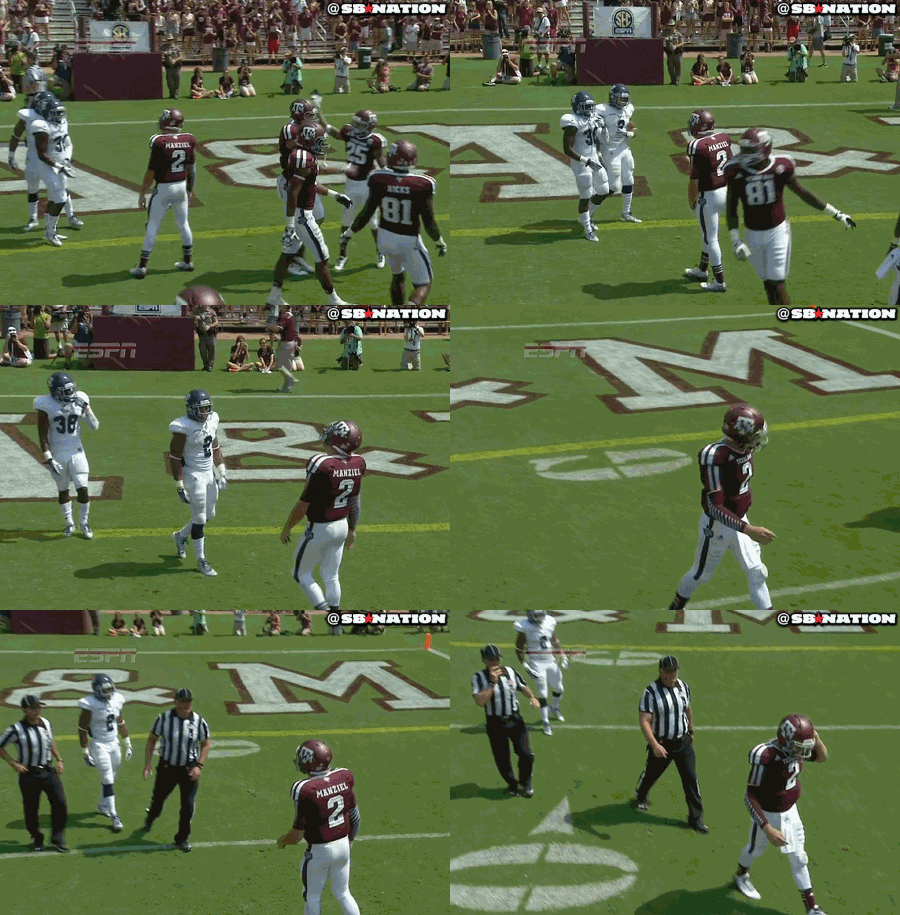
In case you missed it, Johnny Manziel picked up a taunting penalty in his season debut (GIF credit: SBNation).

manziel

Alright, that was not smart, but let’s not pretend he’s the only quarterback (or football player for that matter) to do such a thing. Of course ESPN’s Lou Holtz had a major problem with it, saying he would have grabbed Manziel “by the throat.” Also blowing things out of proportions was Mark May, who had plenty of off-field trouble in his college days.

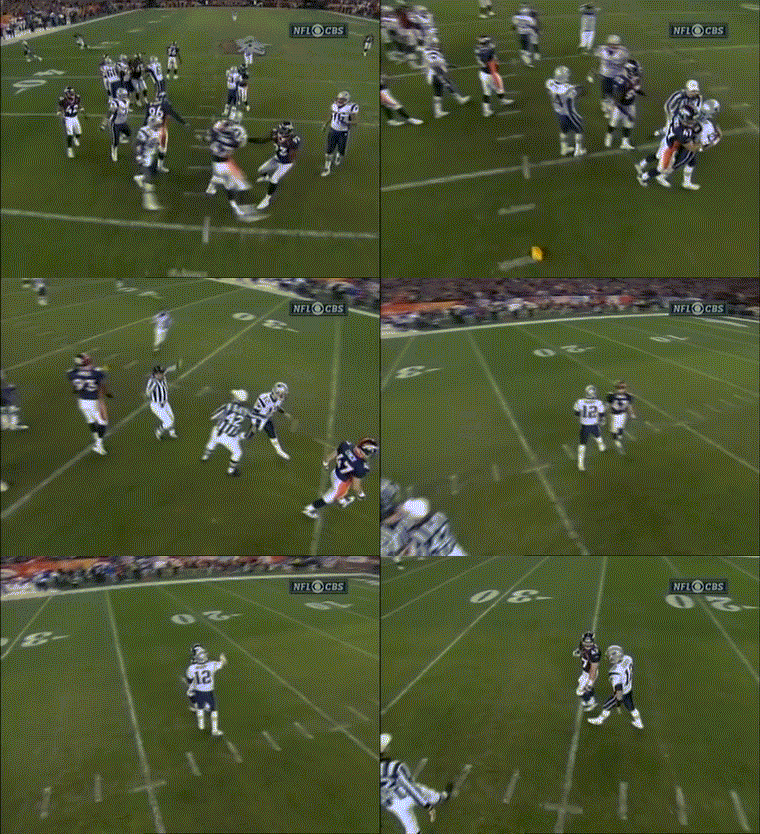
If this is the act of a “selfish knucklehead,” then let’s just say Manziel may have taken some pointers from the best.

TBJL05AFCD

That’s Tom Brady taunting John Lynch, perhaps a future Hall of Famer, on the opening series of a January 2006 playoff game in Denver. Jim Nantz’s response: “He’s got a pump fist of his own.”

At least Johnny Football kept his distance.

Peyton Manning’s Eight One-And-Done NFL Playoffs: Learn What You Are Criticizing

Peyton Manning lost another playoff game. Starting as a common quarterback narrative, the story has breathed too many years without more Super Bowl success to dispel, because we all know the “NFL For Dummies” handbook says to judge a quarterback based on championships won in the ultimate team sport.

So when Manning loses a playoff game, the popular thing to do is bash his reputation as a postseason quarterback, bash his losing playoff record (9-11), and call him a choker. The latest loss was probably the most painful one yet, and it gives Manning 11 playoff losses (tied with Brett Favre for record) and eight one-and-done postseason’s (another record).

But when someone throws that last fact out, they clearly do not realize what they are criticizing. If you want to bash the Colts and No. 1 seed 2012 Broncos for losing these games, five of them at home (by a combined 14 points), as a team, then feel free. They probably should have won at least 5-6 of them.

Though if you are bashing Manning based on his performances, then you need your head examined. Which other QB in NFL history could possibly produce these numbers and go 0-8 in the process without getting royally screwed over by his teammates and various other factors in a way no player ever has?

This is what you are knocking when you throw out the eight one-and-done seasons and 0-8 record:

  • 176/302 (58.3 percent) – This includes over 30 dropped passes in what equates to half a regular season
  • 2,075 passing yards (6.87 YPA)
  • 10 TD passes, one TD run
  • 6 INT – Three deflected off his own receiver’s hands, two thrown vs. 2002 Jets when Colts trailed 34-0/41-0 in 4th quarter
  • 82.0 passer rating – This would rank 23rd all time in postseason history (min. 150 attempts).
  • Six games with rating of 82.0 or better (five over 88.3, which is roughly career rating).
  • Seven losses by a combined 26 points; one other loss by 41 points.
  • Led in final 5:00 of fourth quarter five times.
  • Led in final 0:40 of fourth quarter four times.
  • Three overtime losses.
  • Two games where Manning’s last possession resulted in a missed field goal by Mike Vanderjagt (2000 MIA, 2005 PIT).
  • 2002 at Jets: Manning set Vanderjagt up for 41-yard FG, trailing 7-0. The next time he took the field, it was 17-0 Jets.
  • A memorable play where Nick Harper could have returned Jerome Bettis’ fumble for game-winning TD, but was tackled by Ben Roethlisberger.
  • Billy Volek came off the bench for Philip Rivers to lead Chargers on fourth-quarter comeback win (2007).
  • The worst average starting field position for any road team in the playoffs in the last 30 years (2008 San Diego).

These are not normal occurrences, and somehow the same quarterback keeps experiencing them, and becomes the easy target every year.

Saturday was the ultimate bow on top. Rahim Moore had a shot at a game-ending interception, and instead offers up what will go down as the worst ball misjudgment in NFL playoff history, resulting in Baltimore’s 70-yard game-tying TD. That is “Game Over” for any other quarterback. This was supposed to be “Manning’s best defense ever,” yet they suffered the biggest lapse and letdown in his career.

The game incredibly continued into overtime, and on Manning’s second possession, he went Favre and threw a bad interception. Immediately this cues the “Manning with another crushing playoff INT” talk, yet look at the list. This is the first time he’s ever thrown an interception in a close game like this that was actually his fault.

Just like how the Tracy Porter play in Super Bowl XLIV was the first time Manning ever turned the ball over in the fourth quarter/overtime in a one-score game in the playoffs. Yet the narrative is he always does these things. How does that happen when the facts show otherwise? These plays are first’s, not repeats.

What Manning usually does in the playoffs is give his team a chance to win the game in a way no other quarterback has. When they don’t, he takes the blunt of the criticism regardless of his play.

This stuff isn’t that hard to analyze. They only play 11 playoff games a year. Blame the quarterback when he deserves it. Don’t just blame Manning because of his status, and that you expect a touchdown every single drive from him. He’s not perfect. No one is in the playoffs.

In a 20-game sample, things are not going to even out, and they certainly have not evened out for Manning just yet, and he is really running out of chances. If the playoffs are supposed to be so important, so micro-analyzed, why are we seeing more garbage analysis than ever before? Just saying “9-11” does not prove a thing.

You know why quarterbacks who win a lot of playoff games do so? It’s not because they statistically out-produce Manning, because few do in the postseason. It’s because their teammates don’t muff onside-kick recoveries like Hank Baskett in the Super Bowl, miss clutch field goals like Mike Vanderjagt, forget a snap count on 3rd-and-1 with a chance to clinch the game, or allow a back-breaking 70-yard touchdown bomb.

Winning playoff teams limit their mistakes and finish games in the playoffs. There is no magical playoff quarterback formula about it. Manning was just over 30 seconds away from clinching his 50th game-winning drive, moving onto next week’s AFC Championship, and then disaster struck. A disaster other quarterbacks simply don’t have to deal with, because games never end that way.

Stop writing your stories before the game even starts, and pay attention to what actually happens. Be a defensive writer; one who reacts to what they see. Otherwise, you end up with garbage that truly defines the word “offensive.”

NFL Week 7 Predictions, Dick LeBeau and Writing Recap

That was a historic week. Peyton Manning set the new mark for fourth quarter comebacks, which only changed record holders for the third time since 1963, and I wrote eight articles totalling over 24,000 words.

Think I need a bye week.

This Week’s Articles

Captain Comeback Week 6: Matt Ryan Passes Tom Brady For Best Record in the Clutch – Cold, Hard Football Facts

While Manning and the Denver Broncos had the Drive of the Week, there was a rare (or at least they used to be) blown lead of two scores in the fourth quarter by the Patriots. With Tom Brady unable to answer, he was surpassed by Matt Ryan (19-11) for the best record in NFL history at 4Q/OT drives to win games.

Peyton Manning is the NFL’s All-Time Leader in Fourth Quarter Comeback Wins – Cold, Hard Football Facts

With 37 4th quarter comeback wins, Peyton Manning now has the NFL record. Of course in classic comeback semantics style, he was asked in the post-game conference the following question: “Did you know you passed, or tied Marino for the most fourth quarter comebacks?” You can’t make this stuff up, just as the Broncos can no longer claim Elway had 47 comebacks. The comeback king lives in Denver, and this time it’s valid.

NFL Rookie QBs Off to Unprecedented Start – NBC Sports

The 2012 season is the first time five rookie quarterbacks started in Week 1, and Andrew Luck, Robert Griffin III, Ryan Tannehill, Brandon Weeden and Russell Wilson continue to hold onto their jobs. They are off to one of the most productive starts in NFL history for a rookie class. I understand the table is not displaying properly in this article, so here is a picture of it.

2012 NFL Season is the Year of the Kicker – Bleacher Report

Did you know through 91 games kickers were on pace for the greatest kicking season ever? They have made 326 of 372 field goals (87.63 percent), which would be a new NFL record. A crazy fact: the top nine seasons in NFL history for FG percentage are the last nine seasons (2004-12). Find out what could be causing this.

Following a Legend: Andrew Luck Week 6 at New York Jets – Colts Authority

The second career road game, much like the first, for Andrew Luck did not go so well. A look at every drop back.

The Thinking Man’s Guide: NFL Week 7 Predictions – Bleacher Report

This week we take a look at Seahawks/49ers, and already a correct prediction on the 49ers holding up at home in a low-scoring game. Also: Joe Flacco is a much different QB on the road, Eli’s revenge on Washington, and the Steelers’ recent struggles in prime time.

Captain’s Challenge: Your Answers to the Top 5 Quarterbacks in NFL History – Cold, Hard Football Facts

Here are some of your answers and feedback on the challenge of using one stat to reflect the best top 5 group of QBs in NFL history. I still think 4QC wins does the best job, but some interesting choices also came up.

Don’t Believe Hype with Steelers’ Defense – NBC Sports

Steelers’ CB Ike Taylor asked us to look at the facts, so I did. Not only has the defense been blowing leads in the fourth quarter with regularity since 2007, but this was a big problem in Dick LeBeau’s first run as defensive coordinator in Cincinnati (1984-91). They allowed 27 game-winning drives in that span, tied for most in the NFL. Since 2007 the Steelers have allowed 20 (tied-2nd), and a whopping nine of them came with less than 0:40 left in the game. It’s a career trend, as is the constant failure against the elite QBs in the game.

This is one that can get at least two follow-up articles, so I’m not done yet.

One thing I’ll point out right now is why I didn’t include LeBeau’s 2004-2006 tenure into the stats.

For one, I do have a space limit, and already went over more than I should have on this piece. Two, I feel the problem has grown since Mike Tomlin became the head coach (2007), and I also know the game has statistically changed since that season in terms of passing efficiency.

LeBeau’s defense works great…if you want to win the AFC Central in 1995. But against today’s pass-heavy offenses with multiple receiver sets and little care to the running game, it is a lot easier to pick up his blitzes and throw against his CB cushions. If the scheme was still really that signficantly great, then why is it so dependent on one player (Troy Polamalu) to be there? Without Polamalu this defense is one of the worst in NFL history at creating takeaways.

As for the 2004-2006 seasons, let’s do a quick review for notable games.

2004

Week 1 vs. Oakland – in his first game back, LeBeau’s defense squandered a 21-10 lead in the fourth quarter, with Rich Gannong throwing a 38-yard TD pass on 4th and 12. Ouch. Fortunately, the offense put together a game-winning drive, using up 4:30 of the final 4:36 on the clock in a 24-21 win.

Week 4 vs. Cincinnati – Down 21-17, Carson Palmer threw a pick six late to Troy Polamalu, in what may have been the first big impact play of Troy’s career.

Week 6 at Dallas – Down 24-20, Vinny Testaverde only had 0:25 left at his own 35, but was able to get the ball to the PIT 30 for one final play. The Hail Mary was broken up in the end zone.

Week 11 at Cincinnati – Up 17-14, the Steelers made four stops in the fourth quarter, including forcing a late safety when Palmer was called for intentional grounding in the end zone.

Week 13 at Jacksonville – The Jaguars went 62 yards for a field goal to take a 16-14 lead with 1:55 left. Roethlisberger led the game-winning drive, and Byron Leftwich only had 0:11 left. He would complete a 19-yard pass to Jimmy Smith, but Josh Scobee was wide right on the 60-yard FG.

Week 15 at NY Giants – After the offense took a 26-24 lead, the Steelers allowed a 52-yard TD drive by the young Eli Manning. Giants led 30-26, but Ben led another go-ahead drive. With 3:31 left Manning’s deep ball was intercepted, and the offense converted two third downs to run out the clock.

Week 17 at Buffalo – Playing their backups, the Steelers forced a fumble of Drew Bledsoe, and a young James Harrison returned it for a touchdown to take a 26-17 lead.

AFC Divisional vs. NY Jets – After the offense tied the game 17-17, the defense allowed the Jets to drive, but Doug Brien missed a 47-yard FG with 1:58 left. Roethlisberger threw a big pick, but Brien missed it again. The Jets converted a 3rd & 13 in OT, but a holding penalty stalled their drive. The Steelers drove for the GW FG.

2005

Week 3 vs. New England – Down 13-10 in the 4th, Tom Brady led the Patriots on a 86-yard TD drive. They went 59 yards to add a FG (20-13). Roethlisberger led a game-tying TD drive. With 1:14 left Brady found two quick, easy completions to running backs, and Adam Vinatieri made the 43-yard GW FG with 0:01 left. It was a 37-yard drive.

Week 5 at San Diego – Down 14-13, Drew Brees led the Chargers 62 yards for a FG to take a 16-14 lead. Roethlisberger got the lead back with a 3-play TD drive. The defense allowed an 11-play, 62-yard TD drive to give up the lead again. Fortunately they stopped the 2pt conversion. More fortunately, the Steelers drove for the game-winning FG with only 0:06 left, so Brees didn’t have a third chance.

Week 6 vs. Jacksonville – Defense made a few stops in a tied game, but Tommy Maddox threw a game-ending pick six in OT.

Week 8 vs. Baltimore – Anthony “Radio” Wright led three straight FG drives in the 4th quarter to turn a 17-10 deficit into a 19-17 lead for Baltimore. Roethlisberger led the go-ahead FG drive, and the defense finally stopped Wright on a 4th and 6.

Week 9 at Green Bay – Up 13-10, the Steelers forced a 3 and out and a pick of Brett Favre.

Week 11 at Baltimore – With Maddox struggling at QB again, the Ravens went on a 30-yard drive in OT that ended with Matt Stover’s 44-yd GW FG.

AFC Divisional at Indianapolis – Despite leading 21-3, the Colts went on TD drives of 72 and 80 yards in the 4th QT, plus a 2-point conversion to make it 21-18. Getting the ball back, the Colts went 4 and out after two sacks of Manning. Jerome Bettis shockingly coughed the ball up, and Roethlisberger tackled Nick Harper. Manning completed two passes for 30 yards before rookie Bryant McFadden prevented a Reggie Wayne TD. Mike Vanderjagt missed a 46-yard FG.

Super Bowl XL vs. Seattle – Down 14-10, Seattle drove from their own 2-yard line to complete a pass to the 1-yard line, but Sean Locklear was called for holding. Three plays later Matt Hasselbeck threw an interception and the Steelers all but put the game away on Randle El’s touchdown to Hines Ward.

2006

Week 1 vs. Miami – Up 21-17, this one was a good hold to start the season. The defense intercepted Daunte Culpepper twice, including a pick six by Joey Porter to ice the game.

Week 3 vs. Cincinnati – Two fumbles led to two Carson Palmer touchdown passes on short fields in a comeback win for the Bengals. While the fumbles were bad, there’s no reason to give up one-play TD drives of 9 and 30 yards. Hold them to a field goal at least once. This was the season-long problem with the 2006 Steelers. The offense would turn it over, and the defense would compound it by allowing instant points. A perfect example here.

Week 7 at Atlanta – An unexpected shootout, the Steelers tied the game late 38-38. Michael Vick drove the Falcons, but Morten Andersen was short on a 52-yard FG. In OT Andersen made the GW FG from 32 yards out on the only drive of OT. Key play was Vick converting a 3rd and 9 for 26 yards to Alge Crumpler.

Week 10 vs. New Orleans – Another shootout with Brees, the Steelers took a 38-24 lead. The Saints went 64 yards, scoring on a “fumblerooski” play. Brees was driving late for the tie, but Terrance Copper fumbled at the PIT 25 after a huge hit from Tyrone Carter. Steelers won 38-31.

Week 11 at Cleveland – One of Roethlisberger’s best comebacks. Down 13-3, he led the offense 87 yards for a TD. Josh Cribbs returned the kickoff for a TD (20-10). Ben led another TD drive, then another with 0:32 left. Charlie Frye only had 0:27 left, but moved the ball to the PIT 22. On his last chance, Braylon Edwards could not complete the catch in the end zone.

Week 17 at Cincinnati – This turned into a 4th QT shootout. Down 7-3, Palmer went 80 yards, completing a 66-yard TD to the late Chris Henry. The Steelers went 63 yards for a TD (14-10). The Bengals came right back with a 73-yard TD drive (17-14). Steelers tied with a FG (17-17). With 0:55 left at his own 33, Palmer would find Henry deep for 47 yards. Shayne Graham was wide right on a 39-yard FG with 0:08 left, or else the Bengals would have won, made the playoffs, and another GWD against this defense. Instead the Steelers get the ball in OT and Santonio Holmes goes 67 yards for the TD to give a disappointing season a nice finish.

What do we see? Some good, some bad, and more of the offense bailing out the defense at the end. Things were better then than they have been in recent years, but it’s not the lockdown defense the stats show in terms of how many points and yards they allow. No one cares how many yards you gave up if you blow it at the end of the game.

2012 NFL Week 7 Predictions

I had the 49ers, so I’m already four wins away from matching last week’s awful total.

Winners in bold:

  • Titans at Bills
  • Cowboys at Panthers
  • Ravens at Texans
  • Browns at Colts
  • Cardinals at Vikings
  • Redskins at Giants
  • Packers at Rams
  • Saints at Buccaneers
  • Jets at Patriots
  • Jaguars at Raiders
  • Steelers at Bengals
  • Lions at Bears

Season results:

  • Week 1: 12-4
  • Week 2: 11-5
  • Week 3: 4-12
  • Week 4: 10-5
  • Week 5: 10-4
  • Week 6: 5-9
  • Season: 52-39

NFL Week 4 Predictions and More Golden Tate Hail Mary Response

Well this has been the most interesting week yet in the brief time I have covered the NFL. It started with a Sunday full of crazy games, which resulted in a nice stat of the week I jumped on first after the New England loss.

Then Monday night came, bringing in the biggest overreaction to a correct call in NFL history. But this wasn’t about injustice as much as it was scorn for the replacement referees, and the only positive is it did end the lockout.

But the controversial Golden Tate Hail Mary touchdown is a classic example of groupthink and media manipulation. How one views this play really separates the sheep from people willing to think for themselves and not be influenced by Jon Gruden’s second-half disgust, which is an entertaining thought because he still looks like a Chucky doll.

At the very least, any objective person should see this was too close of a call to make in real time for anyone, and that there’s no way you could have clearly called it an interception. It  is completely understandable why they ruled what they did, and upon further analysis, it was the right call just as the NFL and that replacement referee have said.

So in writing the article, I tried to put as much as I could into it. That’s why I write long articles, as I try to cover all bases and leave little for anyone to nitpick over. But I will reply to a few of the same things I’m seeing in response to it on Twitter or in your e-mails. And no, I won’t use anyone’s name.  Reaction has been 50/50, even though it seems like reaction to the call has been 90/10.

Well Allow Me To Retort

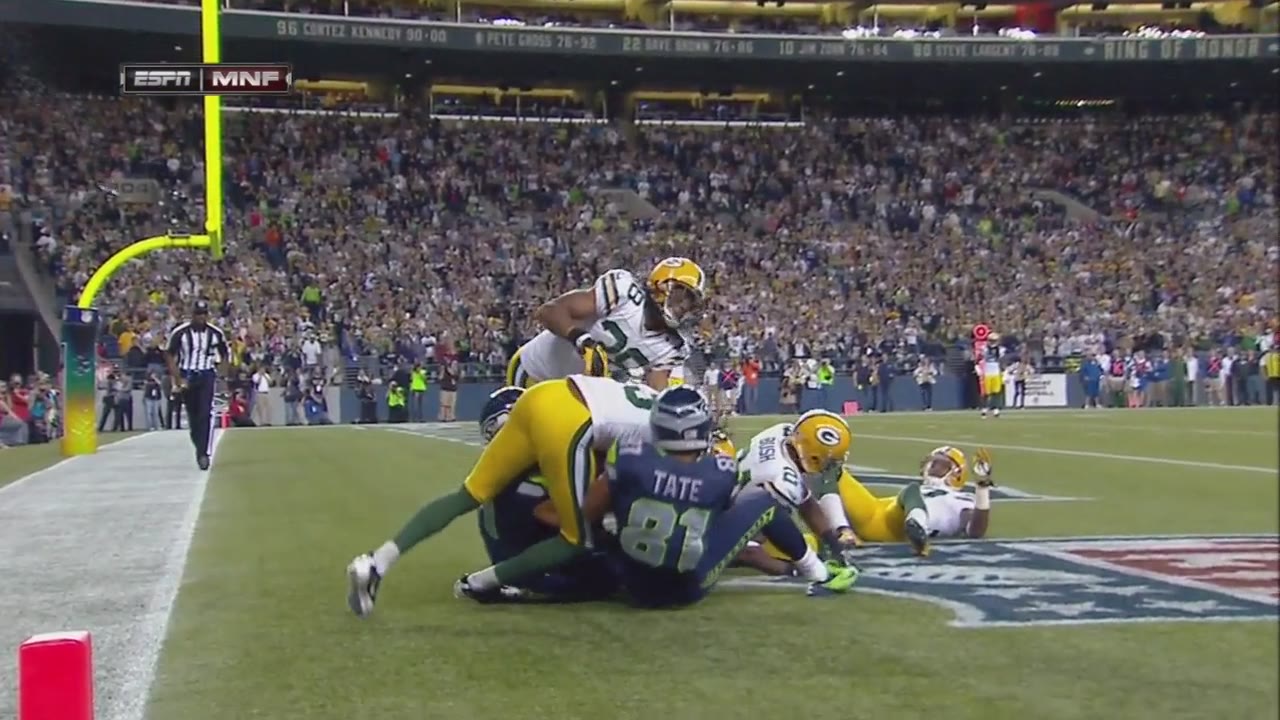
Worthless Picture – First, it is always easy to see which people actually read the article and which respond after reading only the headline. Anyone still trying to use this picture as proof of anything needs to get a clue.

This is several seconds after both players have landed on the ground. The catch was already over as all aspects of a catch have been satisfied (control and possession through the process of going to the ground). Just because the refs came in late doesn’t mean anything. This wasn’t a fumble and two players battling on the ground for the ball, in which refs will often let them fight it out. This was a (TD) catch.

Back judge – He never signaled touchback like some have said. That has a distinct motion — like a vertical spanking/tap that ass motion — which he never used. What the back judge even ruled was never going to be more reliable than the ref on the spot, because look how far away the back judge is at the moment both players have hit the ground:

He is barely past the goal post at this point. How could he possibly been able to tell who controlled the ball first? From the point of contact with the ball to this picture where the second foot hits for Jennings, a total of 0.7 seconds passed. Over three additional seconds pass before the back judge runs in to take a look at the players on the ground, which makes for a call from him that was never going to be conclusive or even confident.

Semantics – Lots of semantics mess again this week with control, possession and catch. I have seen people say simultaneous possession, even though the only thing in the rule book is “simultaneous catch.” I have heard comments from a ex-NFL referee talking about possession in the air, even though the NFL clearly said in their statement possession cannot happen in the air. A player must get two feet or an equivalent like a knee down to legally gain possession.

It is also indisputable that Tate gains possession first, but the most important part of the play comes at the very beginning.

Physics of the play – First let’s talk about control, since that is the common complaint.

You can control a ball with one hand. That was the point of the one-handed examples I used to refute the article from ProFootballTalk or Hochuli’s mumbo-jumbo about four arms. You do not need two hands/arms, and this Randy Moss TD is another nice example pointed out by @DeeepThreat. You can move your hand/arm off the ball (see Reggie Wayne) if you want, but as long as you have sustained control with one hand, it counts.

As for Tate, I have yet to see anyone explain this. First, let’s recall the fact Tate was in front of Jennings and should have been the first to contact the ball. I proved the ball made first contact with his left hand. Do not even try and say it hit Jennings’ right hand first, as that is just depth perception. If you watch the video in conjunction with making the frames, the ball hits Tate first, and it did much more than just touch him.

Why does the ball get stuck in the air at this point if Tate didn’t have control, or only had his fingertips on the ball? Go outside and have someone throw you a football and try to hold it up in the air without any real control or grip. It won’t happen. The ball will deflect off your hand. Any non-sticky object would if you don’t actually initiate some type of grip on it.  Jennings only closed his hands around it after Tate stopped it in the air first for the play to even develop into a catch.

How else are you going to stop a football traveling roughly 45 yards in the air in 2.85 seconds if you didn’t initiate a good grip to control it?

This isn’t to say that you can’t grip an object with just your fingers. Having a big, strong hand would definitely help make it more possible.

Tate has a very interesting Twitter background pic  that shows him hauling in a ball with his left hand on a more difficult looking play in practice. These guys get drafted high for a reason. They are great athletes capable of making tough catches.

Notice that Jennings does a horizontal close on the ball with his hands. It does not move backwards or fall forwards after Tate’s initial grab. That supports his grip of the ball. It’s not like Jennings had to keep the ball up from being deflected away incomplete. Tate controlled it. Watch most catches in football. The receiver’s initial contact with the ball is when he gets the grip on it, and it is possible to do so with one hand.

Less than a tenth of a second passes between Tate’s contact and Jennings’ close on the ball. If you are trying to judge this in real time, how could that not look simultaneous? Makes perfect sense why referee Lance Easley made the call he did.

Consider the initial contact Point A, and we know from the end of the play when Jennings struggles to wrestle the ball away from Tate that Tate has that grip with his left hand still on the ball (Point B). So where between Point A and Point B does Tate ever lose the ball from his left hand? No one has any evidence that he loses control. That is why this is a TD, because he maintained that control from the start of the play through the process of going to the ground.

Other criticisms – Some people talk about the ball being in Jennings’ chest. For starters, there is no rule that says you have to have the ball in your chest, so just ignore Steve Young’s revisionist, agenda-pushing history. More importantly, everyone who thinks this is ignoring the fact that Tate’s hand was in the way of his chest throughout the play. Pretty hard to pull something to your chest if a guy has his hand lodged in there the whole time.

The NFL would have admitted they blew the TD call and it should have been an interception if that was actually the case. They did admit the OPI, which also would have ended the game. People don’t think the NFL admits such game-changing errors, but the fact is they do. What they don’t do is change the final outcome because of one.

Listening to some people, you’d think Jennings caught it first and Tate just fingered the ball on the way down. Some of the reaction has just been embarrassing. Not sure how long this play will be in focus, but expect to hear about it more should the season continue going sour for Green Bay. But hopefully by that point people would just realize this game didn’t decide their season, and it was their disappointing play starting in Week 1 that was the real culprit.

Not a right call that Mike Tirico initially made himself in the heat of the moment, only to bash for the last 12 minutes of the broadcast.

Take emotion out of it, and you will understand why Seattle got the touchdown.

This Week’s Articles

Captain Comeback Week 3: What the Hell’s Going on Out There? – Cold, Hard Football Facts

After 12 games with a fourth quarter comeback opportunity, this was a jammed-packed edition of Captain Comeback. It has only received about 4,900 fewer Facebook likes than you know which article.

Crazy Season Even Affecting NFL’s Best Quarterbacks – NBC Sports

For the first time in 58 opportunities, Peyton Manning, Tom Brady, Drew Brees and Ben Roethlisberger all lost on Sunday. If that’s not enough, Week 2 (1-3) was their first losing week. It’s just a reflection of what’s been a crazy season so far.

New Orleans Saints’ Disastrous 0-3 Start Goes Well Beyond Sean Payton’s Absence – Bleacher Report

The Saints are 0-3, but before we give Sean Payton coach of the year in his absence, let’s call a spade a spade. Drew Brees is playing like an average quarterback at best, and the defense might be the worst in the league.

Following a Legend: Andrew Luck Week 3 vs. Jacksonville Jaguars – Colts Authority

Luck came very close to his first 4QC, but a shocking 80-yard TD put that out of reach. Check the analysis of every drop back.

The Thinking Man’s Guide to NFL Week 4 – Bleacher Report

Included: the greatest 0-3 at 1-2 game ever, San Francisco’s Jet lag, must-win weekend for the century’s best quarterbacks, and no-huddle nuggets.

Shame on the Angry Mob: Golden Tate’s Touchdown Was Legit – Cold, Hard Football Facts

I just call it like I see it.

2012 NFL Week 4 Predictions

After an all-time worst 4-12 record in Week 3, it’s time for some redemption. Baltimore has started me off 1-0, but that was closer than it should have been.

Winners in bold:

  • Panthers at Falcons
  • Patriots at Bills
  • Vikings at Lions
  • Titans at Texans
  • Chargers at Chiefs
  • 49ers at Jets
  • Seahawks at Rams
  • Dolphins at Cardinals
  • Raiders at Broncos
  • Bengals at Jaguars
  • Saints at Packers
  • Redskins at Buccaneers
  • Giants at Eagles
  • Bears at Cowboys

Season results:

  • Week 1: 12-4
  • Week 2: 11-5
  • Week 3: 4-12
  • Season: 27-21

You can keep e-mailing me if you want, but I am less likely to reply and really would like to move on from Monday night starting with Week 4 Sunday action. Believe it or not the season has continued. More bad calls will be made. A lot more bad plays that lead to losses will also happen. That’s football.

NFL Week in Review: Andrew Luck Live, Matt Ryan on FOX, and 5th-Year Breakout QBs

A goose, a moose, and the son of Marv Albert walk into a bar…

Watching a live NFL broadcast is good for the creative mind. You can pick up plenty of ammo for The Whistleblower, and every once in a while you might learn something of value.

I watched the Cincinnati Bengals at Atlanta Falcons preseason game on Thursday night, or at least as much as I could stomach, and I found multiple things worth looking into.

First, the FOX broadcast team of Kenny Albert, Daryl Johnston and Tony Siragusa seemed pretty supportive of Atlanta’s Matt Ryan. There was not much talk about the playoff struggles, but instead they went optimistic for Ryan to really get things going in his fifth season.

In fact, even after one nice play by Ryan in the game the crew said something to the effect of “maybe the 5th year really is the breakout year for a young quarterback!”

Now they were not being scientific of course, and neither am I today. But I decided to dig a little into quarterbacks, with the help of Pro Football Reference’s Play Index, and see if there was any proof for the 5th season being the breakout season.

This would be defined as the QB having his best season in his fifth year, and ignoring any season that came afterwards for the purposes of this study.

The results were surprising, as I actually did find several high-profile cases of a QB having a career-year in season 5. Certainly enough to actually warrant the claims the FOX crew threw out there.

Note: When I say career-high here, I am only looking at the first five seasons unless noted otherwise.

5th-Year Breakout QBs

  • Sid Luckman (1943) – This one is influenced by WWII, but 1943 was the year Luckman threw 28 TD and had a ridiculous 107.5 passer rating.
  • Sonny Jurgensen (1961) – after riding the bench for four years in Philadelphia, Jurgensen got his shot in 1961 and threw for a then NFL record 3,723 yards and 32 TD.
  • Daryle Lamonica (1967) – After four backup years in Buffalo in which he was also a punter, Lamonica exploded with the Raiders, throwing 30 touchdowns and leading the team to Super Bowl II.
  • Bob Griese (1971) – Had a career-high 90.9 passer rating while throwing 19 TD to only a career-low 9 INT.
  • Ken Stabler (1974) – Threw 26 TD  and won the only AP NFL MVP award of his career.
  • Ken Anderson (1975) – Though 1974 was incredible too, Anderson made his first Pro Bowl and a 10-win season in 1975, while throwing for a      career-high 3,169 yards and 21 TD.
  • Danny White (1980) – Backup to Roger Staubach no more, White threw 30 TD and led Dallas to a 12-4 record and the most points scored in the league.
  • Joe Montana (1983) – One could argue 1981, the first Super Bowl win, was a better year, but in 1983, Montana had a career-high in yards (3,910), TD (26), and passer rating (94.6).
  • Dave Krieg (1984) – though he was more efficient in 1983, he only played half the season. In 1984, Krieg threw 32 TD and led Seattle to a 12-4 record.
  • John Elway (1987) – His lone MVP  award of his career came in 1987, which was the best season Elway had in his first 10 seasons actually.
  • Boomer Esiason (1988) – Won league  MVP and led the highest-scoring offense in the league to the Super Bowl in the best year of his entire career.
  • Chris Miller (1991) – Here’s a former Falcon. 13th overall pick in 1987, Miller had his lone Pro Bowl      season in 1991 when he threw 26 TD and led Atlanta to the second round of the playoffs.
  • Brett Favre (1995) – had a career-high in yards, TD and passer rating. Favre won his first MVP award.
  • Scott Mitchell (1995) – Yep, the one-year wonder came alive in 1995 with 4,338 yards and 32 TD for the Detroit Lions.
  • Matt Hasselbeck (2003) – Threw a career-high 26 TD while leading Seattle to 10-6 and the playoffs. He wanted to score too much that year.
  • Tom Brady (2004) – Brady had his best statistical season in year 5 as he led the Patriots to a third Super Bowl in four seasons. It was the first time he had a passer rating over 90.0 in a season, and this was easily the most dominant NE team to win a Super Bowl.
  • Tony Romo (2007) – In his second year as a starter, Romo led Dallas to a 13-3 record, threw for 4,211 yards, 36 TD and had a 97.4 passer      rating.
  • Philip Rivers (2008) – forget the  8-8 record, Rivers was on fire that year with 34 TD and a league-best 105.5 passer rating.
  • Eli Manning (2008) – After the  Super Bowl win, Manning had the best regular season of his career in 2008, leading the Giants to a 12-4 record and setting career highs in comp.  percentage, YPA and passer rating.
  • Aaron Rodgers (2009) – In just his second year as a starter, Rodgers threw 30 TD to only 7 INT, and had a 103.2 passer rating.

I could go on, but 20 rather high-profile cases is good enough to get the point across. Year five has been a breakout year for many of the all-time greats.

But what about the math check? We are talking about five seasons, so there is a 20 percent chance a QB will have his career/breakout year in the fifth year.

Even more inflating is the fact that most of these quarterbacks are not like Matt Ryan: starters from day one. Only Griese and Elway were five-year primary starters. When you sit on the bench for multiple seasons like Rivers or Rodgers, then it is even more likely your 5th season will be your best. Rodgers had a 50 percent chance, because all you could really compare are 2008 and 2009.

Notice players that started as rookies like Peyton Manning, Dan Marino, Ben Roethlisberger and Johnny Unitas did not make the list. That’s not to say they were not any good in year five, but it was not their best effort.

Matt Ryan’s best season was 2010. Maybe he will surpass it this year, but it is far from being a lock.

Great QB-Head Coach Pairings

Matt Ryan entering his fifth season also means Mike Smith is entering his fifth season as head coach of the Falcons. They came in together, and as I wrote at Bleacher Report last week, that is one of the great ways to turn a team around.

I looked at 80 cases in the Super Bowl era (but not every single case) of a team getting a new head coach and quarterback in the same year. Nine have been extremely successful (the elites), 20 had moderate success (Ryan/Smith fit in here), 12 were average/one-year wonders, and 34 were complete and utter failures together. That leaves five active/unknowns.

That includes 2012 rookies Chuck Pagano/Andrew Luck in Indianapolis, and Joe Philbin/Ryan Tannehill in Miami. They are the 31st and 32nd examples of a team hiring a rookie head coach and drafting a first-round QB in the same year since 1966.

FOX Gave Me a Concussion

The worst thing from the NFL on FOX, besides Laura Okmin’s interviews in Baltimore on Friday, was the semi-brutal discussion in Atlanta about the new kickoff rule helping to bring concussions down 43 percent on kickoffs. The crew boasted about how great that was, but they were misleading people by only looking at that one number.

As I wrote last week with data from Edgeworth Economics, concussions may have went down 43 percent on kickoffs, but it is because the number of kicks actually returned went down to 53.5 percent. In previous seasons, returnable kicks were in the lower 80’s in percentage.

Kickoffs are not safer. They just are less frequent. Going from 35 to 20 concussions on kickoffs sounds nice, but not so much when the overall concussion number only goes from 270 down to 266. That means concussions on other types of plays increased in 2011.

Also, we are talking about a one-year sample size, which was unusual because of the lockout. Let’s see what happens with the injury data this year before declaring the kickoff rule change a success.

Maybe we need five years of data for it to be clear. Just throwing it out there, much like Fox did in their effort to talk up Matt Ryan during a meaningless preseason game.

At least they were not blatantly wrong…this time.

Andrew Luck…Live and In Person

Finally, I went to the Colts/Steelers game last night, which means I did not get to hear any of Al Michaels and Cris Collinsworth. They are not a duo I have a beef with, and you kind of miss hearing some type of analysis offered other than the loudest people sitting in your section.

With the stadium Wi-Fi almost nonexistent and a lack of stats on the scoreboard, I was pretty much forced to use the eyeball test to follow the game. This is exactly why I never go to regular season Sunday games (I have actually never been to a regular season or playoff game period), because I cannot be away from all the action going on around the league. I need details.

Not to mention I still favor my couch and computer chair. Even if the seat was pretty damn nice.

Ben Roethlisberger threw maybe the worst interception I have ever seen him throw, and I have seen them all. The Steelers showed very little on offense outside of Antonio Brown’s incredible run-after-catch on the touchdown. I have not seen a Pittsburgh WR do that since Santonio Holmes did it to the Baltimore Ravens in the 2008 AFC Championship.

I don’t know if Antonio Brown can replace Mike Wallace, but he has been a great replacement for Holmes.

Just before the game I learned via Twitter the NFL Network showed my tweet about predicting a 9/16 for 84-yard performance by Luck against Pittsburgh’s defense. I missed it. Again.

Andrew Luck started off with a weird Bruce Arians screen that saw Reggie Wayne go in motion, and Luck threw at his teammate’s ass (it appeared that way to me at least). I actually saw Wayne in motion and line up on the right, which is far different from his usual “I only line up on the left” role in Indy’s offense.

Luck threw a good pass to Collie, who must have dropped it on the way to the ground after taking yet another hit that saw him walk slowly to the bench. I don’t feel very good about the long-term career of this kid, which is a shame because he is a talented receiver.

That 19-yard reversal seemed to take forever, as did most of the challenge/reviews with the replacement refs. At least they knew which teams were playing tonight.

Luck’s pick six by Ike Taylor was a poorly thrown pass, and you know things are going bad when stone-hands Ike Taylor is taking your pass to the house. At this point, Luck was 2/8 for 16 yards and the INT.

But like he did last year at Stanford, he came right back from a mistake and led his offense to a touchdown. This is a great article from ESPN on Luck’s career at Stanford, and one of the facts I remembered was Luck bouncing back from interceptions last season.

After 10 interceptions in 2011, Luck led Stanford to 7 touchdowns on the ensuing drives. He was 28/34 for 288 yards, 3 TD and no turnovers on those drives. He knows how to immediately make up for a mistake.

After starting the next drive with a sack, Luck could have easily folded down 14-0 on the road, but he came back with four straight completions on a touchdown drive. He did have a second interception, but that was all on T.Y. Hilton throwing the big gain up into the air for a turnover.

Though he was 8/16 for 79 yards and two picks to start the game, numbers pretty close to my 16-attempt prediction, I was still far off on how Luck would finish the night. He was 16/25 for 175 yards, a TD run, and the two INT.

He had a spike to set up a last-second field goal. He had at least two drops that would have been another 40 yards in the half. Luck was pretty impressive in my book.

The game does not count for anything, and is irrelevant in the grand scheme of things.

But for one night, I experienced football from an angle without any commentary, statistics, while watching two teams I respect, and with players I may never see in person again in my life.

Now that it’s over, my anticipation for the real thing is much greater.

Coming up this week: expect articles on regression for elite offenses, potential myth-busting, and a PSA on bad stat usage. I will also give the podcast world a try for the first time.

(If you were looking for the punchline to the joke at the beginning, think “something, something…sodomy and glory holes”)

Carolina Panther Fans: You Can’t Handle the Truth

Aaron Sorkin once delivered gold with this line from A Few Good Men, and Jack Nicholson immortalized it on the screen. Not only was it a classic moment in film history, but the line itself can be thrown back at many people out there who clearly can’t handle the truth when it comes to hearing valid criticism of their favorite athletes.

Since I started writing football articles, I have received almost zero criticism from anyone. There was one Saints fan that was probably just drunk at 3 a.m. and mistakenly thought I put down Brees, but that was about it.

People that know my work know I turn in-depth research into quality writing as well as anyone out there. I have established a standard for myself, and refuse to put out something in my name that does not live up to that standard.

Enter my articles on Cam Newton (one, and two), and I saw how the other side lives. There was a huge negative response, but it was concentrated from the Carolina fan base. Look at this gem from Twitter. People like that led the way that day.

In other words, it was a homer attack that I could give two shits about. I know what I wrote, and I know what research I had to write what I did.

It is easy to see what’s going on here. Carolina fans have zero experience in having a franchise QB to root for. Steve Beuerlein’s one year of greatness? Jake Delhomme’s solid play for a few years? No. This is different with Newton.

The Panther fans have their binky now, and they love their binky, and will say anything to protect him.

THE SECOND WAVE

So after Monday’s article, the second wave came, but this time it was different. Now I had other writers responding to what I wrote with their own article. This takes it beyond “random Twitter asshole.”

First, Jimmy Grappone put this piece together last night on Bleacher Report. It really doesn’t refute my articles, and I noticed he made mention of Jaworski’s QB ranking ofNewton as No. 15 in the league. That is fine, but my beef is with the other lists and much higher rankingsNewton was given from other sources. Jaworski’s ranking is more in touch with reality. Contributor Hank Kimball’s comment at the bottom sums up the rest of my feelings towards this one.

Then I awoke today to find someone I never heard of on a site I never visit call me lazy.

L-A-Z-Y.

That’s a new one. You can call me a lot of things, but lazy is not one of them. At least not when it comes to researching and writing.

He didn’t mention me by name, and I will offer him the same courtesy here.

You can choose to read the article here. Or, you can just allow me to demonstrate how the pot called the kettle black, and show just how lazy this piece was.

(Guess starting this blog last week was good timing)

I’M LAZY?

This is not something I normally will plan to do – I normally never would have to – but if you are going to attack my work, I will make it a point to show just how bad yours is. Just how lazy the research, or lack thereof, was.

First, he even begins his article with “As a writer there are few things more important than holding your tongue if you haven’t done the adequate research needed to cover a topic.”

The “I watched every play” defense is always laughable. Great, you were a fan and watched your team’s 16 games each week. Welcome to the club of millions that did the same.

Now did you go back and watch the game again? Did you supplement the shaky eye test with indisputable data? Or are you just going all by memory of a game you saw one time with a biased interest as a fan?

Lazy Statement No. 1 – “As the season progressed we saw Jonathan Stewart given more and more short-yardage carries.”

This is exactly what I’m talking about with hard data versus fluffy memories. This was in response to me saying Newton’s rushing TD record was a fluke. Jonathan Stewart was not given more carries near the goal line as the season progressed.

Inside the 10-yard line last year, Newton had 23 carries to 10 for Stewart. I think a logical split would be the first eight games vs. last eight games (not to mention Carolina had a bye after the 8th game).

In the first eight games, Newton had 16 of the 25 carries (64%), and Stewart had 8 (32%). In the last eight games, Newton had 7 of the 16 carries (43.8%), and Stewart had two (12.5%).

Those TWO goal line carries Stewart had in the second half of the season must have really resonated with this fan.

The player that actually was given more carries was DeAngelo Williams, who had six carries in the second half of the season, after just one in the first half.

Either way, Newton was still the No. 1 option for Carolina in this situation.

Misconceived Statement No. 2– “There’s no single statement that makes blood shoot out of my orifices faster than reading pieces that refer to Cam Newton as a ‘running QB’. That statement alone should be a bellwether than the writer didn’t watch him play.”

What we have here is a failure to understand averages. A running quarterback does not mean it is someone who has more carries than pass attempts (or close to a 50/50 split). A running quarterback is someone who is more likely to take off and run than the average (pocket) quarterback.

Newtonhad 126 carries in 2011, which are the second most in NFL history for a QB. Not even Michael Vick has topped that number.

Meanwhile your pocket passers like Peyton Manning, Tom Brady and Drew Brees average well under 40 attempts a season, and many of those are kneel downs to secure a win (not many of those included in Newton’s season).

When someone is much more likely to take off and run, not to mention have the most designed running plays in the league, then it’s clear they are a running quarterback.

That does not mean they can’t throw or don’t throw. Only an idiot would take that angle from it.

Last season Matthew Stafford ran on just 3.1% of his drop backs. Newton ran on 18.6% of his drop backs. Big difference.

Same thing in basketball with outside shooters.

LeBron James averages 4.0 attempts per game from 3-pt territory in his career. That’s almost as many as Kyle Korver (4.1). So why is James not considered a 3-pt shooter like Korver? James makes .331 of them, compared to .413 for Korver. He is inefficient at doing it, and it is a much lower percentage of his overall attempts.

And while I never specifically said running quarterbacks are figured out quickly in the NFL, there is no denying players like Michael Vick, Kordell Stewart, Aaron Brooks, and Vince Young were successful early, but failed to improve their game. Players like Randall Cunningham and Steve McNair played their best when they stayed in the pocket later in their careers.

I think Newton has a better chance than those players, but there is zero to suggest he’s going to automatically be a better passer this year.

Lazy Statement No. 3 – “It’s the same thing we saw from Ben Roethlisberger his rookie year, when he ran 56 times (a mark he’s never matched again). Like Roethlisberger it’s likelyCam will take that next step where he’s more willing to stand in the pocket and look at every single read before leaving, rather than taking off before every option is examined.”

If you know about Ben Roethlisberger, then you know he hates to scramble. He always wants to throw the ball, and looks downfield for the big play first and foremost.

Roethlisberger was not often scrambling in his rookie season. He was kneeling down on his way to a 13-0 record as a starter.

27 of Roethlisberger’s 56 runs in 2004 were kneel downs. That means he attempted to throw the ball on 8.2% of his drop backs. That is more than a pocket passer like Stafford, but still nowhere near the level of Newton.

Roethlisberger and Aaron Rodgers use their legs, but still look to throw.Newton is more likely to run at this point of his career.

You cannot call Newton a typical pocket passer, so he gets the earned distinction of a running quarterback.

Lazy Statement No. 4 – “The Panthers Newton-led offense managed to eek out six wins in spite of an atrocious defense.”

This is a common mistake many writers make. They take a team’s bad statistic and apply it to the full season, completely ignoring what happened in said wins.

For example, the 2006 Indianapolis Colts had a very poor regular season defense, but they played great for 3.5 of the playoff games, and that helped the team win Super Bowl XLI.

Newton never overcame an atrocious defense for a single win in 2011.

When the team allowed more than 20 points, they were 0-10. They were 6-0 when allowing 20 points or fewer, and they only managed that against bad offenses with an inexperienced quarterback starting.

Considering Josh Johnson, Curtis Painter and John Beck are a combined 0-20 in the NFL as starters, Newton better have led his team to a win in those games.

Five of the six quarterbacks Carolina beat in 2011 were making their 1st-to-8th career start in the NFL Only Josh Freeman (39th start) was experienced, and he had a bad season.

The Panthers also only won when Newton took on more of a game manager role. They were 5-1 in his games with the fewest passing yards.

  • If you have, at best, league-average passing stats (pick any site and metric)…
  • If you have an absurdly inflated rushing touchdown record…
  • If you fail more often than you succeed in the clutch…
  • If you can only win when the defense shuts down subpar offenses…

Then clearly, you are not the greatest rookie ever, and far from a top 10 (or higher) quarterback in this league.

You are overrated.

Conclusion

It’s a new age for Carolina Panthers football. But their fans are going to have to start accepting the truth. Your quarterback is far from perfect. Far from being accomplished in this league too.

I did not have to pull things out of thin air or fabricate anything to make my points. The facts are the facts. If Newton has a great 2012, then fine. He’ll no longer be overrated (unless of course people start putting him even higher than he deserves again).

But what he does in 2012 will not change the fact his 2011 was a vastly overrated season.

People that rely solely on the eye test are always going to be lacking in the facts department. That’s the whole problem with the eye test. You see what you want to see, and it’s even worse when you are a fan of that team.

While you should supplement watching games with the data, some people seem to think their eyes and memories are all they need. Facts? Well we will just make some generalizations and that should work for most of the sheep.

Now that’s being lazy.