Most Passing Touchdowns and Yards Thru Game X in NFL History (2020 Update)

Now that the 2020 NFL regular season is over, it is time to update the leaders in most passing touchdown and yards through game X in NFL history.

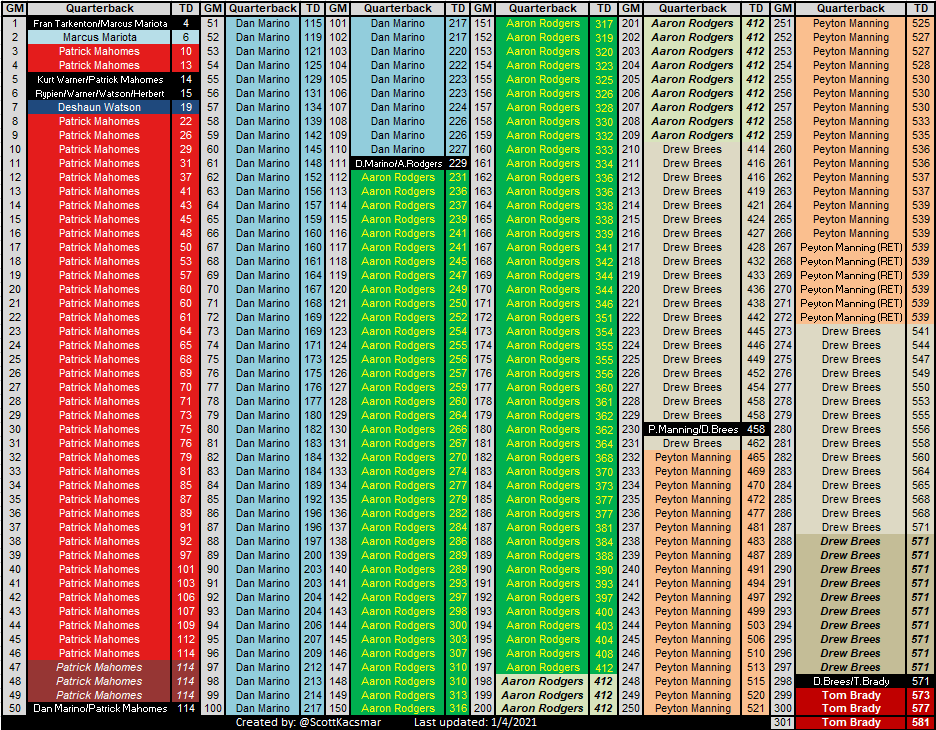
First is the table for touchdown passes, which saw Drew Brees and Tom Brady battle back and forth over the all-time record until Brees’ rib injury cost him four games. But Brees still makes 48 appearances on the list compared to just three for Brady, who did not surpass him until Game #299.

(Click on picture to enlarge)

Take note of Justin Herbert sneaking in there to make it four quarterbacks with 15 touchdown passes through six games. I’m rooting for someone to soon start super hot and throw 16 to clean that cell up a little.

Dan Marino’s days of having a whole column (51-100) to himself are numbered. Patrick Mahomes is currently tied with Marino for the most touchdown passes (114) through 50 games in NFL history. Problem is Mahomes has only played 46 games. Marino’s prime for throwing touchdowns lasted 63 games, so there is a chance he could still hang onto a spot here. Mahomes would have to throw 43 touchdowns in his next 17 games to wipe Marino’s prime out entirely.

Contrary to what happened in 2020, I don’t think 40 touchdown pass seasons grow on trees, though there is a good chance of a 17-game season in 2021. Of course, that may not matter as much if it means the Chiefs are going to end up resting Mahomes again late in the season with the top seed wrapped up.

After a career-high 48 touchdown passes this season, Aaron Rodgers has picked up the pace and is currently wiping out a lot of Drew Brees entries. Rodgers is currently 12 games ahead of Brees’ pace. Whether he can wipe out Brees and Peyton Manning depends on how long Rodgers wants to play. If he played four complete 17-game seasons, that would take him to 265 games through his age-41 season. If he were to average 2.2 touchdowns per start, that would put him at 562 touchdowns through 265 games, easily topping the current mark of 539 by Manning. But projecting out that far with a quarterback who has had multiple collarbone fractures and recent down seasons is tricky. Still, the main takeaway is that he has a shot to take over much of this table.

If reports are accurate, Brees’ regular season career is over at 287 games. He plans to retire after this postseason. It took Brady an additional 12 games to surpass Brees with 573 touchdowns in his 299th game. With one more start in 2021, Brady will be the first QB in NFL history to start 300 regular season games.

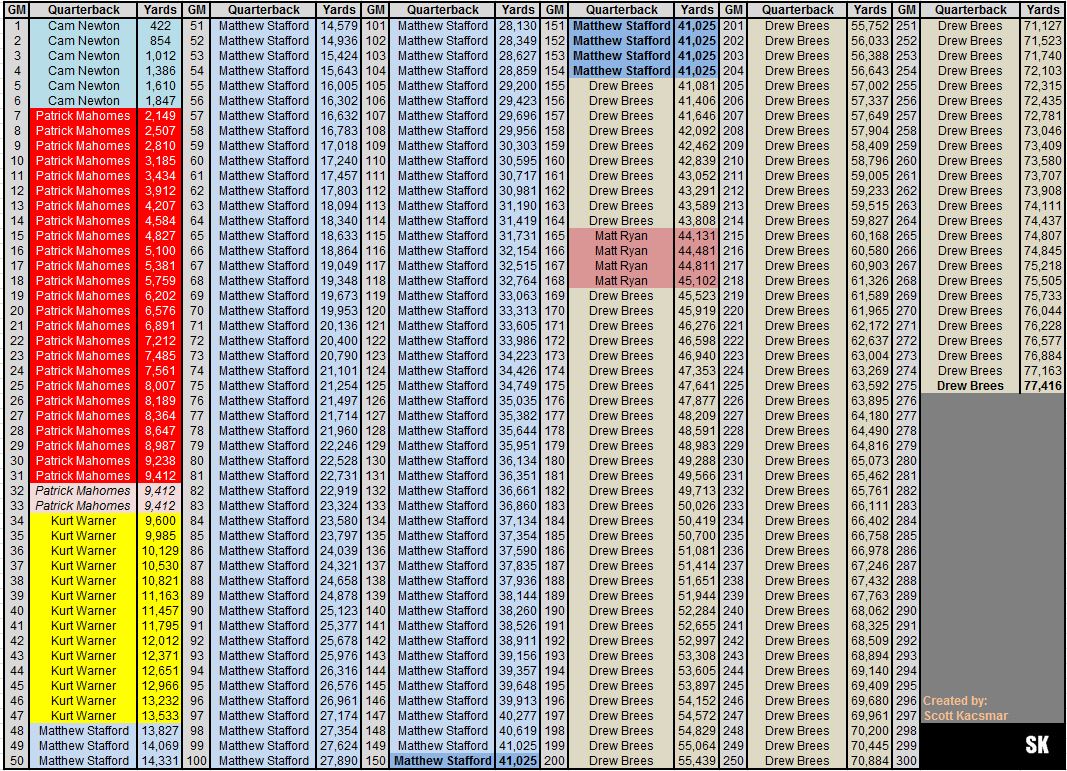
Now let’s look at the table for passing yardage leaders, which does not feature as many names as the touchdown pass table.

(Click on picture to enlarge)

So we have Cam Newton for six games before Mahomes takes over. Mahomes has now wiped out all of the old Kurt Warner entries. Mahomes’ lead on Matthew Stafford is actually not that substantial, but he has a good shot to start erasing the beginning of Stafford’s high-volume run.

Stafford just recently took out the little four-game blip that Matt Ryan had taken from Drew Brees before Brees took over for good. Stafford may possibly be done in Detroit, but once he goes to another team he’ll still be able to keep taking spots from Brees. It just seems unlikely that he’ll play long enough to take all of them.

Again, Brees is expected to be finished at 80,358 yards in 287 games. With Brady at 79,204 yards in 301 games, this expects to be another table of mine that he’ll screw up by making me add another column as he surpasses 80k in over 300 games.

There is no denying that longevity plays a huge part in career records.

NFL Stat Oddity: Week 15

If last Sunday in the NFL was boring, then this week more than made up for it. Even though the “Game of the Year” (Chiefs-Saints) wasn’t even the best game played in the last seven days (Ravens-Browns), this was a Sunday filled with memorable action.

Favorites were 11-4 SU, but the Rams christened SoFi Stadium with one of the most embarrassing losses in NFL history.

Previous weeks in Stat Oddity:

Rams Lose, Jets Lose Out, Only Trevor Lawrence Wins

It is not hyperbole to say that the course of NFL history for the next two decades could have just been drastically altered on Sunday when the 0-13 Jets beat the Rams 23-20 for their first win of the season.

For a franchise familiar with low points, the 2020 season may have taken the Jets to a new low under head coach Adam Gase. Some people have been calling the Chiefs “inevitable” this year, but the most inevitable thing felt like the Jets cruising to 0-16. That is a horrific season, but it’s not like we haven’t seen the 2008 Lions and 2017 Browns already do this. In fact, the biggest surprise would be that the Jets weren’t already in the club (the 1996 team finished 1-15).

The reward at the end of such a terrible season was supposed to be a new coach and the No. 1 pick in the draft, undoubtedly, to be used on Clemson quarterback Trevor Lawrence. Gase will now likely go down as one of the most hated coaches in NFL history as he could not even finish 0-16 properly. The Jaguars are now in the driver’s seat for Lawrence in the draft, and if he is as generational as advertised – a mobile, long-haired Peyton Manning – then it is sure to be a move that has massive ripple effects around the league for years to come.

Why are the Jets always the ones botching history? They could have drafted generational passer Dan Marino in 1983 but chose Ken O’Brien instead. They drafted wide receiver Al Toon over all-time leading receiver Jerry Rice in 1985. They drafted running back Blair Thomas over all-time leading rusher Emmitt Smith in 1990. Maybe none of those picks lead to Super Bowls for the Jets, but they absolutely changed the course of the league at that time. Imagine the Dolphins without Marino and Don Shula. Imagine the 49ers’ dynasty without Rice. Joe Gibbs’ Washington teams may have been the dynasty of the 1980s instead. Likewise, Emmitt is probably not the all-time leading rusher if he started with the Jets instead of the dynastic Cowboys in the 90s.

Maybe Lawrence is better off if he doesn’t go to the Jets. In 1997, the Jets thought they could cash that 1-15 season in for Peyton Manning at the top of the draft, but Manning returned to Tennessee for another year and ended up going No. 1 to the rival Colts in 1998. Good move, but also a massive one for the league’s next two decades.

Oh, and never forget the Jets are more responsible for the New England dynasty than anyone after botching the hiring of head coach Bill Belichick in 2000 and injuring Drew Bledsoe in 2001, leading to the rise of Tom Brady.

Never has a win felt like such a loss for a team than this one. The fact that Frank Gore put the game away with two first downs is just the cherry on top of the shit sundae. Jacksonville fans will for sure be pushing Gore for Canton now.

And how about these Rams? So much for the new hyped “best team” in the NFC. I’m going to remember Sean McVay as the photographic memory wunderkind coach who lost a Super Bowl 13-3 and lost to the 0-13 Jets.

There has just been something about Game 14 where perfect seasons go to die. As I pointed out in my preview for this one, the 10 teams to start 0-13 are now 5-5 SU in Game 14. That means these teams went from a combined 0-130 to 5-5 in that 14th game. Interestingly enough, four of the eight 13-0 teams in NFL history also lost their first game in Game 14 (1998 Broncos, 2005 Colts, 2009 Saints, and 2011 Packers).

This is not quite the biggest upset in NFL history. You only have to go back to Week 17 last year to find a worse loss by the point spread when the 17.5-point favorite Patriots lost at home to the Dolphins to lose out on a first-round bye. However, this is only the fifth time since 1978 that a 17-point favorite lost outright.

But this is almost surely the most embarrassing loss a team has ever had to a team 0-13 or worse that notched its first win. The Rams lost this game wire-to-wire, meaning the Jets led the whole way, including a 20-3 lead. Only the 1962 Patriots can say they lost wire-to-wire to an 0-13 (or worse) team after they fell 20-0 to the Oakland Raiders to end the 1962 AFL season.

This was not some December game in trash weather at MetLife Stadium with a full, roaring crowd where Jared Goff melted down and threw a pick parade. The Rams only had one turnover (and one blocked punt) in the game, played in new SoFI Stadium. This was not a blown lead by the Rams. This was not a game where the Rams missed any field goals. The only fumble (on a Sam Darnold sack) went out of bounds.

The Rams were just outplayed by an inferior team. The Jets were able to convert 7-of-17 on third down while the Rams were only 2-of-11. Show up on a few more of those plays and this outcome is likely different, but the Jets deserved this win.

They just had no business actually pulling it off, putting the future of the franchise in doubt again.

The final magnitude of this loss for me personally remains to be seen after the Steelers play on Monday night. I was hot on my bets this weekend, but one game I needed was for the Rams to win and Cam Akers to score a touchdown. That seemed simple enough after Akers’ breakout game last week and the mismatch here, but neither part came through. I also liked Robert Woods scoring (he did), but still would have been screwed by the moneyline. I’ll scowl over this day forever that Akers’ 18-yard touchdown run in the fourth quarter was called back for a holding penalty if Diontae Johnson and the Steelers come through. I stood to win more than $36,000 on a series of round robin parlays that only cost $105.

I’m sad. Rams fans are sad. Jets fans are sad. Only Trevor Lawrence and Jacksonville fans are probably happy right now. And just think, if the Jets finish on a winning streak, they just may bring Gase and Darnold back for 2021…

I Fvcking Love Patrick Mahomes Chapter 50: Week 15 at Saints

Despite holding 14-point leads early and late, the Chiefs had to grind out another close win, 32-29, in the four-minute offense to knock off the Saints in Drew Brees’ return. The big matchup had some really strange plays, Brees got off to the slowest/worst start to a game in his 300th career start, and it technically never had a game-winning drive opportunity, but it was a decent game in the end.

How did New Orleans fare with my tips for beating the Chiefs? Not good as the only achievement was #6 as the Saints racked up four sacks, getting some of the best pressure any defense ever has (without blitzing too) on Mahomes, which was to be expected with the offensive line situation there.

The 29 points were not bad, but the Saints absolutely hurt themselves before halftime by not recovering the obligatory fumble on a ridiculous punt fielded by Demarcus Robinson with only seconds left in the half. The Saints had a great chance to fall on the ball in the end zone for a touchdown, but Alex Anzalone botched that play and the Saints only got a safety out of it. Those five points were a huge miss.

You know the standard for Mahomes is getting ridiculous when people scoff at putting up 32 points and 34 first downs on what was supposed to be one of the best defenses in the league. The Saints had not allowed more than 24 points in a game since doing it four games in a row in Weeks 2-5, but the Chiefs were able to do that in this one, scoring 11 points in the fourth quarter to keep the Saints down.

Much like the 26-17 win in Buffalo, the Chiefs were able to mix the pass and run in moving the ball effectively. This team’s success on the road is historic this season even if it could be asterisk worthy given the pandemic impact with limited or no crowds.

Still, the 2020 Chiefs are the first team in NFL history to win five road games in a season against teams with a winning record. This is set in stone with the Bills (11-3), Saints (10-4), Ravens (9-5), Dolphins (9-5), and Buccaneers (9-5) all guaranteed to have a winning record this season. The only mystery is if the Chiefs will pick up a sixth win if the Raiders (7-7) finish 9-7.

The Chiefs just had the seventh game in NFL history where they put up 32 points and 34 first downs on the road in regulation. That’s impressive when you also consider that they have the sixth such game this season when they did it in Las Vegas.

Now 50 starts into his career, I am still waiting to see what a legitimately bad game from Mahomes looks like. His consistency is unmatched. The 2020 Chiefs are now the fourth team in NFL history to score at least 22 points in each of their first 14 games in a season. The other teams on that list are the 1983 Redskins, 1998 Vikings, and 2018 Chiefs, so they have already done it twice here. Only that 2019 Colts game (19-13 loss) is stopping it from being 50-for-50 for Mahomes in scoring 22+ points as a team.

Sunday is the 33rd time Mahomes has led the Chiefs to at least 30 points in one of his starts. If he does it again next week against Atlanta, then that will be 34 times over his last 50 starts. That would match the best 50-game stretch of the careers of Manning and Brady. I included a chart that shows how the count of 30-point starts over those quarterback’s last 50 starts progressed over time, as well as the same data for Dan Marino, Aaron Rodgers, and Brees.

Like Mahomes, Marino got off to that super-fast start to the point where his best 50-game stretch was the first 50 games when he led the Dolphins to 30+ points 26 times. Marino and Mahomes are the only two listed to top 20 games in their first 50 starts (this includes playoffs). Some of this is about league trends as scoring went up in the later stages of these careers (think Manning in Denver or Brees in the Michael Thomas-Alvin Kamara years), but you can see where the peaks and valleys are.

These are just team points, but Mahomes has plenty of other superlatives through 50 games that we could go on about. Sunday was his 24th game with at least three touchdown passes, the most in NFL history for a quarterback through 50 starts (including playoffs). Marino had 22 such games that early.

It can still be debated if Mahomes is the best 50-game stretch of quarterback play in NFL history, but there is no debate if this is the best 50-game start to any quarterback’s career.

Eagles at Cardinals: The Jalen Hurts Era Is for Real

Carson Wentz may understandably not like it, but the rest of us are better with the Eagles moving forward with Jalen Hurts as their starting quarterback. Hurts impressed again in a fun 33-26 shootout with Kyler Murray in Arizona. Sure, the Eagles lost after playing in their 23rd straight game that was within one score in the fourth quarter, but Hurts showed so much poise and promise for a rookie.

Hurts passed for 338 yards, three touchdowns and rushed for 63 yards and another score. That 401 yards of total offense in Hurts’ second start is more than Wentz ever had in 69 career starts. Had Dallas Goedert been able to pull in a dagger of a throw from Hurts in the end zone late to tie the game, Hurts may have finished with over 365 passing yards, which also would top Wentz’s career high.

Look, I have said these things well before Hurts was drafted. Doug Pederson’s offense works best when his quarterback is NOT Carson Wentz. With Nick Foles, the Eagles could actually win high-scoring games, beat good teams, win without much rushing support, and come through in the clutch. Hurts still has plenty of room to grow but he is only a second-round pick with three games of relevance under his belt.

The fact that this was such an exciting game between two young, mobile quarterbacks who could run and throw is a great sign for the future of the NFC. Let Wentz go do his thing in Indianapolis where he thinks Frank Reich is the answer to all his problems.

The Eagles are in a better place now, and likely would still be in position to win this terrible division had Wentz been benched sooner. You can talk about heart and leadership if you want, but there’s just something about Wentz where things don’t all click with this coach and team when he’s the quarterback.

Bucs at Falcons: The Most Predictable 17-Point Comeback in NFL History

You could say Tom Brady holds a psychological edge on the Falcons after 28-3, but it could just be as simple as the Falcons are a joke of a franchise and blowing leads is what they do best. We have already seen it this year with the losses against Dallas, Chicago, and Detroit.

In fact, I even wrote in my preview for this one that Atlanta would blow a double-digit lead to the Bucs. Not even at 24-7 in the third quarter did this feel in doubt. Sure enough, the Atlanta offense folded while Tampa Bay scored on five straight drives. Antonio Brown made by far his biggest play for the team yet with a 46-yard game-winning touchdown catch with 6:19 left. Matt Ryan is still gunning for the only season of his career without a 4QC or GWD.

Tampa Bay scored 31 points in the second half. Something like that hasn’t happened in the NFL since… well, when the Falcons allowed 30 in the second half to the Cowboys this year.

Tampa Bay is now 4-3 when falling behind double digits this season. Doing that in half your games seems like a bad formula for the playoffs where you absolutely will not see a team as dumb as Atlanta. These slow starts are a problem, but the talent on this roster is still a lot to deal with as well. Don’t rule out Tampa lucking into a No. 2 seed with the way the other NFC teams are playing down the stretch. I still ultimately think the Saints will beat Carolina in Week 17 to secure the division if it’s not done on Christmas, but there is a chance here after this comeback for Tampa Bay to move up the standings.

In a crazy year, here is something that at least feels right: Falcons and Chargers lead the NFL with four blown leads in the fourth quarter or overtime.

Browns-Giants: What a Change from 2016

Sunday Night Football may not have been the most exciting game, a 20-6 win by Cleveland over the Giants, but consider where these teams were four years ago. The 0-11 Browns lost 27-13 to the offensively challenged Giants in a game with 17 punts and four turnovers. Gross.

Four years later, the Browns actually have a fun offense and won their 10th game last night. The Giants are still offensively challenged but did better than the 20-6 score shows. They just failed on too many fourth downs.

In fact, this is one of the most offensive-driven 20-6 games you’ll ever see in the NFL. This game only had 14 total possessions with five punts, no turnovers, and three stops on fourth down. The Browns scored 20 points (another Cody Parkey missed extra point) on their first five drives before staying understandably conservative with the big lead. The “Browns only scored 20” crowd seems to have overlooked just how few drives were in this game.

In the last three games, Baker Mayfield has thrown for over 900 yards with eight touchdowns and one interception. These were marquee games for the Browns too, including two in prime time and a big matchup in Tennessee. Winning two of these three games and only losing 47-42 to the Ravens is huge progress for this franchise. I’m not going to say the Browns have what it takes to go on a Super Bowl run this year, but this team has definitely improved and so has the quarterback. I’m not sure what more he should be doing in the last month to silence the critics, but I’m coming around on him with this recent performance.

It’s weird to talk about the Browns offense being worth a damn, but it’s 2020. All bets are off. Hell, even the Chicago Bears have scored at least 25 points in four straight games for the first time since 1995. If the Bears can do that, the Bills can win the division, then why not see Cleveland win 11 games and make the playoffs?

Patriots Done (For How Long?)

New England has been eliminated from the playoffs for the first time since the 2008 season after a 22-12 loss in Miami. The Dolphins will have a winning record this year while the Bills (11-3) have already won the AFC East for the first time since 1995. The Jets were also in position to get Trevor Lawrence, but you know what happened there.

It leaves the Patriots in a tricky position with quite arguably the worst long-term quarterback situation in the division depending what the Jets do. Cam Newton is not the answer but there is also not much of a roster here.

This last-gasp effort in Miami, a familiar losing venue for New England in December, showed some signs of life early that the Patriots could pull one out and stay alive another week. They were playing a Miami team missing its top wideouts and tight end. In classic bend-but-don’t-break fashion, the Patriots turned a 95-yard, 9:11 drive by the Dolphins into an interception after making Tua throw under pressure. Then Newton got away with a would-be 86-yard fumble return because the ball just grazed a Miami defender who was out of bounds. Instead of a turnover, the Patriots scored a field goal to lead 6-0. Miami finished off the half with a missed 52-yard field goal, because again, this is what the Patriots do.

But the second half was a different story. The Dolphins continued to put together long drives and finished them off this time while Newton and the limited offense couldn’t answer. Tua was credited with his second fourth-quarter comeback of the season and the defense shut things down with a fourth-down sack of Newton with 1:08 left.

It was the first time all season the Patriots blew a fourth-quarter lead, but this team was never in much of a position to do any damage in 2020 between the loss of Brady, the COVID opt-outs, the losses on defense, Julian Edelman’s surgery, and just general roster flaws like not having a tight end.

It would actually be a lot more enjoyable to see this team struggle if only they were recognizable as the Patriots, but they never really were such a team this season. Now they’re just another team, and it’s only fitting that the Bills and Dolphins have gotten some decisive licks in on them.

Can the Jets do it too? They almost beat them last time in a 30-27 game, and this may be one where Belichick decides to just let the Jets win to make sure Trevor Lawrence doesn’t find his way to the Jets after all.

I mean, there’s always a plan with Belichick. Just not much of one this year as far as a contender goes.

Cruel Close Game Regression: Texas Edition

My goodness, I know I said Houston could be in trouble in close games this year after Deshaun Watson led five game-winning drives in both 2018 and 2019, but this is ridiculous. For the second time this season, Watson had the Texans knocking on the door of a tying or go-ahead touchdown against the Colts. Last time it was a bad snap that led to a game-ending fumble in a 26-20 loss.

This time, down 27-20, Watson converted a 4th-and-5, but Keke Coutee went from looking like he was about to score to fumbling the ball into the end zone where the Colts recovered with 19 seconds left to end the game. Watson had some huge numbers again with 373 yards, but his teammates found another way to blow a game even without Bill O’Brien involved.

Houston is now 0-5 at 4QC/GWD opportunities this season.

Meanwhile in Dallas, the Cowboys had a minor upset of the 49ers in a 41-33 final that was filled with big plays and turnovers. Nick Mullens had three turnovers himself, including an interception that set up Andy Dalton for the lamest game-winning drive of the year: three incomplete passes and a 46-yard field goal by Greg Zuerlein.

In a game that would never end, the final 43 seconds saw a field goal, an onside kick returned for a touchdown, and a meaningless Hail Mary touchdown with no time left. Well, not entirely meaningless. Someone (not me) won or lost money on that bullshit.

So we will have a new NFC champion with San Francisco eliminated after an injury-ravaged, disappointing season. The 49ers are now 1-4 at 4QC/GWD opportunities this season, which has always been a problem during the Kyle Shanahan era in San Francisco outside of some Jimmy Garoppolo starts.

But last year with a healthy Garoppolo, the 49ers were 4-2 at GWD opportunities and only blew one fourth-quarter lead in the regular season. However, we know this team was struggling late in the year with that against Atlanta (lost), New Orleans (offense had to bail them out), and the Seattle game in Week 17 came down to the final stop at the 1-yard line. Then we of course know what happened with a 20-10 lead in the fourth quarter against the Chiefs in Super Bowl LIV. Stung by the Wasp.

The 49ers started this season with blown leads to the Cardinals and Eagles before the injuries and a tough schedule just seemed to be too much for this team to overcome. Will 2019 be a one-year wonder in the NFC again? We’ll need to see next year to verify, but it’s not a bad bet to say it was.

That is why every opportunity in this league must be taken seriously. You never know if things will come together at the right time again. You know, like when you’re going to finish 0-16 and draft a generational talent quarterback, but oh fuck, that’s enough about the Jets and Rams.

On to Week 16.

NFL Week 15 Predictions: Mahomes vs. Brees (Finally)

With two games on Saturday, I’m a day early with the preview for Week 15. You can read my look at how Aaron Rodgers got his groove back this year for CAR-GB, how I’ve given up on picking the Jets to cover, how Colt McCoy is 0-18 when his team allows 20+ points for CLE-NYG, and how I still expect the Falcons to blow a double-digit lead against Tampa Bay despite Matt Ryan having arguably his worst season yet.

Otherwise, all attention should be on the potential Game of the Year this regular season when the Chiefs face the Saints in the Superdome. It’s not everything it could have been, but at least we’ll get to see Patrick Mahomes and Drew Brees square off in an important game for both seeds in pursuit of the No. 1 seed. I wanted to see this as the Super Bowl for the last two seasons, but we’re getting it at least once this season.

Game of the Year: Chiefs at Saints (+3)

It’s amazing how fast fractured ribs can heal after your team loses to Philadelphia and loses control of the No. 1 seed. While the Saints did not plan to rush back Drew Brees, it is obvious that they need him to go far this season, and they certainly need him in a game like this one against the high-scoring Chiefs. This is nothing like playing Atlanta or a Denver team without a quarterback like the teams the Saints beat with Taysom Hill.

Despite the three interceptions in Miami last week, Patrick Mahomes still had the fourth-highest yards per attempt (11.56) in a game in his career in last week’s win. He doesn’t have bad games, but it’s inevitably going to come some day. If you were brewing up a perfect storm for it to happen, you would start with a strong opponent that has played well defensively this year like the Saints have, including an offense that can score and put pressure on Mahomes to match.

Then you have to look at the injury situation on the offensive line where both starting tackles are in question for the Chiefs. Left tackle Eric Fisher at least practiced Friday, so that sounds optimistic. But right tackle Mike Remmers is a bigger question mark and he’s already the backup to Mitchell Schwartz (IR). So we’re talking potentially about a third option (at best) to start at right tackle. Singular injuries on the line are really no big deal. You just go next man up and deal with it. If you think your quarterback can’t handle one lineman being out, then he’s probably not a franchise QB. However, when you start relying on the backup to the backup and potentially are missing both tackles, then that’s cause for concern. The Chiefs will hopefully get Fisher in this game and Andy Reid and Mahomes will just have to make due at RT.

The Saints are dealing with their own injuries to dampen the hype and potential of this matchup. It has been ridiculously hard for the Saints to put Brees and leading receiver Michael Thomas together on the field this year. Brees returns, but Thomas will reportedly be out of action again with another injury. That means the offense reverts to where it was earlier in the season with Alvin Kamara having to carry the load as a dual threat and dynamic YAC receiver. The Chiefs have allowed the third-most receiving yards (623) to running backs this year, but I feel like that’s not going to be enough for the Saints to outscore the Chiefs.

To beat the Chiefs you have to either have a dominant ground attack that shrinks the game, which is not something the Saints do that well, especially with Brees at QB instead of the run-heavy Taysom Hill. Or you have to hit big plays like the Raiders did in the only Kansas City loss over the last 22 games. Derek Carr had a career day hitting the deep ball, and while Thomas isn’t a big loss in that department for the Saints, the deep ball is not a big part of what they do these days. Still, this will have to be a big game for tight end Jared Cook. Also, when the Panthers pushed the Chiefs 33-31 this year, they had some really aggressive plays on fourth downs and a fake punt to stay close in that game. You have to make some really great plays to score enough on this Kansas City defense. I’m not sure Brees dinking and dunking behind the sticks is going to lead to an explosive enough 30+ point day.

I like the Chiefs in this matchup. I don’t think you’ll see the multiple picks from last week that came on two tipped balls and a one-handed catch by the league’s INT lead (Xavien Howard). I think the Chiefs will clean that up. But also, seemingly no matter how well the offense plays, the Chiefs still seem to find every game come down to the four-minute offense with Mahomes having to bail them out by running clock and adding to the lead. Some week it’s not going to work out and it’s going to be all on the defense to stop a game-winning drive for the opponent. Brees can certainly deliver that drive, but we’ll just have to see if he gets the chance or not.

The Chiefs can improve to 5-0 on the road against teams with a winning record this year. They’ve already won in Baltimore (8-5), Buffalo (10-3), Tampa Bay (8-5), and Miami (8-5). That is very impressive. The Saints, along with the Green Bay team they’re chasing for the NFC’s top seed, have played a league-low three teams currently with a winning record, including a game against each other. The Saints’ crowning achievement this year has been sweeping Tampa Bay in impressive fashion. Otherwise we’ve seen this team winning a lot of one-score games against teams with 4-6 wins right now, or blowing out a Denver team without a quarterback.

That’s not to say the Chiefs are blowing teams out weekly. Their last five wins have been by a combined 21 points. But they are battle tested, have the best player, and deserve to be favorites in this one. We’ll just have to see if this is the only time Mahomes and Brees match up in the NFL.

Final: Chiefs 27, Saints 23

NFL Week 15 Predictions

Sometimes you wonder if the NFL is fixed. I only needed a Nelson Agholor touchdown in overtime last night for a nice win, which would have covered the 3.5 spread for Las Vegas too. Of course, the Raiders came out on third-and-goal at the 5 with three tight ends and threw a hopeless pass into the flat at a fullback. WTF was that? Raiders settled for a field goal, Chargers won on a TD. Not to mention this came after Jon Gruden bypassed a Hail Mary for a 65-yard field goal to win the game that never even had a chance to be kicked.

Betting on football is insane, but let’s do it again Saturday, Sunday, and Monday.

The Steelers really need their heads examined if they can’t beat the Bengals. I’m not crazy about the spread here, but I’m more confident the Steelers can win 24-10 in Cincinnati than I am in being able to pick Zac Taylor out of a lineup.

Why the Saints are Really 8-0 Without Drew Brees Since 2019

Maybe I should wait for the Saints to extend their winning streak to 10 games before writing this, but consider it the beginning of the build-up for possibly the biggest game this regular season when the Chiefs (11-1) face the Saints (10-2) in Week 15.

Both No. 1 seeds could swing on the outcome of that game, and it could end up being the return of quarterback Drew Brees, who has been out with fractured ribs and a collapsed lung.

The Saints have won their last three games without Brees, starting Taysom Hill in his place. You may also recall that the Saints were 5-0 last year with Teddy Bridgewater starting for an injured Brees.

That adds up to an 8-0 record without Brees the last two years, and that’s not something you can sneak past the mainstream media.

It doesn’t take much scrolling in the replies to such tweets to see labels of “system QB” being thrown at Brees. Including 2020 in his record, Brees is now one of four notable QBs I have tracked that saw the backup win over 60% of starts when the starter was out.

The 11-6 record is not too far off from New England’s 13-6 record without Brady. Naturally, the worst football fans on the internet see this as making Brees equally a system QB if Brady is one.

The fact is the Saints have gone 8-0 without Brees the last two seasons by playing great team football against mostly bad teams instead of just relying on great quarterback efficiency.

If a team is well coached with a good roster, then there is a chance for success without the intended quarterback. These teams understand that the defense has to play even better to compensate for the loss of offensive efficiency, provided there is a decline with the backup (there usually is). The running game has to step up too. The special teams need to be solid.

Let’s look at how the Saints have actually done the last two years with and without Brees.

The Passing Stats

Teddy Bridgewater was a starting QB in Minnesota before his horrific knee injury. He’s a starting QB again in 2020 with Carolina. He’s not a top 10 guy and has limitations, but he is a starter in this league. Hill was still recently available as a tight end in fantasy football leagues. He’s a much bigger project than usual for the position — more than backup Jameis Winston would have been — but so far Sean Payton is making it work, and we know he has more confidence and faith in Hill than anyone on Earth.

On the surface, the passing stats for Bridgewater/Hill look respectable compared to Brees the last two years. Brees has completed 74% of his passes at 7.66 YPA (45 TD, 7 INT) while the others are at 68.6% and 7.31 YPA (11 TD, 3 INT). Certainly better numbers than the average backup in this league. Remember, Payton gets paid well to coach too. Those backups also provide more rushing value than Brees as Hill already has five rushing touchdowns this season.

However, once you start factoring in the down-and-distance on these plays, the notable difference in sack rates (3.8% for Brees, 6.5% for Hill/Teddy), and adjust the numbers for opponents, you get a different picture.

By ESPN’s QBR, you get a top 3 season with Brees the last two years that turns into a below-average one with Hill and Bridgewater if they had enough attempts to qualify for the season rankings.

2020 QBR

  • Drew Brees – 81.0 (ranked 3rd)
  • Taysom Hill – 54.3 (would rank 26th)

2019 QBR

  • Drew Brees – 73.3 (ranked 3rd)
  • Teddy Bridgewater – 50.9 (would rank 22nd)

Since joining the Saints in 2006, Brees has never ranked lower than 9th (2017) in a season in QBR.

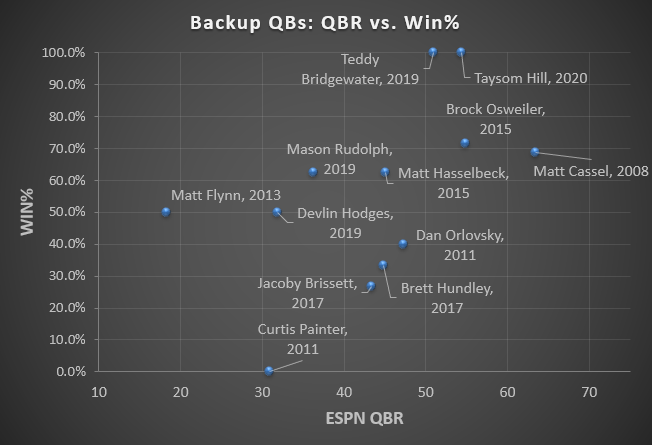
We don’t have QBR for the days of Johnny Unitas and Roger Staubach, but when Tom Brady missed the 2008 season with a torn ACL, the Patriots led the league in first downs and Matt Cassel, a QB who hadn’t started since high school, finished 9th in QBR (63.4). When Jimmy Garoppolo had to start two games in 2016 for a suspended Brady, his QBR was a scintillating 87.5.

That’s a lot different than when Peyton Manning missed the 2011 season for Indianapolis. Curtis Painter’s 30.9 QBR would have ranked next to last. Dan Orlovsky’s 47.3 QBR would have ranked 22nd. Manning was at his professional worst in his final season with Denver in 2015 (44.2 QBR ranked 28th), but it’s not like Brock Osweiler (54.9, ranked 20th) was a significant upgrade. Manning reclaimed his starting job in Week 17 and the rest is history.

Likewise, Ben Roethlisberger missed the last 14.5 games last season and Mason Rudolph finished dead last in QBR (36.2). Devlin Hodges (31.8) would have ranked even lower if he had a few more plays to qualify. And for those keeping score at home, Brett Hundley (44.8) ranked 24th in QBR for the 2017 Packers when Aaron Rodgers broke his collarbone for the second time. QBR actually despised Green Bay’s Matt Flynn in 2013. His 18.3 QBR would be the second-worst season since 2006, only beating out 2010 Jimmy Clausen (13.8).

If you need that in a chart, then here you go.

This is not the first time I’ve looked at this.

So if you’re questioning why there’s still a stigma with Brady being more of a system QB than the other elites of his era, this is why in a nutshell. You see less of an offensive drop-off when you take him out of things. It’s also because the coach there was Bill Belichick, and love him or hate him, the guy knows how to coach.

The Other Offensive Stats

So we shouldn’t expect the Saints to have the same passing dominance without Brees, but what about the impact on scoring and the other offensive stats to get to 8-0?

Note: This won’t be a perfect comparison since Brees left the 2019 Rams loss early with injury and did not play the second half of the 2020 49ers win due to injury. Also, Taysom Hill is sprinkled into every game, because Sean Payton.

With Brees (15-5 record): 30.2 points per game, 380.1 yards per game, 22.9 first downs per game, 44.9% on third down.

Without Brees (8-0 record): 25.1 points per game, 353.8 yards per game, 20.8 first downs per game, 43.2% on third down.

As expected, the Saints with Brees score over 5 more points per game while averaging more yards, first downs and a higher conversion rate on third down. Not astronomically higher numbers, but still significant.

The scoring also doesn’t factor out return touchdowns. The Saints have five of those since 2019, but two of them came in the 33-27 win in Seattle that Bridgewater started. That helped a lot that day.

The offense has been more than serviceable without Brees, but it’s not the same level of greatness without him. It’s had an interesting effect on the main skill players in this offense too. Michael Thomas has gone over 100 yards in both Atlanta games with Hill as his passer, but Brees has rarely been able to play with Thomas this year because of injury.

The more interesting case is Alvin Kamara, who was having the best receiving season of his career in order to make up for the absence of Thomas (and Emmanuel Sanders some weeks). In three games with Hill as the starter, Kamara has 3 catches for 7 yards. In Week 11 against Atlanta, Kamara had the first game of his career without a reception. He followed that up with -2 receiving yards on one catch against Denver. He had 2 catches for 9 yards in the Atlanta rematch on Sunday.

As for the running game, the Saints averaged 113 yards and 4.26 YPC for Brees compared to 147 yards and 4.55 YPC for the backups. So they are running it more and a little better without Brees, but that can be misleading when Hill is a big part of the running game. He already was before taking over as the starter, but since Brees’ latest injury, Hill is getting over 10 runs a game now. He had 14 carries for 83 yards on Sunday in Atlanta, his most prolific rushing game yet. Again, these numbers can be difficult to present since Payton loves Hill so much and was playing him while Brees was the quarterback. For instance, Hill had 54 rushing yards, his second-highest game, in the 38-3 rout of the Buccaneers this year.

Ultimately, everything with this offense without Brees points to still being solid, but not as great. So what’s the real reason for 8-0?

The Defense and the Schedule

While the Saints lose over 5 points per game in scoring without Brees, they more than make up for it on defense.

  • Points allowed per game with Brees: 23.1
  • Points allowed per game without Brees: 15.0

Can a big-time offensive mind get his team to go 8-0 when they’re only allowing 15 points a week? Absolutely. The Saints won two games last year when they didn’t score 14 points (12-10 vs. Dallas, 13-6 at Jaguars). They have one such win with Brees since 2006.

Seth Galina had a breakdown of the EPA for the defense in these games:

By Pro Football Reference’s EPA measure, the Saints’ five best defensive games this season are their last five games (top six are the last six too). It has been quite a run, and sure, getting to play the 2020 Broncos without a quarterback helps juice the numbers, especially for the pass defense. But isn’t that part of the reason this split exists? They probably beat Denver with Drew Lock anyway, but it’s likely not a 31-3 win that covered up a poor game by Hill.
  • With Brees: Saints’ average spread is -6 since 2019 (10-10 ATS)
  • Without Brees: Saints’ average spread is -1.5 since 2019 (8-0 ATS)

Vegas doesn’t like the Saints as much without Brees, but they are an impressive 8-0 ATS without him. However, this is where the schedule and improved play on defense intersect. The Saints are not beating good teams without Brees. In fact, out of the eight opponents, only the 2019 Seahawks made the playoffs as a wild card team. We know the 2020 Falcons (4-8) and Broncos (4-8) are not going to finish with a winning record. Brees played at least seven likely playoff teams (maybe eight if Las Vegas makes it) in his 20-game sample.

That Seattle win was the first game without Brees and it was the one with the worst point spread for the Saints (+5). It was also the game where the Saints scored two return touchdowns and built a 33-14 lead before Russell Wilson led a couple late touchdown drives to make it look closer at 33-27. The last touchdown came on the final snap, an untimed down at that. Bridgewater passed for 177 yards with 146 of them going to Kamara (92) and Thomas (54). He was solid, but not spectacular. The Saints also had a 28-yard touchdown drive set up by the Seahawks turning the ball over on downs.

It was a great team win for New Orleans, but it’s also the only game where you wonder if the Saints would have won if Brees was the quarterback. Would they have still scored two return touchdowns if they thought they could just rely on the offense to do its normal thing? We’ll never know.

Beat the Chiefs with Hill and Then We’ll Talk

What’s next for the Saints? Why, of course, they get the 3-8-1 Eagles with rookie Jalen Hurts making his first start. Now this could be a trap game as Doug Pederson will want to look good on his decision to bench Carson Wentz. The Eagles have been within one score in the fourth quarter of every game this season, and there was a spark provided by Hurts in Green Bay on Sunday. So it’s an interesting game for multiple reasons, but it’s also one where you think the Saints would win comfortably if Brees was the quarterback.

For the Saints to continue the winning streak and keep Green Bay out of the No. 1 seed, they will have to get Brees back in the lineup. It is hard to see Hill outscoring Patrick Mahomes in Week 15, but then again, 2020 has been anything but predictable.

NFL Stat Oddity: Week 9

Clue: The day after Donald Trump lost the election, this famous friend lost 38-3 on Sunday Night Football, ruining the season debut for Antonio Brown, his new roommate and other alleged rapist friend.

Answer: Who is Tom Brady?

We’ll miss you, Alex Trebek. R.I.P.

Previous weeks in Stat Oddity:

Saints at Buccaneers: STOP THE COUNT, THEY’RE DEAD!

Wow, that was insane.

With the NFC West regressing, Seattle not having to play GB/TB/NO this year, the NFC East’s historic sucking, and the Packers in stasis without any real tough games left, you could easily argue this Saints-Buccaneers game was the biggest NFC matchup in the 2020 regular season. The winner would move into first place with Tampa Bay eying a No. 1 seed thanks to destroying Green Bay.

But if you thought that 38-10 rout of Green Bay was what made Tampa Bay the Super Bowl favorite in the NFC (if not NFL), then where are you now after the Saints (6-2) handed them a 38-3 home loss that was the biggest ass kicking of the season?

The 35-point margin is the largest halfway through 2020.

This was an absolutely unreal performance by the Saints on offense and defense. When Tampa Bay crushed Green Bay, it was literally a meltdown by Aaron Rodgers. He essentially threw two pick-sixes (one returned to the 2) and just crumbled from there. This game, it was pure domination. The Saints started with four touchdowns on five drives, only getting stopped when Jared Cook lost a fumble at the 2 after trying too hard to score. Meanwhile, Tom Brady came out ice cold and had four three-and-outs before he threw the first of his three interceptions on the night. Rob Gronkowski looked awful, Mike Evans struggled again with the Saints, and Antonio Brown (31 yards) was not much of a factor in his debut. Brown did at least break up a pick or else Brady would have had a four-interception night.

The Buccaneers finished with 194 yards, were stopped in a goal-to-go situation for the first time all year, and were 1-for-9 on third down (0-for-3 on fourth down). Even when it felt like the Saints were keeping the door open for a comeback, namely Cook’s fumble and his third-down drop that led to a field goal try instead of a touchdown, Brady and the Bucs never threatened. Their only points came on a cheap field goal late in the fourth quarter to avoid a 38-0 shutout.

Tampa Bay set an NFL record with just 5 rushes, and one of those was a kneeldown by backup Blaine Gabbert to end the game. The Buccaneers’ vaunted defense even made Taysom Hill look unstoppable. Hill was the game’s leading rusher (54 yards), completed two passes for 48 yards, and caught a 21-yard pass.

Drew Brees was fantastic with four touchdown passes, doing so for the record 38th time, and regaining the all-time lead by three over Brady.

It helped that Michael Thomas (5 catches, 51 yards) and Emmanuel Sanders (4 catches, 38 yards, TD) returned to the wide receiver corps, but the Saints were as dialed in as a team can be in this game. They tied the league record with 12 different players making a reception.

You still suspect these are both playoff teams, but that makes it even more shocking just how one-sided this was. Since 1970, only 13 games between playoff teams saw one take a 31+ point lead at halftime, and only one of those games (2010 Patriots at Bears) was by the road team.

For the first time in his career, Brady has been swept by a divisional opponent. For the first time in his career, Brady has a division rival worth a damn. Funny how that works. I’ve been saying this for years about the historic advantage the AFC East provided Brady in securing high playoff seeds over the years. We’ll never see another quarterback have such an advantage in his division for two decades like Brady did. The minute he left for a division with a first-ballot HOFer in Brees and an MVP like Matt Ryan, he’s already been swept by the Saints.

In my preseason predictions, I had the Saints finishing 13-3 and the No.1 seed while the Buccaneers at 11-5 and No. 5 seed. We’ll see where this goes, but the Saints are in a good position now. Both teams still have to host the Chiefs and Vikings and play the Falcons twice this year.

Does this make the Saints the new favorite in the NFC? Perhaps, it is a flawed conference where it’s hard to trust anyone right now. If this is what the Saints can look like at “full strength” then you must think they have as good of a shot as anyone.

All I know is, much like when the Chiefs went to Baltimore in Week 3, the Saints left no doubt as to whether they are a nightmare matchup for the Buccaneers. But then you think about Tampa Bay trailing by double digits in five games this year, blowing a 13-point lead in Chicago, now this domination, and it starts to become clear: Green Bay was the anomaly game this season.

Now we just have to see if the Buccaneers can ever put things together this season, or if the Saints end up being the team that goes on a run that lands them back on this field in February.

Small Game Steelers, But Spare Me the Worst 8-0 Team Ever Talk

My fear of the Steelers blowing off a small game to Dallas was well warranted. If you know this team well, you know they always underperform in games like this. The 15-point spread was always a bit too high coming off the three emotional wins in a row, and the fact that Dallas had an unknown fourth-stringer (Garrett Gilbert) at quarterback with a strong cast of skill players around him. This was going to be competitive, but it really shouldn’t have been the toughest win yet of the season for the 8-0 Steelers.

This was like the Steelers’ 2011 Colts/Curtis Painter or 2011 Chiefs/Tyler Palko or 2017 Colts/Jacoby Brissett wins. Yeah, they were ugly, but at least they were still wins.

The lack of an offensive identity is starting to catch up with Pittsburgh after a second straight slow start where they wasted four drives while the Cowboys jumped out to a 13-0 lead. The run defense also had some issues again and Gilbert played admirably for someone without experience, but the Steelers are taking too long to figure out the opponent.

Still, it was yet another game where they finished with 24 points, Ben Roethlisberger threw for 306 yards and three touchdowns, and they had zero turnovers. They probably should have had 26 or 27 points, but Chris Boswell was shaky on the day with two missed extra points (one blocked). Mike Tomlin also screwed up big time by going for a fourth-and-1 with 43 seconds left to seal the game when he should have kicked a short field goal to take a 27-19 lead. You can’t worry about a block there. It’s a routine kick and they already blocked one. Getting two in one game would be crazy improbable. Keeping yourself open to a loss with a touchdown is not the right move, and for the second week in a row the Steelers had to knock down a pass at the goal line to save the win.

Alas, the Steelers join some elite company as the fifth team to start 8-0 and score at least 24 points in every game: 2007 Patriots, 2009 Saints, 2011 Packers, and 2015 Patriots.

Now I would be the first person to start a debate on the worst 8-0 team in NFL history, but I cannot see how the 2020 Steelers win that title.

Not when the 2013 Chiefs exist, a team that started 9-0 by beating several backup quarterbacks with a boring brand of offense when Andy Reid was getting his feet wet in Kansas City with Alex Smith. Once that team started playing real quarterbacks (Peyton Manning, Philip Rivers, Andrew Luck) and teams, they finished 2-6 and blew a 28-point lead in their first playoff game.

I also refuse to buy that the Steelers aren’t better than the 2008 Titans, who started 10-0 in Jeff Fisher’s final playoff season with the team. That team finished 13-3 and had 13 touchdown passes with Kerry Collins as the main starter. They also went one-and-done, losing to the Ravens at home.

I would also bring up the 2015 Panthers, who started 14-0, and I was always saying they were the worst 15-1 team in NFL history (lost the Super Bowl to Denver and finished 6-10 the next year). When the Panthers were 8-0, they were doing it with the best defense in the NFC and Cam Newton was not having a great season. He was just getting ready to go on a big run, but he certainly didn’t have the numbers when they were 8-0 (14 TD, 9 INT, 53.7% complete, 7.40 YPA, 81.4 PR).

Roethlisberger has not been hitting the deep balls this year and it is getting frustrating. I think he can still turn that around, but similar to the Saints and Drew Brees, we should acknowledge that the way they do things now still is effective. It puts points on the board and wins games. Combine that with a defense that may not be anywhere close to historic, but even just merely good puts you a leg up on most of the league in 2020, and you have a pretty solid contender in a year where no one is blowing the field away.

Clearly, I do not see the Steelers going 16-0. They’ll slip up eventually, but I still think winning in Baltimore was a huge deal, a better win than most teams can point to this season, and they have a chance to complete a sweep of the Ravens on Thanksgiving.

I would love nothing more than to see the Steelers play the Chiefs in the AFC Championship Game, but until that feels more likely, let’s not make the whole season about that. Just like we shouldn’t overreact to this 24-19 (should have been 27-19) win in Dallas. Did Tampa Bay not just win 25-23 over the Giants? How did Sunday night go for the so-called NFC favorites? A New Orleans team that was in overtime with Chicago a week ago just destroyed them 38-3 in their house. That same New Orleans team squeaked by Carolina a couple weeks ago in a 27-24 game. Carolina just came up a FG short of knocking off the Chiefs in Arrowhead.

Pandemic football is a little different. You never know who will be available to play in a given week these days. If you want to put the Chiefs in a class of their own as the defending champs, that’s fine. But there’s no reason to say the Steelers aren’t up there with any other team in the league (Ravens, Saints, Buccaneers, Packers, Seahawks, etc.).

The Latest Records for the Chiefs

STOP THE COUNT! After a 33-31 decision against Carolina, Patrick Mahomes is now 45-0 in the NFL. That’s actually 45 games and 45 times he’s had a lead, but Sunday was one of the toughest wins yet this year for the Chiefs, now 8-1 and going into a bye week.

More history was made by Kansas City on Sunday. Mahomes threw his 100th touchdown pass in his 40th regular-season game, setting a new record (Dan Marino, 44 games).

The Chiefs also broke a record for the second time in the Mahomes era for consecutive games with at least 23 points (playoffs included):

This deserves some real attention. It’s practically unheard of in the NFL to break a record streak, have one off game, then immediately start up another record-setting streak. I showed you the only other team to reach 20 games was Joe Gibbs’ Redskins. The No. 4 spot is a tie at 19 games between Peyton Manning’s Broncos (2012-13) and Tom Brady’s Patriots (2006-07). The second-longest streak for the Patriots was 15 games in 2012 while the second-longest streak for a Manning-led team was 13 games for the 2004 Colts.

Now scoring is up in the NFL in the Mahomes era, but we just don’t see other teams in the league approaching these numbers. The longest streaks since 2017 that don’t belong to the Chiefs are 12 games by the 2018 Rams and a pair of 11-game streaks by the Ravens – oddly, one of them happened in 2017-18 pre-Lamar Jackson. The second-longest active streak of 23-point games is nine by Seattle.

We risk taking Mahomes for granted this early into his career, but that may be changing since this latest win seems to reignited the MVP race this year. Mahomes is up to 25 touchdown passes and one interception this season, which has never been done before in the NFL to start a season. He just threw for another 372 yards and four touchdowns in a 33-31 win after his running game finished with 10 carries for 30 yards. Mahomes is now second in QBR (85.3) and the Chiefs could set a modern record for the most yards per drive in a season as they were over 43 yards coming into the week.

This is the most enjoyable team to watch in the NFL today. The skill and creativity are second to none, and they find plenty of different ways to win now. Sunday was a little tougher than usual, but that’s always fun to watch too. It was actually the first time this season the Kansas City defense had to uphold a one-score lead in the fourth quarter. The game was right there for the win for Carolina, but Teddy Bridgewater is 0-6 at leading game-winning drives this season, the worst record in the NFL. Only needing a field goal, he took too much time with completions not going out of bounds and I did not agree with the final sequence when they bypassed a Hail Mary for a 67-yard field goal that was well off.

So I’ll miss not being able to watch the Chiefs in Week 10, but the march towards history resumes in Vegas in Week 11 when the team will look to avenge its only loss in the last 18 games.

Pete Carroll: What a Day for an Extension

While the Saints found a defense on Sunday night, the Seahawks continued to exhibit none after a 44-34 loss in Buffalo. The Seahawks are the first team in NFL history to have nine straight games where they scored and allowed at least 23 points, which includes last January’s 28-23 playoff loss.

That is a hell of a change for a team that once led the NFL in scoring defense four years in a row from 2012 to 2015. Those days are long over, we have gone from Legion of Boom to Let Russ Cook, and Pete Carroll just signed on for a multi-year extension.

Not the greatest timing right before this loss that makes you question if the Seahawks are headed for another No. 5 seed, a Wild Card win over a terrible NFC East winner, and then a divisional road loss.

This was a strange game in that Russell Wilson turned the ball over four times, the Seahawks registered seven sacks on Josh Allen, but Allen still completed 31-of-38 passes for 415 yards, three touchdowns and zero turnovers. It is the kind of game he would never have in 2018-19, but Allen is better this year and the Seahawks are historically bad against the pass.

The 2020 Seahawks have allowed 2,897 net passing yards, the most through eight games in NFL history. The previous record belonged to the 2002 Chiefs (2,589 yards). Apparently, trading good picks for a safety (Jamal Adams) isn’t a cure-all for the defense. Adams returned to action on Sunday and it was the nadir of the season so far as Allen had 282 yards and all three touchdowns at halftime alone.

What really caught my eye were some words from Carroll after the game about his surprise that Buffalo abandoned the run and came out passing:

Look, I know I’m just a data nerd who doesn’t leave the house, but it literally would take minutes to go through Buffalo games in 2020 and see that an Allen-dominant offense (his passes and runs) that ignores RB carries is something they are comfortable with this year. Here is some proof I grabbed in a couple minutes:

  • Jets (Week 1): 38 Allen dropbacks to 6 handoffs in first half
  • Raiders: 20 Allen dropbacks to 9 handoffs in first half
  • Titans: 24 Allen dropbacks to 10 handoffs in first half (38 to 13 through 3Q)
  • Jets (Rematch): 25 Allen dropbacks to 4 handoffs in first half
  • Chiefs: 27 Allen dropbacks to 14 handoffs through 3Q

It’s not that crazy for Buffalo to do this, and sure enough it treated the Seahawks like the Jets. Allen had 32 dropbacks to two handoffs in the first half against Seattle, so they took it to another level since it was working so easily.

I love the stat that Buffalo was 1-12 against playoff teams in 2018-19 and already lost this year to the Titans and Chiefs. The Bills usually don’t beat teams like Seattle, but Seattle is a team with a quarterback who is usually amazing – he wasn’t on Sunday – and a defense that is terrible.

While Carroll and company finally seem to understand this year that passing early and often is a good strategy, they still seem oblivious to the idea that other teams know this too and attack Seattle’s pass defense accordingly.

Carroll said he didn’t recognize his team on Sunday, but it looked like more of the same to me with too many giveaways to make it a hopeless road trip. Sean McVay and Jared Goff are next with the Rams, who also feature a defense that held Wilson to two field goals in the last meeting (28-12 loss in 2019).

We’ll see if there are any adjustments.

Dalvin Cook Actually Matters

If the Vikings are going to recover from a 1-5 start, it was sparked by Dalvin Cook’s domination of division foes the last two weeks. He scored four touchdowns and had 226 yards from scrimmage in last week’s upset win over Green Bay. On Sunday, he rushed for 206 yards in a 34-20 win over Detroit to get Minnesota to 3-5.

Add this to the file on “Why the Hell Is Matt Patricia Still Employed?”. The Vikings became the eighth offense since 1940 to average 8.0 yards per carry and 10 net yards per pass attempt in a game. It has only happened two other times since the 1970 merger: 2017 Chiefs vs. Jets (in a 38-31 loss) and 2012 49ers vs. Bills (45-3 win).

The Vikings just had one of the most explosive, but balanced offensive performances in NFL history. Minnesota finished with 275 rushing yards and averaged 8.1 yards per carry. Kirk Cousins completed 13-of-20 passes for 220 yards, three touchdowns and only one sack. His net yards per attempt was 10.1.

With an upcoming schedule that features the Bears, Cowboys, Panthers and Jaguars, it is not a stretch to say the Vikings could still win 9-10 games and reach the playoffs.

Almost, Atlanta

Well, Georgia blew one big lead this week, but for that I am grateful. How about the sports teams though? Can’t the Falcons ever just win a game with ease? You know, like the 2016 NFC Championship Game when they routed Green Bay?

On Sunday, Atlanta punted to Denver with 5:38 left and a 34-13 lead. That’s an easy win and 4-point cover, right? Think again. The Broncos drove 69 yards (nice) in 1:45, forced a three-and-out that included one incomplete pass, then drove 82 yards in 90 seconds to make it 34-27. Atlanta just needed one first down to ice the game, but botched that badly. On a 3rd-and-6 run, the Falcons were penalized for illegal formation. Denver declined that penalty, but it still stopped the clock. So instead of punting the ball back at 13 seconds, the Falcons had to punt at 50 seconds. Huge mistake.

Fortunately, the defense forced Denver into a pathetic four-and-out to end the game, but you can just see how this team (now 3-6 when it should be 6-3) is going to torture its fans with impressive starts against the Buccaneers and Saints before it all goes horribly wrong later this season.

New AFC Three Stooges: Texans, Bengals, Chargers

Unless you’re the Colts in Week 1, the 2020 Jaguars (1-7) have been like a Pandemic Relief Package granting wins to their opponents, especially those in dire situations. Houston completed the season sweep with a 27-25 win over the Jaguars, though rookie quarterback Jake Luton was more than respectable in his first start. He led a late touchdown drive (capped off by his 13-yard scramble score) but was unable to complete the two-point conversion to tie the game.

Houston is 2-0 against Jacksonville and 0-6 against the rest of the NFL this year. A couple other AFC teams are in similar spots. The Chargers are 2-6 after another close loss to the Raiders as their only wins have been against the Bengals and the Jaguars; the latter being rookie QB Justin Herbert’s lone win so far. The Jaguars were also the first NFL win for Joe Burrow and the Bengals.

That means out of six combined wins for the Texans, Chargers and Bengals this year, four of them are against Jacksonville, one against each other (LAC-CIN), and the Bengals also beat the Titans recently. Don’t forget the Texans took the Titans to overtime, their closest loss of the season so far, and even the Jaguars only had a 33-30 loss to the Titans in Week 2.

For the second time this season, Herbert saw his receiver drop a game-winning touchdown on the final play of the game after Donald Parham could not hang on in the end zone on a play that was initially ruled a touchdown. Mike Williams also did not come down with a ball on the previous snap. Against Carolina, the Chargers botched that incredible lateral (dropped by Austin Ekeler) that would have won that game too. Burrow can relate. In Week 1, A.J. Green caught a game-winning touchdown against the Chargers, but it was negated for offensive pass interference. Deshaun Watson can relate too. He thought he had a touchdown pass on fourth and goal down 31-23 against Minnesota, but it was overturned on replay to an incompletion and game over.

The futures may be bright for these teams given Burrow and Herbert’s rookie performances, and Watson getting a new coach in 2021, but for now they just cannot seem to find a win unless it’s coming against Jacksonville or each other.

Updates on the NFL’s Passing Touchdown Record

Tom Brady (552) is chasing Drew Brees (555) for the NFL’s all-time touchdown pass record, while Aaron Rodgers (377) still has an outside shot of passing both if he chooses to play long enough (and if they ever retire).

With Brady kicking off Week 5 against Chicago on Thursday night, it wouldn’t surprise me if he goes all out — think excessive throws from inside the 3-yard line — to throw three or four touchdowns to get at least a share of a record he has yet to hold.

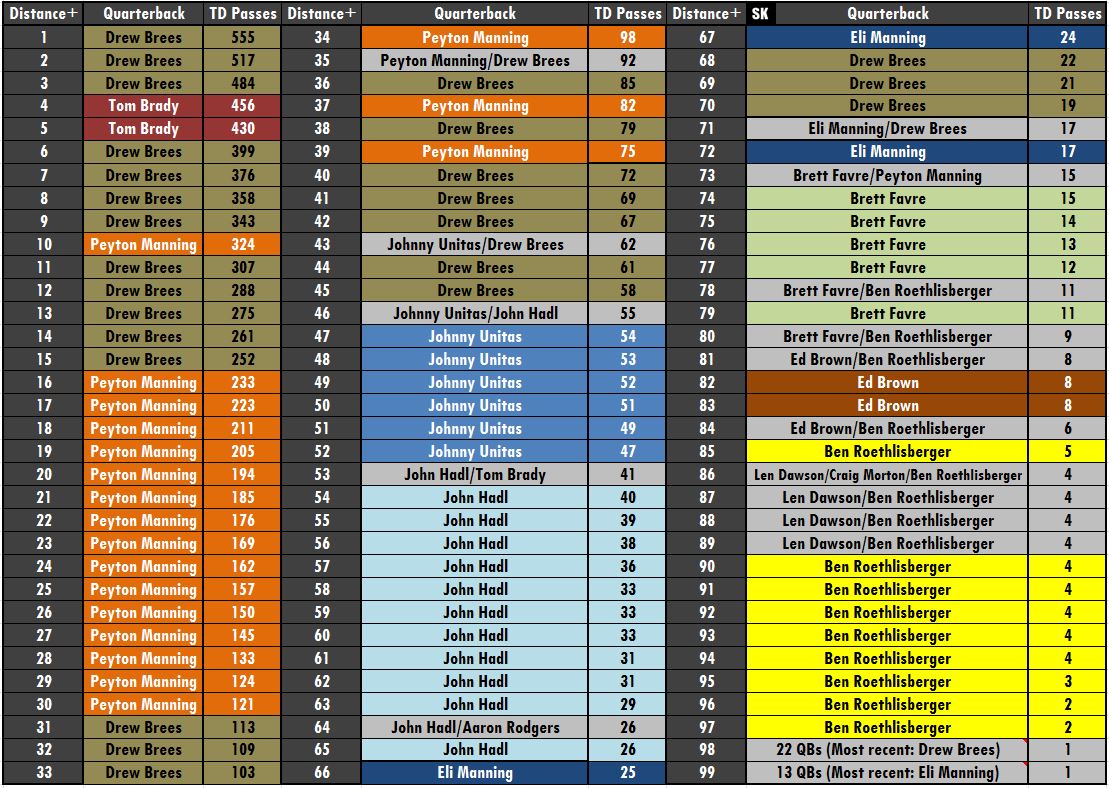
It’s unclear if this will be the final season for Brees or Brady, but this should be a tight race in 2020, and neither may be able to entirely wipe out Peyton Manning from the leaderboard when you break down the touchdown passes by yards gained.

In the following chart, you can see the record holder for the most touchdown passes that gained at least X amount of yards from 1 to 99. So for the entry of 10, that means Peyton Manning threw 324 touchdown passes that gained at least 10 yards, still beating out Brees (320), Brett Favre (298), and Brady (293) for the time being.

CLICK HERE TO ENLARGE

Brees is within striking distance of basically the whole 1-45 block, but there are some amusing entries in the middle column that show how different the NFL used to be in regards to the long ball. John Hadl and the great Johnny Unitas threw long touchdown passes with amazing frequency that still holds up today. Eli Manning making a few appearances is also interesting. Ben Roethlisberger has a chance to take over the 80+ yard plays, but Aaron Rodgers isn’t far behind for the 70+ yard touchdowns. He has 18 of those, or one behind Brees.

We can also see some interesting things when we go by the game-by-game progression of these records.

CLICK HERE TO ENLARGE

Brees is at 555 touchdown passes in his 279th game. Brady will play in his 290th game on Thursday night. You can see Rodgers is ready to do some damage to this leaderboard after taking over from Dan Marino at Game 111 of his career. Remember, this includes the seven games he didn’t start as Favre’s backup in 2005-07. Rodgers is at 377 touchdown passes in 185 games, giving him a share of the record with Brees at 193 games. So that’s an eight-game cushion.

He still has a long way to go, but Patrick Mahomes may very well wipe out Marino, Rodgers, and anyone else in his path on this chart. Mahomes has a tie of the record at 39 games with Marino, but he’s only played 35 games so far. He should become the fastest player to 100 touchdown passes, then we’ll see from there.

NFL Week 3 Preview: Packers at Saints

The NFL’s Week 3 schedule is so packed I wanted to highlight earlier than usual Sunday Night Football’s big NFC matchup between the Packers (2-0) and Saints (1-1) in New Orleans. This is the fifth and potentially final matchup between future HOF quarterbacks Aaron Rodgers and Drew Brees, who have split the first four meetings and actually haven’t met since 2014. The Saints are 2-0 at home against Rodgers with 51 and 44 points scored in those games, but this offense right now doesn’t look like anything we’re used to seeing from New Orleans.

Thanks to Minnesota’s pointless upset in last year’s playoffs, we didn’t get to see these teams play last year when the Saints lost out on a first-round bye despite a stronger regular season than Green Bay because of the tie-breaking system. So we get the matchup now in a premiere prime time slot with the Saints actually being a 3-point favorite, but Drew Brees is throwing some major red flags our way, and one problem is he’s not throwing them that far either.

Drew Brees: Is 2020 the End?

Everything else is dying in 2020, so why won’t this be the end of this peak run of HOF QB play from Brees that he’s been on since 2004?

Brees has already talked about this being his last NFL season before retirement, but it’s not going to be a happy swansong if the first two weeks are any indicator of what’s to come. Despite the Week 1 win over Tom Brady and the Buccaneers where the Saints scored 34 points, the offense actually didn’t play well. They scored 27 points on 12 drives, one of which was a late field goal after the Bucs botched a kick return. Brees struggled to throw for 160 yards, only connecting on a deep ball after a pump fake late in the game. According to ESPN, Brees’ air yards per pass are the lowest in the first two weeks of a season since Brett Favre in 2009. Now that was the great Favre year in Minnesota and not the bad one in 2010 that made his retirement an obvious decision, but this is still alarming stuff from Brees. While he’s been throwing very short passes since 2017, especially on third down where some of his efficiency has declined, he’s taking things to young Alex Smith territory so far this season and it hasn’t worked as well for the Saints with Michael Thomas suffering a Week 1 high ankle sprain.

We know Thomas doesn’t stretch the field much, but that highly efficient connection the two have that can consistently gain 5, 8, 12 yard chunks has been crucial to the Saints offense. Emmanuel Sanders has had a slow start in his first year with the team so far. It’s mostly been checkdowns to Alvin Kamara so far.

However, some took the 34-24 upset loss in Las Vegas on Monday night to extremes, proving the point once again that the scoreboard really tricks people’s minds. The Saints actually were better on offense in the Week 2 loss without Thomas than they were in the Week 1 win where he played over 80% of the snaps and had 17 receiving yards. On one hand, Tampa Bay’s defense looks considerably better than the Raiders so far. Alas, the Saints scored 24 points on 9 drives on Monday night, and that ninth drive was one in the final 65 seconds where they kind of went through the motions, conceding defeat early instead of trying to get a quick field goal, onside kick recovery and Hail Mary — that may have needed Jameis Winston’s arm — to tie the game.

The bigger problem than Brees on Monday night was the defense that allowed Derek Carr, after a rough start with some embarrassing sacks, to pick apart the defense on long, time-consuming scoring drives. The Raiders scored on six of their last seven drives, and it would have been seven straight had Jalen Richard not fumbled. Richard also scored a 20-yard touchdown run on a 3rd-and-10. That kind of terrible defense brings back memories of the Saints of old, but without the high-powered offense to do better than a 34-24 defeat.

This is bad news when Aaron Rodgers, a more dangerous QB than Carr, is coming to town with a hot hand. That’s why the Saints will have to be much better early in the game on offense. Brees was far from great on Monday night, and he did piss away a drive before halftime with a bad interception, but when you only get eight real drives in the course of the game, it’s hard to be expected to do a lot better than 24 points. Not to mention on the Saints’ only third quarter drive, they self-destructed with three penalties, including a very questionable call on Sanders that led to a 2nd-and-31 situation. That’s a tough situation even if Patrick Mahomes is your QB.

So it was a horrible night on defense that should have been the bigger story for New Orleans, but of course the attention goes to the quarterback. People are already calling for him to be benched for Winston or to retire midseason, and it just reminds me that there’s too many days in between games, so people resort to filling that time with nonsense. There are alarming issues with Brees not showing his usual pinpoint accuracy or really attacking anything past 10 yards, but he’s not at the point where he needs benched. The Saints will just have to get a bit more creative without Thomas, which is why I don’t understand Sean Payton using a great trick play at the end of a sure win against Tampa Bay and not saving it for more desperate times.

With the Saints possibly slipping to 1-2 this week, desperate times are coming quickly.

Prime Aaron Rodgers: Is He Back?

If the 2020 Saints are the 2015 Broncos because of the old quarterback, then I guess they’re going to kick Green Bay’s ass on SNF, right?

That’s a reference to the 2015 SNF game when the 6-0 Packers, coming off a bye week, played the 6-0 Broncos with Peyton Manning in his final zombie-fied season. It’s one of the weirder games in NFL history in that the Broncos destroyed Green Bay 29-10 with huge performances on both sides of the ball, including the old QB, and it really seemed to set Rodgers, who only passed for 77 yards, into a tailspin after a big start to the season.

Before that game Rodgers was on a pretty incredible run of play that included two MVP awards and a Super Bowl MVP. But look at the drop in his statistics from the start of his career and ever since he returned from that bye week to face the 2015 Broncos:

You can see the YPA drop over 1.2 yards, the win percentage and passer rating down 10 points, and his touchdown pass rate has dropped by 1.46 percentage points. Sacks have been about the same, though he’s lost more fumbles per play and his completion percentage has dropped 3.3 percentage points as he’s fallen in love with throwing the ball away, which helps lower his interceptions.

Things have just not been at the peak level for Rodgers for years, and the coaching change to Matt LaFleur last year also didn’t have the desired impact. However, maybe it’s taking two years to have an impact as Rodgers is off to his best start in years. His Week 1 game in Minnesota was arguably as good as any game he’s had since 2015.

The 2020 Packers are the first team since the 2009 Saints (Payton-Brees’ Super Bowl year) to score at least 42 points in the first two games of a season. They’re only the sixth NFL team to do so since 1940. It’s not just Rodgers as RB Aaron Jones is off to a huge start to the season and the Packers lead the NFL in rushing yards (417) and yards per carry (6.2). Now they’ve only played stumbling division rivals so far, but the Packers look to be in great shape offensively so far. By Pro Football Reference’s metrics, they had their 2nd and 3rd best games by offensive EPA under LaFleur the last two weeks, and Rodgers has the second-lowest pass pressure rate (11.7%) as his line is doing a great job of protection.

If there’s a reason to be pessimistic, it’s the hamstring injury for Davante Adams. He may not play Sunday and he’s still the most trusted receiver on the team, catching 17 of his first 20 targets this year. It would be a shame for this game to go without Adams and Thomas as each team’s WR1, but that’s possibly reality and it’s only Week 3.

While the Saints need this one more than Green Bay, the fact of the matter is it’s a new season, and the Packers look like the superior team with the better QB right now.

The Pick

Under normal circumstances, I would be all in for the Saints rebounding with a win in this game. With a loud crowd amped up for Sunday night and Brees bringing his usual prime time mastery and accuracy, this is a spot where I’d expect Green Bay to fold and allow a lot of points in a loss.

But this year is different. The crowd is empty, the Saints are not playing complementary football, Green Bay and Rodgers are hot, and Brees sadly looks like what you’d expect to see from a 41-year-old QB. Maybe he takes all the criticism this week and it motivates him to a vintage performance, but if he doesn’t, then I think we’re just seeing the early stages of a rough season for New Orleans. The Packers going to 3-0 and dropping the Saints to 1-2 with a head-to-head tie-breaker would be huge for them in a conference where the rest of the South and North don’t look imposing so far, the East might be a bigger joke than last year, and the West is going to rough each other up all year.

Final: Packers 31, Saints 24

Patrick Mahomes and the Race for the Most Yards and Touchdowns

After the dramatic ending to Super Bowl LIV, we face the reality of seven months without meaningful football again. That means seven months until we see Patrick Mahomes continue his assault on the NFL record books, raising the standard at the position with each game he plays. We’ll also see if Drew Brees returns for a 20th season to add to his passing records, which I’ve documented recently.

A couple of tables I like to post on Twitter from time to time are the leaders in passing yards and passing touchdowns by X number of regular-season games (no playoffs here). This is always an interesting way to look at the progression of these records and see who is really on pace to topple Brees some day.

Let’s start with the passing yardage leaders (CLICK TO ENLARGE):

MPYBG

Mahomes already has the most passing yards through a player’s first 33 games (9,412), except he’s only played in 31 games so far. You can see he is on track to completely wipe Kurt Warner off this list, which used to include Andrew Luck and a first 17-game offering from Marc Bulger.

I’m not going to entertain the Matthew Stafford for Canton takes I’ve seen on Twitter recently in this post, but you can see he has the volume here to perhaps finish very high one day. Of course he could also get wiped out by Mahomes. But there’s a good chance we’ll see Stafford continue to erase some of Brees’ marks and probably take out that Matt Ryan chunk for Games 165-168.

If we turn our attention to touchdown passes, we see a higher caliber of quarterbacks (CLICK TO ENLARGE):

MTDPBG

Mahomes once again has been downright historic, though like Dan Marino in 1985 he did see a little decline towards the end of the season that has him neck and neck with the HOFer.

Aaron Rodgers has taken control of the leaderboard since Game 112, and he is technically currently tied with Brees at Game 187 with his 364 touchdown passes. It’s not a given that Rodgers continues to stay ahead the pace of Brees and Peyton Manning. Rodgers has had his lowest TD% of his career in each of the last two seasons. He’ll be 37 in 2020. If he maintains his average of just over 2.0 TD passes per game, he’d be at roughly 553 touchdown passes in his 275th game, or 6 TD passes above the Brees mark. That’s 94 games away, so Rodgers would have to play all but two games of his next six seasons to get there assuming we stick with 16-game seasons (hopefully) for the time being. He’d be 42 in the 2025 season at that point so it’s far from a lock.

Brees is reportedly thinking about retirement, but he finished 2019 so strong (playoff loss aside) that it would be a real shame if he didn’t return for his age-41 season. He is currently six touchdown passes ahead of Tom Brady (541 TD in 285 games), who only gets mentioned now because he’s never had the lead in any of these statistics.

Whether it’s Brees, Brady or Rodgers with the eventual lead here, it’ll be most interesting to see how dominant of a run Mahomes can have. Marino once look poised to put the record books out of reach, but he too slowed down after a torrid start.

When does Mahomes fall back to earth?

NFL Top 100 Players of All Time

Back in August I spent a little time breaking players down by position to create my list of the 100 greatest players in NFL history. My plan was to post this before the 2019 season started to celebrate 100 years of the league, but then I ran into a familiar problem of not being sure how to rank one player over another when they play different positions.

For example, I knew I would have more quarterbacks (15) than any other position. However, just because I favor Roger Staubach over John Elway, does that mean I like both over Jack Lambert, my No. 4 linebacker, or does Lambert belong somewhere between the two? Also, thought was given to extending the list to 101 players and starting it with Patrick Mahomes just because of how absurd the start to his career was coming into 2019. I’m not doing that, but he is off the charts so far.

So as a late Christmas gift, you are getting my list today. After seeing the way the NFL has rolled out its controversial top 100, I decided to just rank the players by position instead of a 1-100 ranking. I’ve already made my share of comments on here and Twitter about the NFL Network’s list, and some of those will be repeated here. I expect about 66 of my players to match the 100 on here:

nfl100

My Approach

As far as how I arrived at my 100 players, I did not purposely neglect the early decades. I absolutely did place an emphasis on players who were truly dominant and stood out despite having so many worthy peers to compete with for honors and statistics. I can honestly say I’m not too interested in what a two-way lineman from the 1920s did, but I feel like I still included enough pioneers of the game who deserve honor in 2019. I also wasn’t going to neglect this past decade and the players who have already carved an incredible legacy.

I am not a ring counter, but I respect a player’s contribution towards winning. There’s no fancy formula or system I use to rank players, but I try to take everything I’ve learned from research into consideration from stats, eye test, peak performances, longevity, durability, awards, rings, how quickly they made the Hall of Fame, and how the player was perceived during his career. When we’re only picking 100, we should be focusing on first-ballot HOF types.

The choice to keep comments open may be one I regret, but let’s do this. Scroll to the bottom (or click here) if you want to see my full list of the top 100 players in NFL history.

Quarterbacks (15)

  1. Peyton Manning
  2. Joe Montana
  3. Johnny Unitas
  4. Drew Brees
  5. Tom Brady
  6. Dan Marino
  7. Steve Young
  8. Roger Staubach
  9. Brett Favre
  10. Aaron Rodgers
  11. Sammy Baugh
  12. Fran Tarkenton
  13. Ben Roethlisberger
  14. John Elway
  15. Otto Graham

My last real post about the top quarterbacks in NFL history is over four years old and a Part II was never made. You can read that if you want, but the fact is my thoughts have changed a lot since September 2015. Sure, my top 15 quarterbacks are the same group of players, and my top three hasn’t changed. However, nearly five full seasons have been played since and even just fundamentally I am seeing things a bit differently now.

I may be even more down on rings for quarterbacks than I was in 2015. This comes after watching Zombie Manning win his second, the Falcons handing Brady another after he turned a game-ending pick into a 23-yard catch by Julian Edelman, Nick Foles Super Bowl MVP, and Brady again cementing his legacy as the only quarterback to win a Super Bowl by scoring 13 offensive points (for the second time). When 2016 Matt Ryan and 2018 Patrick Mahomes turn in two of the greatest QB seasons ever and don’t even get the ball in overtime in championship game losses, what are we really accomplishing by putting everything on rings?

Sustained peak play is also something I value more now, so that will definitely come up when we get into the middle of the list here.

1-3: No Changes (Manning-Montana-Unitas)

I still have Peyton Manning, Joe Montana and Johnny Unitas as my top three quarterbacks of all time, which has been the case for quite a while now.

3. Johnny Unitas

Unitas always deserves respect for being the game’s first true field general. He called the shots and is regarded as having created the two-minute drill. His championship game performances against the Giants are the stuff of legends. He led the league in touchdown passes four years in a row. He threw 32 touchdowns in a 12-game season in 1959. He was as good as anyone when it came to throwing game-winning touchdown passes. He was a five-time All-Pro and three-time MVP winner. He succeeded with multiple coaches. The only real knock on him would be that his career was in the gutter after Year 12 and his playoff games after 1959 were rough, but what a run it was before that. He would have loved to play in this era with more passing, more shotgun, better kickers, wild cards, etc. In his last great season (All Pro in 1967), Unitas led the Colts to an 11-1-2 record that wasn’t good enough for the playoffs. Imagine that now. Unitas would have routinely been in the playoffs in a league with expansion.

2. Joe Montana

Montana was a great fit for Bill Walsh’s West Coast Offense, displaying elite accuracy, decision making and underrated mobility for years in San Francisco. He put up great numbers and won two Super Bowls even before the team drafted Jerry Rice in 1985. Montana proved he could win big without Walsh as he did in 1989, his most dominant season and first MVP. Montana also showed later in Kansas City after major injuries that he could still lead a team to success, getting the cursed Chiefs in the AFC Championship Game immediately in 1993. Like Unitas, Montana was great at throwing game-winning touchdowns in the clutch. His playoff runs over the 1988-1993 seasons were incredible. Durability was a knock as Montana did miss roughly 55 games to injury in his career. So he never threw for 4,000 yards and only hit 30 touchdown passes once, but he was the most efficient passer of his era.

1. Peyton Manning

Peyton Manning played the position at a higher level more consistently for a longer period of time than any quarterback in NFL history. He was the most individually-honored QB of all time with seven first-team All-Pro seasons and five MVP awards. He could have easily had eight of each (see 2005, 2006 and 2012). He struggled the first six games of his career before improving and setting numerous rookie records in 1998 at a time when rookies rarely did anything in the NFL. He didn’t struggle consistently like that again until 2015 when he was 39 and his body was failing him. He still led the Broncos to five late wins in the fourth quarter that year to help win a second Super Bowl before retiring.

Manning’s career path is most enviable, if not logical. He was at his worst as an infant and an elder, and still came away with records and a ring in those two seasons. For the 15 seasons in between, he was the most valuable player in NFL history. We’ll likely never see another quarterback take four different head coaches (from two franchises) to a Super Bowl like Manning did. He was the system, and it fell apart any time he was taken out of the game for playoff rest or when he missed the 2011 season for the 2-14 Colts. He couldn’t even leave a game for one play with a broken jaw without the offense fumbling in the fourth quarter to lead to a game-losing touchdown. No player took on a heavier burden and won as often as Manning did. He was also 89-0 when his team allowed fewer than 17 points in a game he finished. No one was better at making sure a strong defensive effort resulted in a win.

We’ll likely never see another quarterback break the passing touchdown record twice like Manning did, including 2013 when he threw 55 scores and the most yards ever in a season with marginal arm strength at best. The way he tailored his game in Denver to throw with even more anticipation was amazing.

In his physical prime in Indianapolis, Manning led the Colts to at least 12 wins in every season from 2003 to 2009. They were almost never out of any game then, including that 21-point comeback in the final four minutes in Tampa Bay in 2003 or the 18-point comeback win over the Patriots in the 2006 AFC Championship Game. With most quarterbacks you can turn the game off with a big deficit in the fourth quarter, but Manning was the best at making those games uncomfortable for the opponent.

Aside from maybe Dan Marino, Manning was the toughest quarterback to pressure and sack, always making life easier for any offensive line put in front of him. He called his own shots like Unitas in an era that’s increasingly gone towards radio communication telling the QB what to run. The Colts took the no-huddle offense to new heights in the 2000s. Manning was so uniquely talented that he even made the end zone fade — one of football’s worst play calls — a useful weapon thanks to the work he put in with Marvin Harrison before games. Manning’s work ethic, accuracy and consistency helped make millionaires and household names out of numerous coaches and teammates. When a putz like Adam Gase brags about being rich, he can thank Manning for their time in Denver.

The bugaboo for Manning will always be the 14-13 playoff record and the nine one-and-done postseasons, but the fact is he was one of the best playoff quarterbacks in NFL history too with numerous records there. As I solved before Super Bowl 50, the record number of playoff losses (13) are a combo of making the playoffs more often than anyone with teams that sometimes had no business being there, and losing several of the most highly-contested opening-round games to good teams. Most players aren’t opening their playoffs against the 99 Titans, 05 Steelers, 07 Chargers, or 12 Ravens. Other quarterbacks would have their close calls in the later rounds of the playoffs, but Manning saw five of his record six blown fourth-quarter leads in the playoffs happen in opening games. Only one other QB in NFL history (Warren Moon, 3) had more than two such games. In years where Manning got past the first game, his teams were 13-4 in the playoffs and 2-2 in the Super Bowl.

The detractors have to stick with poor box-score scouting of playoff games and remembering things like Tracy Porter and Ty Law (but forgetting the picks the 2003 Colts didn’t make that day) because that’s all they have left. Year after year Manning erased the arguments against him:

  • They said Manning was only good because of RB Edgerrin James (see record in 1998 and 2001 without him), so Manning immediately won his first Super Bowl after Edge left in 2006.
  • They said Manning was only good because he had a left tackle like Tarik Glenn, so after Glenn retired he kept things going and even won an MVP with noted bust Tony Ugoh as his left tackle in 2008. He also improved his pocket movement after the 2005 Pittsburgh loss.
  • They said Manning would miss the calming presence of Tony Dungy and his all-time leading receiver Marvin Harrison after retirement in 2009. He only started that season 14-0 with the corpse of Jim Caldwell on the sideline and by integrating Pierre Garcon and Austin Collie seamlessly into the offense.
  • They said Manning’s QB whisperer Tom Moore was the key to his success in Indianapolis, but Manning set up shot without Moore in Denver and immediately got the desired results for a franchise that tried to run a 1930s offense with Tim Tebow in 2011.
  • They said Manning had great stats because he played in a dome in Indianapolis, so after diminished arm strength following four neck surgeries, he led one of the most dominant passing offenses in NFL history for three years in Denver outdoors. Several of his worst games in that uniform came indoors as a visitor.

The only thing Manning didn’t prove is that he can still play at a high level thru age 39 and beyond like Favre, Brady and Brees have. Then again, they’re the only three on my list to do that, so it’s not a deal-breaker.

Manning is the easiest quarterback to defend because his success isn’t dependent on one constant coach, team, owner or any factor but his own hard work and skill. He wasn’t the most durable, but he was more durable and harder to replace than Montana. He wasn’t washed after Year 12 like Unitas nor did he peak in his first five years like Marino. His peak was far longer than the eight years of relevance Young gave us. He didn’t need four years to break out like Brees did and 7-9 seasons were beneath him. There were some throws he’d like to have back, but that’s true for all of these guys, and there were fewer regrets than Favre had. He also didn’t have Bill Belichick holding his hand for two decades like Brady. We didn’t have years of “What’s wrong with Peyton?” articles like we’ve had with Aaron Rodgers since 2015, because the decline was so rapid.

Manning ascended to the top of the game quickly, stayed there for a long time, and then fell off the cliff in a hurry. Maybe another quarterback with the initials P.M. will wipe Manning out of the record books in the next 15-20 years. But for the first 100 years of NFL history, the only clear GOAT to me is Peyton Manning. Period.

4-6: I Want to Watch the World Burn (Brees-Brady-Marino)

Good news for Brady fans: this is the first time you’ve seen me rank Brady ahead of Dan Marino. Bad news for Brady fans: I put Drew Brees ahead of them both, which you might have expected was coming from my recent look at Brees as the Hypothetical GOAT. You can read that for more context on the crazy amount of records Brees owns so I don’t need to repeat them here.

My very recent epiphany on this was that Brees is having the career we wish Marino had. Don’t get me wrong when it comes to Marino’s greatness. If Marino played now he would be battling Brees for the most 5,000-yard passing seasons and would still be incredibly hard to sack with his quick release. But why do we seemingly only do this “if he played now” thing with Marino and never with Unitas or Montana or even 1983 classmate Elway? It’s always the hypothetical for Marino, the best to never win a Super Bowl, or something Brees actually has done and could still do again.

My justification for putting Marino ahead of Brady all these years was that he was a better passer surrounded by far worse teams, especially on defense. If it was a close playoff game, Marino always did his job. He just wasn’t always close or in the playoffs often enough because he didn’t have enough help around him.

This argument actually works better for Brees, who has seen more great seasons and games go to waste than any QB in NFL history. Sean Payton has just never done much to coach up the defense in New Orleans. Brees won three passing titles in a row in 2014-16 for teams that never won more than seven games in any of those seasons. Brees has been saddled five times with a defense that ranked 31st or 32nd in points per drive allowed. As I already explained a few weeks ago, Brees has the most fourth-quarter comebacks in NFL history, but not the most comeback wins.

In the playoffs, Brees actually has better efficiency stats than Brady and Marino. Brees is one of 12 quarterbacks to appear in at least eight different postseasons (he’ll make his ninth this year). He’s the only QB out of those 12 who can say he’s never had a bad postseason. The closest was 2013, but in two road games he still pulled out one late win in Philadelphia before struggling with Seattle’s vaunted defense. The guy just doesn’t have duds in January, and I’m sure I’m jinxing myself here but it’s a fact so far.

Brees has been on the losing end of many heartbreakers in the playoffs. Brees lost his first playoff game (2004 NYJ) after his kicker missed a game-winning field goal in overtime. He threw for over 400 yards and scored 36 points in Seattle, but it wasn’t enough because of the Beastquake. He is the only quarterback to lose a playoff game after throwing two go-ahead touchdown passes in the fourth quarter because of what Alex Smith did to his defense in the final two minutes. Then we have the last couple of years with the Minnesota Miracle (only walk-off TD in 4Q in playoff history) and the sham of no DPI on the Rams that would have enabled the Saints to kick a last-second field goal and get to another Super Bowl.

While Brees continues to excel at 40, Marino peaked very early with that 1984 sophomore season and never got back to the Super Bowl. His first five years are significantly better than the rest of his career. He struggled at 38 and retired. One of the most nonsensical things is when people say “Marino would throw for 6,000 yards and 60 TD if he played today.” No, he wouldn’t. Even though passing stats continued to get better throughout Marino’s career, his own numbers did not. Maybe that was from a decline of the talent around him a la Rodgers in Green Bay right now (see below), but he never really found that resurgence outside of his 1994 season when he came back from the Achilles injury. Why would Marino throw for more than Brees and Peyton ever did when he was barely ahead of the pace of Moon and Kelly in the 90s?

Meanwhile, Brees was the best QB not named Mahomes in 2018 and should have been back to the Super Bowl. He was injured this year, but is back to being a top passer again. Even if he was fully healthy he’d probably still be denied MVP because of what Lamar Jackson did, which is just the kind of luck Brees has had in his career.

Brees’ continued excellence and success that would be even greater if he had better teammates gives him my Marino argument, except his case is even better. So that’s really why I swapped him into Marino’s spot at No. 4 ahead of Brady. The biggest knock on Brees is really the length of time it took him to get to a high level of play.

Brees didn’t do himself any favors in that he played one game as a rookie, was middling at best in 2002, then played poorly and was benched in 2003. He finally broke out in 2004 and has played at a high level for the 16 seasons since. Meanwhile, Marino had that incredible start, but as I said, he never really had elite years down the stretch of his career. Brady also started off better than Brees, only hitting his low point this year at the age of 42. So early impressions have put Brees behind the eight ball here, but he’s continued to play at such a high level that he owns the all-time passing records and may never have to give them up to Brady if he puts it far enough out of reach.

The concept of Brady chasing Brees is wild given how it’s really always been the other way around due to how their careers started. Perception is a hell of a drug in the NFL. By the time Brees finally showed us he was good (2004), Brady had already won two Super Bowls. After Brees’ first year in New Orleans, big things were expected, but 2007 actually proved to be his worst season as a Saint with a poor 0-4 start. Meanwhile, Brady exploded that year with by far his best season with 50 touchdown passes. Then after Brees was Super Bowl MVP in 2009, big things were again expected with him set to join the ranks of Manning and Brady at the top. However, 2010 proved to be Brees’ second-weakest season as a Saint while Brady had a hot eight-game finish to claim his second MVP award. Brees exploded in 2011 again, but Aaron Rodgers was just a hair better, so Brees again was second fiddle. Then a lot of those seven-win seasons started for the Saints and it wasn’t until 2017 that they started consistently winning again. Meanwhile the Patriots are in at least the AFC Championship Game every year since 2011.

Over the last three years Brees’ passer rating is 15 points higher than Brady’s (111.1 to 96.1). If we continue working backwards from 2019, Brees has a higher rating than Brady for every single year back to 2001. However, we experienced their careers in the normal order where Brady was higher every year from 2002 through 2017. Brees didn’t surpass him until 2018.
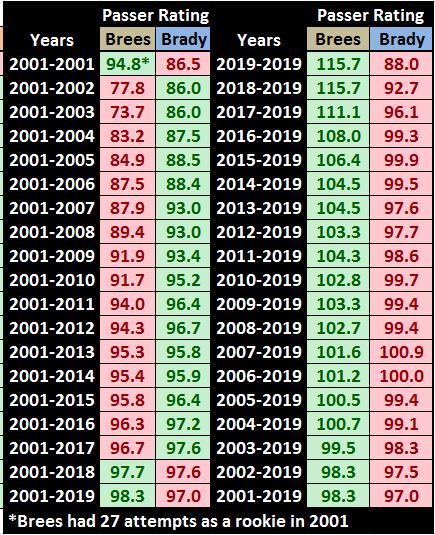
DBTB-PR

Now how could I put Brees ahead of Brady when the MVP count is 3-0? Even with Marino it’s 1-0. That one’s simple. I think their top seasons match up very well, and Brees’ lack of MVPs is a case of bad luck. Several of his best years coincided with someone else having a career year like Mahomes in 2018 or Rodgers in 2011. Then he’s also been bitten by Peyton a couple of times. Meanwhile, I think Brady was a default MVP in 2010 and 2017 since no other candidate stayed healthy or was worthy enough that year. In the end, I think Brady (2007) and Marino (1984) have the best individual seasons (2007) between the three, but seasons from Brees like 2009, 2011 and 2018 are all better years than Brady’s MVP years of 2010 and 2017. Marino’s only other MVP argument would have been 1986, but he missed the playoffs at 8-8. So I don’t think the MVP argument is a valid one for Brees vs. Brady/Marino like it would be for Brees vs. Peyton/Unitas/Montana.

Sadly, it looks more and more likely that Brees will be left off the NFL’s top 100 as I have been saying for weeks. It’s a tough list to crack and people have stronger biases than usual when it comes to quarterbacks. Brees has had the misfortune of trying to shine in an era with three other all-time greats, but I just don’t know how anyone could look at the body of work and how he’s played and not be super impressed. Most accurate quarterback of all time and most prolific passer of all time are worth celebrating.

Some quarterbacks simply receive more help and have better luck than others. These things do not just even out, even over two decades in the league. It’s true that I don’t think I can use my method of changing one play (usually one that has nothing to do with the QB too) to change enough outcomes to get any other QB in nine Super Bowls like Brady. But I know I just have to change the Tuck Rule/Vinatieri’s kick (2001), Lee Evans in the end zone (2011), and Dee Ford offsides (2018) and I already have Brady down to a 4-2 Super Bowl record. Don’t even get me started on the 2014 Seahawks and 2016 Falcons not committing to the run when they should have, or Drew Bennett in 2003 (Titans) or #MylesJackWasntDown in 2017. The list just goes on and on for what I call the Coin Flip Dynasty in New England. Meanwhile, I could find a few more title games and possible Super Bowls for Manning and Brees quite easily.

That’s how I don’t get caught up in counting Super Bowls for this list. I can look at how the QB performed individually and asses how much help they had to win or lose the game. We know Brady isn’t blowing away his peers in any statistic except for the one that says New England wins the most in practically every situation.

The one stat the QB has the least control over should not be the centerpiece for his greatness. That’s been my argument for Marino over Brady, but it’s better applied to Brees now.

7-10: The Curious Case of Aaron Rodgers

Here’s an interesting one. Roger Staubach and Steve Young are similar in that they were the most efficient passer of their decade while also being really good at scrambling. Both had shorter-lived runs as starters for various reasons, but they rarely left you disappointed. The Green Bay quarterbacks, Brett Favre and Aaron Rodgers, also showed some dominance with multiple MVP awards and a flair for extending plays. They however couldn’t be any more different when it comes to interception avoidance. Maybe Rodgers learned from watching Favre slump through a bad 2005 season as a rookie, but we know he’s very protective of the ball and will throw it away or take sacks at a higher level than he should. Favre was the ultimate gunslinger, but he paid for that a lot too. You had more exciting comebacks with Favre, but also some really tough losses after bad interceptions.

With Staubach, we basically had eight relevant seasons with only one of those (1974) seeing him have subpar stats and missing the playoffs. With Young, his peak in San Francisco was also eight years (1991-98) and it’s one of the best eight-year runs you’ll ever see. I think only 2003-2010 Manning exceeds it. Young, Favre and Rodgers are three of the best ever one-ring QBs. Favre’s Packers (and Aikman’s Cowboys) actually had a lot to do with Young only starting one Super Bowl. It’s one of the biggest disappointments this decade that the Packers haven’t been back to the Super Bowl with Rodgers.

Favre obviously has the ironman streak and longevity in his favor. The thought was that Rodgers could provide 15 years of standout play despite having to wait until his fourth season to start a game thanks to Favre. However, it has been a strange path. Most all-time great quarterbacks don’t have to wait as long to start as Rodgers did. Most never come close to the peak run Rodgers had in 2009-2014, which I have dubbed as Peak Aaron Rodgers. Then we have the last five years that have taken place since I last ranked quarterbacks. Ever since that 6-0 start in 2015 without Jordy Nelson, Rodgers has seen his stats take a major nosedive from his lofty standards. In his last 64 regular season games, starting with that embarrassing night in Denver (2015), his YPA is just 7.05. Rodgers has had the lowest TD% of his career in the last two seasons.

Blame has made its rounds everywhere. Former head coach Mike McCarthy took the brunt of it, but under new coach Matt LaFleur, Rodgers is having a very familiar 2019 season that looks a lot like last year. The difference is the defense has been much better and the schedule more favorable. We have metrics to show the offensive line is pretty good. Aaron Jones has been an impressive running back as the running game has been blamed for this decline even though Rodgers rarely had one in his peak years.

I think there is something to be said for having the best and deepest receiving corps in the NFL when Peak Aaron Rodgers played, compared to now just having Davante Adams and some guys. That obviously doesn’t reflect greatly on Rodgers for not developing the receivers better, but he is clearly working with less than he had before. He’s also never been a huge fan of tight ends for some reason so Jimmy Graham hasn’t been much help there. I think this hurts him a bit in an era where Manning and Brees could seemingly plug anyone in and get production. Rodgers loves to extend plays and go off script, but the rewards just haven’t been there like they used to, and he misses having a threat like Jordy Nelson. Health concerns have also been present for Rodgers in some of these seasons.

I used to knock Rodgers for the lack of 4QC/GWDs. He’s improved there for sure, but some of it has come at the expense of his usual early-game dominance. Simply put, the Packers trail by bigger margins and more often now than they used to. So while it helps Rodgers get more big comeback opportunities like the ones he led last year against the Bears and Jets, it’s overall hurting the team that he’s just not as efficient as he used to be.

So it’s unusual to see such a great QB with these struggles in his ages 32-36 seasons. If Rodgers had a 15-year career that looked like his play for 2015-19, I’m not sure he’d be a HOFer. He might be short of the mark like Philip Rivers actually. I’ve been saying that the ways to get Peak Aaron Rodgers back come in only three forms. One is to change teams, which seems unlikely right now. Another was to change coaches, but again, that hasn’t done the trick yet. The third is for Green Bay to land a generational talent at receiver that can transform the offense. Unfortunately, players like this rarely come along (think Rob Gronkowski or Randy Moss). That might be the only hope.

Peak Aaron Rodgers is one of the best QBs we’ve ever seen, but this guy of the last five years is not. I’m keeping Favre ahead of him for now because not only did he have an MVP reign and great run in the 90s himself, but he rebounded later with a great season at 38 in 2007 and nearly had the Vikings in the Super Bowl when he was 40.

Rodgers will turn 37 next season. Does he have that kind of resurgence in him? Time will tell, but he still has an opportunity right now to turn in an impressive postseason no one really expected from Green Bay and get to another Super Bowl in February. Perhaps denying Brees a second trip would be a big win for Rodgers’ legacy.

11-15: Roethlisberger over Elway

Wrapping things up for quarterbacks, I’ve kept my order of Baugh > Tarkenton > Graham from 2015, but Elway has moved down from eighth and Roethlisberger has gone from 15th to 13th. I have known for years that I wanted to move Elway down more, but this did not prove to be perfect timing for the Roethlisberger push only because he suffered the first long-term injury of his career this year and missed all but 1.5 games.

Let’s not ignore the facts though. Roethlisberger and Elway have each played 16 seasons in the NFL. Roethlisberger expects to play at least a 17th too, so there’s no longevity dispute here. Elway has only appeared in 16 more regular-season games than Ben, but Ben already has more passing yards, more passing touchdowns, and he is only four wins behind Elway as a starter. They have the same number of comeback wins (34) and game-winning drives (46). Roethlisberger has one more lost comeback (9) than Elway (8), or games where the QB put his team ahead late but still lost.

Roethlisberger kills Elway in rate stats and top 5/10 finishes among his peers. Top 5 seasons in passing DVOA? Roethlisberger has five to Elway’s two. Top 10 seasons in passing DVOA? Roethlisberger has 10 to Elway’s seven. Roethlisberger has finished 11th or better in passing DYAR (total value) in 14 of his 16 seasons, only missing in 2008 (23rd) and 2019 (IR). We don’t have any QBR data on Elway’s career, but chances are he wouldn’t finish that well in most years. Elway had more rushing production which could help, but he also fumbled 38 more times.

Beyond that, Roethlisberger didn’t need 11 seasons to start putting up efficient passing numbers like Elway, who had 158 touchdowns and 157 interceptions from 1983-1992. Look at this split for each quarterback’s first 10 seasons versus their 11th-16th seasons and how they ranked among their peers at that time (minimum 1,000 attempts for rate stats).
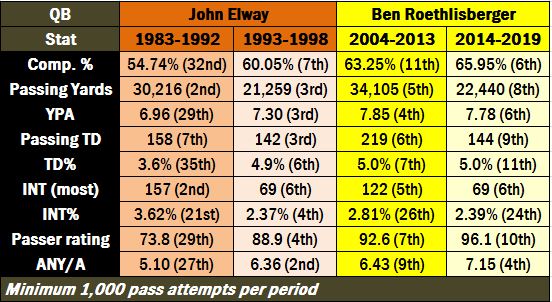
JE-BR

(Keep in mind Roethlisberger has had stiffer competition too with Brady, Brees and Rodgers in each split. Someone like Manning is replaced by Mahomes in the 2014-2019 split. Meanwhile, Chris Chandler and Mark Brunell were two of the better quarterbacks in that 1993-1998 split for Elway, a bit of a down period for offenses league-wide.)

Roethlisberger immediately had great efficiency stats and was Offensive Rookie of the Year before later having the volume stats as well. He’s always had top 10 statistics while Elway was often poor for a decade among his peers before turning it on later when the Broncos eventually supplied him with a HOF tight end (Shannon Sharpe), HOF RB (Terrell Davis), HOF left tackle (Gary Zimmerman), HOF-caliber wideout (Rod Smith), and other good assets. Roethlisberger’s boost starting in 2014 was Le’Veon Bell becoming a capable receiver at running back, which he never had before in his career. The improved line and his personal change to get rid of the ball faster has resulted in far fewer sacks taken. The Steelers also had better skill weapons in recent years before Bell and Antonio Brown mentally imploded, but Roethlisberger has always helped his receivers excel. Santonio Holmes, Antwaan Randle El, Mike Wallace and Martavis Bryant disappointed greatly after leaving Pittsburgh, and almost every draft prospect (mostly mid-round picks) has panned out thanks in part to Roethlisberger’s consistency. The only wideout who broke out somewhere else was Emmanuel Sanders in Denver (with Manning of course).

Roethlisberger didn’t need 15 seasons to win his first Super Bowl either. He needed two and then added a second in his fifth year with the greatest game-winning touchdown pass in Super Bowl history. If you want to say Roethlisberger sucked in his Super Bowl win against Seattle, that’s fine. Just admit the same for Elway against the 1997 Packers. The helicopter spin was cool, but it’s not a better play than the tackle Roethlisberger made to save Jerome Bettis’ legacy and his team’s ring in the playoffs in Indianapolis in 2005. While “The Drive” is an iconic moment for Elway, it didn’t directly win the game for Denver like Roethlisberger’s march and throw against Arizona.

Elway has his moments of lore, but so does Roethlisberger to anyone paying attention to the last 15 years of the NFL. This is the problem of playing in the same era as the big four of Manning, Brady, Brees and Rodgers. Yet Roethlisberger is the only QB in NFL history with three 500-yard passing games, which were all wins against winning teams, including the last-play touchdown to Mike Wallace against the 2009 Packers. He also has the most 450-yard games (7). He’s the only QB to ever throw six touchdown passes in back-to-back games, which was also done against playoff teams. He is tied with Brady for the third-most games of five touchdown passes (seven) in NFL history, and five of those games were nationally televised. He is tied with Peyton for the most 158.3 perfect passer rating games with four. He had a great game as a rookie to end New England’s historic 21-game winning streak. He led a memorable comeback to win the AFC North on Christmas in 2016, connecting with Antonio Brown in the final seconds. There was the slug-out win in Baltimore in 2008 with a Santonio Holmes touchdown breaking the plane late. He’s broken the hearts of Bengals and Ravens fans with nine game-winning drives against each.

At the end of the day, it doesn’t surprise me that Roethlisberger wasn’t even one of the 22 nominated names for this list by the NFL. He’s always been the Rodney Dangerfield of quarterbacks — no respect. But what factors other than nostalgia would make one choose Elway? Are an extra two Super Bowl losses the deciding factor? It’s not for me when I know that’s the result of Elway playing in a far weaker AFC where he took advantage of cursed Marty Schottenheimer teams like so many others would. Imagine if Elway had to deal with the Patriots and Manning-led teams like Roethlisberger has. Elway did nothing to break up Buffalo’s four-year run of winning the AFC. Elway wasn’t the only one who saw his defense implode in playoff games either, most notably those three Super Bowl losses. Roethlisberger is 13-1 in the playoffs when the Steelers allow no more than 24 points, but 0-7 when they allow 29-plus.

It’s hard to say how Roethlisberger, going on 38, will recover after surgery. The Steelers could also be in for some lean years with the Ravens running wild now and the Bengals probably drafting QB Joe Burrow with the top pick. The Super Bowl window may be closed for Ben, but he’s long since matched Elway in that “precious” ring category people care about.

It has been a pleasure watching Roethlisberger the last 15 years. It has been painful watching the Steelers try to operate an offense without him this season. That should earn him more respect, but we know that never seems to be the case despite all the evidence.

Running Backs (7)

  1. Barry Sanders
  2. Jim Brown
  3. Walter Payton
  4. Emmitt Smith
  5. Eric Dickerson
  6. LaDainian Tomlinson
  7. Marshall Faulk

My top three have been set in stone for quite a number of years now thanks to their pure domination and consistency. When it comes to No. 4 Emmitt Smith, I hear the arguments about the offensive line, but his longevity and durability were special. There’s no other way you get to be the all-time leading rusher without that. He was also the dominant, featured player in his offense at a time when his Cowboys were the most successful team in the NFL. The 90s were a peak time for workhorses and he won four rushing titles despite battling with the human highlight reel that was Barry Sanders. Eric Dickerson rounds out my top five, and he may be No. 1 if we just focused on his first six or seven seasons when he was so prolific and didn’t have much help from his passing game. His record of 2,105 rushing yards in 1984 still holds up and may never be broken (at least not in a 16-game season).

While the NFL included 12 backs, I only felt it was necessary to pick seven as I am a firm believer in the ease of replacement at the position. I also picked LaDainian Tomlinson and Marshall Faulk to round out my list, which explains why I was so shocked to see neither make the NFL’s list. Both were league MVPs who set the single-season touchdown record and were prolific receivers as well. Faulk had that dominant 1,000-yard rushing, 1,000-yard receiving season in 1999 that led to a Super Bowl win for his Rams. Tomlinson was insanely productive through seven seasons back at a time when the league was still filled with the workhorse back, a dying breed ever since.

You have to wonder if there was a personal vendetta against Faulk at the NFL Network to not honor him on this show due to his involvement in a sexual harassment case years ago. That would be a bit hypocritical for a show that had no problem bringing Jim Brown, Ray Lewis, and Lawrence Taylor on the studio and also talked about the inclusion of O.J. Simpson. Not to get on a moral high horse, but allegations of murder and physical/sexual assault against women are a serious matter.

Either way, I have no problem putting players who finished third and seventh in career touchdowns on my list. Tomlinson and Faulk were massive snubs by the NFL. I did not pick a back older than Brown, but I respect the NFL’s decision to include Steve Van Buren. I think that’s the right pre-1950 pick and I also like Lenny Moore a lot too as a big-play threat. I can even respect O.J. Simpson’s inclusion as he was a monster (on and off the field).

But again, I just do not love the position enough to include more than seven as I wanted to get more quarterbacks on my top 100.

Wide Receivers (10)

  1. Jerry Rice
  2. Randy Moss
  3. Don Hutson
  4. Terrell Owens
  5. Lance Alworth
  6. Calvin Johnson
  7. Larry Fitzgerald
  8. Julio Jones
  9. Marvin Harrison
  10. Cris Carter

For the record, if I was ranking all players 1-100, Jerry Rice would be my No. 1 overall player, the GOAT. You could kill a lot of time digging into his records and being amazed at how incredible his peak was and how he was the best Old Man WR in history too. One of the first football articles I ever did was about how unbreakable Rice’s records were. Even in this era of pass-happy offenses, it’s hard to see anyone playing now breaking his records. It would have to be someone who comes in later when the seasons are 18 games long. Hopefully that change never happens and someone beats him on merit instead of increased opportunities. If one record falls it would have to be receptions, but good luck to anyone on the yards and touchdowns. Not to mention all the playoff records.

I saw more of Randy Moss than I ever did Rice, but he’s my No. 2 because I think he had a tendency to take plays off. He basically quit on the 2006 Raiders, which maybe I can’t blame him for given his QB was Andrew Walter and his coach was Stuck in the 1990s Art Shell. But Moss was such a dangerous deep threat and I loved seeing him raise his hand almost instantly out of his break to get his QB’s attention to throw it. He might have sniffed Rice’s touchdown record if his career didn’t go haywire at age 33 (played for three teams in 2010), but that’s just another reason Rice is the GOAT.

Now that I hit on my two favorites, let’s circle back to the NFL’s very controversial list, which I had a somewhat viral tweet about in mocking the addition of Elroy “Crazy Legs” Hirsch.

In my opinion, my top five players should be locks for a top 10. The NFL didn’t go with Terrell Owens for probably some of the same reasons he had to wait years for the HOF. Perceived “bad teammate” stuff. As an on-field talent, the guy was amazing and excelled with several quarterbacks and franchises, and his teams generally won. His performance in the Super Bowl loss after a serious leg injury was also awe inspiring. T.O. can be in my top five for sure.

When it comes to 6-10, I think many players have a good argument. Wide receiver is a very difficult position to evaluate because their success is so dependent on the quarterback in a way that just isn’t true for RB/OL/TE (see my rant here). We have to consider the team’s pass-run ratio, the quality of the quarterback and other receivers, and did the receiver create a lot of YAC, score a lot of touchdowns, or did he just load up on short completions from the slot? There’s a lot more to evaluate here so it’s not surprising that the HOF has a difficult time with the position and so did this list.

For one, I think having five of the top 10 wide receivers of all time as white players is a head scratcher (unless that was the Bill Belichick Special given he’d include “Julian Welkendola” as a player if he could combine the three). Don Hutson and Lance Alworth were locks that I included in my top five. Hutson is basically the George Washington of the position, the first true great receiver. Alworth was an incredible deep threat and the best from the AFL era. I did not include Raymond Berry or Steve Largent on my list, but I at least see cases for them making the NFL’s list.

The one that bugged me was Crazy Legs Hirsch. He indisputably had one of the all-time great receiving seasons in 1951 with 1,495 yards and 17 TD in 12 games. But that was on a stacked, historically prolific passing team with two HOF passers. The competition also leaves something to be desired from that year. The Rams opened the season with the New York Yanks, a team that finished 1-9-2 and was defunct the following year. That’s the game where Norm Van Brocklin set the single-game record with 554 passing yards, and Hirsch had 173 yards and four touchdowns that day. Hirsch never came close to his 1951 numbers again and only had a couple other really strong seasons.

I get that they were trying to highlight different eras, but why so much focus on that time between Hutson and the pass-happy AFL that Alworth helped bring along? I would have ignored Hirsch’s era for sure, just like how they ignored the last dozen years when Calvin Johnson and Julio Jones were so outstanding, living up to the draft hype with their freakish talent. Calvin came the closest to a 2,000-yard season of anyone so far and retired early much like Detroit’s other great skill player (Barry Sanders). Julio doesn’t score touchdowns like you’d like to see, but it’s hard to argue with his NFL record average of 96.4 receiving yards per game. He is looking to finish in the top three in yards for the sixth time this year. That’s big when you consider Larry Fitzgerald has only finished in the top three one time in his career (he has been fourth a total of three times). This gets back to how voters don’t seem to properly understand how to evaluate a player relative to his peers in this era.

Fitzgerald made my list too even though he’s less dominant than most of the other guys. His hands are amazing, he’s been very durable, and his playoff performances were nothing short of historic. Cris Carter also made my list for his ability to score a ton of touchdowns with various quarterbacks. I’ve always had him ranked ahead of the likes of Tim Brown and Michael Irvin. Sterling Sharpe would get more respect if injury didn’t stop him early, but he should be in Canton.

Then there’s Marvin Harrison. I’ve said that the best WR in NFL history, statistically, would be Peyton Manning’s No. 1 WR. Harrison was fortunate to get the biggest chunk of those seasons as he lit up the record books with Manning in Indy. Harrison’s playoff struggles are hard to explain, but it’s hard to argue with his 1999-2006 peak when he averaged 105 catches, 1,425 yards and 13 TD per 16 games.

Tight Ends (6)

  1. Rob Gronkowski
  2. Tony Gonzalez
  3. Antonio Gates
  4. John Mackey
  5. Kellen Winslow
  6. Mike Ditka

This was probably the least disagreeable position on the NFL Top 100. They only selected five players, but I had the same five plus Antonio Gates, who played college basketball in case you forgot. Shannon Sharpe would also be an honorable mention, but I like this list.

Gronk was the GOAT and the numbers would be even more stunning if he wasn’t injured so often. But when playing he was the best. Think of Tony Gonzalez as Arnold’s T-800 model of Terminator. Iconic and durable. Got the job done. But Gronk was the T-1000, except he’d rather melt into a puddle of goo off the field than continue risking his body after yet another Super Bowl win. Man, it sure is funny how the two most stat-inflating receivers of the last two decades (Moss and Gronk) played at their peak with the quarterback who “never has any weapons” in New England.

John Mackey has one of the best highlight reels of any player in NFL history. He was an OG like Mike Ditka, and Kellen Winslow took things to another level in Air Coryell’s offense as a receiving tight end. A relatively newer position than the others, it wasn’t hard to come up with the tight ends.

OFFENSIVE LINE (19)

Before we get into the OL positions, I want to acknowledge that it’s still the unit we have the least data for, especially for past decades. At least we have new game charting metrics for blown blocks and rates of snaps won in pass blocking, but we’re still pretty much in the dark on most decades of NFL history. So excellence at these positions have largely been defined by draft status, games started/longevity, and Pro Bow/All Pro honors. We know that can be very dubious, such as Maurkice Pouncey making eight Pro Bowls largely on the fact that the Steelers drafted him in the first round in 2010 rather than his actual play. So when I’m picking an offensive lineman, I try to pick someone who contributed to successful offenses while also garnering a lot of individual honors, but again I think a lot of us are simply guessing when it comes to these positions.

Offensive Tackle (7)

  1. Anthony Munoz
  2. Orlando Pace
  3. Jonathan Ogden
  4. Willie Roaf
  5. Joe Thomas
  6. Forrest Gregg
  7. Jim Parker

The NFL list had seven tackles too, though we only agreed on three of them. Sort of. Jim Parker made my list here, but the NFL list put him at guard where he also played. He was Johnny Unitas’ left tackle during the title years in Baltimore. Point is he’s on this top 100 list. My top pick was Anthony Munoz who seems to be the consensus for the best tackle ever.

It was surprising not to see Orlando Pace on the NFL’s list. He was the No. 1 overall pick in 1997 and really highlighted that great run on tackles in the late 90s with Jonathan Ogden, Walter Jones, Tony Boselli, etc. I have no problem including someone from the Greatest Show on Turf Rams.

Joe Thomas did not make the NFL’s list, which is another slap in the face to modern players since he was retired at the time they voted. Thomas went to 10 Pro Bowls and 6 first-team All-Pros for the freakin’ Browns, their best player by far since returning to the league in 1999. He never missed a snap until 2017. He’s a first-ballot HOF lock and in an era where a lot of tackles struggle and high draft picks miss, it’s worth highlighting the best of the last two decades in Thomas. It’s just too bad he retired right before the Browns got a quarterback worth protecting (at least we hope that’s the case with Baker Mayfield).

Offensive Guard (7)

  1. John Hannah
  2. Bruce Matthews
  3. Gene Upshaw
  4. Larry Allen
  5. Randall McDaniel
  6. Jerry Kramer
  7. Steve Hutchinson

John Hannah was the GOAT for the Patriots before people ruined that label. Bruce Matthews could excel at any position on the line, so you know he would make the list high somewhere. I did not choose Art Shell for my tackles, but I did go with Gene Upshaw from those Oakland lines for the guards. Larry Allen was a monster who could also play multiple positions. Randall McDaniel was a 12-time Pro Bowler who was also All-Pro when the 1998 Vikings set the scoring record.

The NFL also chose seven guards, including my tackle pick of Jim Parker. They didn’t pick Steve Hutchinson and Jerry Kramer like I did. Kramer finally got into the HOF as a key member of the Packers, the most successful dynasty in NFL history. Hutchinson was my pick for representing the last 20 years of football. He should get into the HOF soon too, and he was an anchor for those strong Seattle offenses and also blocked for a young Adrian Peterson in Minnesota.

Center (5)

  1. Jim Otto
  2. Dwight Stephenson
  3. Mike Webster
  4. Dermontti Dawson
  5. Mel Hein

Hard to say if there’s any consensus on the #1 center like there is for tackle (Munoz) or guard (Hannah), but Jim Otto was a 10-time first-team All-Pro. Sure, it helped that most of that came in the AFL when there weren’t many teams, but the Raiders were a highly successful offense in that era. Dwight Stephenson might have gone down as the best if he played longer (just 114 games), especially since he was with Dan Marino in Miami.

I mentioned Pouncey earlier, but you can see why center is such a big deal in Pittsburgh. Mike Webster and Dermontti Dawson were two of the best to ever do it. Finally, Mel Hein made my list as the best from his era (1931-1945).

The NFL had the same list, except Dawson didn’t make it there. So there’s probably more groupthink with OL than any position, but my 19 picks being somewhat close to the NFL’s list makes me feel good.

Defensive End (9)

  1. Reggie White
  2. Bruce Smith
  3. Deacon Jones
  4. J.J. Watt
  5. Carl Eller
  6. Michael Strahan
  7. Jack Youngblood
  8. Julius Peppers
  9. Gino Marchetti

You might be able to argue with the order, but I think White/Smith/Jones make up a pretty consensus top three. This is such a crucial position, so I was surprised to see the NFL only chose seven players. More baffling was how they included Doug Atkins and Lee Roy Selmon, but not J.J. Watt or Michael Strahan.

The Watt snub especially bugged me because it showed that they’re not acknowledging how great an active player has already been in his career. Watt played six full seasons and was first-team All-Pro in five of them and won three Defensive Player of the Year awards. Most guys can play 15-20 years and never sniff those achievements. Watt’s only played nine fewer games than Selmon, who started out on those horrible Tampa Bay teams and only had one All-Pro season and DPOY award. Watt is as big of a snub as any by the NFL.

I also like to represent Minnesota’s Purple People Eaters line, so I included Eller on my list. Strahan was a surprise snub too. Not only does he still hold the record for sacks in a season (22.5), but he still ranks sixth all time (141.5) and led the Giants defense on that great Super Bowl run in 2007, shutting down the undefeated Patriots. Julius Peppers also made my list as a modern player with his freak athleticism and having the fourth-most sacks ever. He should be an easy HOF choice in 2024.

Defensive Tackle (9)

  1. Joe Greene
  2. Merlin Olsen
  3. Bob Lilly
  4. Randy White
  5. Warren Sapp
  6. John Randle
  7. Alan Page
  8. Cortez Kennedy
  9. Aaron Donald

Much like with the Watt selection, I think Aaron Donald has already done enough this decade to belong on the list. We are fortunate to have stats for pressures and QB hits now, even if they aren’t as objective as a sack. But Donald is so dominant in those categories despite playing inside and seeing a lot of double teams. Donald and Watt will be the first two incredible defenders in the game charting era where we have more data to quantify just how much better they were than their peers. I’m not surprised the NFL snubbed him, but I won’t.

Like with Marshall Faulk, I wouldn’t be surprised if Warren Sapp was purposely left off as he’s also run afoul off the field in recent years. But he was another great pass-rusher at a position where it’s just harder to break through to the quarterback than playing on the edge.

The NFL chose seven players, of which I agreed with six of them (not Buck Buchanan from the Chiefs). It’s pretty obvious to agree with the gold standards of the position like Greene, Olsen and Lilly. I just think Sapp, Donald and also the late Cortez Kennedy deserved it too.

Linebackers (12)

  1. Lawrence Taylor
  2. Ray Lewis
  3. Derrick Brooks
  4. Jack Lambert
  5. Junior Seau
  6. Mike Singletary
  7. Dick Butkus
  8. Derrick Thomas
  9. Chuck Bednarik
  10. Joe Schmidt
  11. Bobby Bell
  12. Jack Ham

Here is an old-school position where teams start three or four players, so it’s not that hard to come up with a list of legends. I picked 12 just like the NFL did, but we had two big disagreements. I went with Derrick Thomas and Mike Singletary while they chose Willie Lanier and Ted Hendricks. Sure, Hendricks is a fine selection and nearly made my list too. Lanier is overkill for me since he played with Bobby Bell on the Chiefs, who also made the list. Singletary was a dominant force in Chicago and is second to only Ray Lewis in Pro Football Reference’s new HOF monitor for inside linebackers.

Derrick Thomas was the snub that stood out most to me the night the NFL revealed their list, because I assumed Singletary was on there too. But for Thomas, he was a great pass-rusher with monster games (games of 7 and 6 sacks) and production (41 forced fumbles) for a winning Chiefs team in the 90s. He sadly passed away at 33 after a car accident, but I have to have him on my list.

This was a position where I didn’t think any active player was really deserving of inclusion. Ray Lewis was the most recent player, retiring after 2012. Luke Kuechly is building up a great resume in Carolina, but I wouldn’t put him ahead of Brian Urlacher yet, let alone in the top 12.

Cornerback (9)

  1. Rod Woodson
  2. Deion Sanders
  3. Mel Blount
  4. Champ Bailey
  5. Darrelle Revis
  6. Night Train Lane
  7. Willie Brown
  8. Charles Woodson
  9. Herb Adderley

This was another controversial position from the beginning when Patrick Peterson was included on the finalist list over Richard Sherman. What bugged me about the NFL’s list of seven cornerbacks is that Mike Haynes was reportedly a unanimous choice, but Rod Woodson and Deion Sanders were not. How in the world can any of the 26 voters not all have Woodson and Sanders on their ballot? That’s absurd. I put them in my top two along with Mel Blount, who changed the game so much for Pittsburgh that they had to create illegal contact.

I also made sure to give credit to shutdown corners in this era where the pass is so heavily utilized. So that’s why I have Champ Bailey and Darrelle Revis so high when neither made the NFL’s list. Charles Woodson also made the cut for me with one of the best resumes a football player has ever put together.

Night Train Lane is someone I joke about getting 15-yard penalty after 15-yard penalty if he played today with his rough style, but he was the stud corner in his era. I also gave respect to Willie Brown and Herb Adderley with the latter being a snub in my eyes from the NFL list. Given what we know about NFL media and the things they value, you would think a six-time champion with five picks in the playoffs and four All-Pro seasons would be more highly regarded.

I left out Darrell Green on my list, but the NFL didn’t. I said on Twitter that he was most notable for his speed and insane longevity (played thru his age-42 season). In 20 seasons he was an All-Pro just once and he never had more than five interceptions in any season. While interceptions may not be the end-all, be-all stat for a player, just keep in mind that roughly 600 players can claim to having a season with six interceptions at least once. It’s not asking for much. So I’d much rather have Revis and Bailey than Green and Mike Haynes.

Safety (4)

  1. Ed Reed
  2. Ronnie Lott
  3. Emlen Tunnell
  4. Larry Wilson

This was a position I cut short a bit at the end to not go over 100 players. The NFL list had six, including all four of my players. Ed Reed was an easy choice as the GOAT for me and the only one needed from his era (over Troy Polamalu and Brian Dawkins). Ronnie Lott was crucial and a punisher for the 49ers’ success so he’s up there, but I love the way Reed could outsmart the Manning’s and Brady’s in a way no other safety could. When Reed got the ball in his hands (64 INT!) he was electric to watch too. You didn’t know if he’d make a 100-yard return or lateral to a teammate. Here’s one of my favorite stats ever:

Emlen Tunnell was before my time, but the four-time All-Pro still ranks second in interceptions (79) and probably will never be passed unless someone changes teams weekly to play against Jameis Winston for years to come. Paul Krause still holds the record with 81 interceptions and may have been my fifth safety if I had room, but I felt like he was more of a compiler in that statistic than anything. So my last pick went to Larry Wilson, an innovator of the safety blitz.

Others

I did not select a punter, let alone two like the NFL did, but Ray Guy is the obvious choice there. For kicker, I’ll go with Adam Vinatieri for his longevity and reliability in clutch situations and inclement weather. He also really started finding the touch on 50-plus yard kicks in the back half of his career. Justin Tucker is on his way though, but this is still too much kicker talk. Devin Hester would be my pick for the return specialist, and finally, you can see my top 10 coaches here:

Here is the final breakdown of my top 100 players in NFL history:

Top100NFL


Wide Receivers: Fun Toys If You’re a Good Boy (Or QB)

I’ll post my Week 16 predictions a day earlier with the NFL having a good triple-header on Saturday. First, I wanted to rant about wide receiver value in relation to the Cowboys-Eagles showdown on Sunday. As the week wore on, I realized it can apply to so much more than that game.

You can tell the playoffs are close because people are spouting crazy quarterback legacy takes again. We still are several weeks away from a potential Chiefs-Ravens AFC title game where the outcome could set the course of the narratives for Patrick Mahomes and Lamar Jackson for the rest of their careers (a la you know who in 2003). Let’s set that depressing thought aside today and focus on the damage done to the last 20 years of quarterback analysis.

The source of this week’s frustration was after Drew Brees broke more NFL records on Monday night. Patriots fans suddenly wanted to count playoff passing touchdowns with the regular season. Mike Florio and Chris Simms managed to post two horrible top 10 lists for quarterbacks:

Their blatant disrespect for Johnny Unitas aside, I couldn’t get over the appearance of John Elway twice in the top three. So I fired back with this to make sure my Tuesday would go to waste fighting off the same arguments I’ve battled for two decades now:

After reading the usual weak arguments in defense of Brady and Elway, I had a bit of an epiphany. I realized that the quarterbacks I tend to defend have a long history of success with throwing to wide receivers. This would be the likes of Peyton Manning, Drew Brees, Ben Roethlisberger, Tony Romo, Dan Marino, Andrew Luck, etc. Meanwhile, the quarterbacks I’ve call overrated tend to always get the “he doesn’t have good receivers or enough help!” excuse:

  • “Manning’s always had better receivers than Brady, who would throw deep more if he had those guys instead of slots and receiving backs!”
  • “Elway would have all the records if he played with the receivers Montana and Marino had! One-man show before Shannon Sharpe!”
  • “Switch Carson Wentz and Dak Prescott and Wentz would be 12-2 right now with those wide receivers!”
  • “Cam Newton’s only had Greg Olsen and recently CMC.15-1 with Ted Ginn!”
  • “Look what Donovan McNabb did as soon as he got Terrell Owens instead of Stinkston and Trash!”

You can probably throw Joe Flacco and Alex Smith in there as other past whipping boys of mine, but you get the point.

But when you get down to it, it’s the wide receivers that people are really complaining about when it comes to the lack of help. Let’s just take the trio of Manning, Brady and Brees for example:

  • Brady (Bill Belichick) and Brees (Sean Payton) have clearly had better coaching than Manning, who was the closest thing to an on-field coach in his era.
  • Brady (Rob Gronkowski) and Brees (Antonio Gates/Jimmy Graham) played with superior, game-changing tight ends than Manning (Dallas Clark) ever did.
  • Brady (Kevin Faulk, Danny Woodhead, James White) and Brees (LaDainian Tomlinson, Reggie Bush, Pierre Thomas, Alvin Kamara) played with better, specialized receiving backs than Manning (one year of Marshall Faulk and 38 games of pre-ACL Edgerrin James) ever did.
  • Brady and Brees had better high-end offensive line play and superior results in run blocking led to better rushing production than Manning had in his career.

Then you get to wide receivers and it’s a different tune. Brady had Randy Moss for two full years as his best weapon. Both had deep threat Brandin Cooks briefly. Brees’ best WR may be Michael Thomas, who is in his fourth year. Meanwhile, Manning had Marvin Harrison and Reggie Wayne for a long time in Indy, then Demaryius Thomas and some other talented players (Eric Decker, Wes Welker, Emmanuel Sanders) in his Denver stint. So it’s not a debate that Manning had the better group of wide receivers.

There’s just one big problem with using this against a quarterback.

Wide receivers have the least independent value to a quarterback among his offensive teammates.

It’s 2019 so we’re just going to ignore the fullback position like most of the league has, but think about this before dismissing it as a controversial take. It should be common sense.

Offensive linemen have a lot of value because they have to block (run or pass) on every play. In the rare event a quarterback throws a block for a teammate, it’s usually a half-assed effort to not get hurt. The linemen’s blocking is especially crucial to the team’s ground game and screen game having success. While the quarterback does control his sack rate more than his line, they still play a vital role in his pass protection. A quarterback can make his line look better by getting rid of the ball quickly (and worse by holding it too long), but they still have to limit quick blown blocks or the offense will have a hard time doing anything.

I’ll say “Running Backs Don’t Matter” but don’t misconstrue a comment on replacement value for one on responsibility. Whichever back is in the game, they do matter. Unless you’re Lamar Jackson, most quarterbacks don’t have a huge role in the team’s rushing offense, so it’s on the back to have good vision for lanes, follow his blockers, and create missed tackles. Backs can also be crucial in blitz pickups, throwing a key block to save the QB’s bacon. Backs also provide value in the passing game where they catch the highest rate of passes of any position and gain the most YAC because of how short the throws are on average. Whether it’s a screen, a pass to the flat, or a checkdown over the middle, RB passes are easy plays for quarterbacks to make.

Tight ends do a little bit of everything. They might be a key part of your run blocking, pass blocking, chip an edge rusher before going out to catch a pass, or they could be major receiving threats themselves, dominating matchups with smaller linebackers and safeties. They too catch a high rate of passes due to the distances and they can be deadly in the red zone especially.

Wide receivers, by and large, play at the mercy of their quarterbacks. Their success is more dependent on the quarterback than any other position. Good runs are always valuable. Good blocks are always valuable. A good route? It doesn’t mean a thing if the quarterback never looks in that receiver’s direction. The quarterback has to decide to throw to the receiver first. A good route and a target? Still might not mean a thing if the throw is so bad there’s no hope it ever gets completed. Some routes could open up the route for another player, but that’s just part of the play design. If as many as five eligible receivers are hoping to get the ball, the QB has to identify and deliver to them. It starts with the QB.

Only a small number of wideouts will ever get praise for their run blocking, but that’s not a significant part of their game now. They need to run good routes, get open, catch the ball and create YAC (or win contested catches). When we’re talking about outside receivers, those are the lowest-percentage throws because of the distance involved (wider and deeper than RB/TE/slot throws). In addition to the tougher throws, the top wideouts are more likely to draw double teams or the best cornerback matchup on a weekly basis too.

It’s never made sense to me how people penalize a QB for producing with the position he should be able to claim the most success for utilizing. Accuracy definitely comes into play here, and it’s no surprise to me that Elway, Newton, Wentz and McNabb are four quarterbacks with undisputable accuracy issues in their careers. Brady’s reputation is dink-and-dunk, so it’s the throws over 15 yards that you question there even in his prime.

The thought that adding a top-flight receiver is the only thing those quarterbacks needed doesn’t fly with me. Take McNabb for example. Sure, he had his best season ever in 2004 when they brought in Terrell Owens. His completion percentage shot up to a career-high 64.0%, but notice that he was down to 59.1% in 2005, a season where Owens’ antics helped bring the team down quickly. For the rest of his career McNabb was just a 59.6% passer. This is a case study in outliers and identifying cause and effect. McNabb didn’t suddenly shoot up to 64% because he was throwing to TO. Owens caught 61.1% of McNabb’s targets. That’s solid, but the big change was RB Brian Westbrook getting utilized more and catching 83.9% of his 87 targets from McNabb. That success didn’t continue as Westbrook only caught 73.8% of his targets in Philadelphia from 2005-09. McNabb didn’t sustain or repeat his level of 2004 play because that’s not the type of quarterback he usually was.

This isn’t to say a great wide receiver can’t have a huge impact on an offense. It’s just that very few players in the league qualify as a game-changing talent. Tyreek Hill is one of those players in Kansas City because of his unique speed. That’s not to say Patrick Mahomes still didn’t do great things without him earlier this year, but that’s because Mahomes is a unique talent himself.

Look at the Colts for a different example. T.Y. Hilton was quite a receiver when Andrew Luck was his quarterback, but if all we knew of him were his years without Luck (2017 and 2019) he would look like a marginal No. 1. So how does one justify holding it against Andrew Luck for having a 1,000-yard WR in Hilton when Hilton wouldn’t be a 1,000-yard WR if Jacoby Brissett was his QB? This is why the WEAPONZ arguments are always so bad when people talk about quarterbacks.

A great statistical season for a quarterback almost certainly means he was able to get production from multiple receivers. A great statistical season for a wide receiver means he played great, but chances are his teammates, including the QB sometimes, did not fare so well. What do you think is more helpful for scoring points and winning games in this league? It sounds nice in theory to get an increase in production for your best receiver, but success in the NFL comes easiest when your best player is actually the quarterback and he’s finding the right matchups all over the field instead of keying in on one guy.

In this era we think of 4,000 yards as a bare minimum for a prolific passing season, efficiency aside. No receiver has ever had a 2,000-yard receiving season, so it’s not like we see one player responsible for over 50 percent of the production in the passing game in this league. Among the 46 players with 1,500 yards in a season, Lance Alworth was the closest with 47.4% of San Diego’s yards in 1965. His team lost 23-0 in the AFL Championship Game.

Super Bowl winners certainly haven’t needed prolific receiving numbers from one player. Steve Smith’s incredible year for the 2005 Panthers where he accounted for 44.8% of the team’s gross passing yardage led to two playoff wins. Out of the 40 seasons where the 1,500-yard receiver had at least a third of his team’s passing yardage, only Smith and 1995 Michael Irvin (Cowboys) played for teams with multiple playoff wins. Antonio Brown (2015) is the only receiver this century to win a playoff game after a 1,600-yard regular season. Jerry Rice, the GOAT, set the single-season record with 1,848 yards in 1995 and it was 38.7% of the 49ers’ total. When Calvin Johnson set the current record with 1,964 yards in 2012, the Lions finished 4-12 and 17th in scoring. No other Detroit player had 600 receiving yards even though Matthew Stafford set a record with 727 attempts (No. 2 all time is 691, Drew Bledsoe).

You’ll hear a lot now about Michael Thomas set to break Marvin Harrison’s record of 143 receptions. When Harrison did that with Peyton Manning in 2002, it led to 41 percent of the Colts’ passing yardage, but that was also the second-worst scoring offense (ranked 15th in points per drive) of Manning’s career. Only two guys playing pitch-and-catch while RB Edgerrin James had a slow return from an ACL injury apparently does not lead to a great offense. Brandon Marshall had arguably his best year ever when he reunited with Jay Cutler on the 2012 Bears, but the offense finished 22nd in scoring. Julio Jones had 1,871 yards in 2015, which ranks second in NFL history. It’s also the second-worst scoring offense (ranked 16th) in Matt Ryan’s career. Josh Gordon (2013 Browns), Isaac Bruce (1995 Rams), Rob Moore (1997 Cardinals), and David Boston (2001 Cardinals) are four more examples of career-peak seasons for offenses that still didn’t rank higher than 22nd in points per drive.

Too much from a great player can actually be problematic when it creates an imbalance on the offense and the ability to create plays from multiple options.

Nothing I’ve said here — I want to make it clear this was a late-night rant more than a deep dive — disputes the idea that an offense with two (or three) really good wide receivers would be very beneficial to a quarterback. That way he wouldn’t have to lean on one player and they could attack from different angles. Look at the greatest quarterbacks in NFL history and it’s no coincidence that their best statistical seasons likely came with their strongest supporting casts.

However, I think people tend to overlook the importance of consistent accuracy, and they love to exaggerate just how good (or bad) one quarterback’s supporting cast really is. It’s not like Kirk Cousins’ season fell apart when Adam Thielen was injured this year. It’s not like Stafford’s efficiency numbers haven’t shot up since Calvin Johnson retired and he’s changed his playing style to accommodate. (It’s a shame we didn’t get a full season from Stafford in 2019 as he was playing arguably his best football.) Even Derek Carr is setting career highs in 2019 without Amari Cooper (or Antonio Brown). Baker Mayfield did better as a rookie without Odell Beckham Jr. on his team. Jameis Winston just stacked historic games of 450 yards and 4 TD with Mike Evans only having a 61-yard TD catch in those games.

There’s some random NFL for you. But what’s not random is a great quarterback finding a way to complete passes with the players he has around him. Maybe that’s a three tight end approach like these historic Ravens, or it’s dominating with your wideouts in 11 personnel like Manning’s Colts used to. There is no one right way to build an offense, because you have to shape it around the skillset of your quarterback.

So when I see Eagles fans wish for Wentz to get his own Amari Cooper for Christmas to make all the difference in the NFC East, I just laugh. If he’s not fumbling in the pocket after four seconds, then it’s still a matter of hitting the mark too.

ACSeye