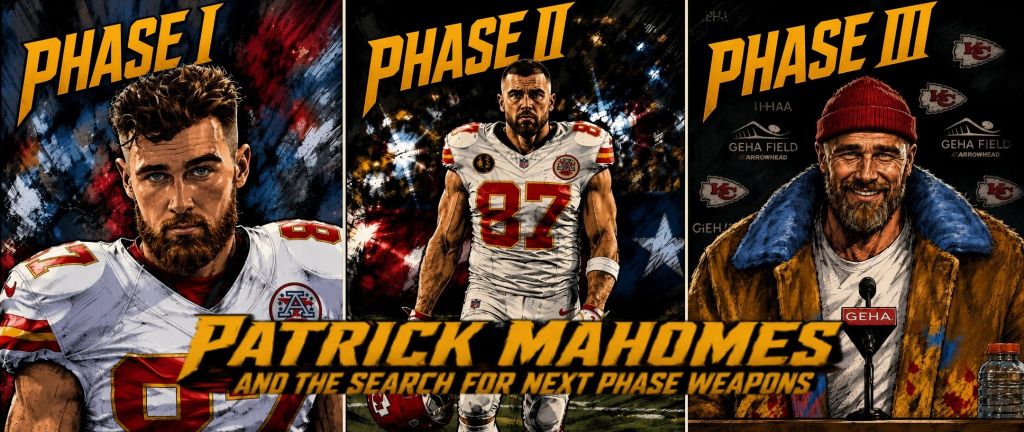
Very few franchise quarterbacks exist in NFL history. I’m talking about the kind of player who can give you the better part of two decades of his career, which is what active players like Patrick Mahomes (Chiefs), Josh Allen (Bills), and Lamar Jackson (Ravens) can only hope to do for their teams now that they’re at or approaching 30 years old.
When they are willing to make that kind of commitment to your team, it’s only fair that you do right by them and continue finding them pieces to work with to score points, win games, and compete for Super Bowls.
Every quarterback, including the best to ever do it, needs weapons. You can get by in the short term by going cheap at the skill positions by investing in the defense and/or the offensive line and running game. But I think it’s clear that what really moves the needle in the passing game are the wide receivers, tight ends, and any good receiving backs you can find for your quarterback.
By Weapons, I don’t mean the most overrated movie of 2025. A great quarterback doesn’t need a bunch of elite weapons to succeed. He needs competent, value-added players with diverse skillsets who are not going to turn into domestic terrorists and sabotage your season with costly drops, penalties, and mistakes that lose games.
Name a great quarterback, and chances are their statistical peak coincides when their receiving corps was at its strongest too:
- Joe Montana (1987-90) was already a 2-time champion for the 49ers, but he wasn’t an All-Pro or MVP until he had Jerry Rice, John Taylor, Roger Craig, Brent Jones, and fullback Tom Rathman operating at a high level together.
- Peyton Manning was setting records from his rookie year, but his most efficient stretch (2003-06) came in Indy once Reggie Wayne proved to be a legitimate counterpart to Marvin Harrison, Dallas Clark broke out at tight end, Edgerrin James was healthier after a 2001 ACL tear, and he had a reliable slot option like Brandon Stokley.
- Tom Brady already helped establish a New England dynasty, but his statistical peak came in 2007-12 once the Patriots brought in a perfect complementary duo in Randy Moss and Wes Welker to run a shotgun-spread offense, then they shifted again in 2010 with the two tight ends in Rob Gronkowski and [REDACTED].
Take note that each of those quarterbacks were already established before these peaks started. They got there with what I call Phase II weapons after already completing a successful Phase 1 of their career with the pieces they started out with.
This is a natural progression that people come to expect from a great quarterback’s career. That he’ll get better with experience and start to peak around 30. But then you have some quarterbacks who flipped the script by playing their best right away after becoming the starter, shining in Phase 1 instead. That’s because their Phase 1 weapons were the strongest core they were ever given in the NFL:
- Dan Marino was a great rookie in 1983 and a record-setting legend in 1984 for the Dolphins when he threw 48 touchdowns and over 5,000 yards. That’s when he had a young Mark Duper and Mark Clayton, the Marks Brothers. They were the best receiving duo Marino ever played with, but he was unable to keep up his torrid statistical start once they got older and Miami still couldn’t field a competent defense or running game.
- Once Aaron Rodgers finally took over for Brett Favre in Green Bay in 2008, he got to play right away with veteran Donald Driver, breakout star Greg Jennings, and rookies Jordy Nelson and Jermichael Finley. They also had James Jones, giving Rodgers the deepest receiving corps in the NFL when the Packers won the Super Bowl in 2010 and he won his first MVP in 2011, the year they drafted Randall Cobb too. That’s why his peak was 2008-14, and things didn’t get back to that level until 2020.
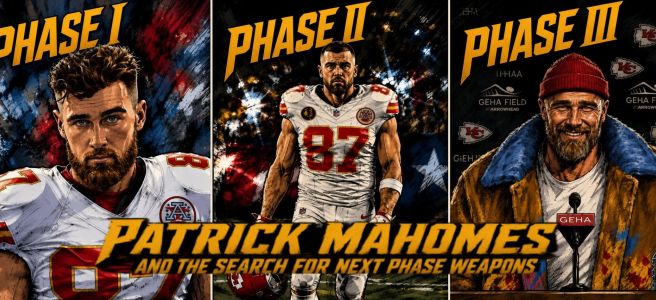
The third quarterback who may very well belong in that group is Patrick Mahomes. He started his career with Travis Kelce and Tyreek Hill in their athletic prime, and he even had his best running back (Kareem Hunt) right away in 2018 before the team understandably released him in November after that video of him pushing and kicking a woman surfaced.
The Chiefs traded Hill in 2022, but with Kelce still about to have his last great season, Mahomes was still the MVP and led the league in the key stats with an all-time great season that resulted in his second Super Bowl MVP.
But sometimes you let success trick you into thinking everything is okay. Had the 2018 Chiefs still won the Super Bowl with a terrible defense under coordinator Bob Sutton, they may have ran it back instead of getting Steve Spagnuolo in 2019. With Mahomes winning a Super Bowl with JuJu Smith-Schuster as his WR1, the Chiefs went into 2023 with the likes of Kadarius Toney, Marquez Valdes-Scantling, rookie Rashee Rice, and Skyy Moore while Kelce started to look slower.
The receivers led the NFL in dropped passes in 2023 and made huge mistakes in losses to the Lions, Eagles, and Bills. But with the Chiefs going on yet another epic Super Bowl run, including three straight underdog wins, the team again felt vindicated in its approach, even drafting yet another speedy little receiver in the first round in Xavier Worthy in 2024.
But when Rice’s injuries and legal issues have led to so many missed games, then you start the 2025 season with Kelce running right into Worthy on the first dropback of the year, and you just have little trust in those guys to lead this passing game as the Chiefs essentially are starting Phase III of Mahomes’ career after he signed another record-setting extension worth over $500M that runs through the 2033 season.
Mahomes is in Year 10 and yet he’s still playing with his Phase I tight end and arguably has no wide receiver or tight end that is a lock to be there for Phase III as he recovers from a torn ACL last December.
That sounds like front office malpractice. That’s how you end up with Colin Cowherd questioning if we’ve already seen the best of Mahomes in the NFL after correctly pointing out the offensive tackle inconsistency and increased competition in the AFC West:
It’s a fair question if only because Mahomes set the bar so high right away. The rest of that video is an incoherent mess that butchers any understanding of history and QB statistics, but that’s for another time.
Let’s look at this concept of Phase X Weapons for 10 all-time quarterbacks.
- Franchise Quarterbacks and Their Weapons by Phase
- Joe Montana
- John Elway
- Dan Marino
- Brett Favre
- Peyton Manning
- Tom Brady
- Drew Brees
- Ben Roethlisberger
- Aaron Rodgers
- Patrick Mahomes
- What Will It Take for Mahomes to Get Phase III Weapons?
Franchise Quarterbacks and Their Weapons by Phase
I said franchise quarterbacks are rare, so the ten I chose to study this for (collected the data over a month ago) include Joe Montana, John Elway, Dan Marino, Brett Favre, Peyton Manning, Tom Brady, Drew Brees, Ben Roethlisberger, Aaron Rodgers, and Patrick Mahomes. That takes us back to the 1980s, and you can see a stark difference in pre-free agency and salary cap (1994) eras as teams used to keep role players a lot longer than they do today.
My only concern was what changed around the quarterback for his long-term team. It doesn’t matter here that players like Montana, Manning, Brady, Favre, and Rodgers left and got new teammates elsewhere. We’re talking about the phases they spent on the teams they put 12+ years into.
Here’s a quick guide on how the phases were created and how the players are grouped:
- Phases are determined by stark change in era for the team and quarterback, including coaching changes and the arrival or departure of a significant player.
- Players are not strictly grouped into phase by the year they were acquired but more of the year they became relevant.
- Players in larger text are considered the key playmakers, the players most likely to lead the team in receiving or rushing or post 1,000 yards in a season.
- Players in blue text are mostly for that one phase while players in red text are also a significant part of the next phase too.
- Players in pink text left the team at some point and returned for a later phase.
Joe Montana
Phase I (1981-84): Dwight Clark was obviously the go-to receiver for a young Montana. “The Catch” kicked off a dynasty, and he also had a reliable veteran like Freddie Solomon as his second-leading receiver on the 1984 team that went 18-1 to win a second ring. Wendell Tyler rushed for 1,262 yards that year while Roger Craig showed dual-threat ability with 649 rushing yards and 675 receiving yards.
Phase II (1985-90): Their fortunes changed in the 1985 draft when they used their first-round pick on Jerry Rice, who became the GOAT. Craig, who was finally inducted into the Hall of Fame this month, had the first 1,000-yard rushing/1,000-yard receiving season in 1985, and they added John Taylor (game-winning Super Bowl touchdown vs. 88 Bengals), a good tight end in Brent Jones, and a quality receiving fullback in Tom Rathman in the next two years, creating the most loaded offense in the NFL that won two more Super Bowls in the decade to lay claim to a dynasty.
Montana won MVP in 1989 and 1990, but after he was injured in the 1990 NFC Championship Game, his time in San Francisco was effectively over, and Steve Young replaced him.
John Elway
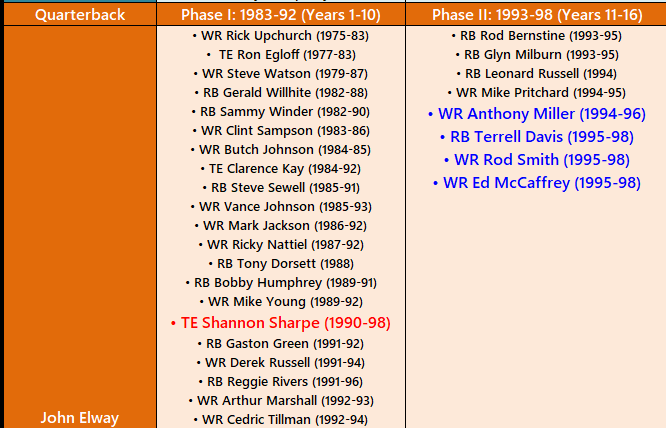
Phase I (1983-92): This one breaks down nicely as you have John Elway with Dan Reeves as his coach for 10 years, then you have those final six seasons without Reeves. The Broncos went through a ton of players in Elway’s early career, though they did keep a lot of them for many years too. But the most notable pickup in Phase I was HOF tight end Shannon Sharpe, a seventh-round pick in 1990 and the brother of HOFer Sterling Sharpe, who was already a star wideout in Green Bay.
Phase II (1993-98): By the time Mike Shanahan returned as Denver’s head coach, the Broncos brought in a complete lineup for Elway, including Anthony Miller, Rod Smith, and running back Terrell Davis to go with Sharpe. With his Phase II weapons doing the trick, Elway finally won two Super Bowls to end his career after getting blown out three times in the 1980s. He also had most of his best statistical seasons in Phase II.
Dan Marino
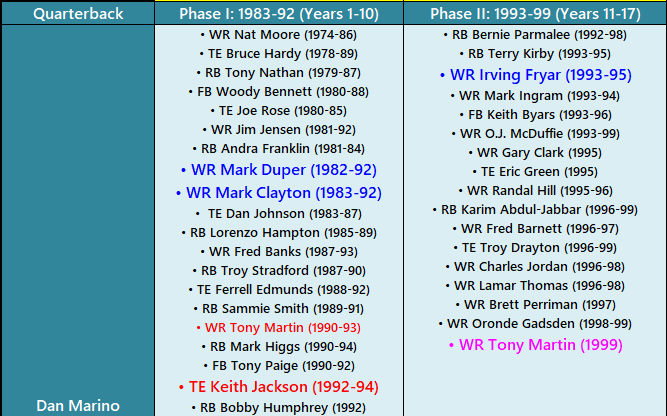
Phase I (1983-92): Another one that breaks down easily. For a decade, Marino had the Marks Brothers, Duper and Clayton, and those were his guys with limited size but great speed. He also had a veteran WR3 in Nat Moore for his first four seasons, including both years he threw over 40 touchdowns. Finding a good running back was a career struggle for Marino in Miami, and they really didn’t have a great tight end outside of veteran Keith Jackson for a few years there in the 90s.
Phase II (1993-99): After the Marks Brothers left following the 1993 season, the Dolphins had a hard time finding their replacements. Irving Fryar (1993-95) was the best choice, though Marino tore his Achilles in that 1993 season too, and 1994 was his last great statistical year. They brought Tony Martin back in Marino’s final year in 1999, but the quarterback was washed up by then, losing his final game 62-7. Still the best quarterback to never win a Super Bowl.
Brett Favre
Phase I (1992-98): The Mike Holmgren years saw Brett Favre win three straight MVP awards in 1995-97, and that was without Sterling Sharpe on those teams after his neck injury ended his career in 1994. But with Holmgren’s West Coast offense, this was Favre’s best group of weapons with players like Antonio Freeman, Robert Brooks, and running back Dorsey Levens.
Phase II (1999-04): After Holmgren left for Seattle, Favre did lose some control of his turnovers, but he also still had some Pro Bowl and playoff seasons after the team acquired Donald Driver (late-round gem) and got running back Ahman Green from the Seahawks. They also used a first-round pick on Javon Walker in 2002, and he looked very good before a season-ending injury in 2005. The Packers wouldn’t use another first-round pick on a pass catcher until Matthew Golden in 2025.
Phase III (2005-07): The writing was on the wall for Favre in Green Bay after the team used a first-round pick in 2005 on Aaron Rodgers. But he still hung around for three more years and the introduction of new coach Mike McCarthy. Things started rough with the Packers missing the playoffs in 2005-06, but Greg Jennings was a nice add to the team at wide receiver, and Favre reached the NFC Championship Game in 2007 before going to the Jets after his first retirement didn’t stick.
Peyton Manning
Phase I (1998-02): Manning joined an Indianapolis team that already had Marshall Faulk and a promising young wideout in Marvin Harrison in 1998. They ended up trading Faulk to the Rams and drafting Edgerrin James in 1999, but Manning, Edge, and Harrison would form the Triplets modeled after the Dallas approach with Troy Aikman, Michael Irvin, and Emmitt Smith. But the Colts lacked the defense, and Harrison would play poorly in the playoffs while Edge would look tired after taking on most of the carries in the regular season. so they needed to build the rest of the offense after Tony Dungy arrived in 2002.
Phase II (2003-10): With Reggie Wayne finally emerging in Year 3 (2003) as a viable WR2 behind Harrison after he caught 147 balls the year before, Manning had his best group of weapons yet and won his first MVP. The Colts drafted Dallas Clark that year to go with Marcus Pollard, and Edge looked better after tearing his ACL in 2001. Brandon Stokely was also of great help to Manning in the slot, and by 2004, they put it all together for a record-breaking season with 49 touchdown passes and three wideouts with over 1,000 yards and 10 touchdowns each.
After 2005, the Colts replaced Edge with rookie Joseph Addai and won the Super Bowl in 2006. They drafted Anthony Gonzalez in the first round in 2007 as an eventual replacement for the aging Harrison, but he was often injured too. After Harrison and Dungy retired after 2008, Manning won his fourth MVP in 2009 after leading the Colts to a 14-0 start with Wayne and Clark as the leading receivers, and he made great use of Austin Collie and Pierre Garcon on the way to the Super Bowl they wouldn’t win.
After an injury-plagued 2010 for the offense, Manning himself ended up missing all of 2011 with four neck surgeries, and the Colts released him since they knew they could draft phenom Andrew Luck with the No. 1 pick in the 2012 draft.
Tom Brady
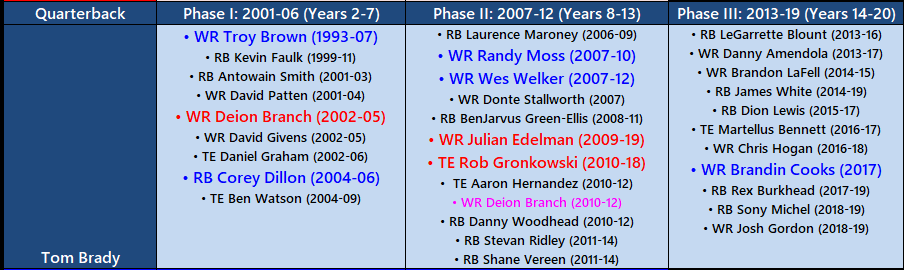
Phase I (2001-06): The pre-Spygate era Patriots were known for their dink-and-dunk passing attack, spreading defenses out in an era they just wanted to play base defense, and never knowing if it was going to be a big day for Troy Brown, Deion Branch, David Givens, or David Patten. They’d also work in defensive players on offense like Mike Vrabel at the goal line. But by 2004, they acquired Corey Dillon to spruce up the running game, and Brady threw more vertical passes in 2004-05 with Branch as his favorite receiver before they let him go to Seattle in 2006.
Phase II (2007-12): After being unhappy with the lack of weapons in 2006, the Patriots went all out in acquiring Randy Moss, Wes Welker, and Donte Stallworth in the same offseason. Brady threw 50 touchdowns, won his first MVP, and for the second time in his career, Moss helped a team set the scoring record in his first season with them. But they blew the perfect season in Super Bowl 42, and Brady tore his ACL in the first quarter of Week 1 in 2008.
While the Patriots still were successful in 2009, they weren’t nearly as scary as the first half of 2007, and early into the 2010 season, they showed they didn’t need Moss anymore and traded him. They went forward with two tight ends in Aaron Hernandez and Rob Gronkowski, who were both better than their draft position suggested. Brady won his second MVP and Welker developed into the most dominant slot receiver in the game. They also brought Branch back for chemistry in 2010-12.
Phase II (2013-19): But 2013 saw Welker, Branch, and Danny Woodhead leave. Hernandez was released for being a murderer, and the Patriots had to regroup with Gronk and using Julian Edelman as their new Welker, a role he was born to play. In this phase, the Patriots ended their 9-year title drought in 2014, but it was really Gronk and Edelman, Phase II pickups, who carried the way in Phase III, going to four more Super Bowls and winning three of them in 2014-18.
The best talent the Patriots added in this time was Brandin Cooks for the 2017 season, one that Edelman missed with a torn ACL. That was Brady’s third MVP season as Gronk was still playing at an elite level. But most of the additions for the Patriots in Phase III were really good receiving backs like James White and Dion Lewis after just having Woodhead and Shane Vereen.
Drew Brees
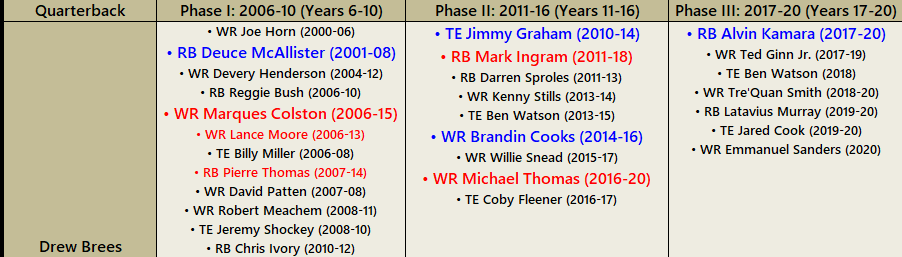
Phase I (2006-10): After his breakout in San Diego and 2005 injury, Drew Brees wound up with Sean Payton in New Orleans where he joined a team that just drafted Reggie Bush and a hidden gem in Marques Colston, the latter becoming his most trusted wideout in his first decade. Brees also had players like Lance Moore and Pierre Thomas around him when he won his only Super Bowl in 2009.
Phase II (2011-16): What really helped the Saints take off in 2011, arguably their most impressive offense ever, was the breakout of athletic tight end Jimmy Graham. They also got the perfect little receiving back for Brees in Darren Sproles that year. They’d later add Brandin Cooks as a speedy WR1 to replace an aging Colston, and Michael Thomas was a big draft pick for them in 2016 to set up the final phase of Brees’ career.
Phase III (2017-20): The Saints had a great 2017 draft that included running back Alvin Kamara, another dynamic receiver at the position. With Thomas leading the wideouts and Kamara in the backfield, the Saints had a nice group there while just adding veterans like Ben Watson, Ted Ginn Jr., and then Emmanuel Sanders for that final season in 2020.
Ben Roethlisberger
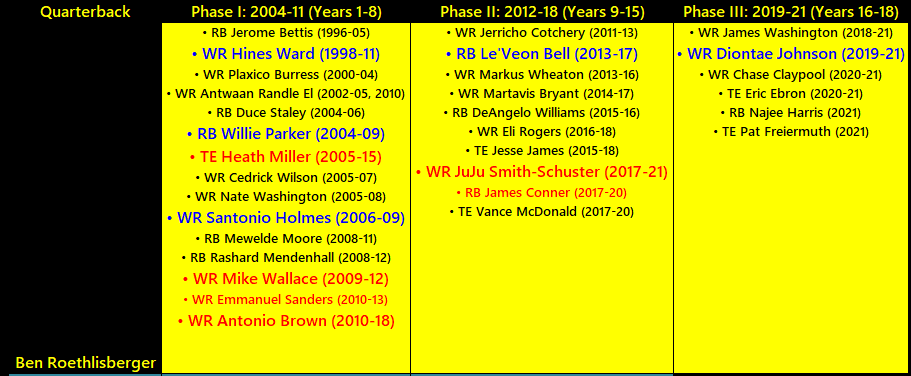
Phase I (2004-11): Ben Roethlisberger won his first 14 starts in Pittsburgh with a veteran group of weapons, including Jerome Bettis, Hines Ward, Plaxico Burress, and Antwaan Randle El on gadget plays. He got his most trustworthy tight end in Heath Miller in Year 2, which was a Super Bowl season. He got Santonio Holmes in the 2006 draft, and that was his go-to man on the game-winning drive in Super Bowl 43 for his second ring.
Phase II (2012-18): The next phase saw Big Ben getting rid of the ball faster after taking so many hits in a Bruce Arians-coached offense all those years. They had already put the pieces in place to replace the retiring Ward by adding Mike Wallace, Antonio Brown, and Emmanuel Sanders. But it was clear early that Brown was the best of that group, and they let Wallace go. They drafted Le’Veon Bell in 2013, and he was so fun to watch in 2014 before tearing his ACL in Week 17 made him a much more patient runner. But it gave Ben the first great receiving back of his career.
Martavis Bryant could have been another very talented piece to this offense if he wasn’t a nightmare off the field, but that would became the recurring theme with the “Killer B’s” era with Brown, Bell, Bryant, and Ben. Lots of missed games for various reasons, and they never got back to a Super Bowl before Brown basically forced the team to bench him for his final game in 2018 before letting him go.
Phase III (2019-21): The Steelers would go years before figuring out how to move on without Brown. Roethlisberger’s elbow surgery two games into 2019 didn’t help, though he played well with Diontae Johnson and Chase Claypool in 2020 when they started 11-0 before the collapse. By the time the Steelers drafted running back Najee Harris and tight end Pat Freiermuth in 2021, it was clear Roethlisberger was at the end of his career, and that proved to be his final season.
Roethlisberger remains the only 40,000-yard passer in NFL history who won a Super Bowl for the team that drafted him and played his entire career with them.
Aaron Rodgers
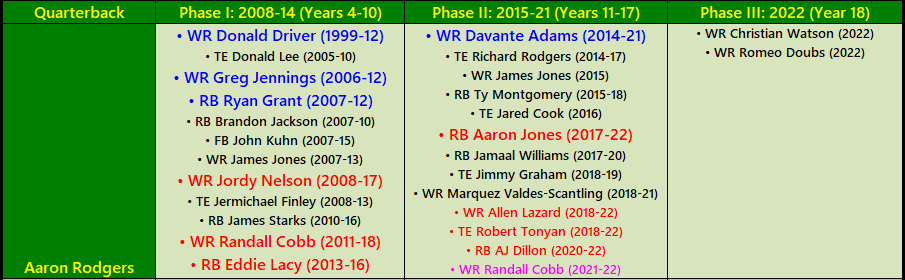
Phase I (2008-14): We covered Rodgers in the intro when he came in hot right away with his best weapons and the league’s best receiving corps with Donald Driver, Greg Jennings, Jordy Nelson, James Jones, and tight end Jermichael Finley. Ryan Grant and Eddie Lacy were two of his best running backs too, and they also drafted Randall Cobb in 2011.
Phase II (2015-21): There was that decline period starting in 2015 after Nelson tore his ACL in the preseason, and young Davante Adams wasn’t quite the great player he’d become later. But Adams’ development did help the Packers get back on track in 2016, and then adding Aaron Jones at running back was a good move in 2017. But it was really the arrival of coach Matt LaFleur in 2019 that eventually got Rodgers back to MVP form in 2020-21.
Phase III (2022): Things were clearly souring with the relationship between Rodgers and the Packers, and Adams left for the Raiders in 2022. But had he stayed on, he would have had Christian Watson and Romeo Doubs as his main weapons moving forward. We got a taste of that Watson connection in 2022.
Patrick Mahomes
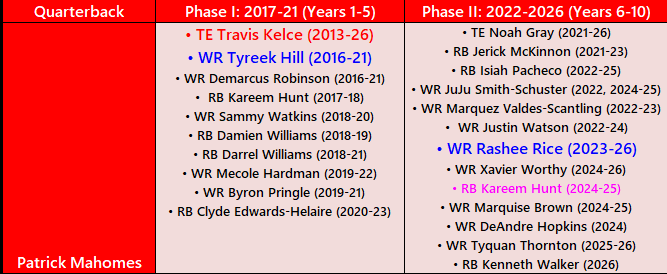
Phase I (2017-21): As we said above, Mahomes came out swinging with 50 touchdowns and 5,000 yards in 2018 to win MVP in an offense with Tyreek Hill, Travis Kelce, Kareem Hunt, and arguably his best WR2 ever in Sammy Watkins too. Don’t forget that one. Adding Mecole Hardman and Byron Pringle had marginal impact, and running back was always sketchy after releasing Hunt. Drafting CEH in the first round (2020) was especially a blunder.
Phase II (2022-26): I’ll hold off for now on declaring 2026 a Phase III start even though it feels like it can be. But after trading away Hill in 2022, the Chiefs have searched far and wide for wide receivers, missing often on players like Kadarius Toney, Skyy Moore, Marquise Brown, and DeAndre Hopkins developed the dropsies in 2024 for the Chiefs. Rashee Rice has those off-field issues and drops to correct, and Xavier Worthy looks like the reminder that you don’t draft the fast 40-time guy.
At least Mahomes could finally have his first 1,000-yard back of his career in Kenneth Walker (Super Bowl MVP) this season, but we’ll see if that works out because they have to actually evolve the offense first instead of relying on Mahomes to make chicken salad out of chicken shit.
What Will It Take for Mahomes to Get Phase III Weapons?
The reason I am hesitant to say 2026 is the official start of Phase III for Mahomes is that I truly believe Travis Kelce and Andy Reid have to retire for the Chiefs to get there. A true shift in philosophy and leadership, and probably in personnel beyond tight end and even the very core of how they scout wide receivers.
Because how do you get to a point with the best quarterback in football where you don’t know for sure who will be his tight end and No. 1 wide receiver next season? That’s like if Marvel was making a Phase III Thor sequel and they still hadn’t introduced his f’n hammer (Mjolnir) yet.
There should be more long-term viability around Mahomes than this. By this point in their careers:
- Montana had Jerry Rice and Roger Craig going full blast in San Francisco.
- Manning had Wayne and Clark to eventually replace the production of Harrison in Indy.
- Brady had Moss and Welker, and he was soon getting Gronk and another scheme change for New England to stay ahead of the curve.
- Roethlisberger had Antonio Brown and just got Le’Veon Bell in Pittsburgh.
- Brees just got Jimmy Graham, and his top four wide receivers were all 26-28 years old and knew their roles in New Orleans.
- Rodgers was enjoying Jordy Nelson and Randall Cobb with Davante Adams learning the ropes in Green Bay.
- At least Elway got Shannon Sharpe in Year 8 with Denver.
- Favre still had Antonio Freeman and Dorsey Levens, and Donald Driver proved to be a seventh-round steal in Green Bay.
- Marino was on his last year with the Marks Brothers, but at least Miami was going to get him proven veterans like Irving Fryar, Keith Jackson, and Keith Byars – two of them made the Pro Bowl in 1993 when Marino was injured.
By this point of his career, it is troubling that Mahomes is still relying on Mr. Taylor Swift as his only noteworthy tight end. The Chiefs had a few chances already to get his replacement in the draft (Sam LaPorta and Harold Fannin Jr. stand out) and didn’t do it.
With the rising cost of wide receivers, giving someone like Rashee Rice over $30M per season sounds absolutely absurd and like setting money on fire. This is his contract year too, so they’ll have to decide something soon. Also, I’ve always been on record saying they should have drafted Ladd McConkey instead of Worthy.
Maybe the Chiefs get lucky with 2026 fifth-round pick Cyrus Allen despite the odds not being in their favor of him turning into a star. He averaged 50.5 receiving yards per game at three different colleges. That would also require playing their fifth-round rookie real snaps, which they’re reluctant to do as they already dialed back Tyquan Thornton’s snaps last year when Worthy and Rice returned despite him outplaying both and being a much better target for Mahomes in 2025.
But finding those next weapons may also not be the job for current GM Brett Veach, who has had the role since July 2017, meaning he wasn’t the one who actually pulled the trigger on the picks of Kelce, Tyreek Hill, Chris Jones, or the trade-up for Mahomes. That was John Dorsey.
Veach may need to go too because he has been up Andy Reid’s ass since 2004, dating back to the Eagles where he was on the staff before moving into a personnel role and eventually GM of the Chiefs.
If you’re wondering why the Chiefs have that weird wide receiver speed fetish/blind spot, don’t forget the same thing plagued Reid in Philadelphia where he basically needed Terrell Owens to save him in 2004 and got one great pick out of DeSean Jackson. Sound familiar? One great pick of Tyreek Hill, and the Chiefs have been chasing that high ever since, opting for short and speedy players over precise route runners, physical freaks with large catch radiuses, and basically ignoring what is working for so many other offenses in today’s NFL who have players who can beat man coverage quickly and get open without the quarterback extending the play.
But the Chiefs? Apparently they have no need or desire for a DK Metcalf or George Pickens or Tee Higgins type of receiver. Maybe they’ll sign JuJu Smith-Schuster for a third time after he bombed before the second preseason game and was cut by the Giants already.
The longer this lasts, the more likely Mahomes finishes his career with another NFL team. If you’ve watched sports for a minute, you know there’s not a single athlete in the world who is above switching teams. Michael Jordan, Wayne Gretzky, Babe Ruth, Tom Brady, Jerry Rice, Joe Montana – they all did it.
At some point, you get fed up with no 1,000-yard rushers in eight years, five Super Bowls with five different left tackles, eight left tackles since the last Super Bowl win, no 1,000-yard wide receiver since the Hill trade, and all the drama that Rice brings to the table.
At some point, you have to stabilize things around your quarterback to make him still want to be there year after year. Right now, the Chiefs are walking a dangerous path by failing to prove they can build a winner around Mahomes without relying on the pieces that were already in place when he arrived.
This was all about the weapons. We didn’t even talk about the way the pass rush looks outside of Chris Jones, who is 32 years old now. That’s another sign that the GM should probably go when Reid calls it a career.
If you’re hoping for the best from Mahomes in his 30s, you should probably root for Phase III to start as soon as possible. The fact they came one game away from a three-peat during Phase II is remarkable enough, but you can’t stay on this path and expect any more success to come out of it.
The league has caught up and moved on. When will the Chiefs?