NFL Week 3 Predictions and Writing Recap

After being fooled by the Thursday night home-field advantage, I’m now 0-3 at picking games with the Carolina Panthers this season. That’s what I get for trusting a team that has not yet arrived with a quarterback I pegged as the most overrated in the league heading into the season. Won’t make that mistake next week, but let’s worry about this weekend first.

This Week’s Articles

Breaking Down the Pivotal Moments of NFL Week 2 – Bleacher Report

A loaded recap of the Giants’ big comeback, the comedy of errors in Arizona/New England, C.J. Spiller’s big average, Rex Ryan’s foot fetish, and whether or not the 2012 Philadelphia Eagles are the worst 2-0 team in NFL history.

Captain Comeback Week 2: No. 1 QB’s to the Rescue – Cold, Hard Football Facts

We only had six games with a fourth quarter comeback opportunity this week, but still some great finishes. Eli Manning did it again for New York, the Eagles came through the second week in a row, Andrew Luck’s first game-winning drive, and a rare St. Louis comeback win. Also the Patriots missed a clutch field goal and lost because of it for the first time since December 26, 1999. Is Stephen Gostkowski a huge choker compared to Adam Vinatieri? All the details included.

Can’t Laugh at NFC West Now – NBC Sports

After just their second ever Sunday of going 4-0 as a division, the NFC West looks much improved this season. Find out how they’ve done and it whether or not the four teams can sustain success this season.

Following a Legend: Andrew Luck Week 2 vs. Minnesota Vikings – Colts Authority

Andrew Luck had a much better performance this week, leading his first game-winning drive in the Colts’ 23-20 victory over Minnesota. Found out what was different for Luck this week versus last with a full breakdown of every drop back.

The Thinking Man’s Guide to NFL Week 3 – Bleacher Report

Previewing Giants/Panthers, Texans/Broncos, Patriots/Ravens, Steelers/Raiders and Packers/Seahawks.

Those 2-0 Teams Couldn’t Be More Different – NBC Sports

The Cardinals are tied for a league-best 9-2 record in their last 11 games, while the Eagles have the longest active winning streak (6). Yet, why does this 2-0 battle look so weak on paper? Find out how fortunate the 2-0 starts have been for each team, plus a statistical analysis that shows it does matter how you play on your way to a 2-0 start. I really enjoyed writing this one, as some of the data provided unexpected results.

Thursday Night Lights: Giants Blast Panthers in Historic Rout – Cold, Hard Football Facts

The Giants’ 36-7 win in Carolina on Thursday night is the 6th highest by a road team in any Thursday game since the 1970 merger. Find out if the Thursday home advantage is real or has just been a matter of favorable scheduling on the NFL Network.

2012 NFL Week 3 Predictions

Need to trust my gut more. The Week 1 team I was all in for except making the pick was Tampa Bay, and last week was Seattle, as I explained in this exact spot. This week I am going to make that team San Diego, as I think they will beat Atlanta at home and finally earn some respect this season as a contender in the AFC.

Winners in bold:

  • Rams at Bears
  • Bills at Browns
  • Buccaneers at Cowboys
  • Jaguars at Colts
  • Jets at Dolphins
  • 49ers at Vikings
  • Chiefs at Saints
  • Lions at Titans
  • Bengals at Redskins
  • Eagles at Cardinals
  • Falcons at Chargers
  • Texans at Broncos
  • Steelers at Raiders
  • Patriots at Ravens
  • Packers at Seahawks

Season results:

  • Week 1: 12-4
  • Week 2: 11-5

NFL Week 2 Predictions and Writing Recap

Pretty good start to the NFL season. On Thursday I was introduced on Wisconsin radio as someone “who really hates the Packers.” Not true, but good times.

This Week’s Articles

Peyton Manning Ties Dan Marino for Fourth Quarter Comeback Record – Cold, Hard Football Facts

Started the week off in historic fashion with Manning finally tying Dan Marino with his 36th fourth quarter coemback win.

Breaking Down the Pivotal Moments of NFL Week 1 – Bleacher Report

New column to review the weekend’s most interesting action. Putting things into context.

Captain Comeback Week 1: Broncos Skewer Dick LeBeau’s Defense Again – Cold, Hard Football Facts

This season’s first real edition of Captain Comeback where I review this week’s close games. Included: Manning’s record, ugly wins for Stafford/Vick, a historic finish in Minnesota, and those front-running Green Bay Packers.

NFL Week 1 Scoring Record Belies Offensive Issues – NBC Sports

While there may have been a Week 1 record of 791 points scored, there was still plenty of bad offense and ugly special teams play in these games. Quite a few quarterbacks threw pick parades, and the return of defense looks well intact. See Thursday night in Green Bay for more proof this year is going to be different.

Following a Legend: Andrew Luck Week 1 at Chicago Bears – Colts Authority

This is an article I had planned to do months before Luck was even drafted by the Colts. Every Wednesday I am going to have the breakdown of his game in ways that I don’t think anyone has ever done before, or at least not all in one place and free to the public. Metrics for how long Luck held the ball, incomplete pass splits, YAC stats, number of pass rushers faced, use of play-action passing, etc.

The Thinking Man’s Guide to NFL Week 2 – Bleacher Report

This week’s preview includes a look at domination by home teams on Thursday night, what 0-2 really means for your playoff chances, an update on the five rookie quarterbacks, and statement games in prime time for Detroit and Atlanta.

Carson Palmer Leads NFL in Failed Completions – Cold, Hard Football Facts

Who was this week’s Captain Checkdown? Carson Palmer of course. He had 13 failed completions. Learn about this statistical concept of measuring passing success for all 32 teams.

2012 NFL Week 2 Predictions

Last week I had a great start with a 12-4 record. I should have picked Tampa Bay too, but their December blowout losses to Carolina scared me away. Off to a 1-0 start this week after rolling with the Packers. Thanks, Jay.

Winners in bold:

  • Chiefs at Bills
  • Saints at Panthers
  • Browns at Bengals
  • Vikings at Colts
  • Texans at Jaguars
  • Raiders at Dolphins
  • Cardinals at Patriots
  • Buccaneers at Giants
  • Ravens at Eagles
  • Cowboys at Seahawks
  • Redskins at Rams
  • Jets at Steelers
  • Titans at Chargers
  • Lions at 49ers
  • Broncos at Falcons

I am very tempted to take Seattle, but I just can’t do it yet. Want to see Russell Wilson with a capable NFL performance first. I think Andrew Luck gets his first win after playing Minnesota’s bad defense at home this week. The Patriots are as much as a lock as you can get this week. The Lions have lost 8 straight to San Francisco, and they have no wins against a winning team under Schwartz/Stafford (0-12). Finally, I rarely ever pick against Peyton Manning, but I just have a feeling this is Atlanta’s big moment in the dome on Monday night. It is very important for their development to win a game like this. I can see a 31-28 finish after playing more keepaway from Peyton. That Denver defense is not Super Bowl-caliber yet.

NFL Week 1 Predictions and Writing Recap

Near the end of each week I will be posting my NFL game picks and summarizing the week’s articles. It’s simply a way to show a track record of how I wind up just picking the winners in the 60-65% range.

This Week’s Articles

San Francisco 49ers Destined For Big Fall – Cold, Hard Football Facts

Review the unique factors that led to a 13-3 season and near Super Bowl appearance for Jim Harbaugh’s team, and why they will unlikely repeat themselves in 2012.

Andrew Luck: What Have We Learned About Colts’ QB Entering the 2012 Season? – Bleacher Report

My review of what I saw from Indianapolis’ Andrew Luck. Hint: it was very impressive.

Career Records in the Clutch for Active QBs – Cold, Hard Football Facts

You’ve been asking for 37 months, and finally I deliver a table of 41 active quarterbacks with their career records in 4th quarter and OT comeback/game-winning drive opportunities.

NFL offenses won’t feature same fireworks as 2011 – NBC Sports

Believe in 6,000-yard passers? Not so fast. Read about the unique factors that went into making 2011 such an explosive passing season, and why defenses should be a bit more resistant in 2012.

The Thinking Man’s Guide to NFL Week 1 – Bleacher Report

This is a new column I will be doing every Thursday where I preview the upcoming week’s most interesting stats, records, facts, and provide the in-depth analysis & context behind the numbers. Any topic is on the table, and this week was a look at some major QB records that could be broken on Sunday, the expectations for Luck’s debut, New England’s opening-day winning streak, and whether or not the Cincinnati Bengals can step up against the better competition in 2012.

Is Peyton the Greatest Comeback QB Ever? – NBC Sports

Taking the comeback crusade big time on NBC Sports. Peyton Manning’s next comeback could be extra historic as a 4th quarter comeback over Pittsburgh would tie him with Dan Marino for the all-time record.

Captain Comeback: Tony Romo And The NFL’s Four-Minute Offense – Cold, Hard Football Facts

Ever wonder about the NFL’s four-minute offense? I break down the 2011 season to see the results, and they are full of rushes, and offenses relying on their defense and clock to win the game. That’s why Tony Romo’s game-ending dagger on third down to put away the Giants on Wednesday night was so rare and crucial.

2012 NFL Week 1 Predictions

I start off 0-1 after going with the Giants, but at least my prediction of Dallas winning the Super Bowl is off to a good start.

Winners in bold:

  • Colts at Bears
  • Eagles at Browns
  • Rams at Lions
  • Dolphins at Texans
  • Falcons at Chiefs
  • Jaguars at Vikings
  • Redskins at Saints
  • Bills at Jets
  • Patriots at Titans
  • Seahawks at Cardinals
  • 49ers at Packers
  • Panthers at Buccaneers
  • Steelers at Broncos
  • Bengals at Ravens
  • Chargers at Raiders

I will bust out a Christopher Walken-like dance from King of New York if Al Michaels drops the line “You know Cris, John Elway never actually had 47 fourth quarter comebacks in his career” on Sunday night.

2012 NFL Predictions

Even if I’m writing for four websites this season, that doesn’t mean any of them care about my personal predictions for the 2012 NFL season. That is fine, and that is why this blog exists.

The week-by-week win-loss prediction is probably the smartest way to go about it, but I am not interested in predicting records as much as I am predicting the general level of success or failure the 32 teams will have this season.

AFC East

1. New England Patriots – The 16-0 talk is nonsense, because this team is not good enough to compensate for an off day by their offense or defense, but with a ridiculously easy schedule, you can put 12 wins in the bank. This is one of the worst divisions in the league, and the Patriots should have no problem running away with it.

2. Buffalo Bills – Feel like darkhorse (very dark) Wild Card team, but I do not have confidence in Ryan Fitzpatrick playing consistently enough. Seven years in the league and we’ve never seen it, no reason he would start now. At least the schedule is favorable, and the defense should be improved.

3. New York Jets – The weekly circus, I find it hard to believe Mark Sanchez makes it through the entire season as the starter. One benching and one Tim Tebow miracle later, and it is game over for Sanchez in New York. The defense should be better than last year, but this weapons-lacking offense looks to have taken a step back.

4. Miami Dolphins – I will have spent more time watching Hard Knocks than probably watching the Dolphins play this year. Shaping up to be a brutal season. Reggie Bush will get some yards, Cameron Wake will get some sacks, but there’s not much else to see here. This has to be the worst set of receivers any team has had in recent years.

AFC North

1. Baltimore Ravens – I’m actually a bit down on this division this year, and that goes for all four teams. They had three playoff teams last year, but that will not happen again when they are playing the NFC East and AFC West. The Ravens have had their share of losses player-wise, Terrell Suggs’ injury is as big as any team’s biggest injury this year, though somehow I think Joe Flacco has a career year and offsets any possible regression on defense.

2. Pittsburgh Steelers – Not feeling great about the hometown team this season. The “upgraded” offensive line has quickly been reduced to the same subpar group because of injuries and Mike Adams being the disappointing risk everyone knew he might be on draft day. Mike Wallace is back, but how many weeks until he is back at 100 percent in this to-be-determined Todd Haley offense? Love what Antonio Brown brings, but this offense needs the big plays from Wallace. The defense is about what you should always expect: very good against the run, and a real question mark when they play the better passing offenses and quarterbacks. Just have a feeling this could be one of those 8-9 win seasons that’s not good enough for the playoffs.

3. Cincinnati Bengals – If Andy Dalton and A.J. Green are the next great QB/WR combo, then this team has a shot to have consecutive winning seasons, which is something Marvin Lewis has never done as coach. I think they win 7-9 games and miss the playoffs. I like some of their defensive pieces, but I don’t have full faith in Dalton taking it up to a higher level than last year, and I also don’t like their wide receivers after Green. Do like Green-Ellis over the departed Cedric Benson though.

4. Cleveland Browns – Different year, same old shi+.

AFC South

1. Houston Texans – This is their window of opportunity as they have the best team in the division, and one of the best in the conference. Matt Schaub’s return should spark the offense more, though even if he goes down again (real possibility), T.J. Yates gained some great experience last season and can keep things going. Love the combo of Arian Foster and Andre Johnson as their main weapons. Not sure the defense can improve or be just as good as last year, but the specific loss of Mario Williams is overblown. They still have guys that can get to the quarterback, and Wade is a better coordinator than he is a coach.

2. Tennessee Titans – I still can’t figure this team out from last year. They did some things really well, and some things really bad, hence 9-7 and such an enigma. Now they go with Jake Locker at quarterback, and I am very interested to see how he does after a few good showings in limited action last season. He probably won’t complete 60% of his passes, but he might have a high yards per completion average and can run very well.

3. Indianapolis Colts – All in on Andrew Luck, and what once looked like a 4-win season actually could turn into about 7 wins if he plays as well as he seems capable. The receiving corps is much better than given credit for, and Luck will make them better with his accuracy. It was hard to watch the Colts last year, but this season will be very entertaining.

4. Jacksonville Jaguars – Maurice Jones-Drew is the best player on the team, but because he is a running back, he actually is one of the easiest to replace. He’s back from his holdout, and while I’m sure he will put up some numbers by season’s end, everything hinges on Blaine Gabbert improving and using rookie Justin Blackmon to great effect. I’m not sold on that, and I didn’t like the hiring of Mike Mularkey either.

AFC West

1. Denver Broncos – It’s Peyton Manning, so unless the Broncos’ defense allows the most points in the league, that should mean an automatic 10 wins and the playoffs, just like 11 of Manning’s 13 seasons in Indianapolis. He may not be the same exact guy he was in 2010, but he’s still an all-time great. The schedule is tough, but that’s still true for the rest of the division too.

2. San Diego Chargers – Guess it hasn’t been applicable to call San Diego “the most talented team” for a few years now, and things have certainly changed from their past playoff appearances. Names like Tomlinson, Merriman, Williams, Jackson and McNeil are all gone. Philip Rivers should bounce back after a career-worst season last year, but I don’t think San Diego gained enough ground to get back into the playoff bracket.

3. Kansas City Chiefs – I want to say Romeo Crennel will figure it out with what should be his most talented team as a head coach, but I don’t see  a winning record for the Chiefs this year. Matt Cassel only excels when he gets to play a lot of really bad defenses (2008, 2010). He will be better this season with the return of Jamaal Charles and Tony Moeaki, but he is much more of a stopgap QB than a franchise player. Defense will have to carry the team, but the offense will let them down enough to miss the playoffs.

4. Oakland Raiders – “If Darren McFadden stays healthy” he will rush for a bunch of yards, and none of it will really matter as long as Carson Palmer is throwing bi-monthly pick parades. I think the AFC West is a bit loaded with quarterbacks vying for the role of Hollow Man: putting up a lot of empty stats. Palmer has essentially been doing that almost every year since 2006. I also think the defense will be one of the worst in the league, and with so many good offenses in the schedule, they will be torched quite a bit this season.

NFC East

1. New York Giants – They didn’t even win 10 games last year, but it was enough for the division and a Super Bowl run. I expect the Giants to be a better regular season team this year, though don’t count on them to win the close games the way they did last year. Think of it like 2008 when they got better as a team after winning the Super Bowl. Just keep Hakeem Nicks and Victor Cruz away from guns and nightclubs.

2. Dallas Cowboys – They have a lot of injuries to deal with at the start of the season, but so did the Giants last year. Key thing is they are getting through it now, and as long as they can start off respectable in the win column, they will be a Wild Card team by season’s end. I’ll trust Tony Romo over Michael Vick any day.

3. Philadelphia Eagles – If Andy Reid goes 8-8, he gets fired right? Tough pressure on a guy going through hell, but it has been a long, ring-less tenure in Philadelphia for Reid. Unfortunately he is tied down to one of the league’s least dependable quarterbacks, and it has been years since the defense carried the team. The Eagles should win at least 8 games again, but they’re going to miss the playoffs.

4. Washington Redskins – The Redskins finally have a quarterback to be excited about again. But they are at least a year away from doing any real damage in the NFC. RG III will finish as the runner-up to Luck in the Offensive Rookie of the Year voting.

NFC North

1. Green Bay Packers – Things won’t be as smooth as last season, but the Packers should cruise to another 12+ wins and tons of touchdowns on the board. The defense will give up fewer yards, but lowering the points will be the real goal. They cannot keep relying on takeaways.

2. Chicago Bears – Expecting a career-year for Jay Cutler. This should be the best offense he’s been apart of, and the defense is still one of the better groups in the league.

3. Detroit Lions – Nice story last season, but I think Detroit comes up short in their bid to repeat as a Wild Card team. They are not as balanced or deep as Green Bay and Chicago, and it’s always difficult to make the playoffs when you’re the 3rd best in your division. They probably never make it last year if not for Cutler’s injury.

4. Minnesota Vikings – Don’t ruin Adrian Peterson for your next head coach by rushing him back too soon, Minnesota. You’re not going anywhere this year.

NFC South

1. Atlanta Falcons – This is always a strange division to predict with the worst-to-first changes, but I’ll take the Falcons because of their consistency at the top, and I like what a second-year Julio Jones can bring to the offense. Matt Ryan is another QB I see a career season coming from. It’s about time for the Falcons to win a playoff game.

2. New Orleans Saints – If Drew Brees has a very good season again, expect him to win his first MVP award with the “no head coach” argument being his biggest reason. While it seems like Sean Payton is the mastermind of this offense, for Brees to keep things rolling (with a so-so defense too) without him this year would be a very impressive performance. But if you’ll recall those slip-up games last year against Tampa Bay and St. Louis, I expect at least two more of those this season, which is how Atlanta will end up with the division.

3. Carolina Panthers – Maybe this is a good time for Carolina to rise up and sneak into the playoffs, but I still think they’re another year away. The defense will be better with the healthy/improved LB corps, but they’re still not a great unit. Cam Newton won’t slump hard, but I don’t expect him to do as much as he did last year.

4. Tampa Bay Buccaneers – Josh Freeman bounces back with an improved offense and new head coach Greg Schiano, but it’s not enough in what might be the NFL’s deepest division.

NFC West

1. San Francisco 49ers – Already wrote all about the 49ers this week. They’ll win 9-10 games, enough for the NFC West, but it won’t be like last season.

2. Seattle Seahawks – I like what Russell Wilson was showing this preseason, but he in large part was not doing it against starters. It will look much different in the real games, and I don’t think he’s your next Dan Marino/Ben Roethlisberger (rookie QB God). Still, really like the young defense, and a motivated Marshawn Lynch runs well.

3. St. Louis Rams – I actually think Jeff Fisher will find 6-7 wins out of this team. Sam Bradford really needs to start playing better, or else the Rams will have to start looking ahead at the QB position. Just 6 touchdown passes in 10 games does not get it done when you have these other teams throwing 40-50 TDs last season. The defense also has huge strides to take.

4. Arizona Cardinals – Here’s a good candidate for your No. 1 pick in the draft. I cannot imagine how the Cardinals do any better than 4-12 this season. John Skelton is not the messiah, and his close-game success is not going to repeat itself.

Playoffs

AFC

  1. New England
  2. Houston
  3. Baltimore
  4. Denver
  5. Pittsburgh
  6. Buffalo

NFC

  1. Green Bay
  2. Atlanta
  3. NY Giants
  4. San Francisco
  5. New Orleans
  6. Dallas

Super Bowl: Dallas over Baltimore

I only picked two new playoff teams, so you know this won’t happen. What else can one do? San Diego for Pittsburgh? Chicago for New Orleans? Seattle for San Francisco?

And did I really just pick Dallas to beat Baltimore? Yes, because it’s about time the AFC has something not named New England, Pittsburgh or Peyton in there, and the Ravens were a play away last season. As for Dallas, the NFC is often so random, and I just think they’ll take a 2011 Giants-esque approach to the big game.

It’s a better pick than the boring people who have gone with “Green Bay vs. New England” the last three years. I tried to find teams that will overcome some adversity and peak at the right time, because that’s the way it has mostly been done since the 2005 season.

Yet when I look over my picks, I realized I left Chicago out of the playoffs, even though I wanted to put them in. Yet, if I put them in, it means no New Orleans or Dallas, which would really throw off my picks for MVP (Brees) and the Super Bowl.

So in conclusion, let’s just enjoy that the season is beginning, and forget about the half-assed predictions we are throwing out there right now. The only certainty is that you can expect a good share of the unexpected to happen.

The Whistleblower No. 3 – Heath Evans and Simple New York Jets’ Math

Looks like The Whistleblower has the first repeat offender after Heath Evans’ latest comments on Monday’s NFL Total Access about the New York Jets’ QB situation.

After three preseason games without a single touchdown, Evans believes the Jets have the wrong QB in Mark Sanchez, and should “salvage the season, which has yet to actually start, by going with Tim Tebow.

According to Evans, “past says Tim Tebow can win football games, the past says Mark Sanchez can not.”

Whoa, Nelly! Time for a simple bit of math here. Forget the fact that Tebow’s lone playoff win, a Wild Card game over a banged up Pittsburgh team, is not better than the two AFC Championship appearances Sanchez has had. Just the regular season alone proves this to be a factually incorrect statement.

Simple math: The past says Mark Sanchez is 31-22 (.585) as a starter, while Tim Tebow is 9-7 (.563).

I know things work in reverse in the Heath Evans’ zone, such as running back carries leading to wins instead of winning leading to carries, but 58.5 percent beats 56.3 percent. At the very least, they have about the same record of winning, and both often need a lot of help to get many of their wins.

The New York Jets may very well be screwed on offense this year, but there is no secret winner on the bench ready to save the day. They need to start with the guy that at least completes over 55 percent of his passes.

After apparently having someone do the stat work for him, Heath just glossed over the actual records, and must have forgot about 2009 and 2010 for Sanchez.

Next time Heath Evans asks someone to do stat work, he can always contact The Whistleblower. I’ll save him the embarrassment of spraying “winner juice” on live TV for the wrong player.

Shout out to @SeanLDurham on Twitter for pointing out the video and comments.

Addendum: as another pet peeve, Evans mentions “QB rating” in the segment. No, not even “quarterback rating.” He said “Q-B.” It’s just passer rating, people. Why is that so hard to understand?

NFL Week in Review: Andrew Luck Live, Matt Ryan on FOX, and 5th-Year Breakout QBs

A goose, a moose, and the son of Marv Albert walk into a bar…

Watching a live NFL broadcast is good for the creative mind. You can pick up plenty of ammo for The Whistleblower, and every once in a while you might learn something of value.

I watched the Cincinnati Bengals at Atlanta Falcons preseason game on Thursday night, or at least as much as I could stomach, and I found multiple things worth looking into.

First, the FOX broadcast team of Kenny Albert, Daryl Johnston and Tony Siragusa seemed pretty supportive of Atlanta’s Matt Ryan. There was not much talk about the playoff struggles, but instead they went optimistic for Ryan to really get things going in his fifth season.

In fact, even after one nice play by Ryan in the game the crew said something to the effect of “maybe the 5th year really is the breakout year for a young quarterback!”

Now they were not being scientific of course, and neither am I today. But I decided to dig a little into quarterbacks, with the help of Pro Football Reference’s Play Index, and see if there was any proof for the 5th season being the breakout season.

This would be defined as the QB having his best season in his fifth year, and ignoring any season that came afterwards for the purposes of this study.

The results were surprising, as I actually did find several high-profile cases of a QB having a career-year in season 5. Certainly enough to actually warrant the claims the FOX crew threw out there.

Note: When I say career-high here, I am only looking at the first five seasons unless noted otherwise.

5th-Year Breakout QBs

  • Sid Luckman (1943) – This one is influenced by WWII, but 1943 was the year Luckman threw 28 TD and had a ridiculous 107.5 passer rating.
  • Sonny Jurgensen (1961) – after riding the bench for four years in Philadelphia, Jurgensen got his shot in 1961 and threw for a then NFL record 3,723 yards and 32 TD.
  • Daryle Lamonica (1967) – After four backup years in Buffalo in which he was also a punter, Lamonica exploded with the Raiders, throwing 30 touchdowns and leading the team to Super Bowl II.
  • Bob Griese (1971) – Had a career-high 90.9 passer rating while throwing 19 TD to only a career-low 9 INT.
  • Ken Stabler (1974) – Threw 26 TD  and won the only AP NFL MVP award of his career.
  • Ken Anderson (1975) – Though 1974 was incredible too, Anderson made his first Pro Bowl and a 10-win season in 1975, while throwing for a      career-high 3,169 yards and 21 TD.
  • Danny White (1980) – Backup to Roger Staubach no more, White threw 30 TD and led Dallas to a 12-4 record and the most points scored in the league.
  • Joe Montana (1983) – One could argue 1981, the first Super Bowl win, was a better year, but in 1983, Montana had a career-high in yards (3,910), TD (26), and passer rating (94.6).
  • Dave Krieg (1984) – though he was more efficient in 1983, he only played half the season. In 1984, Krieg threw 32 TD and led Seattle to a 12-4 record.
  • John Elway (1987) – His lone MVP  award of his career came in 1987, which was the best season Elway had in his first 10 seasons actually.
  • Boomer Esiason (1988) – Won league  MVP and led the highest-scoring offense in the league to the Super Bowl in the best year of his entire career.
  • Chris Miller (1991) – Here’s a former Falcon. 13th overall pick in 1987, Miller had his lone Pro Bowl      season in 1991 when he threw 26 TD and led Atlanta to the second round of the playoffs.
  • Brett Favre (1995) – had a career-high in yards, TD and passer rating. Favre won his first MVP award.
  • Scott Mitchell (1995) – Yep, the one-year wonder came alive in 1995 with 4,338 yards and 32 TD for the Detroit Lions.
  • Matt Hasselbeck (2003) – Threw a career-high 26 TD while leading Seattle to 10-6 and the playoffs. He wanted to score too much that year.
  • Tom Brady (2004) – Brady had his best statistical season in year 5 as he led the Patriots to a third Super Bowl in four seasons. It was the first time he had a passer rating over 90.0 in a season, and this was easily the most dominant NE team to win a Super Bowl.
  • Tony Romo (2007) – In his second year as a starter, Romo led Dallas to a 13-3 record, threw for 4,211 yards, 36 TD and had a 97.4 passer      rating.
  • Philip Rivers (2008) – forget the  8-8 record, Rivers was on fire that year with 34 TD and a league-best 105.5 passer rating.
  • Eli Manning (2008) – After the  Super Bowl win, Manning had the best regular season of his career in 2008, leading the Giants to a 12-4 record and setting career highs in comp.  percentage, YPA and passer rating.
  • Aaron Rodgers (2009) – In just his second year as a starter, Rodgers threw 30 TD to only 7 INT, and had a 103.2 passer rating.

I could go on, but 20 rather high-profile cases is good enough to get the point across. Year five has been a breakout year for many of the all-time greats.

But what about the math check? We are talking about five seasons, so there is a 20 percent chance a QB will have his career/breakout year in the fifth year.

Even more inflating is the fact that most of these quarterbacks are not like Matt Ryan: starters from day one. Only Griese and Elway were five-year primary starters. When you sit on the bench for multiple seasons like Rivers or Rodgers, then it is even more likely your 5th season will be your best. Rodgers had a 50 percent chance, because all you could really compare are 2008 and 2009.

Notice players that started as rookies like Peyton Manning, Dan Marino, Ben Roethlisberger and Johnny Unitas did not make the list. That’s not to say they were not any good in year five, but it was not their best effort.

Matt Ryan’s best season was 2010. Maybe he will surpass it this year, but it is far from being a lock.

Great QB-Head Coach Pairings

Matt Ryan entering his fifth season also means Mike Smith is entering his fifth season as head coach of the Falcons. They came in together, and as I wrote at Bleacher Report last week, that is one of the great ways to turn a team around.

I looked at 80 cases in the Super Bowl era (but not every single case) of a team getting a new head coach and quarterback in the same year. Nine have been extremely successful (the elites), 20 had moderate success (Ryan/Smith fit in here), 12 were average/one-year wonders, and 34 were complete and utter failures together. That leaves five active/unknowns.

That includes 2012 rookies Chuck Pagano/Andrew Luck in Indianapolis, and Joe Philbin/Ryan Tannehill in Miami. They are the 31st and 32nd examples of a team hiring a rookie head coach and drafting a first-round QB in the same year since 1966.

FOX Gave Me a Concussion

The worst thing from the NFL on FOX, besides Laura Okmin’s interviews in Baltimore on Friday, was the semi-brutal discussion in Atlanta about the new kickoff rule helping to bring concussions down 43 percent on kickoffs. The crew boasted about how great that was, but they were misleading people by only looking at that one number.

As I wrote last week with data from Edgeworth Economics, concussions may have went down 43 percent on kickoffs, but it is because the number of kicks actually returned went down to 53.5 percent. In previous seasons, returnable kicks were in the lower 80’s in percentage.

Kickoffs are not safer. They just are less frequent. Going from 35 to 20 concussions on kickoffs sounds nice, but not so much when the overall concussion number only goes from 270 down to 266. That means concussions on other types of plays increased in 2011.

Also, we are talking about a one-year sample size, which was unusual because of the lockout. Let’s see what happens with the injury data this year before declaring the kickoff rule change a success.

Maybe we need five years of data for it to be clear. Just throwing it out there, much like Fox did in their effort to talk up Matt Ryan during a meaningless preseason game.

At least they were not blatantly wrong…this time.

Andrew Luck…Live and In Person

Finally, I went to the Colts/Steelers game last night, which means I did not get to hear any of Al Michaels and Cris Collinsworth. They are not a duo I have a beef with, and you kind of miss hearing some type of analysis offered other than the loudest people sitting in your section.

With the stadium Wi-Fi almost nonexistent and a lack of stats on the scoreboard, I was pretty much forced to use the eyeball test to follow the game. This is exactly why I never go to regular season Sunday games (I have actually never been to a regular season or playoff game period), because I cannot be away from all the action going on around the league. I need details.

Not to mention I still favor my couch and computer chair. Even if the seat was pretty damn nice.

Ben Roethlisberger threw maybe the worst interception I have ever seen him throw, and I have seen them all. The Steelers showed very little on offense outside of Antonio Brown’s incredible run-after-catch on the touchdown. I have not seen a Pittsburgh WR do that since Santonio Holmes did it to the Baltimore Ravens in the 2008 AFC Championship.

I don’t know if Antonio Brown can replace Mike Wallace, but he has been a great replacement for Holmes.

Just before the game I learned via Twitter the NFL Network showed my tweet about predicting a 9/16 for 84-yard performance by Luck against Pittsburgh’s defense. I missed it. Again.

Andrew Luck started off with a weird Bruce Arians screen that saw Reggie Wayne go in motion, and Luck threw at his teammate’s ass (it appeared that way to me at least). I actually saw Wayne in motion and line up on the right, which is far different from his usual “I only line up on the left” role in Indy’s offense.

Luck threw a good pass to Collie, who must have dropped it on the way to the ground after taking yet another hit that saw him walk slowly to the bench. I don’t feel very good about the long-term career of this kid, which is a shame because he is a talented receiver.

That 19-yard reversal seemed to take forever, as did most of the challenge/reviews with the replacement refs. At least they knew which teams were playing tonight.

Luck’s pick six by Ike Taylor was a poorly thrown pass, and you know things are going bad when stone-hands Ike Taylor is taking your pass to the house. At this point, Luck was 2/8 for 16 yards and the INT.

But like he did last year at Stanford, he came right back from a mistake and led his offense to a touchdown. This is a great article from ESPN on Luck’s career at Stanford, and one of the facts I remembered was Luck bouncing back from interceptions last season.

After 10 interceptions in 2011, Luck led Stanford to 7 touchdowns on the ensuing drives. He was 28/34 for 288 yards, 3 TD and no turnovers on those drives. He knows how to immediately make up for a mistake.

After starting the next drive with a sack, Luck could have easily folded down 14-0 on the road, but he came back with four straight completions on a touchdown drive. He did have a second interception, but that was all on T.Y. Hilton throwing the big gain up into the air for a turnover.

Though he was 8/16 for 79 yards and two picks to start the game, numbers pretty close to my 16-attempt prediction, I was still far off on how Luck would finish the night. He was 16/25 for 175 yards, a TD run, and the two INT.

He had a spike to set up a last-second field goal. He had at least two drops that would have been another 40 yards in the half. Luck was pretty impressive in my book.

The game does not count for anything, and is irrelevant in the grand scheme of things.

But for one night, I experienced football from an angle without any commentary, statistics, while watching two teams I respect, and with players I may never see in person again in my life.

Now that it’s over, my anticipation for the real thing is much greater.

Coming up this week: expect articles on regression for elite offenses, potential myth-busting, and a PSA on bad stat usage. I will also give the podcast world a try for the first time.

(If you were looking for the punchline to the joke at the beginning, think “something, something…sodomy and glory holes”)

The Whistleblower No. 2 – Heath Evans and Buffalo Bills’ Run Defense

Just as I’m ready to get through some brutal preseason action, I hear Heath Evans on the NFL Network talking about RG3’s first drive against the Buffalo Bills. According to Evans, the Redskins gave the rookie no chances to succeed on the drive, which featured two vanilla runs and a third-down pass caught of bounds.

But The Whistleblower’s ears lit up when Evans exclaimed that the Buffalo Bills have “always been good at stopping the run.”

Which Buffalo Bills would that be? Now I’m not an avid Bills watcher, but even I know this team has been lousy against the run for years. In fact, they have been one of the very worst in the league at stopping the run.

Always good at stopping the run? Since 2009, no team has allowed more rushing yards or rushing touchdowns than Buffalo. Only Tampa Bay has allowed a higher YPC.

Come on Heath, even YOU ran for 56 yards on 10 carries against Buffalo in 2007 with the Patriots. That’s the third highest rushing game in your career.

Heath Evans, you used to be pretty good at being bald too. What gives with the hair?

Seattle Seahawks and Terrell Owens: Age More than a Number

While I’m excited to see young receivers like A.J. Green and Antonio Brown take the field this year, those old diva receivers have been hogging up the headlines again. If Randy Moss in San Francisco and Chad Johnson in Miami weren’t enough, Terrell Owens signed with the Seattle Seahawks.

Good move? Of course not. While Pete Carroll is juggling a three-man QB circus, I guess he wanted a ringmaster to steal the show. If signings of Braylon Edwards and Antonio Bryant (was Joey Galloway not interested?) weren’t enough to show that Pete’s not sure what he’s building for a pass offense, they bring big mouth back to the NFC West.

Owens didn’t play in the NFL in 2011, and he is 38 years old. He turns 39 on December 7.

While T.O. is an athletic freak, reportedly running under 4.5 in the 40, the fact is he has been declining ever since 2008. He will put up numbers, but only if you force enough balls to him.

He will no longer break many big plays after the catch, and he is down to catching just over half of his targets.

Just making the team at his age and year off would be impressive, so putting any real expectations on him would be silly. Very few receivers dominate this age. You basically have to be Jerry Rice.

Someone on Twitter predicted over 600 yards. As receivers age, that type of production just gets more rare to the point where you’re left with Rice’s old-man dominance, a few Charlie Joiner seasons, and yes, Owens’ had good years at ages 36 (2009) and 37 (2010).

With Pro-Football-Reference’s play index, we can find these stats quickly. At age 38+, only 17 players in NFL history even have one reception, and that includes five quarterbacks and two kickers on trick or broken plays.

That leaves just 8 WRs and two RBs as the only 10 skill players with a reception at age 38+.

Move it to age 39, which Owens will be, and you’re talking about 268 catches by Rice, 34 by Joiner, 12 by Galloway, 5 by FB Tony Richardson, and that’s it for skill guys.

Terrell Owens may have a Rice/Joiner season left in him, though it’s going to come at the sacrifice of a lot of attempts, a lot of incompletions, and probably some headaches and tantrums.

Why bother?

My 3-Year Story of NFL Comebacks: Crusade Over Conspiracy

In light of the three-year anniversary of my first ever article, I have decided to share the ride’s ups and downs in my attempt to rewrite NFL history by blowing open a statistical conspiracy on the Denver Broncos and the use of fourth quarter comebacks.

Thursday’s article was basically the 8th chapter in the story (first seven are notably linked throughout here), but today is a perfect time to summarize the last three years, while also providing even more new evidence of a Denver comeback clusterfudge.

Documenting this process has been very important to me, and I hope it has been an entertaining and eye-opening look into the dark side of record-keeping and history.

The irony is I never had any intentions of being a journalist or anything of the sort, but this story has basically been my form of investigative reporting, and my angle to breaking into the business.

Please pass this link along and help spread the truth.

2009: The Rookie

August 6, 2009. Three years ago today, I crossed over from the world of internet forum/Excel-worshipping stat nerd to writer. I posted my first ever article.

Actually Doug Drinen of Pro-Football-Reference posted it, but it was my writing, and it was called “Guest Post: Quarterbacks and fourth quarter comebacks, Part 1.” (Chapter 1)

I thank PFR for giving me that first platform to turn my researched data into words, and I can only wish I would have written a better two-part article (Chapter 2) than I did. But that was my first time, and after hundreds of thousands of words later, I think I have a much better grip on this writing thing.

On that same day three years ago, Mike Tanier gave me a boost into the sports writing world by infusing my piece into his great Walkthrough column at FootballOutsiders. That helped spread the word and was phase one of my crusade. Thanks again, Mike.

I have said before I am not the first person to reject or disprove Elway’s mythical “record” of 47 fourth quarter comebacks, but I am the first to create a standardized system of fourth quarter/overtime wins so that we can track the real all-time leaders.

Though in my first articles you can see I was still caught up on trying to bunch all of these wins together, I soon after realized the best method is to make them two stats, and say “QB X has Y fourth quarter comebacks and Z game-winning drives in his career.” This continues to catch on, which I greatly appreciate.

Not long after those first two articles, I sold my database to Pro-Football-Reference and we put the comeback tables on every quarterback’s page for all to use. I added a part three (Chapter 3) to the series during the playoffs to explain the nuances of the data on the site. The data started showing up in writers’ coverage of the NFL.

I talked to Pittsburgh’s best sports writer, Ed Bouchette, for a story after game one of the 2009 season, and it made the front of the Sports’ section in the Pittsburgh Post-Gazette, which had me excited as a local guy. Later that season I contributed data to articles which appeared on Forbes and The Wall Street Journal.

2010: The Plot Thickens

For a newcomer, things were going pretty well, though not once had I heard anything from the Denver Broncos. E-mails to the head of PR went unanswered, as did any phone call attempt. I can’t even get Woody Paige or any Denver-related media person for that matter to slay the dragon. Are they afraid they’ll lose their job or something?

I was also ill-prepared in the instance that Peyton Manning, who pulled to 35 comebacks, one shy of Dan Marino’s record 36, broke the record. I never could get into contact with the Colts on this matter either, despite the fact Manning and Johnny Unitas are two of the most prolific QB’s ever in this area. I will be over-prepared this season in the event that Manning finally ties and then surpasses Marino.

In the summer of 2010 I contacted NFL spokesman Greg Aiello after reading a 1996 article in which he stated the league would look into making comebacks a standard stat. I figured I have already done so much of the necessary work, so why not push him on it?

He eventually got me into contact with another NFL employee, and from there it was passed to the Elias Sports Bureau, who handles the league’s statistics. I must admit I was poorly prepared in adding a professional proposal, and basically just went off the three articles I had written at that point. Had I sent them something along the lines of what I have to work with today, things may have been much different.

Instead, the response was basically that teams are going to keep doing what they want in their media guides and press releases, and Elias, who only uses game-winning drives and never comebacks, was not changing anything.

The one time I tried to call Elias myself, a Spanish woman answered, creating a Consuela from Family Guy-esque moment, and I just hung up out of frustration. If you’re not familiar with the ESB’s website, it is basically an ad for buying a baseball book. It would be easier to reach the CIA for information or discussion.

I recently found this great article by Michael Weinreb, which talks about researcher John Turney’s similar plight with career sack totals. The NFL only made them official in 1982, but obviously sacks occurred for decades prior to that. With NFL Films having every game, why not go back and create the historical record of sacks? I of course fully support Turney’s position.

Weinreb’s characterization of dealing with Elias was classic:

So I called the Elias Sports Bureau, which keeps all the official statistics for all the major sports leagues in this country. I spoke to a man whose name I cannot use because he never gave it to me, and whom I cannot quote because he declined to be quoted, and who didn’t want to be forced to repudiate my premise. At times, I felt like I was engaging in a semantic discussion with the Comic Book Guy from “The Simpsons.”

To summarize: The Elias Sports Bureau feels as if there is no need to revise the history before 1982 because it would be impossible. They claim it would be impossible because there is no uniformity, because there was no standard definition of a sack before 1982, because then you fall into that statistical booby trap of comparing generations, and therefore, to go back to the play-by-play sheets and videotapes is both time-consuming and useless. In fact, Seymour Siwoff of Elias told Pro Football Weekly a couple of years ago that the only reason sacks were adopted as an official statistic in 1982 is because an increased number of incentive clauses and bonuses were built into contracts. This led to increased complaints and queries about statistics, which essentially, Siwoff said, “forced our hand.

It’s not impossible when people like Turney and me are willing to do the work. We may not be the Elias Sports Bureau, but I dare you to check the research and try and question the validity. It doesn’t take a genius to find mistakes in the “official” record.

In the 1990s, George Halas and Fran Tarkenton each held NFL records for most wins as a head coach and starting quarterback, respectively. But go figure, they each had one more win than they actually earned.

In 1992, Pro Football Hall of Fame’s Joe Horrigan found an error in Halas’ total based on a game he won despite having already left for World War II. Horrigan had the total changed from 325 wins to 324 twenty years ago, and it came at an important time as Don Shula was nearing the NFL record.

Sound familiar to anything? I tried contacting Horrigan recently, but he did not return the call.

When I was researching QB starts, I made note of this 1963 game that Fran Tarkenton could not have possibly started, as evident by his lack of any pass attempts or runs, and the fact that every newspaper archive said it was Ron Vander Kelen making his first career start. So I took it away from Tarkenton, which moved his record down from 125 wins to 124, and I put that total on PFR. I also changed it on Wikipedia, and before long, noticed some teams like the Patriots and Colts changed it in their media guides.

Last year I passed it along to the Minnesota Vikings’ PR and they agreed and made the change. They were very courteous about it, unlike some teams would be. Note: the Denver Broncos still have Tarkenton at 125. Gasp.

We’ll get another look next month when Tom Brady (124) takes the field. Right now he’s tied with Tarkenton, and the next win should surpass him.

But back to comebacks, because 2010 was when some really interesting stuff went down.

I wrote this article about the chronology of the records (Chapter 4), which expressed some of the stunning semantics blunders that went on between Elias, Denver and the Miami Dolphins in the mid-90s. That clued me in that this has been a problem that’s been going on for nearly two decades without a correction.

In late November, I put together an article that shines some of the sweetest irony you’ll ever see in life. Do you know what John Elway really did 47 times in his career? (Chapter 5)

47 is the number of times he had the ball in the fourth quarter, trailing by one score, and did not win the game.

46 losses and a tie. How unbelievable is that? I found similar results for Roger Staubach, who was falsely considered to have 23 comeback wins (real number: 15), yet 23 ended up being the number of losses in his career opportunities.

Speaking of Staubach, I experienced an incredible moment of success followed by disgust in the fall of 2010. The NFL Network aired a great NFL Films series called Top 100: NFL’s Greatest Players. During Staubach’s video, the narrator said that Staubach had 15 fourth quarter comebacks in his career.

15, which is my number I put out there in the second article I wrote. Someone had to see it, because you wouldn’t get that number anywhere else. Remember, I was in contact with the NFL that summer, making them aware of the issue. It was a sense of accomplishment. If they use the right number for Staubach, then what was to come for Elway and Marino?

What came next was the first moment I thought there might be a conspiracy that goes beyond the Broncos’ botching the stats for their star quarterback. With Marino aired and no mention, they teased before commercial break about the “king of comebacks” coming up next.

It was Elway, and the first line out of the narrator’s mouth included “a record 47 comebacks.” I could have broken my TV if it wasn’t so expensive. How do you use the factual number for Staubach, ignoring the Cowboys in the process, but then go and use Denver’s falsified number for Elway? It’s absurd.

I contacted NFL Films about it, but nothing came of that either. Could not get in touch with someone that had a clue of what I was talking about.

On the field, Peyton Manning was less than a minute away from that record-tying 36th comeback in the playoffs, but a long kick return by Antonio Cromartie put a damper on the ending with the Jets getting the walk-off field goal win. After seven straight comebacks to get to 35, Manning lost his next six opportunities and hasn’t played a game since that Wild Card loss.

2011: Captain Comeback Begins

Last year I had full intentions of doing a weekly column where I go over all the fourth quarter comebacks and game-winning drives of the week. This would provide an undisputable account of each week’s games, and with lots of exclusive data.

With PFR moving away from blogging, I joined the new site Football Nation last July and one of my first articles (Chapter 6) was about the news I received from the NFL that their Record and Fact Book for 2011 was going to feature game-winning drives. They only limited it to since 1970 and listed the top five, but it was accurate, had Dan Marino at the top, and it was a step in the right direction.

From Football Nation, I quickly got involved with the Cold, Hard Football Facts brand. That would be the destination of Captain Comeback, which had a very successful first season. By midseason I found a format I love, and will continue to provide this type of analysis each week during the season.

Last summer I refined my database of fourth quarter/overtime wins, which allowed for me to have good information done in a timely manner for my articles. I focused more on writing and building a brand rather than trying to get the Broncos or NFL to change anything.

It was a great season with plenty to write about in this area.

Even with Peyton completely gone in 2011, his brother Eli picked up the slack with a record-tying seven comebacks of his own. Tony Romo’s “clutch vs. choker” persona being questioned was good to write about. There was also the Tim Tebow story, which meant good news for me. Even got to correct Elias again on stats related to Tebow’s game-winning drives. And of course the whole Green Bay Packers/Aaron Rodgers mystery of how they’re such an anti-comeback team (3-18 record) continues to be a key story for me.

Getting the @CaptainComeback name on Twitter and networking/promoting there has been a huge boost as well. Interacted with a lot of cool people the last 12 months.

2012: Big Plans

This offseason I have been hammering away at completing an even bigger database in the hope that I can get the information people have been looking for the last three years: full comeback/GWD opportunities. I have been teasing some of the information here on my blog and in some articles lately, and hope to have results during the season.

I also have thought about writing a book in the future on this topic. A complete guide, from going over this history of how screwed up the semantics and use of comeback stats have been, with full tables of stats on teams and quarterbacks, and numerous case studies that you would expect from analysis of thousands of the close finishes in NFL history. So much great stuff could come from these databases. I’m excited about just the possibilities alone.

Peyton is back this year, so hopefully that will lead to a lot of attention over this Denver story. You can say I haven’t done enough to get it out there, but I always thought on-field action backed with indisputable research would always speak louder than anything I do by myself. But admittedly, I could have done (and do) more to get it out there.

I called ESPN’s Outside the Lines on Saturday to pitch a show idea about this story, and I should probably not stop at that one voice message.

I cannot rely on Peyton alone. I thought him joining Denver would do the trick (Chapter 7) by itself, but  of course the Broncos have gone with a defense that makes it look like Manning’s comebacks never existed by not mentioning them once in 678 pages of their media guide.

And these are the days of searchable PDF files, so they can’t say it’s in there and I just missed it. If they try and add it in now, I have the original copy saved and the revision date of 6/24/12 listed inside.

The use of their media guides against them was fun to compile last week, and I went even deeper over the weekend to look at their material from the Jake Plummer era. It further proves how badly the Broncos are botching comeback records and fabricating Elway’s legacy in the process.

This is from a 2006 press release:
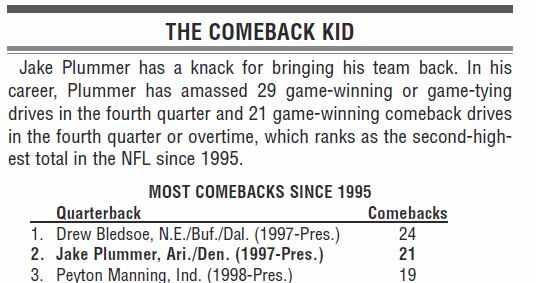
There’s a lot going on here. First, it’s very interesting to see Denver focus on only comebacks, as evident by the 21 and the table. Note: in the 2006 media guide, it even calls them “pure” comebacks. What’s awkward is the table saying since 1995, yet Drew Bledsoe’s total is listed since 1997. Something wrong with the five comebacks he had in 1995-96?

I know that for Bledsoe’s career (since 1993), he had 24 comebacks, but I bet my life they are not the same 24 games Denver had in mind here. Peyton did in fact have 19 comebacks then, which gives me a good idea of what number, if any, they will try and say he has this year. Hint: it will be about a dozen off what they have for Elway.

Plummer’s 21 is a farce. They include this 2002 game against Seattle as a comeback/GWD for Plummer, even though it consisted of Arizona blowing the lead to start the fourth quarter, and MarTay Jenkins returning the ensuing kickoff 95 yards for the game-winning touchdown.

“Pure” comeback, baby. Plummer was so good he got the offense the 4QC/GWD without even taking the field. The masters of comeback deception have outdone themselves here, as I have never seen any team credit their quarterback for a fourth quarter win like this when the return score did all the work.

One could argue Plummer started his career in Arizona, so maybe they were working off bad information. A logical argument, but I have the evidence this isn’t the case.

This is the Denver Broncos’ 2006 media guide claiming in Plummer’s player bio that the Seattle game was Plummer’s 17th comeback. Note the list of games here. That game, listed appropriately in “other games of note” at the bottom, was on 9/15/2002.

If you put the game in chronological order, it would be the 17th game on that page. This is Denver calling all of Plummer’s fourth quarter wins comebacks, even though three of the games (4, 9, 15 on PFR) were just game-winning drives where Arizona never trailed in the fourth quarter. And of course counting the Seattle game is pure lunacy. Plummer never even took the field for the opportunity, let alone do anything to deserve the comeback/GWD.

The Denver bio goes on to say Plummer finished 2002 with 21 comeback victories, even though six of them weren’t actually comebacks for him.

Plummer joined the Broncos in 2003, and his lone comeback/GWD of the season was noted by Denver as being his first for the team and the “22nd of his career.”

In 2004, Plummer had four game-winning drives, but only one of them involved a comeback (Carolina game). This time Denver says that Plummer led “four fourth quarter or overtime game-winning or game-tying drives on the year” to increase his total to 26.

Where they really blow it is when they give Plummer credit for his 19th comeback victory twice in two different seasons (2002 and 2004). Fancy that with both coming against Carolina, but they are two different games set over two years apart.


What does it show? When he was with Arizona, Denver refused to consider the difference between a comeback and a GWD, and just called them all comebacks. When he joined the team, they tried to get cute with “pure” comebacks, but outsmarted themselves when it came time to keep track of the stuff.

The 10/10/2004 game against Carolina was not Plummer’s 19th comeback. It was his 17th. Even if we get dumb about it and count the 2002 Seattle game, then that’s 18, which still comes up one short.

In 2005, Plummer had a comeback (9/18/2005 vs. San Diego) and two game-winning drives, though nothing specifically mentions them.

If the 10/10/2004 Carolina game was the 19th “pure” comeback of Plummer’s career, and he had 21 through 2005, then that means Denver is counting either the 12/12/2004 game against Miami or 11/24/2005 game in Dallas as a “pure” comeback, despite the fact Denver never trailed in the fourth quarter either time.

That would explain the bogus 21 comebacks at the beginning of 2006. However, that means there was another change when Plummer actually did have a comeback in Week 2 over Kansas City, but the number remained at 21 comebacks. Game-winning drives went up to 29.

Sticking with 2006, after a game-winning drive over Baltimore, the Broncos now went with 22 comebacks and 30 game-winning drives.
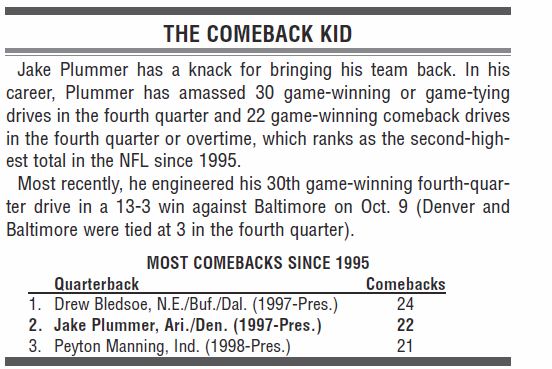
Even though the graphic clearly states the teams were only tied 3-3 in the fourth quarter, they add one to Plummer’s comeback total. The 0-point “deficit” is a popular thing for the Broncos.

And that is one of the core factors in how they were able to fabricate a record for John Elway, and get away with it all these years. If they can’t even handle a few Jake Plummer games from the digital media era, then it’s no wonder they had such ridiculous numbers for Dan Marino the 1990s.

That is why pure ignorance like the following from the Denver Post in 1996 has been allowed to exist: “Despite what you’ve heard and saw again Monday night, Elway is the NFL’s king of comebacks, not Dan Marino. Elway has 41, Marino has 32.”

Why is this so hard for people? In the words of Denver’s own PR man Jim Saccomano from a 1996 Denver Post article:

It doesn’t take a genius to figure out that you’re either ahead or behind and you either won or you didn’t.

Nope, it doesn’t take a genius. It takes Captain Comeback. It takes someone willing to put in the effort and call out a team when they are indisputably wrong.

From the confines of my home, I have done my part to rewrite NFL history. My history does not stand for one team winning the semantics battle to falsify a record to make their Hall of Fame quarterback look better.

For once, I feel very optimistic about this 2012 season, and the next chapter in the crusade over comeback conspiracy. The darkest days are behind us. The hardest work has been finished. Now we wait for new history to unfold, and put the past behind us.

Pass the link, and spread the truth my friends.

The Whistleblower No. 1 – Mark Kriegel and the Most Worthless Stat in the NFL

I had my heart set on doing a weekly “Captain Comeback” column ever since December 2010. Had that idea fail, I was going to do a series called “The Whistleblower”, where I keep my eyes and ears open for media people who use significantly inaccurate and/or misleading statements in their coverage of the NFL, and then I would expose them by stating the facts.

I know, the list could be huge depending how much NFL content one is willing to digest.

It finally crossed my mind that I could use this blog as a forum for “The Whistleblower” every so often, and here is the first edition. You could print it out if you want, but I’m sure it won’t be worth anything like a Batman No. 1 would fetch.

Perhaps it’s fitting my first edition would involve the NFL Network and Dallas Cowboys. That was motivation for my first article at Football Nation a little over a year ago.

Rather than Jamie Dukes and Tony Romo, this time it’s NFL AM’s Mark Kriegel and DeMarco Murray. On Tuesday morning, Kriegel mentioned that the Cowboys need to use their workhorse back DeMarco Murray more, and cited arguably the most useless statistic in football: “the Cowboys are 5-0 when he has 20-plus carries!” Surprised he didn’t support it with “and 2-6 when he’s under 20!”

To quote Kriegel from Monday: who cares?

Does something magical happen when a running back hits 20 carries? Is this to say Murray is really valuable when he gets a lot of carries? No, it just means it’s later in the game, and his team is likely leading and trying to ice the game. I’ll prove it in a second for Murray.

Beyond Murray, there have been 194 running backs with at least 10 career games (incl. playoffs) of 20+ carries (see link here).

Of those 194 running backs, 179 of them have a winning record when they get 20+ carries. Damn, that’s a lot of valuable running backs. And I thought this was the “dime a dozen” position?

Five more have a .500 record, and only an unlucky 10 have a losing record. Most notably, Steven Jackson is 27-30 (.474). Of course the Rams are 37-91 (.289) since 2004, so it’s not like Jackson has had a great opportunity to win no matter what he runs for.

Gerald Riggs (17-25-1, .407) and James Wilder (11-23, .324) are the only other players with a losing record in 20+ games.

Know who had the best records? The immortal group of Leroy Hoard (11-0), Edgar Bennett (18-1), Rob Carpenter (18-1-1),  Mike Alstott (12-1), and Craig James (12-1).

Even Joseph Addai was 15-2 with the Colts. If only Peyton Manning delegated more of the offense to him…

And what about Murray specifically? The five teams he did it against were 26-54 (.325) for starters. The defense allowed 14.0 PPG in the wins. Romo was very good.

And when Murray hit that nice, round number of 20 carries, it was always in the second half, and all but one time with Dallas leading (often by double-digits at that).

If your team is even just average, check your running back’s record when he gets 20 carries and chances are it’s respectable. Likewise, check your QB’s record when he throws 25 passes or less. It’s the same thing. A ton of winning records, because that means the team has taken the air out of the ball and are (literally) running out the clock.

This isn’t just Murray. This isn’t just Kriegel.

It’s the general lack of NFL fans understanding carries are a product of winning, and not the other way around. That is why “RB X’s team is [insert great record] when he gets 20-plus carries” is the most worthless stat in the NFL.

The whistle has been blown. It’s time to put an end to the use of this stat.